
A space shuttle that could never reach space, a name changed by television fans, and the reason it landed like a brick.
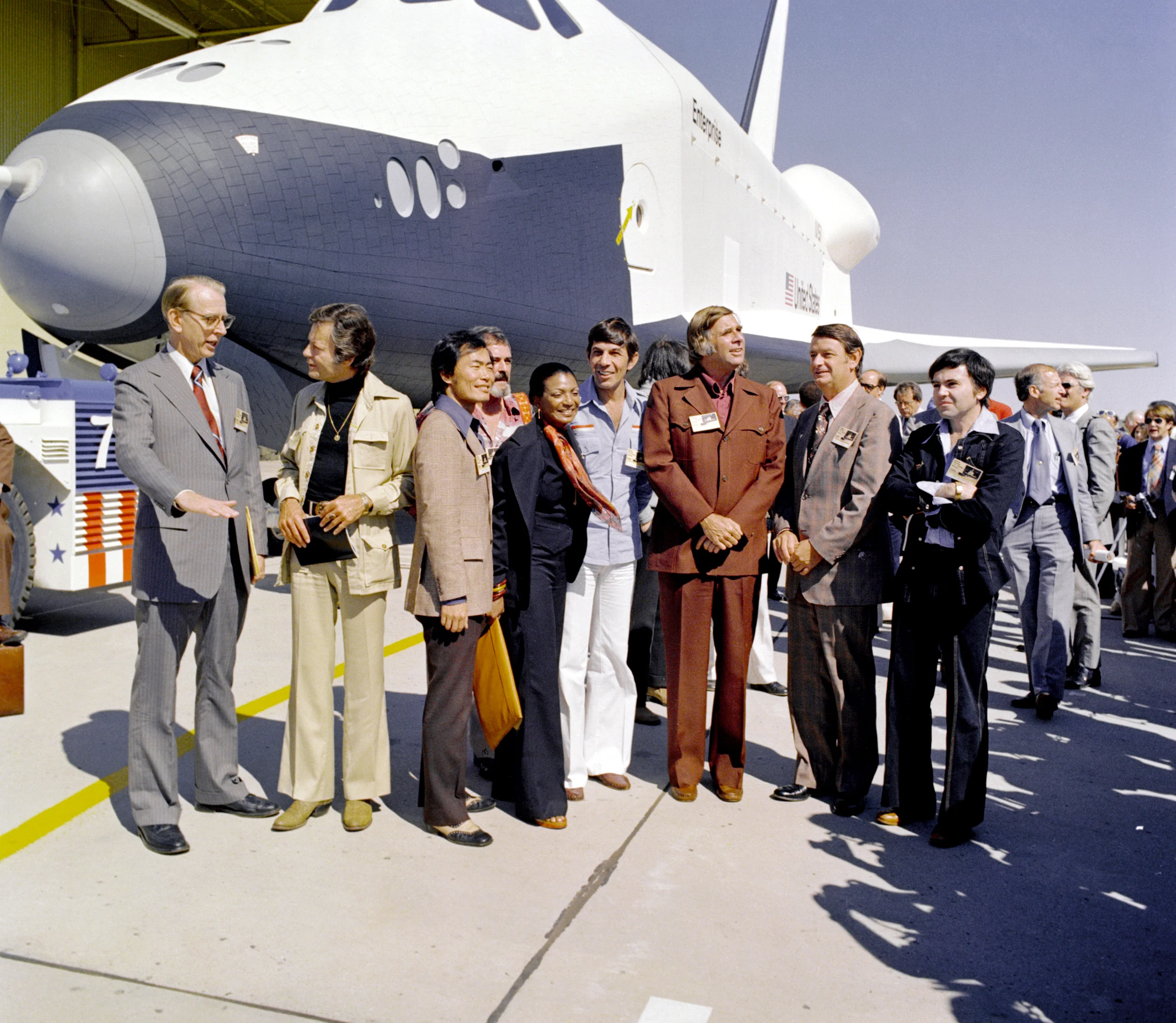
Image: NASA Image of the Day | Image credit: NASA | Image page
Fifty years ago today, on September 17, 1976, the doors of a hangar opened in Palmdale, California.
Out came humanity's first space shuttle orbiter, OV-101, before more than 600 invited guests and 185 reporters. As it emerged, the Golden West Air Force Band from March Air Force Base in Riverside County began to play. The music was not a march or the national anthem, but a theme Alexander Courage had written for a television series.
The series was Star Trek.
The People in the Photograph
NASA's original caption identifies them one by one, from left to right:
NASA Administrator Dr. Fletcher; DeForest Kelley, Dr. "Bones" McCoy; George Takei, Mr. Sulu; James Doohan, Mr. Scott; Nichelle Nichols, Lt. Uhura; Leonard Nimoy, the tireless Mr. Spock; Gene Roddenberry, the Great Bird of the Galaxy; and Walter Koenig, Ensign Pavel Chekov.
Those parenthetical nicknames come from NASA itself. "The Great Bird of the Galaxy" was the cast's nickname for the show's creator.
Two small corrections are needed. The caption gives the administrator's middle initial as D, while NASA's history office identifies him as James C. Fletcher. It also drops one d from Roddenberry's surname. Two slips by a caption writer 50 years ago remain on NASA's website today.
William Shatner, or Captain Kirk, does not appear. I found no explanation in any official source, so this account will say only what can be established: he is absent from NASA's original caption.
The Shuttle Was Supposed to Be Called Constitution
The United States celebrated its bicentennial in 1976. September 17 is Constitution Day, marking the signing of the Constitution by the Constitutional Convention on September 17, 1787. One NASA page calls it the day the Constitution was "ratified," which is incorrect; ratification was not completed until 1788.
NASA's original plan was to name the first space shuttle Constitution and roll it out on Constitution Day during the bicentennial year. The three pieces fit perfectly.
But the name was never announced publicly.
On September 3, 1976, White House aide James Gorog sent President Gerald Ford a memorandum containing a crucial sentence: NASA had not yet announced the shuttle's name and was holding the announcement until after Ford met with Fletcher.
In other words, Constitution was NASA's internal working name. The first name the public heard was the one that replaced it.
Three Layers of Reason
The popular version says that Star Trek fans launched a huge letter-writing campaign and persuaded the president.
The archival version is more complicated, and more interesting.
First: the letters. The campaign was real, and it was enormous. But two NASA figures contradict each other. The 1976 White House memorandum says there were "hundreds of thousands" of letters. NASA's own 2026 anniversary article changes that to "nearly 100,000 people" writing to the White House. The document closest to the event gives a figure an order of magnitude larger than the popular account published 50 years later. As for who organized the campaign, the common story names a married couple, but I found no support for those names in primary or official sources, so they are omitted here.
Second: the packaging. The September 3 memorandum offered Ford three reasons to name the craft Enterprise. The fans' letters came first. The second reason was that enterprise evoked the system on which the American economic structure rested. The third was that the name would add a considerable human touch to that month's rollout in California, where the aerospace industry was vitally important. The memorandum ended with a distinctly period-specific comparison: the decision could generate the same public interest that CB radio had brought Mrs. Ford. The president initialed his approval, and the name was announced on September 9.
Inside the White House, however, there was resistance to naming a shuttle after a television show. Ford adviser Jack Marsh objected that it was catering to a television fad. In a September 7 summary of internal views, the staff therefore supplied the name with a respectable mantle: Enterprise was a hallowed naval tradition. During World War II, one carrier named Enterprise had served in the Pacific fleet alongside Wasp and Hornet. The active USS Enterprise was the world's first nuclear-powered aircraft carrier, and the name reached back to the Revolutionary War.
Third: what the president himself said. This layer matters most because it refutes both popular versions.
One says the fans persuaded Ford. The more knowing version says that Ford chose the name for its naval tradition and that Star Trek had nothing to do with it.
Ford's speech for 4 p.m. on September 8, 1976, survives at the Gerald R. Ford Presidential Library. He gave the two reasons side by side. First he called Enterprise a distinguished name in American naval history, with a long tradition of courage and endurance. In the very next sentence, he said it was also a name familiar to millions of devoted followers of the science-fiction television program Star Trek.
He mentioned the television show himself. That statement also disproves a claim on the Intrepid Museum's website that Ford never directly acknowledged the campaign. He did.
NASA's anniversary article also attributes to Ford the phrase that he "was partial to the name." I found no primary document containing those words, so they are not treated here as a quotation from him.
The accurate story is this: the fans' letters changed the agenda, not the president's private taste. They persuaded the staff that Enterprise was worth placing before Ford, and they ranked first on the list of reasons. The staff gave the name respectability through naval tradition. An opponent complained that it catered to television fashion. The president then stood before an audience and invoked both the navy and the starship.
All three layers matter. Leave one out and it is no longer the same event.
A Space Shuttle That Could Never Reach Space
Many people do not know that Enterprise never went to space, and it was never built to do so.
NASA's description is direct. Enterprise was a test vehicle, not equipped for spaceflight. It had no working main engines and no thermal protection system. It could fly, but only inside the atmosphere.
What was it for?
In 1977 at Edwards Air Force Base in California, Enterprise performed the Approach and Landing Tests, or ALT. The program comprised eight captive flights - five uncrewed and inert, then three crewed and active - followed by five free flights. For a free flight, the orbiter rode on the back of a modified Boeing 747 to altitude. Then it was released to glide back to Earth by itself.
The first free flight took place on August 12, 1977, with commander Fred Haise and pilot Gordon Fullerton. Separation occurred about 22,800 feet above the ground at an equivalent airspeed of 270 knots.
One detail across the five flights tells a story by itself. Enterprise wore a streamlined tail cone for the first three free flights. For the final two, it was removed.
The cone made the orbiter fly more like an airplane by smoothing the chaotic airflow around the engine compartment and improving its aerodynamics. Without it, the flow separated at the tail and drag rose sharply. Enterprise then flew like a shuttle actually returning from space, which meant it descended much faster.
The first three flights practiced flying. The last two practiced falling accurately.
It Landed Like a Brick
A returning space shuttle had no engine available for a go-around. It got one chance and had to land precisely. Its approach, in engineering terms, was not pretty.
NASA's Langley Research Center gives a glide-slope angle of 18 to 20 degrees. An airliner following an instrument landing system approaches at 3 degrees.
The shuttle was 6.3 times steeper.
The angle converts directly into glide ratio, the horizontal distance traveled for each unit of altitude lost. An angle of 18 to 20 degrees gives a glide ratio of 2.75 to 3.08.
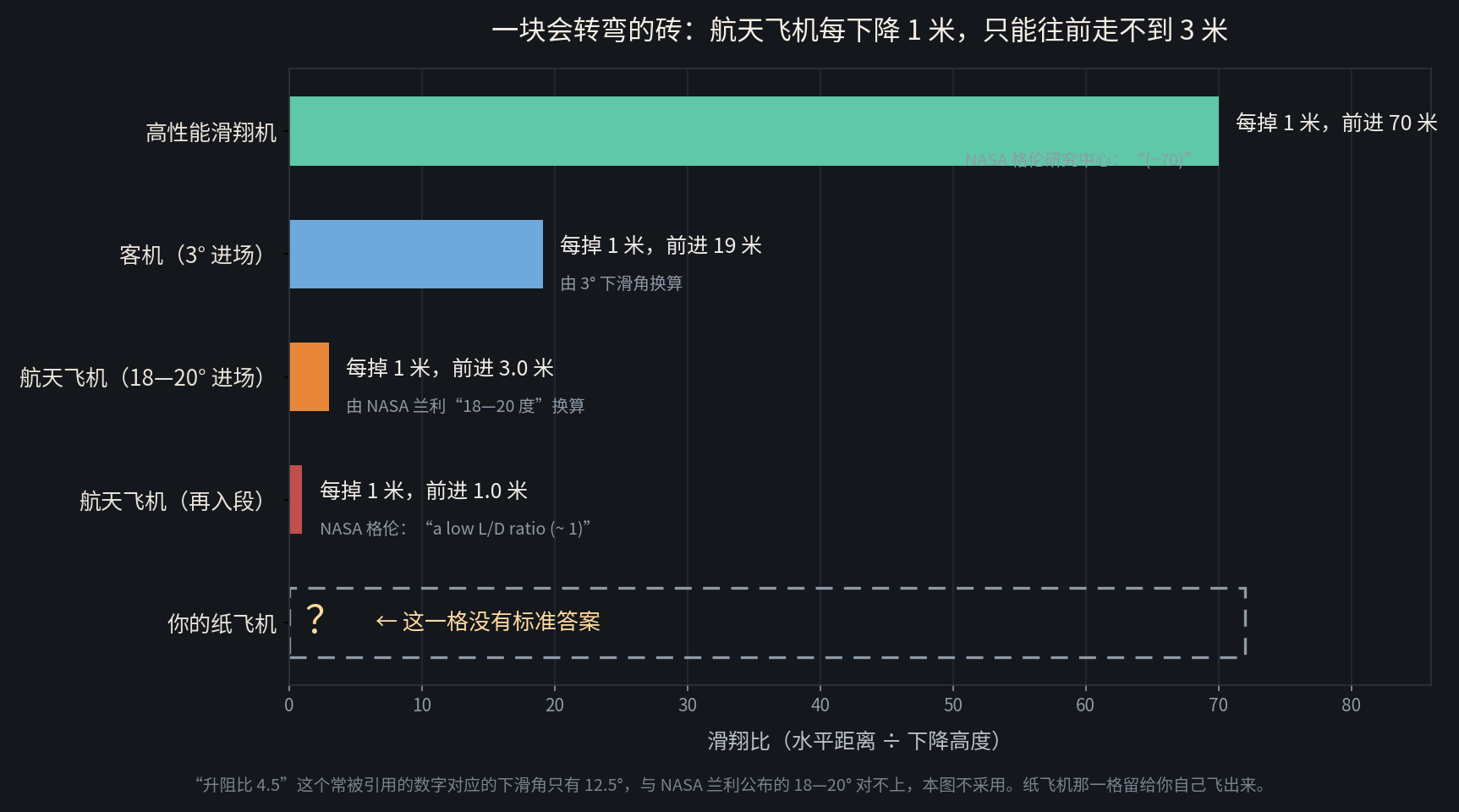
One common figure cannot be used without qualification. Many sources give the shuttle a lift-to-drag ratio of about 4.5. The problem is that 4.5 corresponds to a glide angle of only 12.5 degrees, inconsistent with NASA Langley's 18 to 20 degrees. NASA's own figures are not uniform. Glenn Research Center's introductory aeronautics guide places the shuttle in the "low lift-to-drag ratio (about 1)" category and high-performance crewed gliders in the "high (about 70)" category. A Dryden report on subsonic lift-to-drag characteristics of reentry vehicles plots the shuttle prototype's maximum ratio at about 3.2 to 3.5.
This article therefore uses only the figure that can be checked directly: 2.75 to 3.08, derived from 18 to 20 degrees. Enter 1 / tan(19 degrees) into a calculator and you can verify it.
The reason is more interesting than the number. The shuttle was not simply bad at flying. It deliberately avoided its best glide angle. During approach, it opened its speed brake and dived much faster than the most efficient speed. That preserved excess energy it could shed at will, allowing the crew to place the touchdown precisely. An aircraft with only one chance preferred control to elegance.
Touchdown speed was 215 miles per hour, or about 346 kilometers per hour. The ALT report's planned landing speed was 185 knots, about 343 kilometers per hour, an independent match. The last free flight landed on a 15,000-foot concrete runway.
Fans Named the First; Students Named the Last
NASA's convention was to name orbiters after historic ships of exploration. Columbia came from the first American oceangoing vessel to circumnavigate the globe and was also the name of the Apollo 11 command module. Challenger came from HMS Challenger, a British naval research vessel that crossed the Atlantic and Pacific in the 1870s. Discovery came from the ship Captain Cook used during his South Pacific voyages in the 1770s. Atlantis came from the Woods Hole Oceanographic Institution's principal research vessel from 1930 to 1966.
Endeavour, the last orbiter built, was named through a nationwide competition for American primary and secondary school students. Its name came from the ship Cook chartered in 1768.
The fleet therefore has a graceful symmetry: fans forced the name of the first orbiter onto the agenda; children chose the name of the last.
Where Enterprise Is Now
Enterprise is in New York at the Space Shuttle Pavilion of the Intrepid Sea, Air & Space Museum.
It reached the museum by flying from Washington to John F. Kennedy International Airport, traveling over several days from the airport to New Jersey, and finally moving north on the Hudson River. The pavilion opened to the public on July 19, 2012. Sources disagree on the more detailed dates, and the museum's official page gives only the opening date, so that is the only date used here.
The pavilion contains 17 exhibit areas with original artifacts, photographs, audio and films. Visitors can walk beneath Enterprise or climb to an elevated platform to view it from above. The same museum also displays a Soyuz TMA-6 descent module. At the entrance plays a recording of real exchanges between mission control and Enterprise's pilots during the shuttle tests.
An Unresolved Story Still in Progress
On July 4, 2025, the One Big Beautiful Bill Act became law as P.L. 119-21. It included an appropriation of $85 million to relocate a space shuttle to Houston, with $5 million reserved for transportation. The law required the NASA administrator to select the vehicle within 30 days of enactment. The acting administrator approved the selection in early August 2025. NASA began soliciting contractors in March 2026.
The vehicle is Discovery, now housed at the Smithsonian's Udvar-Hazy Center. The Smithsonian's position is that it owns the space shuttle orbiter Discovery and holds it and all of its collections in trust for the nation.
The dispute remains unresolved. This article makes no prediction about the outcome.
China Looked at the Shuttle and Chose a Spacecraft
The United States chose the space shuttle in pursuit of reusability. When China evaluated routes to human spaceflight, it considered a shuttle and a spacecraft, then selected the latter - the path that became Shenzhou.
The public explanation on the China Manned Space website is unusually concrete: a spacecraft can carry people and cargo, serve as an orbital lifeboat for a space station, and operate at lower transportation cost, making it better suited to China's circumstances.
The explanation is not an abstract judgment such as "the technical risk was too great." It is an accounting of four functions and costs: people, cargo, lifeboat and lower price.
The contrast is sharp. One side sought a vehicle it could use repeatedly; the other asked which option was cheaper and more practical. The prototype in the photograph, which never entered space, was the first physical product of the more expensive path. Several names for proposed Chinese shuttles and specific dates for successive rounds of evaluation circulate online, but I could not verify them in official sources, so they are not included.
Technological paths do not end, however. China's reusable experimental spacecraft has flown. The China National Space Administration's notice said that it launched from the Jiuquan Satellite Launch Center, spent 268 days in orbit and returned successfully to its planned landing site on September 6. The vehicle, it said, could eventually offer a more convenient and economical way to travel to and from space for peaceful purposes.
The notice's extreme brevity is worth noting in itself. There was no shape, no photograph, no launch vehicle and no press conference. Set it beside the 1976 rollout at Palmdale, with a band, 600 guests and television stars, and you have two "space shuttles that never went to space": one built to be seen but unable to go up, the other sent up but never seen.
Another is being built, and its task is precisely what Enterprise practiced over a dry lakebed in 1977. In December 2024, Xinhua reported that the Haolong cargo spaceplane had been selected as one of the winning proposals in a call for designs for a low-cost cargo transportation system for China's space station and had received a contract for the engineering flight-verification phase. Its developer is the AVIC Chengdu Aircraft Design and Research Institute - aviation industry, not aerospace science and technology. It is a winged vehicle with an original integrated wing-folding design. The announcement describes its return this way: it can autonomously return without propulsion and land horizontally at a designated airport.
Unpowered. Autonomous. A horizontal runway landing. Those are the same things Haise and Fullerton tested during Enterprise's five free flights in 1977. Fifty years later, the technology proved by that "brick with a turn" is returning in another form: uncrewed, built for cargo, with folding wings. Its purpose is not to send people up but to bring things back cheaply. Haolong has not yet made its first flight. Officials have said only that they will strive to achieve it at an early date; they have given no date.
There is one final comparison, this time about names. China, too, has allowed the public to name a spacecraft. In 2013, the China Lunar Exploration Program launched a national naming campaign for the Chang'e 3 rover. It opened on September 25 and closed voting on October 25. The public participated online, by television and telephone, through newspapers and by mail. An expert review committee made the final selection: Yutu, or Jade Rabbit. The vote counts available to me contradict one another, so none are cited.
Both events involved the public in naming a spacecraft, but the direction of authority was opposite. One was pressure from below: fans wrote hundreds of thousands of letters, White House staff placed them first among their reasons, and an adviser complained of pandering to television fashion. The other was an opening from above: officials invited names, then experts made the final choice.
The Thing That Was Not Changed
Fifty years ago today, the ceremony was held on September 17 because the vehicle was supposed to be called Constitution.
Fans changed the name. The date did not move.
Enterprise's birthday remains fixed to a holiday belonging to another name, while Enterprise itself never left the atmosphere.
Sources: NASA Image of the Day for September 17, 2026, "NASA Unveils Enterprise, the First Space Shuttle"; NASA History Office, "Space Shuttle Enterprise Makes Its Public Debut"; NASA's The Space Shuttle reference page on orbiter naming traditions; NASA Langley Research Center, The Aeronautics of the Space Shuttle; NASA Glenn Research Center's Beginner's Guide to Aeronautics pages on lift-to-drag ratio and the shuttle as a glider; NASA Technical Reports Server documents on the Approach and Landing Tests; the original September 8, 1976, speech text at the Gerald R. Ford Presidential Library; Foreign Relations of the United States, 1969-1976, volume E-3, document 133, the September 3, 1976, memorandum from Gorog to Ford, sourced to Ford Library, Presidential Handwriting File, Subject File, Box 34, Outer Space; the Intrepid Museum's official Space Shuttle Pavilion page; SpacePolicyOnline.com reporting on the Discovery transfer process and the Smithsonian statement; the China Manned Space website at cmse.gov.cn on the choice of program architecture; the China National Space Administration notice on the reusable experimental spacecraft; Xinhua's December 2, 2024, report on the Haolong cargo spaceplane; and China News Service's November 26, 2013, report on the global naming campaign for Yutu. Anniversary-day counts, glide-angle calculations and glide-ratio conversions were independently checked with Python 3.