
The darkness in this Hubble image is not "nothing." It is an empty room left after more than 30 stars spent five million years pushing aside the gas from which they were born.
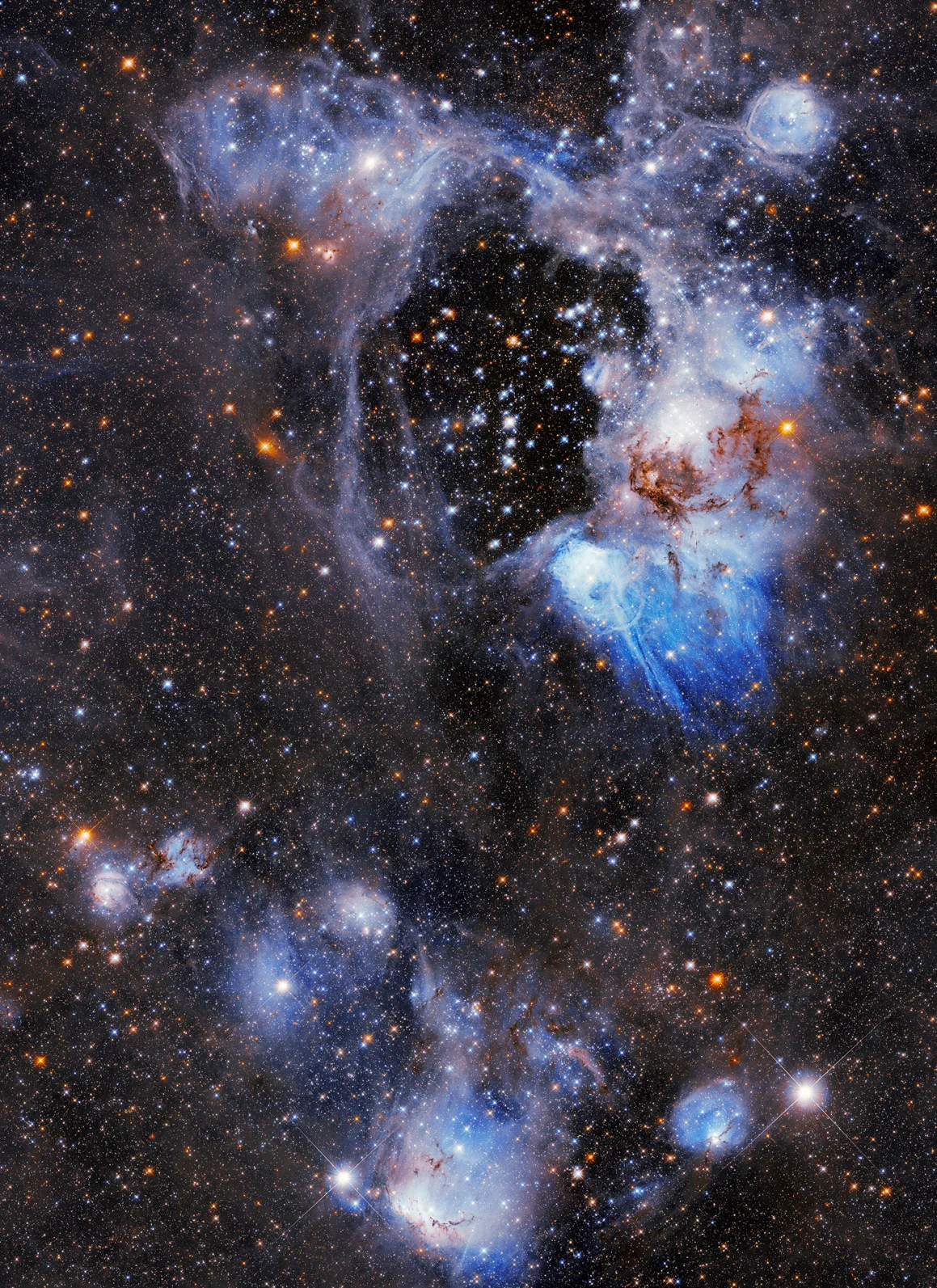
Image: NASA Image of the Day | Image credit: NASA, ESA/Hubble, D. Gouliermis | Image page
NASA calls today's selection Superbubble in the Large Magellanic Cloud.
Its description runs only two sentences, but the second identifies the image's true subject:
N44's most distinctive feature is a dark, star-filled cavity called a superbubble, visible near the upper center of this Hubble Space Telescope image.
Not the glowing gas and not the dust lanes. The subject is the darkness.
In astronomical photographs, we normally look at what shines. This time the image must be read in reverse: look at the part that has been excavated.
The darkness is the trace left by one of the universe's most important kinds of event. And once its story is complete, something stranger emerges: we live inside a cavity like it.
First, Set Out the Ruler
The image is an ESA/Hubble Picture of the Month, released on September 3, 2026, and reposted by NASA the same day. Its underlying data are older. They come from Hubble survey program 14689 and were taken through two filters with the Wide Field Camera 3.
Under the current official figure published in September 2026, the cavity measures about 210 x 140 light-years.
There is a useful wrinkle in the record. A 2021 NASA article called it about 250 light-years across, giving one diameter; wide-field ground observations have given about 325 x 250 light-years. The current description uses two dimensions, a long and a short axis. That change carries information: later measurements treat the cavity as a pronounced ellipse rather than a circle. Its boundary is diffuse, so different data and criteria produce different edges. The figures do not necessarily conflict.
How large is the whole N44 complex? NASA's 2021 article says about 1,000 light-years.
That permits a consistency check. ESA/Hubble lists this image's field of view as 9.63 x 7.66 arcminutes. At a distance of 160,000 light-years, that becomes 457 x 363 light-years. A 1,000-light-year object at the same distance would span 21.1 arcminutes, more than twice this image's field.
The photograph cannot contain all of N44. It shows the central cavity and its immediate surroundings.
In the same calculation, 210 x 140 light-years corresponds to 4.43 x 2.95 arcminutes, about half the image width, matching its appearance. The two measurements cross-check each other.
Who Blew the Hole?
NASA's own description gives the answer:
The glittering stars at the heart of the cavity are the culprits: through their powerful stellar winds and explosive supernovae, they expelled most of the gas in which they formed.
Who, specifically? N44 contains three OB associations, LH 47, LH 48 and LH 49, with more than 30 O-type stars among them. LH 47 sits inside this cavity and is about five to six million years old. The region has experienced two episodes of star formation, one about 10 million years ago and another about five million years ago.
O stars occupy an extreme end of stellar life. An authoritative review of massive stars in the Large Magellanic Cloud reports wind speeds above 3,000 kilometers per second for the earliest subtypes, O2-O3, falling to about 1,500 kilometers per second among late O stars.
Three thousand kilometers per second is enough to cover the distance between Beijing and Guangzhou seven times in one second.
And the wind continues for five million years.
What the Darkness Is: A Balloon Inflated From Within
The mechanism is the heart of today's story.
A classic 1977 paper by Weaver and colleagues in The Astrophysical Journal, volume 218, page 377, divided a bubble driven by stellar winds through interstellar gas into four concentric zones:
- At the center is the supersonic stellar wind flowing directly from the stars, before it has struck anything.
- Next is the wind after it collides with the surrounding gas, is braked by a shock and heated to about one million degrees. It is extraordinarily thin. This is the main volume of the bubble.
- Beyond that lies the interstellar gas being pushed outward and compressed into a thin shell.
- Outside is the original, undisturbed interstellar medium.
The second zone is the key.
The stellar wind does not simply blow material away. It first runs into a wall. The impact brakes the wind and heats it to a million degrees. That impossibly hot, impossibly thin gas then presses outward like air inflating a balloon from the inside, forcing the surrounding material into a shell.
The glowing rim is the balloon's skin. The darkness in the middle does not mean there is nothing there. It means something is there, but it is too hot and too diffuse to see in this image.
How hot, and how empty?
The temperature has an observational comparison. X-ray measurements of N51D, another superbubble in the Large Magellanic Cloud, give an interior gas temperature of 0.27 keV, which converts to about 3.13 million degrees. That is 540 times the Sun's surface temperature of 5,772 K.
The emptiness can only be estimated from models. Direct measurements of a superbubble's interior density are not available because X-rays constrain a combination of density and volume-filling factor, which cannot be separated. Under a typical Weaver-model case, the order of magnitude is about 0.01 particle per cubic centimeter. That is an estimate, not a measurement.
For comparison, air at sea level contains 2.55 x 10^19 particles per cubic centimeter. The most extreme vacuum humans can make in a laboratory still contains about 240 particles per cubic centimeter.
The emptiest space built by people is more than 20,000 times as crowded as the inside of a superbubble. And that almost perfect emptiness is three million degrees hot.
What Makes the Bubble "Super"
The prefix does not merely mean that the bubble grew large. It means the power source changed.
An authoritative review of bubbles and superbubbles draws the line clearly:
- A bubble is powered by one isolated massive star and spans tens of parsecs.
- A superbubble is powered by a group of massive stars, such as an OB association or young cluster, spans hundreds of parsecs and may reach an interior temperature of 10 million degrees.
"Super" means combined force. It is not one unusually strong star. It is the winds of many stars superimposed, followed by successive supernovae that pressurize the cavity again and again.
How much energy does one supernova supply? The standard estimate is 10^51 ergs, or 10^44 joules. This is the conventional astrophysical scale, not a figure attributed to one institution.
Divide 10^44 joules by the Sun's total radiated power, 3.828 x 10^26 watts, and the result is 8.28 billion years.
The Sun's main-sequence lifetime is about 10 billion years.
In the seconds to days of its death, one star releases energy comparable to 8.3 billion years of the Sun's light - nearly a solar lifetime, paid all at once.
The cavity in N44 was made by several such events added together.
Another common misconception is that starlight pushed the gas out. A 2019 study using the MUSE spectrograph calculated the pressure budget. Stellar winds and ionized gas are the principal drivers; direct radiation pressure is three orders of magnitude weaker.
"Blown" is the correct verb. Wind and hot gas push the shell, not light.
Destruction, Then Birth
For five million years, more than 30 massive stars cleared away the cloud in which they were born. Within the space they opened, little remained. That is destruction.
But the displaced gas piled up at the edge in a thin, dense shell.
ESA/Hubble's 2026 description says:
New stars are forming within this compressed shell of gas, making N44 a compelling target for researchers studying star formation.
Specific observational evidence comes from a 2009 Spitzer infrared study by Chen and colleagues in The Astrophysical Journal, volume 695, page 511 (DOI 10.1088/0004-637X/695/1/511), titled Triggered Massive-Star Formation in the N44 H II Complex of the Large Magellanic Cloud. It identified 60 candidate young stellar objects with masses of at least four Suns in N44. All were projected within molecular clouds, and most lay close to peaks in molecular-cloud density.
A 2021 NASA article also supplied an age sequence: stars inside the bubble are about five million years older than those at its edge. Star formation has proceeded in successive rounds.
One generation's death becomes the next generation's nursery.
That sentence cannot be pushed too far, because the literature reversed itself over two decades. A 1997 paper devoted to the LH 47 association concluded that the stellar population outside the shell had a similar age and therefore offered no direct evidence for sequential star formation. The infrared study overturned that conclusion 12 years later. Even NASA's 2021 article still presents two competing explanations: winds from massive stars cleared the cavity, although the article immediately notes that this is inconsistent with the measured wind velocities; or an expanding shell from an older supernova carved it out.
Scientists have not settled whether the darkness was blown open or blasted open.
The Turn: We Live Inside One
Until this point, N44 can feel remote: 160,000 light-years away, with a cavity 210 light-years across. What does it have to do with us?
In January 2022, a paper by Zucker, Goodman, Alves and colleagues appeared in Nature, volume 601, page 334 (DOI 10.1038/s41586-021-04286-5). Using Gaia data, the team reconstructed the gas around the Sun in three dimensions.
The abstract begins with a fact known for decades: the Sun lies inside the Local Bubble, a cavity of low-density, high-temperature plasma surrounded by a shell of cold, neutral gas and dust.
The paper gives the bubble's current radius as 165 ± 6 parsecs, equivalent to a diameter of about 1,076 light-years. It is still expanding at 6.7 kilometers per second. The process began about 14 million years ago in a burst of star formation and subsequent stellar deaths, or supernovae, near the bubble's center.
In an official release from the Harvard-Smithsonian Center for Astrophysics, lead author Zucker added two more specific statements. The team calculated that about 15 supernovae exploded over millions of years to form the Local Bubble as we see it today. And about five million years ago, the Sun's path through the Milky Way carried it into the bubble.
The Sun is not a native of the cavity. It passed by and happened to enter a room left empty by someone else's explosions.
The paper's most elegant result follows. Almost every molecular cloud forming stars near the Sun lies on the bubble's shell, and those young stars move mainly outward, perpendicular to its surface. Gas swept up by the supernovae has now fragmented and collapsed into the most prominent molecular clouds nearby.
Our neighborhood's nurseries all stand at the edge of the same explosion site.
Zucker called it an origin story: for the first time, the team could explain how all nearby star formation began.
Today's photograph is not someone else's story. We cannot look up and see N44 because, in a sense, we are standing inside our own N44.
Why This Cloud Is an Astronomer's Ideal Laboratory
The Large Magellanic Cloud is the Milky Way's largest satellite galaxy. Several official distance figures coexist: ESA/Hubble and NASA's 2026 article give 160,000 light-years, while the European Southern Observatory gives 163,000. The most precise measurement, using eclipsing binary stars, is 49.59 kiloparsecs with 1% precision, or 162,000 light-years. Its metallicity is about half that of the solar neighborhood.
Astronomers depend on it because of an unusually useful middle distance.
Within the Milky Way, we are inside and cannot see the whole. In a distant galaxy, we see the whole but cannot resolve individual stars. The Large Magellanic Cloud occupies the middle: near enough to count its stars one by one, far enough to see the entire galaxy at once.
"Count" is literal. The survey behind this image cataloged 461,684 stars in the N44 region, then used machine learning to select 26,700 pre-main-sequence stars - stellar embryos not yet fully ignited - at greater than 95% confidence.
Almost half a million stars taught a computer to identify newborns, of which it selected nearly 30,000. This photograph is not merely a beautiful image. It is a census.
The same cloud gave humanity something more extraordinary.
At 7:35 a.m. UTC on February 23, 1987, a detector in Kamioka, Japan, was waiting for neutrinos from the Sun. In 13 seconds, it counted 11 particles that should not have been there.
At the same time, IMB in the United States counted eight and Baksan in the Soviet Union counted five. Three countries, 24 particles.
They had left the Large Magellanic Cloud 160,000 years earlier, crossed the Milky Way and the rock of Earth, then left faint traces in three underground pools. This was humanity's first detection of neutrinos from beyond the solar system. Neutrino astronomy began in those 13 seconds. Fifteen years later, Masatoshi Koshiba received the 2002 Nobel Prize in Physics, officially "for pioneering contributions to astrophysics, in particular for the detection of cosmic neutrinos."
A star died. In dying, it sent 24 letters. Every one arrived.
A Misleading Name
These two clouds are called the Magellanic Clouds.
But Magellan did not finish seeing his expedition through. He died on Mactan Island in the Philippines on April 27, 1521, and others completed the circumnavigation.
He was not the first to see the clouds either. In 964, the Persian astronomer Al-Sufi recorded the Large Magellanic Cloud in The Book of Fixed Stars. He wrote that southern Arabs called it the "White Ox" and that it could be seen from the Strait of Bab el-Mandeb at latitude 12 degrees 15 minutes north, but not farther north. Al-Sufi himself lived in Shiraz, around 29.6 degrees north, where he could not see it. He relayed a report from people beside the Red Sea and is said to have doubted it himself.
The geometry can be checked. The Large Magellanic Cloud has a declination of -69.76 degrees and can rise only south of latitude 20.24 degrees north. At Bab el-Mandeb, latitude 12 degrees 15 minutes north, it culminates about 22 degrees above the horizon. It is plainly visible.
A secondhand report from 1,000 years ago gets the latitude right.
The name "Magellanic Clouds" entered scholarly usage more than 300 years after Magellan. Bayer called them "little and large clouds" in 1603; Lacaille called one the "Large Cloud" in 1756; John Herschel first used "Magellanic Clouds" in an academic paper in 1847.
Long before Magellan was born, Aboriginal Australians had names of their own. Material compiled by Aboriginal astronomy researcher Duane Hamacher says people around Adelaide called the clouds Ngakallamurro, "the ashes of parrots." The Yaraldi people of the lower Murray River called them Prolggi, "cranes": two cranes learned that an emu intended to kill them, flew up in widening circles and entered the sky, never to return. This account comes from the researcher's own compilation, not a peer-reviewed paper, and is attributed accordingly.
The cloud has been in the sky for an immense span of time. Its best-known human name comes from a man who did not finish the journey associated with it.
An Unavoidable Truth: Almost All of China Cannot See It
The object in this article is invisible from nearly all of China.
The reason is not light pollution or an inadequate telescope. It is the curvature of Earth.
The Large Magellanic Cloud's declination is -69.76 degrees. Culmination altitude equals 90 degrees minus the absolute difference between latitude and declination. The resulting figures are:
| Place | Latitude | Maximum altitude of the Large Magellanic Cloud |
|---|---|---|
| Beijing | +39.9 degrees | -19.7 degrees (never rises) |
| Shanghai | +31.2 degrees | -11.0 degrees (never rises) |
| Guangzhou | +23.1 degrees | -2.9 degrees (never rises) |
| Haikou | +20.0 degrees | +0.2 degree |
| Sanya | +18.2 degrees | +2.1 degrees |
| Yongxing Island, Xisha | +16.8 degrees | +3.4 degrees |
| Yongshu Reef, Nansha | +9.6 degrees | +10.7 degrees |
The geometric boundary is latitude 20.24 degrees north. Beijing misses it by 20 degrees; Guangzhou by less than three.
The two or three degrees available at Haikou and Sanya are, astronomically, equivalent to invisibility. The Large Magellanic Cloud is not a pointlike star but a low-surface-brightness extended object almost 11 degrees across. At an altitude of two or three degrees, the atmosphere erases it, and much of its 11-degree body remains below the horizon.
Only from China's Nansha Islands does it rise more than 10 degrees.
How large and bright is it? Its apparent magnitude is roughly 0 to 1, far brighter than the naked-eye limit, and its apparent dimensions are 10.75 x 9.17 degrees. The full Moon is 0.5181 degree across.
Its long axis equals 20.7 full Moons side by side, and its apparent area could contain 367 full Moons.
It is enormous in the sky and plainly visible to the naked eye. Yet almost none of China's sky contains it.
In Australia, New Zealand, Chile and South Africa, the cloud can rise between about 30 and 57 degrees. South of latitude 20.24 degrees south it is circumpolar and never sets, although the season determines its nighttime altitude. The nearest practical viewing latitude to China is around Singapore, where it culminates near 19 degrees, visible but low. From Indonesia it reaches 26 to 29 degrees.
China's Bridge: One Star Recorded a Millennium Ago, Another Awaited Underground
China does have a connection to this story, and NASA itself supplies the bridge.
In 1054, during the Northern Song dynasty, observers saw a star where none belonged, beside Tianguan. It remained visible in daylight for 23 days and at night for one year and 10 months. Court historians recorded it as a "guest star." These durations come from a paper in Science & Technology Review; an authoritative digital text of the historical record was not available, so the article goes no further than that source.
More than 900 years later, NASA's official Crab Nebula page says that Chinese astronomers in 1054 noticed a guest star visible in daylight for nearly a month.
The guest star was a supernova. Its remnant is now the Crab Nebula. The observation entered the human astronomical record and never left.
In 1987, humanity did more than see a supernova: three detectors received it as 24 neutrinos in 13 seconds.
Now, 700 meters underground in Jiangmen, Guangdong, stands a 35.4-meter-diameter acrylic sphere filled with 20,000 metric tons of liquid scintillator. After more than a decade of preparation and construction, the Jiangmen Underground Neutrino Observatory, JUNO, completed filling and formally began taking data on August 26, 2025. An official release from the Institute of High Energy Physics of the Chinese Academy of Sciences names among its scientific goals frontier studies of neutrinos from the Sun, supernovae, the atmosphere and Earth. Two months after completion, it used 59 days of data for its first physics result, measuring two solar-neutrino oscillation parameters 1.5 to 1.8 times more precisely than previous work.
One thing it is waiting for is the next supernova.
According to the JUNO collaboration's technical document, arXiv:2104.02565, a new supernova in the Milky Way at the typical distance of 10 kiloparsecs would produce about 5,000 inverse beta-decay events in JUNO.
Five thousand divided by 24 is about 208 times as many.
JUNO can also give advance warning. A star releases neutrinos before a supernova explosion, and the neutrinos escape before the light. The technical document says this could provide a unique and independent early warning for optical observation of a core-collapse supernova.
One thousand years ago, people in China wrote one supernova into a book. A millennium later, China has dug 700 meters underground to wait for the next.
Mainland China cannot see the Large Magellanic Cloud, but one Chinese facility can. Kunlun Station at Dome A in Antarctica stands 4,093 meters above sea level at latitude 80.4 degrees south. Calculations place the cloud circumpolar there, never setting on any day of the year and culminating 79 degrees high, almost overhead. China deployed three 50-centimeter, wide-field AST3 telescopes there. The official National Astronomical Observatories description names supernova searches among their tasks.
The Man Behind the Number
The N in N44 comes from a person: Karl Henize.
Henize was born in Cincinnati, Ohio, in 1926 and earned a doctorate in astronomy from the University of Michigan in 1954. In 1956, he published a catalog of emission-line stars and emission nebulae in the Magellanic Clouds in The Astrophysical Journal Supplement Series: 236 stars and 532 nebulae, each assigned a number. ESA/Hubble's 2026 description makes a point of noting that every feature in the larger N44 star-forming complex was cataloged by astronomer Karl Henize in the 1950s.
He conducted the survey with an objective prism at an observatory in Bloemfontein, South Africa. The N in N44 comes from that catalog.
His life then took an extraordinary turn.
In August 1967, NASA selected him as a scientist-astronaut.
From July 29 to August 6, 1985, at age 58, he flew as a mission specialist on the STS-51F / Spacelab 2 shuttle mission and spent 188 hours in space.
On October 5, 1993, while climbing Mount Everest, he reached about 6,400 meters before dying of high-altitude pulmonary edema. His formal obituary from the American Astronomical Society records that, in accordance with his previously expressed wishes, he was buried on the mountain.
At 30, in South Africa, Henize assigned numbers to the glowing gas of the southern sky; N44 was one of them. At 59, he flew in space. At 67, he died on Earth's highest mountain and remained there.
Seventy years later, Hubble photographed his number 44 again. NASA's description today still carries his name.
Sources: ESA/Hubble Picture of the Month potm2608a and NASA's official image page; NASA, Hubble Spies a Superbubble (September 3, 2026), and its 2021 N44 article; Weaver et al., The Astrophysical Journal (1977); the Chu, Guerrero and Gruendl review of bubbles and superbubbles; Crowther's review of massive stars in the Tarantula Nebula; Dennerl on XMM-Newton observations of N51D; McLeod et al., Monthly Notices of the Royal Astronomical Society (2019); Chen et al., The Astrophysical Journal (2009); Will, Bomans and Dieball, Astronomy & Astrophysics Supplement Series (1997); MYSST survey papers by Gouliermis et al. and Ksoll et al., The Astronomical Journal (2021); Henize, The Astrophysical Journal Supplement Series (1956); NASA's official astronaut biography and the American Astronomical Society obituary of Karl Henize; Zucker et al., Nature (2022), and the Harvard-Smithsonian Center for Astrophysics release; Pietrzyński et al., Nature (2019); the European Southern Observatory; ESA/Hubble heic1314 on the Magellanic Stream; CERN Courier on SN 1987A; the Nobel Prize website on the 2002 physics prize; Encyclopaedia Britannica on Magellan; the SEDS Messier database and Duane Hamacher's compilation of Aboriginal Australian astronomy; NASA Hubble observing guides for Caldwell 33 and Messier 1; Chandra X-ray Observatory educational material; Las Cumbres Observatory educational material; Zooniverse's Milky Way Project and Galaxy Zoo; the Institute of High Energy Physics of the Chinese Academy of Sciences and official JUNO material; the JUNO collaboration's Physics and Detector technical document; and the National Astronomical Observatories of the Chinese Academy of Sciences on the Antarctic Survey Telescopes, AST3.