
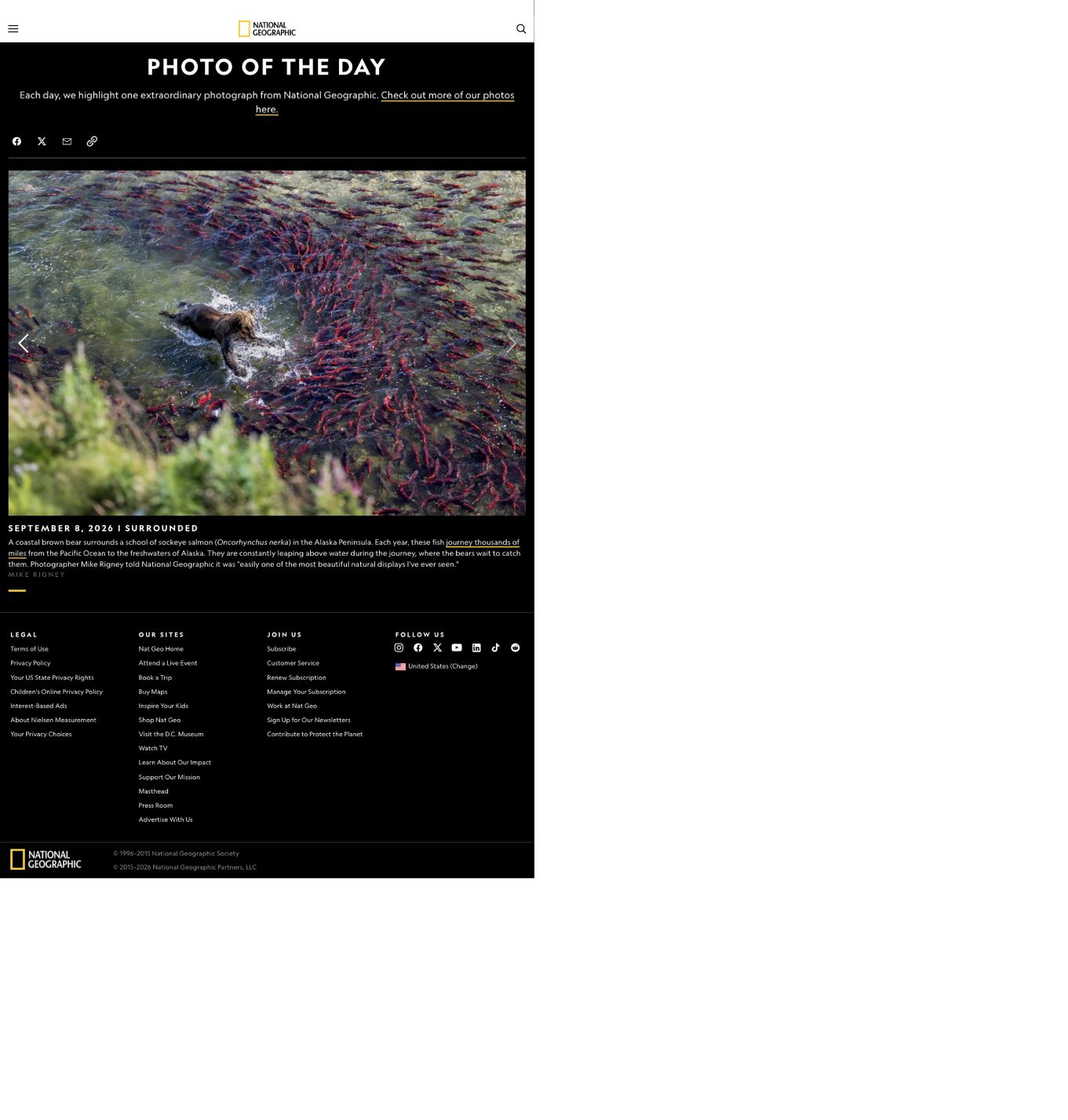
A bear stands in the water, surrounded by red fish. National Geographic titled the photograph "Surrounded."
Screenshot: National Geographic Photo of the Day · Original page
Today's National Geographic Photo of the Day has a one-word title: "Surrounded."
The caption phrases the scene strangely: a coastal brown bear "surrounds" a school of sockeye salmon. How can one bear surround a school of fish? National Geographic's alternative text repeats the idea: "A brown bear in the water surrounds a school of red fish."
This is deliberate, not a typo, and echoes the title. Whether the composition shows the fish surrounding the bear or the bear's open jaws surrounding the fish is impossible to determine from the page's description, so this article will not guess.
The alternative text does establish two crucial facts:
First, the bear is in the water, not on shore.
Second, the fish are red.
The second matters more than it seems. Sockeye salmon are silver in the ocean. Red means they have entered fresh water, are almost home and are close to death.
How Do They Find Their Way Home?
The caption says these fish travel thousands of miles from the Pacific every year to return to Alaska's fresh water.
One potential misreading needs correcting. The thousands of miles are real, but they do not describe the final dash upriver. The Alaska Department of Fish and Game explains that the distance accumulates over the two or three years in which the fish drift and feed around the great counterclockwise gyre of the Gulf of Alaska.
The more accurate account is: they circle for thousands of miles at sea, then return to the lake where they were born.
The sockeye life cycle runs broadly as follows. NOAA Fisheries and the Alaska Department of Fish and Game differ slightly on the ages, so both ranges are retained: hatch and grow for one to three years in a freshwater lake; enter the ocean; spend two or three years at sea; return to the natal river and lake to spawn; then all die. NOAA uses the word all: all sockeye die within weeks of spawning.
How does a fish find the right place across thousands of miles of ocean?
Humans have identified two systems.
The open-ocean stage uses Earth's magnetic field. Researchers proposed and tested a geomagnetic-imprinting hypothesis: juveniles memorize local magnetic values as they enter the sea, then seek the same values as adults. Putman et al. tested this in Fraser River sockeye in Current Biology 23, 312 (2013), DOI 10.1016/j.cub.2012.12.041. The abstract begins candidly: salmon use chemical cues to identify their home river in the final phase of migration, but how they navigate from the open ocean to the correct coastal region has remained a mystery.
Near shore and in the river, they use smell.
Katmai National Park's official sockeye page gives a particularly elegant explanation:
Young salmon imprint on the distinctive chemical signatures of the water where they were raised and the waters through which they traveled to the sea. On the spawning migration, they use those same chemical cues to smell their way back to their natal stream.
The mechanism is better than merely "remembering home." The fish memorizes a sequence of smells - every stretch of water on the route out - and follows that sequence in reverse on the way back.
A 1996 review in the Journal of Experimental Biology supports that wording almost exactly. Dittman and Quinn, DOI 10.1242/jeb.199.1.83, wrote that juveniles learn a sequence of olfactory waypoints during freshwater migration and later retrace that odor sequence as adults.
The experiment behind this discovery was inspired.
As the review recounts, Hasler's team exposed juvenile coho salmon to one of two synthetic chemicals not found in nature, morpholine or beta-phenethyl alcohol. A year and a half later, researchers released the same chemical into a completely unfamiliar stream, and the fish swam into it.
They manufactured a false homeland.
There was a still finer result: only fish exposed during smoltification, the brief stage when juveniles prepare to enter the sea, responded as adults. That is the memory window. Outside it, the odor is not recorded.
(The research line began with Hasler and Wisby's 1951 paper in The American Naturalist, DOI 10.1086/281672. That study was not a nostril-blocking experiment. It conditioned blacknose dace to distinguish water from two Wisconsin streams and concluded that a volatile aromatic substance carried the signal.)
They Give Away All the Red Inside Their Bodies
Now return to the "red fish" in National Geographic's alternative text.
Katmai National Park explains the counterintuitive mechanism with unusual clarity.
Why is salmon flesh red? Because of what the fish eats. More than 99 percent of a salmon's body mass is gained at sea, where its food is rich in carotenoids, the same pigments that color carrots.
Why does the whole fish turn red when it spawns? The park says:
Carotenoid pigments in the flesh are transferred to the skin and eggs. By the time sockeye spawn, their flesh is actually white because all the carotenoids have been moved out of it.
The sockeye does not simply "turn red." It moves the color gathered over a lifetime at sea to the outside. The price of a red exterior is a white interior.
There is an even harsher fact in the same official account:
Once salmon re-enter fresh water, they do not eat. They slowly starve and live only on stored body fat.
(This statement was found only on Katmai's official page; neither NOAA nor the Alaska Department of Fish and Game species page mentions it. The source article also found the title of an outreach article arguing that some Pacific salmon do feed during migration but could not access its contents. Treat the claim as Katmai National Park's official account, not as an uncontested universal rule.)
Together the statements form a complete causal chain:
The fish stops eating, so it must burn itself. The red in that disappearing muscle becomes its wedding clothes.
The Alaska Department of Fish and Game also records the male's transformation: at breeding age, males develop humped backs and hooked jaws filled with small visible teeth.
Bears: One Species, Three Times the Weight
The caption calls the animal a "coastal brown bear."
Official educational material from the Alaska Department of Fish and Game begins with a counterintuitive fact:
Brown bears and grizzly bears are classified as the same species, despite their striking differences.
How striking? The same material gives these numbers:
An adult coastal male can weigh as much as 1,500 pounds, or 680 kilograms.
An adult inland male can reach 500 pounds, or 227 kilograms.
That is exactly three times as much.
The department's species page supplies the reason. Coastal bears have access to seasonal concentrations of spawning salmon, richer vegetation and a milder climate, so they grow larger and occur at higher densities.
The same species reaches 680 kilograms in one place and only 227 in another. The difference is not genetic. It is whether fish are available. Salmon provide those extra two-thirds.
(Two further figures are worth keeping: Alaska holds more than 98 percent of the United States' brown bear population and more than 70 percent of North America's. Bears can add more than 50 percent to their body weight in late summer and fall.)
This Is Not Waste. It Is Accounting
One familiar claim about bears and salmon is that when fish are abundant, bears eat only the fattiest parts and discard the rest.
That is broadly true, but the familiar version misses the point. The correct account is more interesting.
A 2001 study in Oecologia by Gende, Quinn and Willson, DOI 10.1007/s004420000590, recorded more than 20,000 salmon killed by bears between 1994 and 1999. The sites included Bristol Bay for sockeye and Southeast Alaska for pink and chum salmon. Its abstract describes "striking patterns of partial consumption and selective consumption" that changed with fish availability and the fish's own characteristics.
The pattern divides by sex:
- From male salmon, bears eat the brain, dorsal hump and body flesh.
- From female salmon, they eat the eggs and abdominal fat.
- When fish are abundant, bears consume less biomass from each fish and avoid fish that have already spawned.
- When fish are scarce, they eat far more of each one, including spent fish.
A 21-year dataset provides the fuller answer. A 2019 University of Washington master's thesis counted 67,234 salmon killed by bears along a small stream in Southwest Alaska. Twenty-one percent were not eaten at all, while 79 percent lost varying amounts of tissue. Bears consumed lipid-rich parts - the male brain and female gonads - and discarded lower-energy tissue.
The thesis concludes:
The data support an optimal-foraging strategy, not wasteful surplus killing.
The bear is not wasting food. It is doing the accounts. When fish are plentiful, it chooses only the most energy-dense parts; when fish are scarce, it finishes the whole animal. The same bear becomes two different eaters at different levels of abundance.
(One popular claim can also be discarded. None of the three sources reviewed says bears eat only the skin. The documented targets are brains, humps, abdominal fat and eggs. Katmai's official page says bears, plural, may kill hundreds of salmon a day along Brooks River. It does not say one bear does so.)
Then the Fish Left on Shore Become Trees
This is the real subject of today's story.
Another 2001 paper, by Helfield and Naiman in Ecology 82, 2403, sampled tree leaves beside two spawning streams in Southeast Alaska and measured stable nitrogen isotopes.
The principle is simple. Marine and terrestrial nitrogen have very different isotopic signatures. The study's endpoint values were +13.39 for marine delta-15-N and -3.34 for the terrestrial end of the spruce range. Measure a leaf, and you can estimate how much of its nitrogen came from the ocean.
The result:
Isotope analysis showed that about 22 to 24 percent of the nitrogen in the foliage of trees and shrubs beside spawning streams came from salmon.
What did that nitrogen buy? The paper supplies perhaps the most vivid number in the story:
Among trees within 25 meters of a stream, average annual basal-area growth was more than three times higher at salmon-spawning sites than at control sites without salmon. Translated into the time required for a Sitka spruce to reach a breast-height diameter of 50 centimeters:
Beside a salmon stream: 86 years. Without salmon: 307 years.
A difference of 221 years.
(The arithmetic checks: 307 / 86 = 3.57, consistent with the paper's "more than threefold." One caveat must remain. The paper was formally challenged in Ecology, and its authors published a response. The source article could not access the substance of the challenge, so these figures should be understood as the researchers' estimate, not an immutable law. There is also a geographic correction: the study took place in the Southeast Alaska archipelago, not on the Alaska Peninsula, so these are not "Katmai spruces.")
The Bear Is the Irreplaceable Link
One piece is still missing.
If salmon spawn and die in the water, how does their nitrogen reach the trees on shore?
In 2006, the same two authors answered in Ecosystems 9, 167, DOI 10.1007/s10021-004-0063-5. They applied a mass-balance model to data from a Southwest Alaska stream. The abstract contains the most important sentence in today's story:
When salmon and bears were both present, nitrogen inputs to riparian forests increased significantly; neither species could produce the effect alone.
Read that slowly.
Salmon alone cannot deliver ocean nitrogen to the forest. Bears alone cannot either. Both must be there.
The nitrogen is carried out of the water in a bear's mouth. A bear drags a fish into the woods, eats its brain and eggs, and leaves the rest to decay beside the roots. A fish that grew for two or three years in the Pacific becomes one ring in a spruce tree.
The paper estimates that the salmon-bear interaction can supply up to 24 percent of the riparian nitrogen budget, while noting that the fraction varies across time and space with salmon abundance, channel shape and watershed vegetation.
University of Washington salmon researcher Tom Quinn gave National Geographic a more visual description: bears act almost like traffic police directing the flow of nutrients.
The bear in today's photograph stands in the middle of the fish. It is also standing in the exact center of this chain.
Not a Holiday, but the Most Important Two Weeks of the Year
September 8 and 9 are not commemorative days connected to salmon, bears, Alaska or rivers. Nor could the source article find a World Salmon Day established by the United Nations, the Food and Agriculture Organization, NOAA or any government agency.
But September is the crucial point in this annual ecological event, and the photograph itself tells us so.
Three pieces of official evidence form the chain.
First, the fish in the photograph are red, according to National Geographic's own alternative text. Red means spawning color, which means fresh water.
Second, Katmai National Park's official blog describes Brooks River in August and September:
In August and September, Brooks River is dotted with ruby-colored jewels digging nests and competing for territory.
Third, the park's bear-viewing guide says of September:
At Brooks Camp in September, bears are usually numerous as they search for dying and dead salmon.
The same guide supplies an unexpected middle chapter. Mid-July has the most visible bears, when fish accumulate below the falls. But in August, salmon begin spawning along Brooks River while becoming more dispersed, still strong and no longer migrating. Fishing becomes difficult, and almost every bear leaves the area.
Then they return in September, for the dying and dead fish.
The bears do not follow fish. They follow fish that are easy to catch.
September is also when they are fattest, which is a matter of life and death rather than appearance. The National Park Service says bears must consume a winter's worth of food in about six months. Fat fuels hibernation, during which they may lose as much as one-third of their body weight.
Thirteen Days from Now
Fat Bear Week 2026 runs from Tuesday, September 22, through September 29. Voting is open each day from noon to 9 p.m. US Eastern time, or midnight to 9 a.m. the following day in Beijing. The organizers are explore.org, Katmai National Park and Preserve, and the Katmai Conservancy.
It is a single-elimination public vote for the fattest, most successful bear. The organizers' reason is unequivocal: fatter bears have the best chance of surviving hibernation.
Its origin was simple. In 2014, ranger Mike Fitz was reading comments on explore.org's live stream when he noticed how dramatically one bear's body had changed. The first event, on September 30, 2014, was called Fat Bear Tuesday, used Facebook likes and drew 1,700 votes.
By 2024, organizers counted about 1.2 million votes from more than 100 countries.
A global vote began with a ranger noticing something while reading live-stream comments. In twelve years it grew from 1,700 votes to 1.2 million.
(This event had not yet happened when the source was written, so no winner is predicted. A Fat Bear Junior bracket was held in 2025, but the 2026 dates could not be verified and are not given. Voting requires an email address, something parents may want to know.)
A Country Rejected a Mine for These Fish
Where do the fish come from? The caption says only the Alaska Peninsula. Beside that peninsula lies Bristol Bay.
The Alaska Department of Fish and Game calls its connected rivers the world's largest commercial sockeye salmon fishery. The US Environmental Protection Agency says the Bristol Bay watershed produces about half of the world's sockeye salmon.
The scale is extraordinary. The 2022 return was about 79.1 million fish, the largest on record. That year's commercial harvest of 60.5 million was the largest in Bristol Bay since catch records began in 1893. The actual 2025 return was 56.7 million.
(A necessary update: the official 2026 forecast was 45.32 million fish, 26 percent below the most recent ten-year average of 61 million, though still 21 percent above the long-term average since 1963. Officials had not released the actual 2026 figure when the source was written. Any account of "the world's largest salmon run" should include that downward trend rather than only the 2022 peak.)
Beneath the watershed lies an enormous copper and gold deposit.
On January 30, 2023, the EPA used Section 404(c) of the Clean Water Act to issue a final determination prohibiting the discharge of dredged or fill material from the proposed mine into the relevant waters, effectively rejecting it.
The official record lists the permanent losses the mine would have caused:
8.5 miles of anadromous fish streams. Another 91 miles of streams supporting anadromous fish. And 2,108 acres of wetlands and other waters.
The same document explains why. In 2019, the fishery was worth more than $2.2 billion and supported about 15,000 jobs each year. It involved 25 Alaska Native villages and communities; in some, salmon represented more than half of subsistence harvests. The EPA's assistant administrator for water said that after reviewing a scientific and technical record spanning two decades, the agency found that the discharges would cause unacceptable adverse effects in certain salmon fishery areas of the watershed.
To preserve the route home for spawning fish, a country rejected a mine. The official price was 8.5 miles of streams, 91 miles of tributaries and 2,108 acres of wetlands.
The source article checked whether that account still held. The EPA timeline page, last modified in May 2026, said under "Current Status" that a change of administration had prompted discussion of a revised proposal, but no updated application had been submitted to the EPA and no related matter was before the agency.
As of May, the determination remained in force and no new mining application was under review. The fact that revisions had been discussed also shows that the outcome is not immovable.
A Park Created by a Volcano
One final loop was the most unexpected discovery in the source research.
The two best-known places to watch bears catch salmon on the Alaska Peninsula are Brooks Falls in Katmai National Park and McNeil River State Game Sanctuary. Today's caption says only "Alaska Peninsula," so the available evidence cannot establish where the photograph was made. The following describes the region's most famous sites, not the confirmed location of the image.
Brooks Falls is only about six feet high, or 1.83 meters. The National Park Service says it creates a temporary obstacle for migrating salmon, concentrating the fish and therefore the bears because fishing becomes relatively easy. At peak season, visitors may see more than 25 bears at once from the platform, while 200,000 to 400,000 salmon successfully leap the falls each year.
McNeil River's figure is more dramatic. In 1967, the Alaska legislature designated the area a wildlife sanctuary, enlarged in 1993, to protect the world's largest concentration of wild brown bears. The official record says 74 bears have been observed at one time. Entry is tightly limited: from June 7 through August 25, no more than ten people may be present at once.
How did Katmai National Park begin?
Novarupta erupted from June 6 through 8, 1912.
Both the US Geological Survey and National Park Service call it the world's largest volcanic eruption of the twentieth century. It lasted about 60 hours and released 13 to 15 cubic kilometers of magma - NPS gives 13 and USGS 15. Both compare it to 30 times the volume of Mount St. Helens in 1980. NPS adds that it was one of the five largest eruptions in recorded history and no eruption since Tambora in 1815 had exceeded it.
In 1916, botanist Robert F. Griggs entered the buried valley and saw "thousands - literally tens of thousands" of columns of steam rising from its fractured floor. He named it the Valley of Ten Thousand Smokes.
According to the National Park Service, Griggs and the National Geographic Society then helped secure Katmai's designation as a national monument by presidential proclamation in 1918, to protect the smoking stones.
More than a century later, the smoke is gone, and a park born from a volcano has become the world's best-known place to watch bears.
Then, on September 8, 2026, National Geographic placed an image of an Alaska Peninsula bear and sockeye salmon on its Photo of the Day page.
(For precision: NPS says the National Geographic Society promoted the park's creation and supported early scientific expeditions. The specific financing details were not verified, so the account goes no further.)
The China Connection: Half the Fish in Those Studies Were Chum Salmon
Does this story connect to China? At the species level, it does.
The 2001 study of more than 20,000 bear-killed fish states in its abstract that its sample covered two regions and three species: sockeye salmon (Oncorhynchus nerka) in Bristol Bay, and pink salmon (O. gorbuscha) and O. keta in Southeast Alaska.
Oncorhynchus keta is the chum salmon found in China's Heilongjiang River.
In other words, half the species sampled in the work showing how salmon feed trees are fish of the same species found in the Heilongjiang. The same genus, the same migration, the same fate of dying at home.
(There is a linguistic layer too. Secondary sources say the Chinese name damaha was transliterated from the word used by the Hezhen, or Nanai, people who lived along the river and depended on the fish. The detail is apt: the fish's Chinese name was borrowed from the language of the people who lived beside it. But the source article could not verify this in a primary Chinese source, so it should be treated accordingly.)
Chum salmon also migrate through the Heilongjiang, Ussuri and Tumen rivers, but available primary official sources were insufficient to confirm that year's precise timing, hatchery-release programs or related festival dates, so no further inference is made.
(The Amur's chum salmon include distinct summer and autumn populations with different migration seasons. Any further research must keep them separate.)
The Person Who Pressed the Shutter
The photographer is Mike Rigney. His own website says:
I am an engineer, photographer, diver and professional mariner. In 2014, I left my office job in the aerospace industry, sold nearly everything and fell in love with exploration and the sea.
He calls himself an avid bird and wildlife photographer and describes his work as an engineer and photo instructor aboard a National Geographic expedition ship traveling between Alaska and Mexico's Baja California.
He was not a tourist who came to take pictures. He was the ship's engineer.
An aerospace engineer left his office in 2014, sold nearly everything and began living at sea. Twelve years later, a photograph he made in Alaska became National Geographic's Photo of the Day.
He told National Geographic that the scene was easily one of the most beautiful natural sights he had ever witnessed.
His website mentions neither bears nor salmon nor any specific location.
Image: National Geographic Photo of the Day · Photograph: Mike Rigney · Original page
Sources
National Geographic Photo of the Day and Melissa Hobson, "How to See Pacific Salmon Complete Their Epic Annual Migration," August 21, 2026; NOAA Fisheries sockeye species page; Alaska Department of Fish and Game materials on sockeye, brown bears, McNeil River, Bristol Bay's 2022 and 2025 seasons, and the 2026 forecast; National Park Service materials for Katmai National Park, including its official sockeye Q&A, Brooks River salmon blog, Brooks Camp bear-viewing guide, Brooks Falls platform, bear-cam pages and tenth-anniversary release, Fat Bear Week history, and classroom resources; Katmai Conservancy; explore.org; US Geological Survey on the twentieth century's largest eruption; US Environmental Protection Agency materials on the Pebble deposit final determination, Section 404(c) timeline and January 31, 2023 release; Dittman and Quinn, Journal of Experimental Biology (1996); Hasler and Wisby, The American Naturalist (1951); Putman et al., Current Biology (2013); Gende, Quinn and Willson, Oecologia (2001); Lincoln, University of Washington master's thesis (2019); Helfield and Naiman, Ecology (2001) and Ecosystems (2006); World Rivers Day; and photographer Mike Rigney's website.