
It should be sleeping inside the tree, not on top of it.
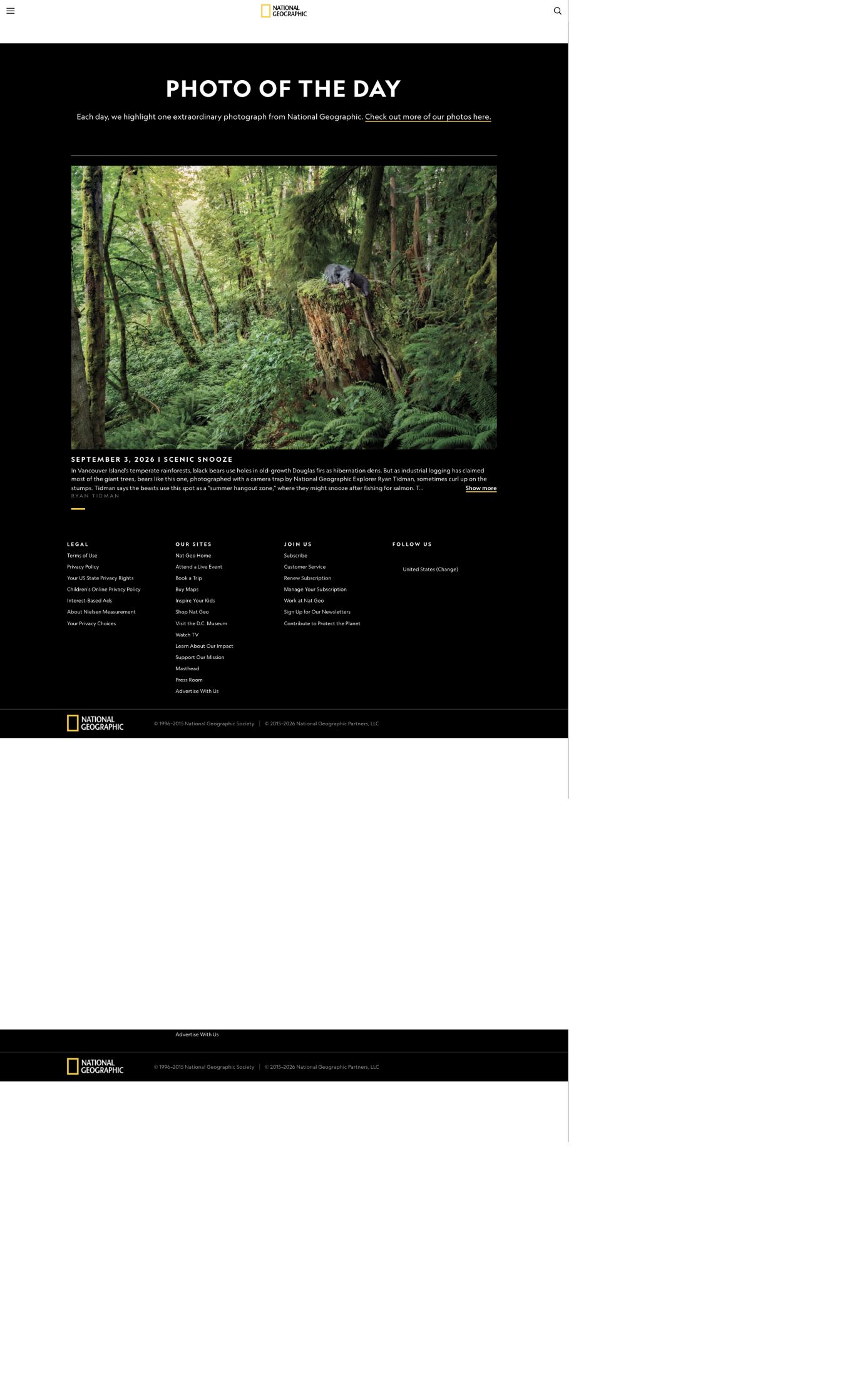
Screenshot: National Geographic Photo of the Day | Photograph: Ryan Tidman | Original page
Today's National Geographic Photo of the Day shows a black bear asleep on a massive stump, all four legs spread out. National Geographic Explorer Ryan Tidman captured it with an infrared camera. The bear did not know anyone was watching and appears wholly at ease.
The setting is the temperate rainforest of Vancouver Island, Canada. Tidman says the stump is the bear's "summer resting area." It had probably just come up from catching salmon in the river and stopped for a nap. The scene is peaceful. Once you know where the bear should sleep, however, it becomes a little sad. The stump beneath it ought to be a living giant large enough to hold its winter den.
A Bear's Bedroom Is Hidden Inside a Tree
This is the one fact worth remembering today: on Vancouver Island, black bears spend the winter not in holes in the ground but inside enormous trees.
Along coastal British Columbia, black bears choose almost one kind of winter shelter: very old, very wide hollow trees. The most substantial study of this behavior, by Davis, Weir and colleagues in 2012, gives an astonishing figure. The bears' chosen den trees averaged 143 centimeters in diameter, nearly a meter and a half. Massive western red cedars and yellow cedars were the most common, followed by Douglas firs, the species beneath today's bear, and hemlocks. Some dens sit more than ten meters above the ground inside the trunk, where mothers and cubs are safer than they would be on the forest floor.
Such a cavity cannot be made quickly. A tree must grow wider than a meter and live for centuries while fungi slowly consume its heartwood, eventually opening a chamber large enough for a bear. Researchers are explicit: these cavities take centuries to form.
In other words:
A bear's bedroom takes a tree three hundred years to build.
That is the source of the photograph's sadness. Industrial logging removed most of Vancouver Island's towering old trees, leaving fewer and fewer that can provide dens. Bears settle for what remains and rest on stumps, as this one does. But a stump decays and collapses. It does not last long. A replanted forest harvested on cycles of a few decades will never get old enough to produce the next cavity. A bedroom can be cut down quickly, but it cannot be rebuilt quickly.
The Bears Themselves Feed the Trees
The relationship forms a cycle beautiful enough to raise goosebumps.
Bears eat salmon. During a salmon run, they carry fish out of the river and into the forest to feed. Bones and scraps remain beneath the trees. Salmon from the ocean contain a distinctive nitrogen isotope, ¹⁵N, that scientists can recognize as marine. Nitrogen from the carcasses seeps into the roots of streamside trees and becomes fertilizer.
University of Victoria ecologist Tom Reimchen calculated the scale. Over a salmon season of a little more than 40 days, one bear can carry roughly 700 salmon into the forest, a total of 1,600 kilograms of "fish fertilizer." With bears doing this work, a substantial share of the nitrogen inside streamside trees comes from the ocean. Different studies put it anywhere from about one-half to as much as three-quarters. Scientists can even read tree rings to see which years had abundant salmon decades ago and which had few.
The cycle closes completely: bears and salmon feed the trees → the trees grow for centuries and hollow into giants → the cavities become the bears' winter bedrooms. The forest gives a bear a bed, but the bear helped grow it one salmon at a time. Reimchen summarized the relationship in one sentence: salmon need forests, and forests need salmon.
One Correction: Black Bears Are Not "True Hibernators"
People commonly say that bears hibernate. Strictly speaking, black bears are not true hibernators like ground squirrels or bats. A true hibernator's body temperature falls close to freezing, and the animal is almost impossible to wake. A black bear's temperature drops only a few degrees. Disturb it and it can wake and even leave the den.
Some biologists prefer to call bears "super hibernators." They can pass five months without eating, drinking, urinating or defecating; recycle bodily waste into protein; and lose almost no muscle or bone. A mother gives birth inside the den in midwinter. A newborn cub weighs around half a jin, roughly 250 grams, cannot open its eyes, and is only a few hundredths of its mother's weight. It survives on milk until spring.
Because black bears are not compelled to hibernate, some on mild Vancouver Island spend only a short time asleep in winter, or scarcely den at all when food remains available. A bear napping here outside winter is entirely normal. It is not hibernating, only sleeping in its "summer resting area."
Vancouver Island has no grizzly bears. Black bears are its only and largest terrestrial carnivores, and they are consequently bolder and more active by day than black bears elsewhere.
On This Side of the Pacific
China has a bear that also needs old trees and cavities.
The Asian black bear is a close relative in the same genus as Vancouver Island's bears. A creamy crescent on its chest gives it another English name, the moon bear, and it lives in Chinese forests. Its winter habits mirror the scene across the Pacific. In a Russian Far East study of 27 Asian black bear dens, 17, or 63 percent, were inside hollow trees, most of them immense old poplars. Most entrances opened high above the ground. On both sides of the Pacific, bears depend on trees that are both old and hollow.
China has also made a consequential decision about whether old natural forests should be cut. After the catastrophic Yangtze flood of 1998, China launched the Natural Forest Protection Program, halting or restricting commercial logging in natural forests in the upper Yangtze and the middle and upper Yellow River regions. The ban on commercial logging in natural forests was later extended step by step across the country.
The decision asks the same question as the debate on Vancouver Island: cut or preserve? A country decided to let its natural forests grow old again. A bear looking for a bed needs precisely that: a forest old enough to provide one.
Sources
research on black-bear tree dens on Vancouver Island, Davis, Weir et al., 2012, and the Artemis Wildlife coastal bear-den identification manual; Ryan Tidman, ryantidman.com, and the Royal Canadian Geographical Society; salmon-forest nitrogen cycling, University of Victoria's Reimchen "Salmon Forest" project and Hakai Magazine; black-bear hibernation physiology, US National Park Service and WildSafeBC; old-growth logging on Vancouver Island, British Columbia's 2020 Old Growth Strategic Review and Ancient Forest Alliance; Asian black-bear winter ecology, Seryodkin et al., Russian Far East; China's Natural Forest Protection Program, Chinese government and National Forestry and Grassland Administration; Tangjiahe; and Northeast China Tiger and Leopard National Park.