
The Moulin Sorine in Santenay, at the southern end of the Côte de Beaune in Burgundy, France
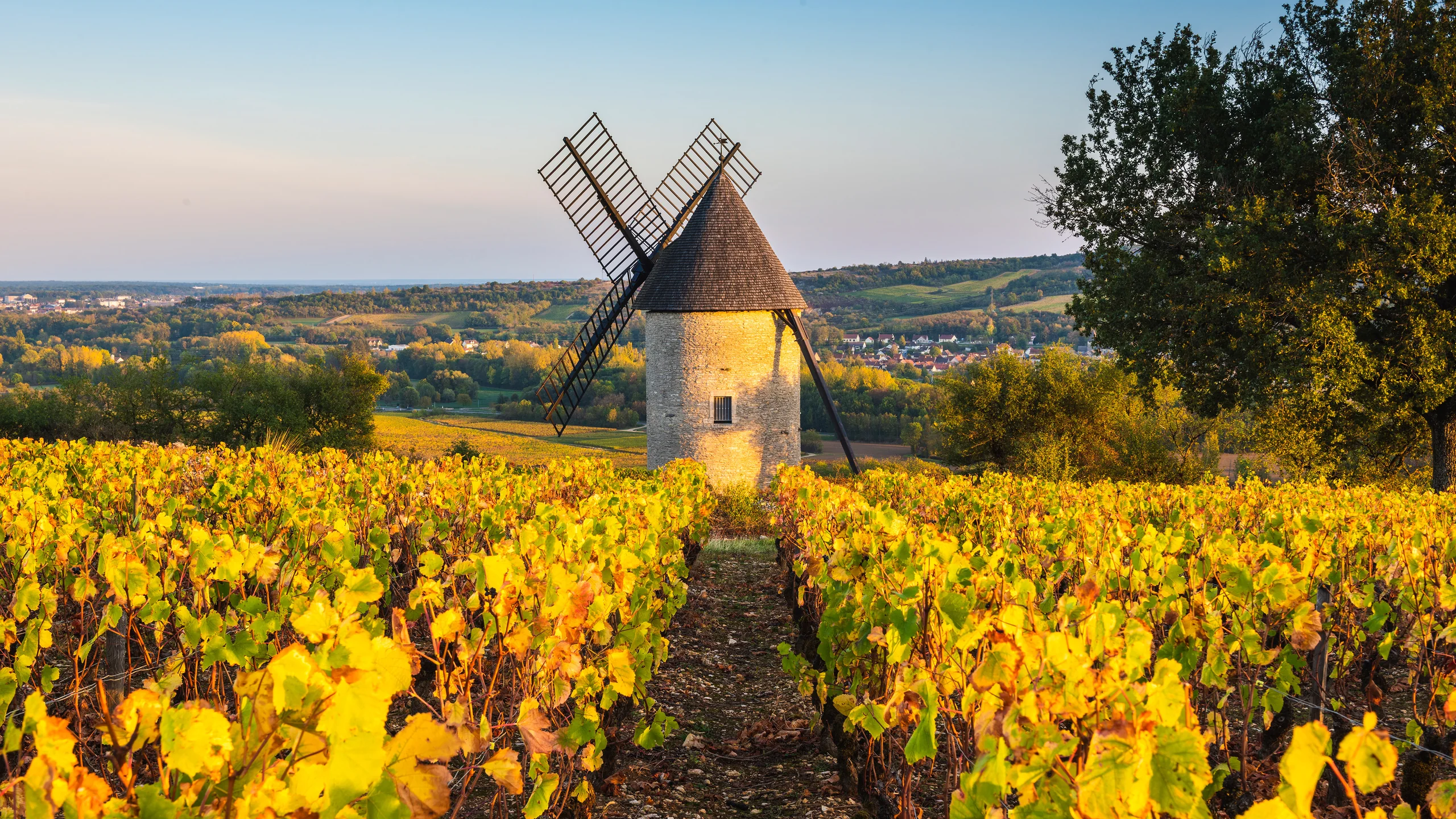
Image: Bing Daily Wallpaper | Moulin Sorine in the vineyards of the Santenay wine region, Côte de Beaune, Burgundy, France (© Marco Bottigelli/Getty Images)
Do not look at the windmill just yet. Look at the slope beneath it.
It runs from the upper left of the image to the lower right, its rows of vines combed neatly downhill. This is the Côte d'Or in Burgundy, France, arguably the most intensively studied slope in the world. Its eastward face, its steep straight profile and its long north-south alignment all have a slightly alarming explanation:
This is not the side of a mountain. It is the face left behind when the Earth's crust split.
A Rift, and Two Thousand Years on Its Edge
Pull back from the scene. The forces raising the Alps and those acting on France's Massif Central pulled against each other here, stretching the crust apart. When it broke, the entire eastern block subsided and became the plain through which the Saône now flows. The western block stayed up, exposing an east-facing escarpment through rock layers that had once joined.
The evidence lies on the slope. Middle and Upper Jurassic limestone is exposed at the top, while the plain below consists of much younger Oligocene, Pliocene and even Quaternary sediments. Old rock stands above land tens of millions of years younger. The drop between them is the distance the basin sank. The escarpment runs about 48 kilometers north to south, from Dijon to its southern end at Santenay, the village in today's photograph.
Once the slope faced east, much else followed. Morning sun dries the dew early. The incline drains rainwater. Walk from the foot to the top and you cross rocks of different ages and textures, overlaid by colluvial rubble and alluvial fans left by the last ice age, each with a different thickness. Keep the exposure, grape and winemaker the same, move 50 meters uphill, and the wine changes.
The people of Burgundy spent nearly a thousand years sorting out those differences. Today the slope is divided into 1,247 parcels, each with its own name and boundary. In French, each is a climat. UNESCO's official description is restrained: the plots are "precisely delimited according to their geological, hydrographic and atmospheric characteristics." It credits the Benedictine and Cistercian monks and the Valois dukes of Burgundy. The monks tested the slope parcel by parcel and recorded where the wine came out differently. On July 4, 2015, the 39th session of the World Heritage Committee inscribed all 1,247 parcels together on the World Heritage List.
Santenay sits at the southern end of that heritage corridor. It is a village of fewer than 900 people, with no grand cru vineyards and 12 premier crus. Pinot noir is planted for red wine and chardonnay for white. It also has something rare in Burgundy: thermal springs. Its other name is Santenay-les-Bains. An entertainment hall built for the spa in the 19th century later became the Casino de la Source. A wine village once made money on the side from bathing.
Behind the village rises the 521-meter Mont de Sène, locally known as the Mountain of the Three Crosses. From its summit, the Côte de Beaune lies to the north, the Saône Valley to the east, Cluny to the south and the Morvan to the west. In a single view, you can see both sides of the fault: the block that stayed up and the block that sank.
The Windmill Did Not Grind Grapes
Now look at the windmill.
It is called the Moulin Sorine and was built around 1825. The French Federation of Mill Associations gives 1825; another French source says "around 1830." The difference is small. Its builder, François Sorine, was the son of a Santenay winegrower. The tower is 8 meters tall and 6 meters across, with walls nearly 1 meter thick. Its sails span 14.5 meters, and its millstone weighs 3.5 metric tons.
It ground wheat. Not grapes.
That matters because windmills play no role in winemaking. This one stands here simply because the slope above the village catches the most wind. It stopped working in 1863 and slowly collapsed into ruins over the next century. In 1990, the municipality of Santenay decided to rescue it; the restoration was completed in 1995. Once repaired, it could grind flour again. The Beaune tourism office calls it the only windmill in the entire Côte de Beaune, "a lighthouse over the vineyards." The village sets it turning for one day on the third Sunday of every June.
The photograph therefore contains something quietly poignant: a machine built to grind people's staple food now stands alone on a slope planted only with grapes. It is physical evidence that wheat once grew here too.
Why Today: A Ledger More Than Six Centuries Long
This is the hardest piece of evidence in the story.
In 2019, Labbé and colleagues published a study in Climate of the Past that arranged Beaune's grape harvest dates, year by year, into a continuous record beginning in 1354. Beaune is just over 20 kilometers north of Santenay on the same slope. At 664 years, it is one of the world's longest phenological records.
The conclusion is stark. From 1354 through 1987, harvest in Beaune began on average on September 28. After 1988, rapid warming moved the date forward by a full 13 days, to around September 15. The paper made an even weightier point: exceptionally hot and dry years had been outliers across six centuries of data. After 1988, they became the norm.
Today is Thursday, September 17. By that old ledger, this is just about when Burgundy's growers should be heading into the fields.
But what about 2026?
The Hospices de Beaune, an institution founded in 1443 that owns 60 hectares of vineyards, began picking on August 15 and finished on August 24, a span of nine days. That was 44 days earlier than the 634-year average.
Nor was Burgundy alone. France's earliest grapes this year were cut on July 16 in Corbieres in the south, roughly two weeks earlier than the previous record set in 2003. In an estimate released on September 7, the French Ministry of Agriculture's statistical service put national production at about 33.8 million hectoliters, down 6 percent from last year and 17 percent below the previous five-year average. It is the lowest crop since 1957. The reasons were drought since May, three heat waves between June and August, and hail. Burgundy-Beaujolais was described as being at a "historic low," with pinot noir yields down by more than half in some areas.
Across the line drawn for more than six centuries, the paper measured a shift of 13 days. In 2026, it was 44. The line does not look as though it is bending. It looks as though it is breaking.
One widely repeated claim also needs correcting: Burgundy today has no official "harvest decree." Such rules existed in the Middle Ages, when no one could begin cutting without the lord's or the church's permission and inspectors were sent into the fields to test whether the grapes were ripe. But legislation in 1794, during the French Revolution, abolished all such bans: "Every owner may harvest at the time convenient to him." Today, weather, sugar levels and the growers themselves decide when picking begins.
There is an interesting fact in the other direction too: the rules do not actually require harvesting by hand. I checked the official specification for the regional Bourgogne AOC. Under harvesting methods, it says "no special provision." The only firm requirement in the entire section is that grapes be protected from rain during transport and reception. Even so, according to the Beaune tourism office, the great majority of the harvest is still done by hand. The law does not force growers to use their hands. They choose to.
The work itself is simple. Pickers cut grape clusters with pruning shears and place them carefully into baskets, while dedicated carriers circulate through the vineyard collecting full loads. A medium-sized estate needs about 20 pickers. Harvest usually lasts 10 to 15 days: work starts at 7:30 a.m., pauses for coffee two hours later, breaks for lunch at 12:30 p.m. and ends at 5 p.m.
By comparison, the Hospices de Beaune needed only nine days this year.
Its charity wine auction is always held on the third Sunday of November. In 2026, that is November 15, and it will be the 166th auction.
Another Slope, Eight Thousand Kilometers Away
China has a wine-growing slope of its own: the eastern foothills of the Helan Mountains in Ningxia.
It is almost the opposite answer to the same problem. Burgundy relies on sloping ground for drainage and fears rain and frost. Official figures for the eastern Helan foothills give 2,851 to 3,106 hours of sunshine a year and less than 200 millimeters of annual rainfall. The vineyards depend on Yellow River water and 100 percent coverage by high-efficiency, water-saving irrigation. This is not the same solution reached by another route. It is an entirely different strategy for survival.
But growers in Burgundy will never face one particular task.
Ningxia's winters are cold enough to kill vines left on their trellises. Every November, tractors fitted with soil-covering plows enter the vineyards. Every vine is taken down, pressed flat and buried no more than 20 centimeters below the surface. The entire job must be finished before November 20, because nighttime temperatures drop below freezing after that and machinery cannot work once the ground hardens. In spring, every vine is dug out and trained back onto its trellis.
Buried once a year, uncovered once a year, year after year. China's vineyards bury their vines and dig them up again every season. Few places on the world's wine map demand that amount of labor, yet official documents reduce it to the understated phrase "soil burial for overwintering."
Sources: UNESCO World Heritage List entry 1425, "The Climats, terroirs of Burgundy," and the July 4, 2015, announcement; the Association des Climats du vignoble de Bourgogne website; the French National Institute of Origin and Quality (INAO) official Bourgogne AOC specification and Santenay product page; the French Federation of Mill Associations directory; moulins-à-vent.net; the Beaune tourism office; the Hospices de Beaune estate website; Labbé et al., "The longest homogeneous series of grape harvest dates, Beaune 1354-2018" (Climate of the Past 15: 1485-1501, 2019); Petit et al., "Vineyard soils and landscapes of the Burgundy Côte" (IVES / Terroir 2012); the French Ministry of Agriculture's Agreste September 2026 wine production estimate; Wang Yufei et al., "Numerical Simulation of the Formation and Dissipation of a Cold Pool Process in the Chongli Competition Zone of the Winter Olympics" (Chinese Journal of Atmospheric Sciences, 2022, vol. 46, no. 1); the Ningxia Hui Autonomous Region Department of Industry and Information Technology overview of the wine region; and China News Service, "Wine Region at the Eastern Foot of Helan Mountain in Ningxia Enters 'Hibernation.'"