
Today's Bing wallpaper in China features a red-and-green macaw. The brilliant blue on its wings is not really a color at all.
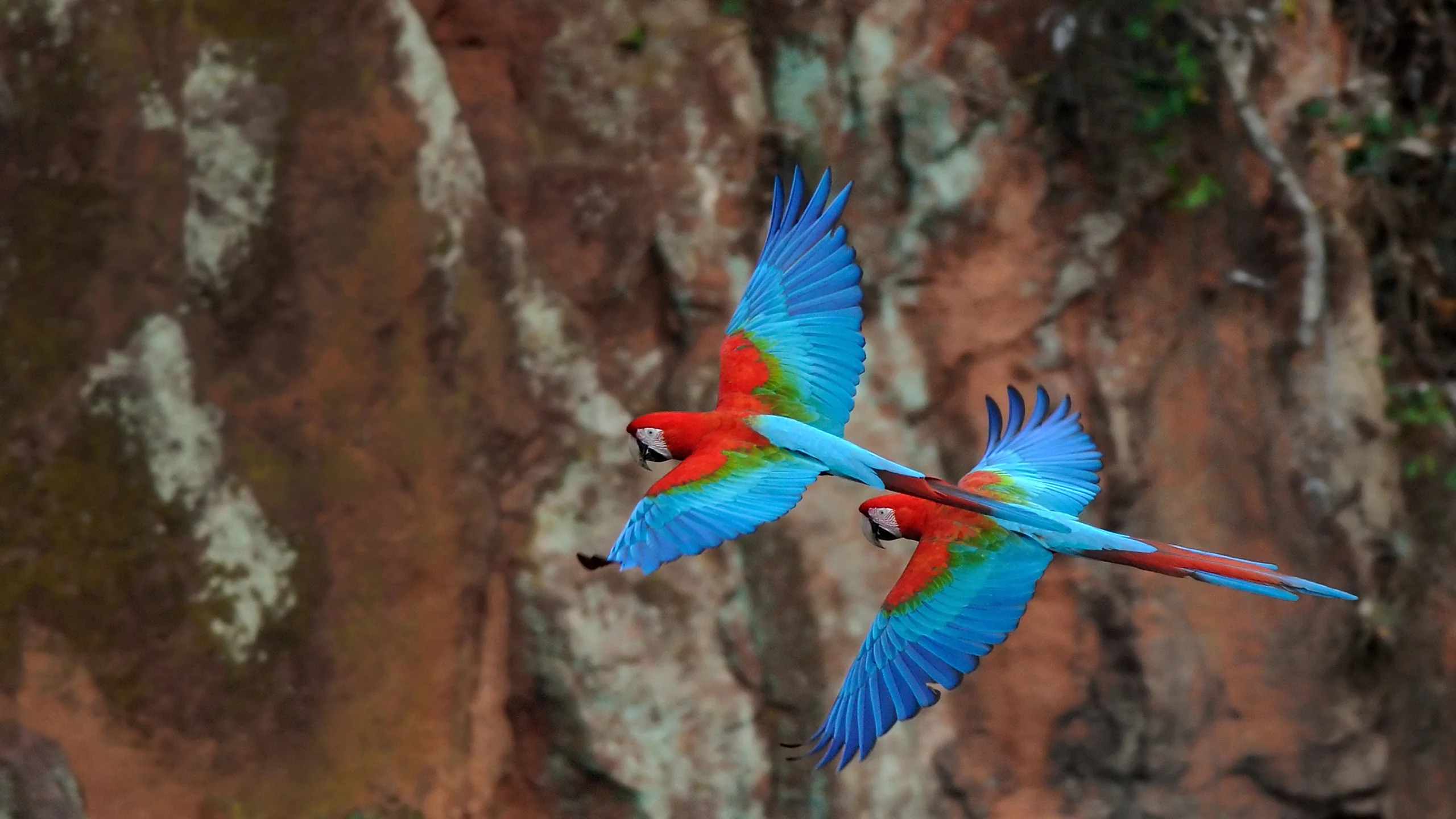
Image: Bing Daily Wallpaper | Red-and-green macaw (© markes51/Getty Images)
Bing gives today's photograph a four-word Chinese title that means "survival of the flashiest." Its one-line description supplies only the species: the red-and-green macaw, Ara chloropterus. It does not even say where the photograph was made.
So let us begin with color, because almost every color on this bird works differently from what you might expect.
It Makes Its Own Red
Start with a question a child might ask: did the bird get all those colors from its food?
Flamingos do. The shrimp and algae they eat contain carotenoids that enter their feathers. A well-fed flamingo turns red; a poorly fed one grows pale. It is easy to assume that parrots work the same way.
They do not. In 2004, Arizona State University's Kevin McGraw and Mary Nogare made a direct comparison. They found carotenoids in the blood plasma of molting parrots, at concentrations comparable to birds that use carotenoids for color. Then they examined the parrots' red feathers and found no carotenoids at all. The pigments were in the blood but not the feathers. Parrots can move carotenoids into feathers; they simply do not.
Instead, they use pigments made only by parrots: psittacofulvins. In 2001, Stradi and colleagues isolated their molecular structures from macaw feathers. Each is a straight carbon chain with alternating double bonds and an aldehyde group at the end. Chain length produces a family of molecules: C14, C16, C18 and C20.
The most elegant evidence came from a 2017 study in Cell. Researchers found a previously overlooked gene in budgerigars that encodes a polyketide synthase. They inserted the gene into baker's yeast - the same kind used to raise bread and brew alcohol. The yeast turned yellow, and its extracts contained precursors corresponding one for one to the aldehydes in parrots' red feathers. The control yeast remained colorless.
Even a jar of yeast can make a parrot's color. Food has nothing to do with it.
A 2024 Science paper took the story another step: red and yellow differ by a single oxidation reaction. An aldehyde dehydrogenase oxidizes the aldehyde group (-CHO) at the end of the polyene chain into a carboxylic acid (-COOH), and red becomes yellow. Change one hydrogen on the same molecular framework, and the color changes with it.
Blue? There Is No Blue in the Feather
Birds in nature can barely make blue pigments. The blue feathers you have seen on magpies, peacocks and this macaw's wings are not painted blue.
In 2012, an international team cut open and measured a blue feather from a scarlet macaw. Inside the medulla of each barb was a three-dimensional network of keratin rods. The rods were about 85 nanometers across at their midpoints and 120 nanometers at the nodes, with about 170 nanometers between nodes. Keratin occupied roughly 38 percent of the volume; the rest was air. The network sorted incoming light by wavelength and returned constructive interference centered near 474 nanometers to the eye.
The researchers gave the structure an evocative name: a photonic crystal with an amorphous diamond structure. It has short-range order but long-range disorder, which means its reflected blue does not change with viewing angle. Turn it and the blue remains blue. Peacock and hummingbird feathers differ: their strictly periodic multilayer structures change color sharply with angle, so a peacock's blue-green shifts as the bird turns.
What about green?
Green is assembled from two effects. In the same feather, the medulla contains that spongelike blue-reflecting framework, while the outer cortex contains yellow psittacofulvins. Light passes through the yellow cortex, reflects from the inner structure, then passes through the cortex again. Those two trips absorb much of the shortwave light below 500 nanometers. What remains is saturated green.
Red is synthesized. Blue is arranged. Green is the result of laying the two effects together. From one end of a parrot's green feather to the other, there is not a single green molecule.
This also explains the "blue" parrot varieties sold as pets. Their psittacofulvin-producing gene is broken, removing the yellow filter and leaving only structural blue. A 2025 study found independently evolved mutations in four distantly related groups: rose-ringed parakeets, Alexandrine parakeets, eclectus parrots and galahs. The same system broke separately, several times over.
The Blue Feather Came from Shanghai Zoo
Chinese researchers have played a substantial part in explaining structural color in birds.
In 2003, Jian Zi's team in Fudan University's Department of Physics published the mechanism of peacock-feather color in the Proceedings of the National Academy of Sciences. The peacock's barbules contain a two-dimensional photonic crystal: melanin rods 110 to 130 nanometers in diameter form a regular lattice in keratin, with air between them. Color depends on the spacing of that lattice. The lattice is densest in blue regions, where rod centers are about 140 nanometers apart. Blue and green regions have nine to twelve layers; yellow has only about six. The flowing iridescence of a peacock's display is, in physical terms, a crystal whose reflected wavelength changes with angle.
Zi was also an author of the 2012 paper that measured the macaw's blue feather. The paper states plainly that the specimen came from Shanghai Zoo.
In other words, half the answer to what the 85-nanometer framework inside today's blue wing looks like was measured from a fallen feather in Shanghai.
A Scientist Spent More Than a Decade Proving Himself Wrong
The red-and-green macaw is famous for something else: eating soil.
Along the Tambopata and Las Piedras rivers in Madre de Dios, southeastern Peru, exposed clay cliffs known locally as collpas draw flocks of macaws at dawn. The Tambopata Research Center is only a few hundred meters from one such cliff, where as many as 250 macaws can appear at once.
The textbook explanation is detoxification. Seeds and unripe fruits in tropical forests are rich in alkaloids, and clay can bind toxins. A 1999 paper by Gilardi and colleagues provided strong experimental support. They fed quinidine to orange-winged Amazon parrots; in the group that also consumed clay, blood concentrations during the first three hours were about 60 percent lower.
That experiment has never been overturned. Clay really can bind toxins.
But it cannot explain why the parrots choose particular layers of soil or why they gather in particular months.
Texas A&M University's Donald Brightsmith followed the question for more than a decade. In 2008, he measured the soil chemistry and found that the soil the birds ate contained about 40 times as much sodium as their normal plant foods. Cation-exchange capacity explained the intensity of cliff use far better than quinine adsorption did. A 2014 dietary survey created a larger problem for the detoxification hypothesis. If detoxification were the goal, the species eating the most seeds should visit the cliffs most often. The opposite was true: the most frequent visitors ate large quantities of flowers and fruit from secondary forest. In 2018, Brightsmith charted more than a decade of observations and found that clay-lick use peaked with the breeding season, not with food scarcity.
Then he said publicly that his original idea had been wrong.
When he began the work, he recalled, he had been certain that clay eating detoxified birds when food was scarce in the dry season. "But it isn't. It is related to the breeding season, and the driving factor is probably sodium." He added that he could still remember the first time he drew the graph and saw the pattern.
That is more revealing than the answer to why parrots eat soil. A scientist proposes a hypothesis, spends more than a decade measuring it, draws a graph that proves him wrong and publishes the correction. The most accurate current account is that detoxification is a side effect while sodium is the motivation, and sodium demand is highest when birds are laying eggs and feeding chicks.
The conclusion is not perfectly tidy. A 2026 study covering 12 years of data from the Manu Biosphere Reserve found that red-and-green macaws there reached their peak clay-lick use outside the breeding season. Sodium and reproductive demand provide the broad pattern, but different birds and different cliffs do not all follow the same rhythm.
Why September?
September 15 has no observance connected to parrots or biodiversity. World Parrot Day is May 31; World Migratory Bird Day falls on the second Saturday in May and October. Bing most likely chose an attractive photograph of a bird in flight.
September nevertheless matters to this species. Tambopata's dry season runs from April through October; the wet season lasts from November through March. Brightsmith's long-term records show that parrot numbers peak in the late dry season, from August to September, while the clay cliffs' busy season runs from August through January. Within weeks, the rains will arrive and red-and-green macaws will enter cavities in tall emergent Dipteryx trees to lay eggs. The earliest known clutch was laid in September.
This photograph therefore appears in mid-September, just when the birds spend more time aloft than at any other point in the year.
A Few Numbers to Treat Carefully
Several widely repeated numbers about this bird do not survive scrutiny.
"Macaws live for 80 or 100 years" has no supporting evidence. The highest documented age is 63 years in captivity, based on zoo records for 981 birds. The same study gives a more easily overlooked figure: for adults more than four years old, the median lifespan was only 14.4 years. The authors wrote that most captive parrots do not live beyond their twenties and that the majority clearly fail to reach the ages people commonly assume. The study explicitly could not determine lifespan in the wild: adults are difficult to age, and studies are too short relative to the birds' lives. A common Chinese-language claim that wild parrots live only a dozen years began when a database mislabeled "median adult lifespan in captivity" as "wild lifespan."
Claims such as "500 PSI bite force" misuse even the unit. PSI measures pressure; bite force is a force. A 2025 study combining anatomical modeling with measurements from living birds concluded that macaws have the strongest bite force yet measured in birds, and that force scales with positive allometry: double the body size and bite force rises by more than double. But the paper reports only newtons, never PSI.
The body-size figures are sound: an average mass of about 1,214 grams, a range of 1,050 to 1,708 grams and a length of 90 to 95 centimeters. The IUCN classifies the species as Least Concern, but its population trend is downward.
Finally
The red-and-green macaw disappeared entirely from northern Argentina for roughly a century and a half.
A reintroduction project began in the Ibera Wetlands in 2015. The first birds released had even lived in cages and had to relearn how to find food in the wild. Seven were released in 2017 and two more in 2018; by 2020, the total had reached 15.
In October 2020, a pair of adults released in 2019 hatched three chicks - the first of their species born in the wild at Ibera in about 150 years.
A later study tracked the released birds' diet and found that they could feed themselves throughout the year, eating 49 plant species in 28 families. That matters because macaws perform an unusual job in the forest: they are among the few animals capable of cracking large seeds. Without them, some trees cannot move.
This is not entirely a story about saving an animal. It is closer to inviting a long-vacant role back onto the stage.
Sources: Bing Daily Wallpaper metadata; Stradi et al., Comparative Biochemistry and Physiology Part B (2001); McGraw and Nogare, Comparative Biochemistry and Physiology Part B (2004); Cooke et al., Cell (2017); Arbore et al., Science (2024); Yin et al., Proceedings of the National Academy of Sciences (2012); Zi et al., Proceedings of the National Academy of Sciences (2003); Ghosh Roy et al., Communications Biology (2025); Gilardi et al., Journal of Chemical Ecology (1999); Brightsmith et al., Biotropica (2008); Lee et al., Biotropica (2014); Brightsmith et al., Ibis (2018); Herrera-Huayhua et al., Ornithology Research (2026); Brightsmith's 2005 and 2006 Tambopata Macaw Project reports; Young et al., Animal Conservation (2012); Harrison et al., Journal of Anatomy (2025); the World Parrot Trust species page; project announcements from Rewilding Argentina and Tompkins Conservation; a 2022 Ornithological Applications study of the reintroduced birds' diet; and the Cornell Lab of Ornithology's Bird Academy