
At the species level, this bird is secure. At the subspecies level, it is endangered. The birds at Tikal belong to the endangered group.
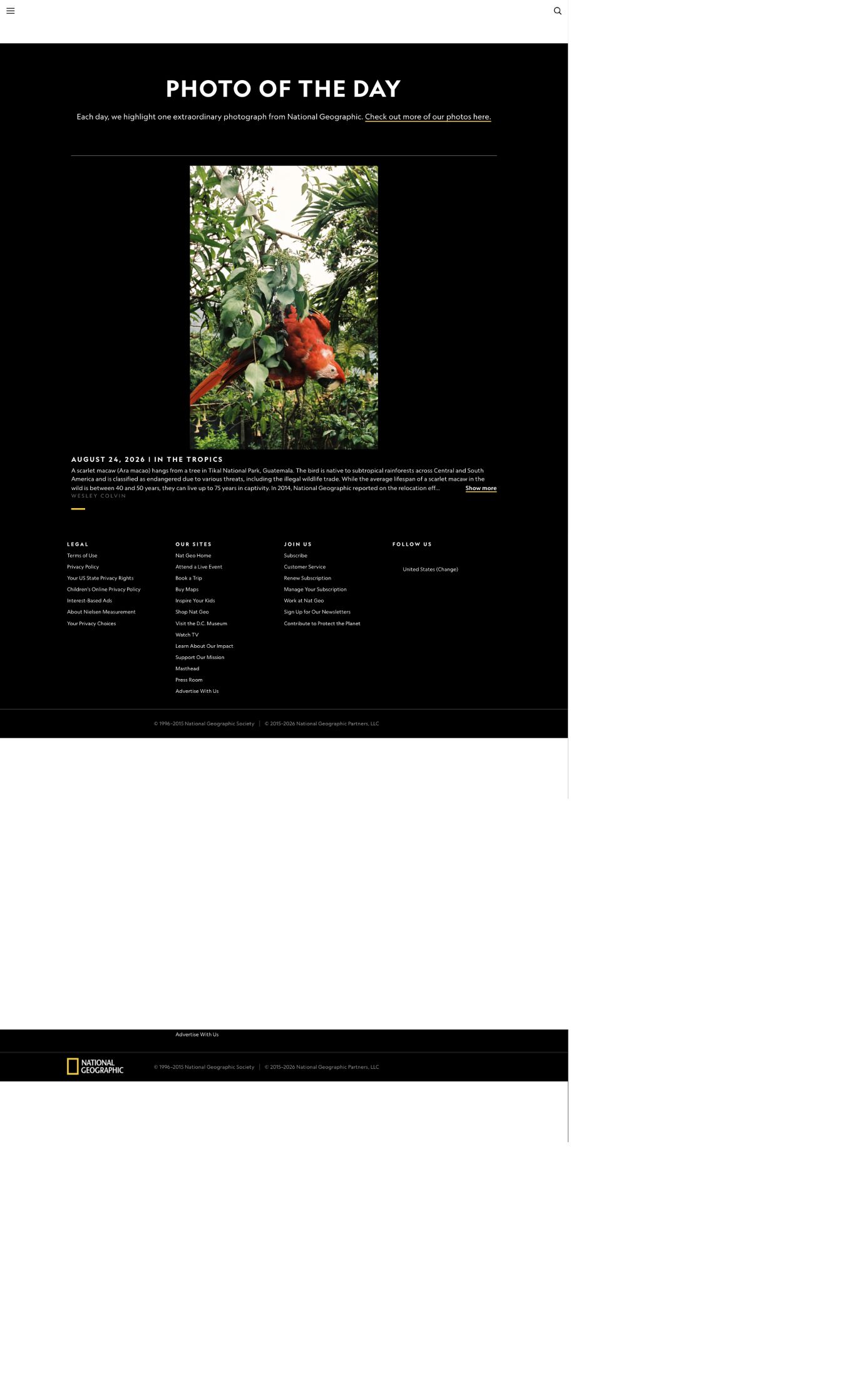
Screenshot: National Geographic Photo of the Day · Original page
National Geographic's Photo of the Day for August 24, US time, is titled "In the Tropics." The photographer is Wesley Colvin. The caption says only one thing about the scene: a scarlet macaw (Ara macao) hangs from a tree in Guatemala's Tikal National Park.
The photograph and image credits are listed on the Original page.
The bird carries a story that words can reveal more clearly than a photograph.
First, Two Kinds of Red
At a zoo, compare two red birds: a parrot and a flamingo.
The reds look alike. Their origins are entirely different.
Flamingos get their red from carotenoids, pigments animals cannot make for themselves and must obtain from food. Remove foods such as shrimp from a flamingo's diet and the bird fades toward white. Its color tells a simple story: you are what you eat.
Parrots get their red from pigments called psittacofulvins, which they synthesize themselves.
A 2024 paper in Science traced this distinction to the molecular level. Psittacofulvins are produced endogenously by parrots, whereas carotenoids must be acquired through food.
The paper also found the switch.
Psittacofulvins are linear polyenes with terminal aldehyde groups. In red feathers they occur mainly in aldehyde form; in yellow and green feathers they occur mainly as carboxylic acids. The enzyme that oxidizes the aldehyde into the carboxylic acid is ALDH3A2.
One enzyme turns red into yellow.
And green? Green is not a pigment. Blue is structural color, scattered by nanostructures inside the feather. Put yellow psittacofulvin over structural blue and the result is green.
The whole mechanism can be reduced to one sentence:
Every color in the parrot family, from scarlet to emerald, requires only two things: an enzyme and a nanostructure.
The bird in today's photograph displays all three stages at once: red aldehyde pigment, yellow carboxylic-acid pigment and structural blue. From shoulder to wingtip, it is a physical demonstration of the entire chain.
There is a bonus. A 2011 paper in Biology Letters found that colored feathers rich in psittacofulvins resisted a feather-degrading bacterium better than white feathers. The color is not only for other parrots to see. It is also a preservative coating.
National Geographic's Caption Has a Problem of Scale
The caption says that this bird is "listed as endangered."
That is not quite accurate, and the inaccuracy contains a useful lesson in conservation biology.
At the species level, Ara macao is listed as Least Concern on the IUCN Red List. BirdLife International assessed it in 2022 and estimated 50,000 to 499,000 mature individuals. A disclosure: the IUCN species page is a single-page application, and six different attempts produced only its loading frame. The listing was therefore cross-checked through three independent sources rather than read word for word on the official page.
At the subspecies level, the picture changes completely.
A final rule by the US Fish and Wildlife Service, effective March 28, 2019, listed the northern Central American subspecies, Ara macao cyanoptera, as Endangered, while listing two distinct population segments of the southern subspecies only as Threatened. A 2019 genetic study in Ibis analyzed mitochondrial DNA from 100 individuals. It found that Costa Rica's Central Mountain Range forms a major geographical barrier, dividing northern and southern lineages. The entire northern subspecies numbers only about 4,000 birds.
Tikal's birds belong to that northern lineage.
Three estimates describe their local numbers. The Wildlife Conservation Society puts the Maya Biosphere Reserve population at about 250. Guatemala's National Council for Protected Areas, CONAP, says only about 500 remain nationwide. A 2014 paper in The Condor cites 250 to 300.
The figures do not conflict; they use different boundaries. The honest range is 250 to 500, depending on whether one counts the reserve or the entire country.
So the caption should read this way: the same bird is secure at the species level and endangered at the subspecies or regional-population level. It is a particularly clear real-world example of the conservation unit.
Two more claims in the caption deserve qualification. First, it gives a wild lifespan of 40 to 50 years and a captive lifespan of 75. The AnAge longevity database's longest traceable captive record is only 33 years. The figures 40, 50 and 75 circulate widely but lack a traceable source. Wild lifespan is almost impossible to establish: nobody has yet finished marking a wild bird and following it for half a century. Second, the caption says National Geographic covered a macaw relocation in Mexico in 2014. Repeated searches of its site found no such 2014 article; the closest match was published on August 22, 2024, about the Lacandon Rainforest in Chiapas. The year may be a typographical error.
Its Fate Depends on an Old Tree with a Hollow
This is the article's second mechanism, and the more urgent one.
All parrots are secondary cavity nesters. They do not excavate their own holes and must use cavities that already exist.
Their requirements are demanding: a large tree, high above the ground, with a chamber half a meter to a meter deep and an entrance suited to the bird's size. Such hollows occur only in trees that have lived for more than a century and grown thick enough to decay from within. Nest trees recorded in Guatemala can reach 25 meters.
Those are precisely the trees loggers value most.
A 2014 paper in The Condor presents a revealing comparison. In 2010, researchers monitored 23 nests in Guatemala's Maya Biosphere Reserve and 20 in Belize's Chiquibul Forest.
In Guatemala, 22 of 23 nests were in a tree locally called Cantemo (Acacia glomerosa). Nest survival was 61 percent. Number poached: zero.
In Belize, 15 of 20 nests were in Schizolobium parahyba. Nest survival was 25 percent. Number poached: nine, or 45 percent.
The same species, the same year and two neighboring countries: that is the difference between guarded and unguarded nests.
Poaching requires no technical skill. Chicks are simply pulled out of the cavity. One can sell for 40,000 Guatemalan quetzals on the black market, more than US$5,000 at the exchange rate of the time. In Mexico, an estimated 100 birds are captured illegally each year, most of them chicks.
The Third Chick Destined to Starve
This may be the part of the story most worth telling a child.
A 2024 study in Diversity analyzed 37 nests across 19 breeding seasons, from 2000 through 2018, in southeastern Peru. It found a brutal pattern:
Of the third chicks to hatch, 91 percent starved. Of the fourth, 100 percent did.
The researchers tested several familiar explanations and ruled them out one by one.
It was not a shortage of food. It was not aggression among siblings.
It was the interval between hatching.
Second chicks that starved were 4.1 +/- 2.2 days younger than the first. Those that survived were only 2.7 +/- 1.1 days younger.
Just a few days made the difference. The older chick could already seize food while the younger one could barely open its mouth.
Guatemalan conservationists responded with a remarkably clean piece of logic: if the third chick would otherwise starve, remove it, raise it by hand, and release it into the forest when it is grown.
Locally the practice is called rescate del tercer pichon, the rescue of the third chick.
In 2024, 39 such macaws returned to the forests of Peten: 20 in two groups of ten released in August and September in Laguna del Tigre National Park, and 19 in Sierra del Lacandon National Park. Each carried a registered leg band and a microchip. That year conservation teams recorded 33 active nests. They have now monitored 23 consecutive breeding seasons since 2002 and regularly assess more than 80 natural and artificial cavities.
Field observations begun in 2000 became an operation that releases dozens of birds each year. That is a concrete answer to the question, "What is research for?"
The WCS says qualitatively that the program has increased the number of fledglings each year, but gives no percentage, so no claim that success rose from X to Y can be made.
Sixty-Two Percent of Its Food Is Unripe
A 2014 study in Biotropica recorded more than 1,400 feeding events among 16 parrot species in the western Amazon. For scarlet macaws, it logged 178 independent observations across 45 plant species.
Two figures stand out: seeds made up 57 percent of the diet, and 62 percent of food was immature, the highest share among all 16 species.
This is strategy, not fussiness. Unripe seeds have higher concentrations of plant secondary metabolites such as alkaloids and tannins, compounds poisonous to many animals. Macaws exploit a niche with almost no competitors.
How do they detoxify the food?
The most familiar explanation is that they eat clay to neutralize toxins. Parrots famously gather at clay cliffs in the Amazon. It is an elegant hypothesis.
The same paper tested it and found that it did not hold.
If clay detoxifies food, species eating more toxic foods should eat more clay. Yet the frequency of clay-lick use correlated neither with food maturity nor with the proportion of seeds in the diet.
The data instead support another explanation: sodium supplementation. The geographical evidence fits. Both clay licks and parrot species richness become more common farther from South America's east coast, the reverse of the gradient in marine sodium deposition. The interior is short of salt.
This scope matters: the research was done in southeastern Peru. The Peten lowlands around Tikal have no record of comparable large clay licks, so an Amazonian phenomenon should not simply be transferred there.
An attractive hypothesis corrected by evidence is science in its ordinary form.
It Also Blushes
An online claim says the fine feather lines on a macaw's bare white face differ among individuals like human fingerprints.
No primary or peer-reviewed source could be found to support it. The claim is not usable.
The real finding is better.
A 2018 study in PLoS ONE observed five hand-reared blue-and-yellow macaws. It recorded whether their crown, nape and cheek feathers were raised or sleek, as well as reddening of the bare skin around the eye.
When a keeper actively interacted with a bird, crown feathers rose significantly more often and observers rated the bird as blushing significantly more often. The authors proposed that these facial displays may provide a visible indicator of the birds' internal states.
The facial feathers rise like an expression, and the bare skin blushes. That has been tested in peer-reviewed research.
Tikal: A City in a Rainforest
The place in the photograph deserves its own account.
Tikal joined UNESCO's World Heritage List in 1979 as reference 64. It meets criteria (i), (iii), (iv), (ix) and (x). The first three are cultural criteria; the last two are natural.
It is therefore a mixed heritage site, recognized for both human construction and the ecosystem itself. Only a minority of the world's more than one thousand World Heritage properties share that designation.
The park covers 57,600 hectares, or 576 square kilometers. Its earliest settlers arrived around 800 BCE, and occupation during the historical period continued until about 900 CE. Dated inscriptions run from the late third century to the late ninth and record 33 rulers.
How many people lived there? A classic 1969 study in American Antiquity gave a conservative Late Classic estimate of 49,000. Contemporary syntheses put the mature Tikal kingdom's core supporting population between 45,000 and 62,000 across about 120 square kilometers.
That is the population of a small modern Chinese county seat, living in rainforest without livestock, wheels or metal tools.
Macaws were not minor figures in the Maya world. In the Popol Vuh, a great bird called Seven Macaw declares himself the sun and moon before the Hero Twins knock out his teeth and bring him down. Karl Taube's 1987 research identified the Principal Bird Deity in Classic-period imagery as a predecessor of that character.
The distinction matters: this does not mean "the Maya believed macaws were the sun." That would be an oversimplification. Taube did not identify the Principal Bird Deity unambiguously as a macaw and also considered the king vulture.
At Copan in Honduras, the final phase of the main ball court carried six tenoned stone macaw heads as court markers.
Feathers 2,300 Kilometers from Home
The next finding is the most startling.
At Chaco Canyon in New Mexico, archaeologists excavated the remains of roughly 30 scarlet macaws at Pueblo Bonito. Fourteen were concentrated in a single room, probably an aviary.
The species' natural range lay 1,700 to 2,300 kilometers away, across deserts and mountains.
A 2015 study in PNAS directly radiocarbon-dated 14 of the birds. Twelve predated Chaco's florescence around 1040 CE, and about half dated to the late 800s or middle 900s.
The long-distance exchange network was established before Chacoan society reached its height. It was not a product of prosperity but one of its preconditions.
Three years later, another PNAS paper used ancient genomics. Researchers sequenced mitochondrial DNA from 20 birds at Chaco Canyon and the contemporary Mimbres region. Fourteen yielded complete mitochondrial genomes of more than 16,000 base pairs, all dating from 900 to 1200 CE.
The result was unexpected. Every bird belonged to the same haplogroup, and 71 percent shared one of four haplotypes. Genetic diversity was so low that capture one by one from a wild population would have been statistically almost impossible.
The conclusion was that an as-yet-undiscovered pre-Hispanic breeding center existed outside the birds' natural range.
A thousand years ago, somewhere in North America, people bred these tropical parrots at scale. We know the place existed. We do not know where it was.
The distances were checked with the great-circle formula: about 2,320 kilometers from Chaco Canyon to Los Tuxtlas, Veracruz; about 1,704 kilometers to the species' historical northern limit in Mexico; and about 2,766 kilometers to Tikal.
Does It Help Plants or Harm Them?
For a long time, ecology textbooks treated parrots as seed predators. They crack seeds, consume the embryos and leave plants with a loss.
That consensus is changing.
A 2017 study in Scientific Reports followed three macaw species feeding on a large-seeded palm. Of 242 fruits removed, 204, or 84.3 percent, were successfully dispersed. Median dispersal distances ranged from 29 to 51 meters, and the farthest observed was 1,200 meters. The behavior was decisive: the birds consistently stripped away the pulp and dropped the undamaged seed. The authors called them legitimate, long-distance primary dispersers of large-seeded plants.
Another study, published in PeerJ in 2016, found intact seeds in the droppings of four among eleven Neotropical parrot species. Between 9 and 49 percent of droppings contained seeds, and one cactus's seeds retained viability as high as 92.7 percent.
Neither study included the scarlet macaw itself. No one has measured the question specifically for this species.
The accurate statement is narrower: close relatives in the same genus have been shown to be genuine seed dispersers, stripping pulp and dropping intact seeds as far as 1,200 meters away. Whether scarlet macaws do the same has not been measured directly.
That boundary is more useful than a vague assertion.
The Chinese Part of the Story
China has native wild parrots.
Under the national list of key protected wild animals jointly issued in 2021 by the National Forestry and Grassland Administration and the Ministry of Agriculture and Rural Affairs, China has nine nationally protected parrot species, all under Class II protection: the short-tailed parrot, blue-rumped parrot, Alexandrine parakeet, rose-ringed parakeet, slaty-headed parakeet, grey-headed parakeet, plum-headed parakeet, Derbyan parakeet and red-breasted parakeet.
The Derbyan parakeet is 37 to 50 centimeters long. According to the Chinese Academy of Sciences' biodiversity platform, it occurs below 4,000 meters in hills and mountains in southeastern Tibet, southwestern Sichuan, western Yunnan and northwestern Guangxi.
Its IUCN category is Near Threatened, one step worse than the scarlet macaw's global category.
The local version of a distant conservation story lives in Yunnan's mountains.
Another comparison is more powerful than a lecture.
Guangzhou once had wild rose-ringed parakeets. According to an official release on the Guangzhou Municipal Government's website, there had been no wild record in the city since 1980, a gap of 44 years. The stated reason was direct: their beauty and ornamental value led to illegal capture.
Around 2021, people introduced more than twenty captive rose-ringed parakeets to Haizhu Wetland for rewilding. The birds underwent one year of acclimatization and became broadly established over the next two.
This was an organized release, not an escaped feral population and not a natural return. The popular claim that some Chinese cities support feral populations descended from escaped parrots lacks a reliable primary record and is not repeated here.
On one side, someone pulls chicks from a tree hollow. On the other, someone places birds back in the wild. The two acts happen on the same planet, 15,000 kilometers apart.
One practical point remains. Many people finish stories like this wanting a parrot. The rules come first.
The National Forestry and Grassland Administration's 2021 reply on captive-bred parrots, Lin Hu Fa [2021] No. 29, created two groups. Peach-faced lovebirds, budgerigars and cockatiels require no special permit. Fischer's lovebirds, purple-bellied lories, green-cheeked conures and monk parakeets entered a special-identification-mark pilot program and may be sold and transported with those marks.
But later guidance cards issued by local forestry departments do not have identical scopes; some lists also include species such as African grey parrots and blue-and-yellow macaws. Policy is changing, and implementation varies by locality. Anyone considering a bird should rely on the latest National Forestry and Grassland Administration announcement and an answer from the local forestry authority, not on any popular-science article, including this one.
As for the bird in today's photograph, the scarlet macaw is in Appendix I of the Convention on International Trade in Endangered Species of Wild Fauna and Flora. In principle, all commercial international trade is prohibited.
Sources
National Geographic Photo of the Day, August 24, 2026, "In the Tropics"; UNESCO World Heritage Centre, Tikal, Ref. 64; the US Fish and Wildlife Service's 2019 final rule in the Federal Register; Guatemala's CONAP; Wildlife Conservation Society projects in Guatemala and the Five Great Forests; Arbore et al., "A Molecular Mechanism for Bright Color Variation in Parrots" (Science, 2024); Vigo-Trauco et al. (Diversity, 2024); Britt, Garcia Anleu and Desmond (The Condor, 2014); Lee et al. (Biotropica, 2014); Renton et al. (Journal of Ornithology, 2015); Banos-Villalba et al. (Scientific Reports, 2017); Blanco et al. (PeerJ, 2016); Watson et al. (PNAS, 2015); George et al. (PNAS, 2018); Bertin et al. (PLoS ONE, 2018); Burtt et al. (Biology Letters, 2011); Schmidt et al. (Ibis, 2019); Haviland (American Antiquity, 1969); Webster, The Population of Tikal (2018); Taube (1987); the AnAge longevity database; the University of Bristol School of Chemistry; China's National Forestry and Grassland Administration, 2021 Announcement No. 3 and Lin Hu Fa [2021] No. 29; the Chinese Academy of Sciences biodiversity platform; the Guangzhou Municipal Government website; and Guatemala's Ministry of Culture and Sports.
Image: National Geographic Photo of the Day · "In the Tropics" · Photograph by Wesley Colvin, Nat Geo Image Collection · Original page