
The "blanks" on the map are often just places no one has bothered to count.
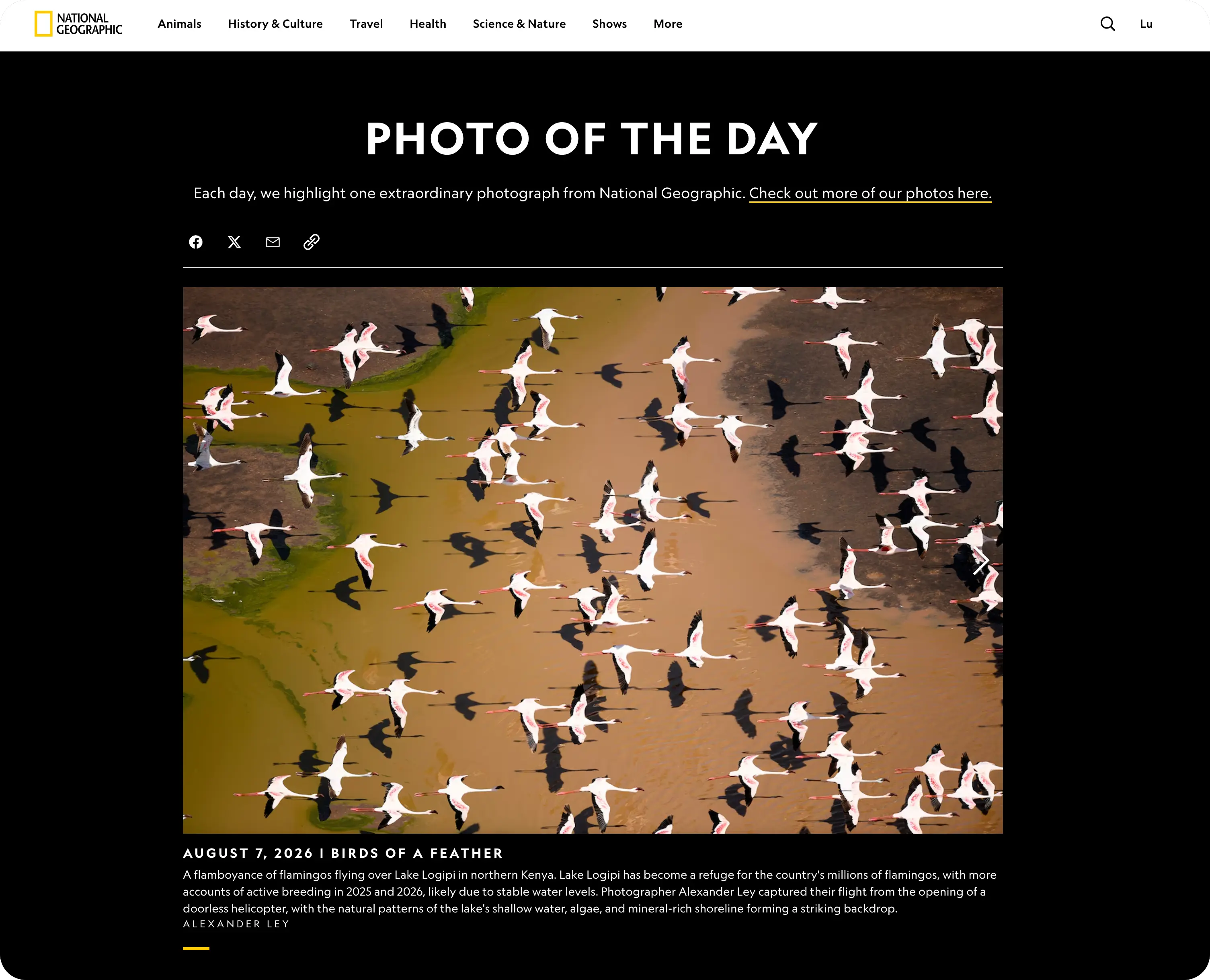
Image: Nat Geo Photo of the Day · Photography by Alexander Ley · View the original on the National Geographic website
The helicopter had its door removed. Photographer Alexander Ley leaned out through the open hatch; directly below was a shallow expanse of brownish-green water with a few strokes of pink drifting across it—not paint, but a flock of flamingos in flight. According to National Geographic's caption, the shallow water, algae, and mineral-rich lakeshore laid a natural backdrop beneath the birds.
A vocabulary note in passing. English has a dedicated collective noun for a group of flamingos: a flamboyance—roughly meaning "showiness." Today's flock lives up to the word—and the extent to which it lives up to it wasn't known to anyone until just over a year ago.
Where this is: an unwatched "hot pot"
The photo was taken at Lake Logipi, at the far northern end of Kenya's Suguta Valley, south of Lake Turkana.
It is a saline-alkaline lake, roughly 6 kilometers long by 3 kilometers wide, no more than three to five meters at its deepest. Its northern end is sealed off by the Barrier volcanic complex—a cluster of young volcanoes whose last eruptions date to the late 19th and early 20th centuries. In the middle of the lake stands a rocky island about 370 meters high, formally named Naperito but commonly called "Cathedral Rock." Hot saline springs well up from the island and along the northern shore; in drought years, these springs are all that keeps the lake alive.
The Suguta Valley is one of Kenya's hottest and most inaccessible corners, and decades of security concerns meant no systematic scientific survey had been conducted there in over 50 years. In most people's minds, it was effectively a "blank."
December 2024: counting a "pink city"
The 2024 long rains were abnormally heavy. Ephemeral pools formed in the valley and an algal bloom erupted in the lake—for lesser flamingos, that's the dinner bell. By December, the surface of Lake Logipi had become a "pink city" visible from high altitude.
A joint team led by Dr. Richard Lamprey—conservation organization Conserve Global, together with Kenya's Wildlife Research and Training Institute (WRTI) and the National Museums of Kenya (NMK)—seized the moment to carry out the lake's first-ever systematic aerial census: flying at 1,400 feet (about 430 meters), they captured 3,000 high-resolution photographs.
How do you count more than 700,000 birds? First, stitching software assembled the 3,000 photos into a single mosaic; then the image-analysis program ImageJ automatically counted the pink dots against the brownish-green water, with manual spot-checks for validation. How do you tell greater flamingos from lesser flamingos? By "pixel size"—greater flamingos occupy more pixels in the photos. Using pixel dimensions to distinguish species was a first in aerial census methodology.
The result: approximately 737,000 lesser flamingos (range: 577,000 to 897,000), equivalent to 30–50 percent of the entire East African lesser flamingo population and the largest single aggregation recorded in Kenya in nearly 20 years. The main flock stretched 9 kilometers long and 500 meters wide—drop it into a city and it would span roughly seven or eight subway stops. The count also turned up 1,196 greater flamingos and 27,790 pelicans.
Kenyan ornithologist Fleur Ng'weno summed it up in a single line: "Nearly a million lost flamingos have been found."
Why alkaline water is paradise: a moat made of "poison"
To understand this photograph, you first have to answer one question: why do so many birds crowd into water that can burn skin?
The soda lakes of the East African Rift sit in volcanic soils and are relentlessly concentrated by evaporation under a fierce sun. Their waters are intensely alkaline, with pH levels reaching 10 or above—by some reports, prolonged contact with water like Lake Natron's can indeed scald skin. The vast majority of plants and animals simply cannot enter. So a cyanobacterium—genus Arthrospira, commonly known as spirulina—has the lake almost entirely to itself, proliferating unchecked.
And the lesser flamingo (the smallest of the world's six flamingo species) happens to be the only creature fully equipped to harvest it: a pair of tough, alkali-resistant long legs; a feeding posture with the entire head inverted and submerged, the tongue pumping like a tiny piston, while fine comb-like lamellae along the bill's edges filter out the algae. Their pink color is also eaten into existence—carotenoids in the algae gradually deposit in the feathers.
One sentence captures the whole business model: The more "toxic" the water, the safer their granary. The alkaline water blocks competitors and predators alike—effectively building a moat for the flamingos.
The twist: water turning "better" is actually bad news
Now for the real suspense behind this photograph.
In recent years, rainfall in East Africa has increased and water levels across the Rift Valley lakes have been rising steadily. For flamingos, this is a slow-motion disaster: more water dilutes the alkalinity, algal productivity drops—and traditional feeding strongholds like Bogoria, Nakuru, and Elmenteita are becoming inhospitable.
The breeding situation is even more precarious. For decades, East Africa's lesser flamingos have successfully nested in essentially one place: Tanzania's Lake Natron—reportedly the birthplace of roughly three-quarters of the world's lesser flamingos. Yet rising water has at times flooded that nesting flat, and proposals for soda-ash mining have hung over the lake for years. For this species, listed as Near Threatened by the IUCN, the fatal vulnerability is that its eggs have long been kept in a single basket.
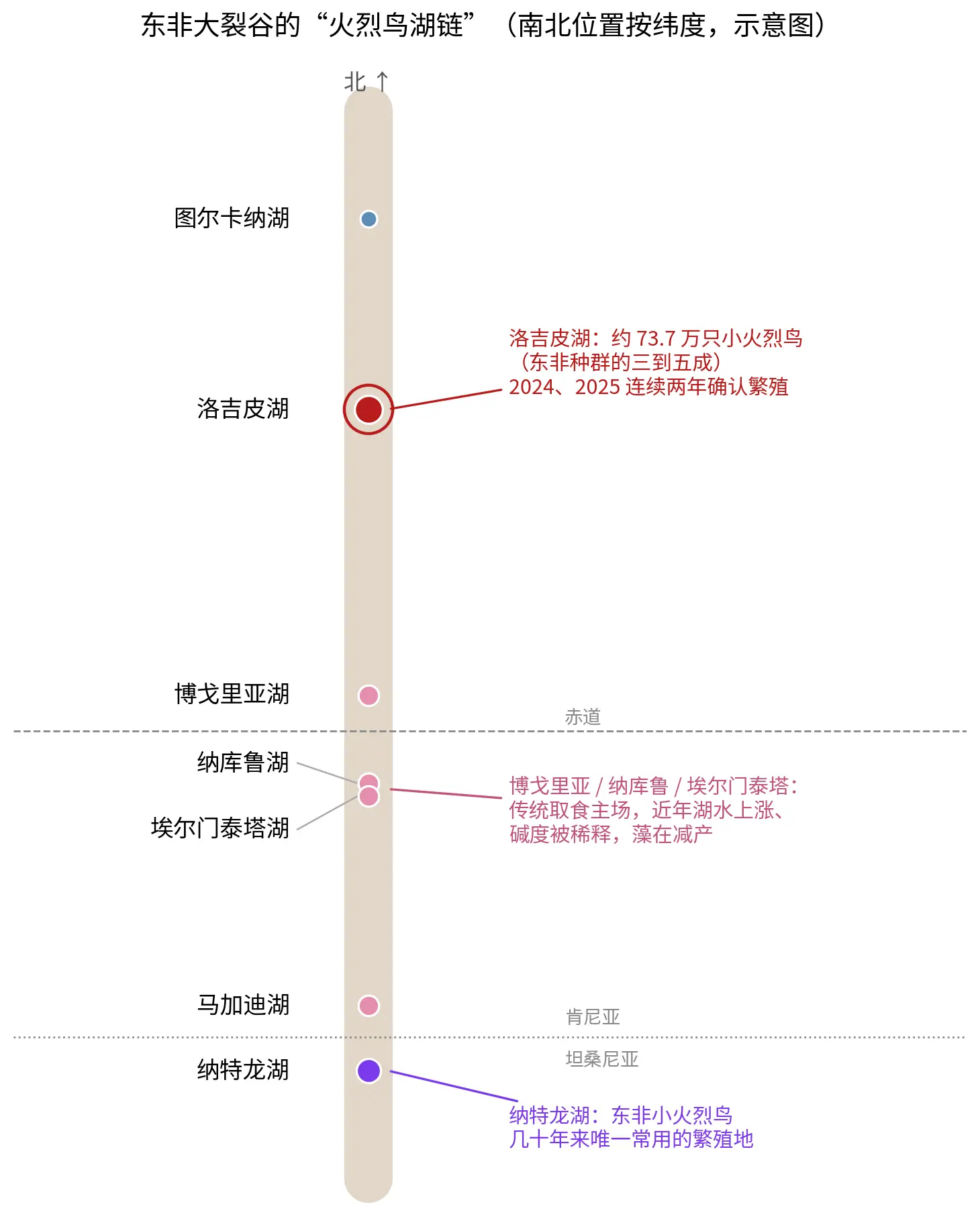
This is the weight behind that line in National Geographic's caption about conditions "likely thanks to stable water levels": while water elsewhere keeps rising, Logipi's levels over the past two years have happened to stabilize at exactly the recipe flamingos need. And so, in both 2024 and 2025, observers confirmed successful breeding here in consecutive years.
For the first time, the eggs have a visible second basket.
Counted, therefore existing
This census was not an isolated piece of fieldwork; it is part of a larger project. Conserve Global and the local Turkana community organization ISVD (Initiative for Suguta Valley Development) jointly launched a village-development-plus-conservation project in late 2023. Over two-plus years, they drilled wells and installed solar-powered water pumps and storage tanks in three villages, sponsored over 190 students' schooling, and employed 24 local community members—among them field monitors responsible for recording wildlife, environmental threats, and human–wildlife conflicts. The project also conducts peace mediation between neighboring communities.
The accompanying biodiversity surveys are the first in this valley since the 1960s and '70s. Beyond flamingos, they also discovered a previously unrecorded breeding colony of the critically endangered Rüppell's vulture. The team is now pushing to have Lake Logipi and the entire Suguta Valley designated as an internationally recognized protected area—a Key Biodiversity Area, and potentially a World Heritage Site.
There's a simple truth buried here: on conservation's ledger, what hasn't been counted might as well not exist. For half a century, this lake didn't lack flamingos—it lacked someone to count them. The value of this photograph is half beauty, half arithmetic.
The photographer
Alexander Ley is a wildlife photographer. According to the homepage he shares with Burkhard Ley, their lenses have traveled to over 50 countries. This shot was taken looking straight down from a helicopter with its door removed—at Logipi, that is virtually the only way to frame the scene. The lake has no road access; it belongs to helicopters, camel caravans, and scientists.
Flamingo feed in your local store
One last thing—something you can do today.
Next time you pass the supplement shelf at a supermarket or pharmacy, look for that jar of green powder—spirulina. It is a cyanobacterium of the genus Arthrospira, the very same genus that lesser flamingos filter from alkaline lakes. That spoonful of green powder you stir into your glass is the same type of stuff that dyes over 700,000 birds pink. (Don't worry—the amount of carotenoids in a human-sized serving is nowhere near enough to turn you pink.)
As for anyone who wants to see the pink army in person: Kenya's Lake Bogoria National Reserve remains the most reliable window—you can rent a car and drive to the lakeshore. Forget self-driving to Logipi—it is a lake you visit by helicopter, and that, as it happens, is precisely why it kept its secret for 50 years.
Sources: Nat Geo Photo of the Day: Birds of a Feather, Africa Geographic: Nearly a million flamingos found in Kenya's Lake Logipi, Atlas Obscura: Photographing East Africa's soda-lake flamingos from the air, Natural History Museum WPY: Lake Illusion (rising water floods nesting flat), Kenya Geographic: Lake Logipi, Malindi Kenya: Lake Logipi and Cathedral Rock, The Safari Collection: A flamboyance of flamingos, Animal Diversity Web: Lesser flamingo, Lake Nakuru: Mapping the flamingo lakes of East Africa, Rufford Foundation: Lesser flamingo tracking project at Lake Natron