
The softest kind of publicity photograph: fans posing with an astronaut beside a football field. Yet the most interesting object in the frame has just returned from the Moon.
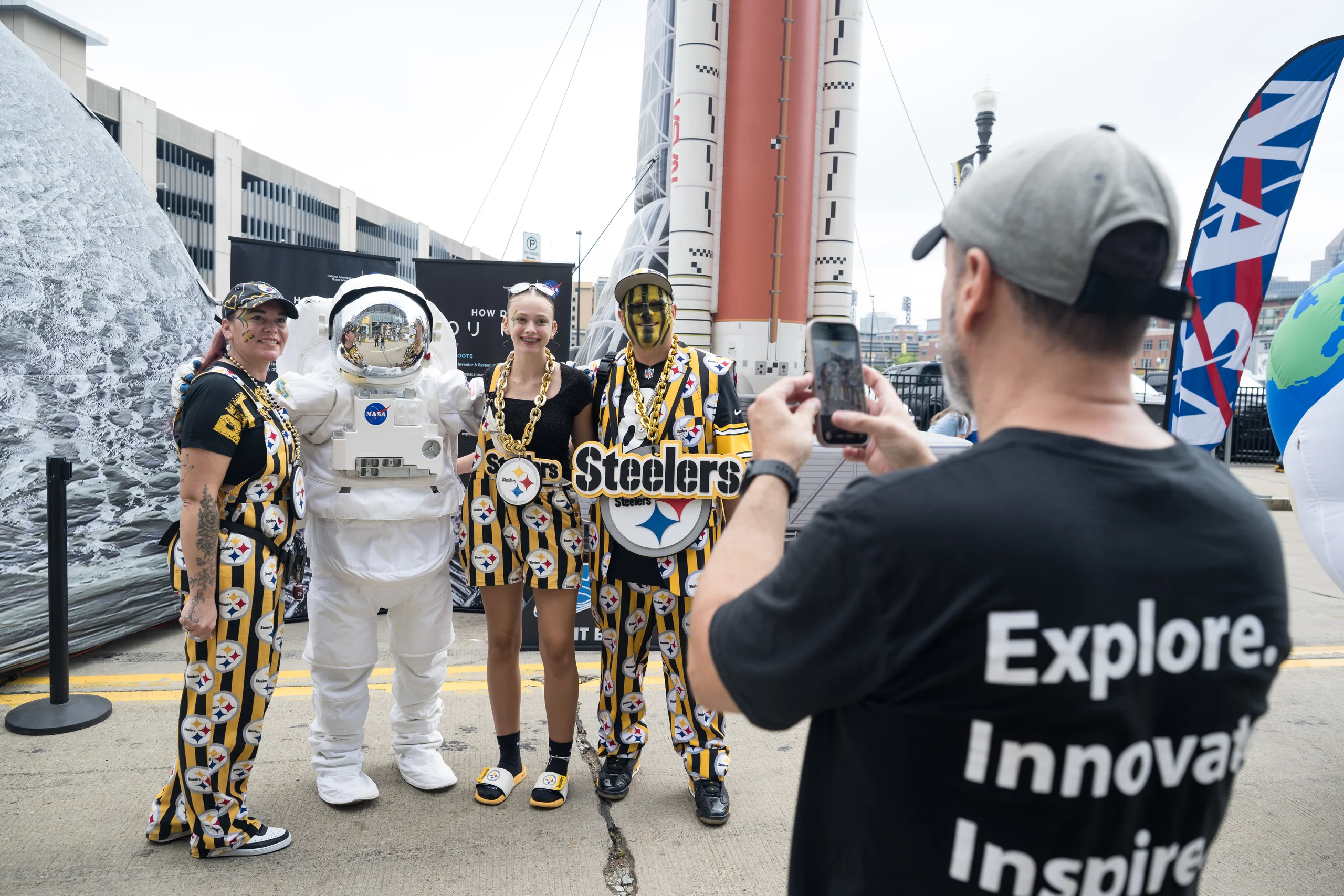
Image: NASA Image of the Day | Image credit: NASA/Aubrey Gemignani | Image page: nasa.gov
Sunday, September 13, 2026, at Acrisure Stadium in Pittsburgh, Pennsylvania. The Pittsburgh Steelers were playing the Atlanta Falcons on the first weekend of the new NFL season.
In NASA's experience zone beside the field, several fans posed with an astronaut. NASA selected the photograph as its Image of the Day for Monday.
It is an exceedingly gentle photograph, the sort you might almost scroll past.
But the little object beside them has just returned from the Moon.
The Plush Toy Was Designed by a Third Grader
One caption in NASA's official set describes a young fan holding an astronaut's hand beside Rise, the zero-gravity indicator for the Artemis II mission.
A zero-gravity indicator is a small tradition aboard crewed spacecraft. A lightweight object hangs in the cabin, and when the rocket reaches orbit and weightlessness begins, it floats. More directly than any instrument, it tells everyone: we have arrived.
Artemis II's indicator is named Rise.
The design was chosen from more than 2,600 entries submitted by elementary and secondary school students in more than 50 countries. Its creator was Lucas Ye, a third-grade student from Mountain View, California. Rise is a round white plush face wearing an Earth-colored hat whose brim carries galaxies, stars and rockets. Lucas said the famous Earthrise photograph from Apollo 8 inspired him.
Commander Reid Wiseman introduced it at Kennedy Space Center on March 27, 2026. Inside Rise is an SD card holding 5,647,889 names submitted through the "Send Your Name with Artemis" campaign.
Then it went aboard the rocket.
Artemis II launched at 6:35 p.m. EDT on April 1, 2026, and splashed down in the Pacific Ocean off San Diego on April 10 after 9 days, 1 hour and 32 minutes. Its four crew members were Commander Reid Wiseman, Pilot Victor Glover, Mission Specialist Christina Koch and Canadian Space Agency astronaut Jeremy Hansen.
Several official figures deserve to be remembered. At closest approach on April 6, the spacecraft passed about 6,545 kilometers above the lunar surface. Its maximum distance from Earth was 406,771 kilometers, exceeding Apollo 13's 56-year-old crewed-distance record by about 6,600 kilometers. The total journey covered about 1.119 million kilometers.
One line from NASA's official release is especially good: "Fifty-three years ago, humanity left the Moon. This time, we're going back to stay." From Apollo 17's departure on December 14, 1972, to Artemis II's lunar flyby was exactly 53 years and 113 days.
The plush toy standing in a stadium exhibit while children hold its hand really did fly around the Moon and come back. A smiling face drawn by a third grader carried more than 5.6 million names to the Moon. Now it stands on a football field for other children to touch.
The same exhibit also displayed a Moon rock and a stand about the X-59 supersonic research aircraft.
(One honest note: in the 51 official photographs NASA took at this event, the agency identifies its administrator, flight directors, team owner and Hall of Fame player by name. It consistently calls this person only "an astronaut." NASA does not say who the astronaut is, so neither will we.)
NASA Flew Over an NFL Stadium for the First Time
The event is called the Inspiration Tour. A NASA release issued on September 10 said the tour would bring flyovers, astronaut appearances and fan interactions to NFL stadiums around the United States. Five stops had been announced: Pittsburgh on September 13, Baltimore on September 20, Cleveland on September 27, Philadelphia on October 4 and East Rutherford on October 11, with more dates possible. It concludes with an aerospace expo at Kennedy Space Center on November 7 and 8, organized for the 250th anniversary of the United States.
One easily confused fact is worth separating out.
The low-altitude military flyovers before football games have traditionally been performed by the U.S. Air Force and Navy. At Super Bowl LX in February, two Air Force B-1Bs, two F-15Cs, two Navy F/A-18Es and two F-35Cs flew overhead. NASA was not involved.
The September 13 event in Pittsburgh was different. NASA's own caption explicitly describes the administrator watching two NASA T-38 training jets complete the flyover. It names the crews as pilots Brett Pugsley and Chris Condon, with Geoff Palmer as copilot.
The T-38 is the jet used to train astronauts. This was the first time NASA itself performed such a flyover at an NFL game.
NASA has interacted with sporting events before. In 2010, the STS-129 crew brought a silver commemorative coin that had flown aboard the space shuttle to the Pro Football Hall of Fame in Canton, Ohio. The NFL used it for the opening coin toss at that year's Super Bowl. One member of that crew, Leland Melvin, had been drafted by the Detroit Lions in 1986. The International Space Station passed over the Super Bowl in 2016 and 2021, and astronauts aboard the station recorded a greeting for fans in 2017.
This City Was Already Building Moon Rovers
NASA brought an astronaut and a Moon rock all the way to Pittsburgh to interest children in the Moon.
Pittsburgh hardly needed outside help.
Astrobotic Technology is headquartered at 1016 North Lincoln Avenue in Pittsburgh. Founded in 2007 by Carnegie Mellon University Robotics Institute alumnus William "Red" Whittaker, the company grew directly out of CMU. The immediate catalyst came that autumn: the Google Lunar X Prize offered $20 million to anyone who could land a robot on the Moon, drive it 500 meters and return images to Earth.
In 2018, Astrobotic joined NASA's Commercial Lunar Payload Services, or CLPS, vendor pool and received two task orders. Its first lander was Peregrine.
Peregrine launched before dawn on January 8, 2024, aboard the first ULA Vulcan rocket. It carried 20 payloads.
It did not land.
Public statements described a propulsion-system problem. Astrobotic's post-mission report, released in August 2024, was more specific: pressure control valve 2 lost its ability to seal, most likely because a threaded part inside the valve loosened under vibration. Helium flooded the oxidizer tank until the tank ruptured.
A threaded part in one valve came slightly loose in the rocket's vibration. The Moon was suddenly out of reach.
Peregrine survived in space for 10 days and 14 hours, then made a controlled reentry over the South Pacific on January 18. It was not a complete loss. Four of NASA's five payloads powered on successfully and measured natural radiation and chemical compounds around the lander.
There was also a tiny rover aboard.
Iris weighed 2.2 kilograms, was about the size of a shoebox, had a carbon-fiber chassis and wheels like bottle caps. Carnegie Mellon built it with contributions from roughly 300 students across seven colleges. Its main circuit board carried the names of dozens of participating engineers. Red Whittaker was again the adviser.
Before launch, the university described it as the first student-led rover intended for the Moon. The title never became reality because Peregrine never landed.
But Iris accomplished other things. It established two-way communication in space, and students read its system status from hundreds of thousands of kilometers away. It transmitted a real-time message of only two words: "Hello, Earth!"
Then it burned up with the rest of the spacecraft over the South Pacific.
MoonArk was aboard too: a ten-ounce cylinder of titanium, platinum and sapphire containing images, poetry, music and samples from Earth. Eighteen universities, 60 team members and more than 250 artists and professionals helped create what was meant to be "the first museum on the Moon." It burned up as well.
Two often-misreported points also need clarification. In 2024, NASA canceled the plan for Astrobotic's second lander, Griffin, to carry the VIPER lunar rover. But VIPER was not dismantled. In September 2025, NASA assigned it to Blue Origin, with a plan to deliver it to the lunar south pole aboard the second Blue Moon MK1 by the end of 2027. Griffin's contract also remains active. It is now intended to fly to Nobile Crater near the lunar south pole carrying Astrolab's FLIP rover and more than 1,100 pounds of cargo. Canceling VIPER's original delivery did not destroy VIPER; losing VIPER did not cancel Griffin. Both survive, with new partners.
Pittsburgh's Robots Began With Places People Could Not Enter
Red Whittaker's career tells the story.
Terregator, built in 1983, was an early mobile robot for autonomous outdoor navigation. Ambler, from 1987, was a walking robot designed for Mars. Dante I and Dante II entered volcanic craters in 1992 and 1994, deployed in Antarctica and Alaska. Nomad completed long overland tests in Chile's Atacama Desert in 1996 and was later sent to Antarctica to search for meteorites.
Another robot had no name: a remotely controlled reconnaissance vehicle sent into the damaged reactor after the Three Mile Island nuclear accident.
A city known for steel began its robot-building tradition with places people could not enter. A reactor, volcanic craters, the Antarctic ice sheet - the Moon is simply the most distant item on that list.
Another Approach: Move the Classroom 400 Kilometers Up
China chose a very different way to pursue the same aim of making children look up.
Official releases from the China Manned Space Agency record four Tiangong Classroom lessons from the Chinese space station. The first, on December 9, 2021, and second, on March 23, 2022, were taught by the Shenzhou 13 crew. The third, on October 12, 2022, came from Shenzhou 14. The fourth began at 3:48 p.m. on September 21, 2023, when Shenzhou 16 crew members Jing Haipeng, Zhu Yangzhu and Gui Haichao taught from the Mengtian laboratory module, the first Chinese astronaut lesson held there. They demonstrated four experiments: a spherical flame, a curious "table tennis ball," conservation of momentum and a gyroscope. Ground classrooms in Beijing, Alxa League in Inner Mongolia, Yan'an in Shaanxi, Tongcheng in Anhui and Ningbo in Zhejiang hosted about 2,800 students.
The earlier origin came on June 20, 2013. Wang Yaping taught China's first space lesson from Tiangong-1 for primary and secondary students across the country, assisted by Nie Haisheng and Zhang Xiaoguang. It ran from 10:04 to 10:52 a.m.
NASA brings an astronaut into a stadium so children can take a picture with them. China moves the classroom into orbit 400 kilometers up so astronauts can teach 2,800 children in five places on the ground. One goes toward the crowd; the other goes upward.
There is one more coincidence. Among the 25 finalist designs for the Artemis II zero-gravity indicator was an entry from a Canadian school called "Lepus the Moon Rabbit." A rabbit nearly made the trip around the Moon.
The rover that actually drove on the far side of the Moon is named Yutu-2, or Jade Rabbit 2.
A Final Word About the Photographer
The photograph is credited to NASA/Aubrey Gemignani. She is a photographer and photo archivist at NASA Headquarters.
Nine years ago, on August 21, 2017, she also took the famous photograph of the total solar eclipse over Madras, Oregon.
In a NASA profile, she said: "I feel like I'm always looking for projects that help people be seen. Maybe that's why I fell in love with photography in the first place - I often feel unseen myself."
In 2017, she photographed the moment when the Moon completely hid the Sun.
In 2026, beside a football field, she photographed a child holding the hand of a plush toy that had been to the Moon.
Sources: NASA Image of the Day and the official NASA image library at nasa.gov and images-api.nasa.gov; NASA release 26-073; NASA's Artemis II mission page and return release; NASA Scientific Visualization Studio and the March 27, 2026, official blog post about Rise; the U.S. Air Force release about the Super Bowl LX flyover; NASA Johnson Space Center's January 4, 2026, release; Astrobotic's website and the August 2024 Peregrine Mission One report; NASA's CLPS and Griffin mission pages; NASA releases dated July 17, 2024, and September 19, 2025, about VIPER; Carnegie Mellon University's Iris rover and Robotics Institute pages; NASA's Apollo 17 mission page; official Tiangong Classroom releases from the China Manned Space Agency; the Ministry of Science and Technology of the People's Republic of China's January 4, 2019, Chang'e 4 release; Xinhua's June 25, 2024, report on the Chang'e 6 return; NASA's Daily Moon Guide; and NASA's profile "Photo Archivist / Photographer Aubrey Gemignani."