
No anniversary, no awareness day. This picture is here simply because of the butterfly itself - and there is not a speck of blue pigment on it.
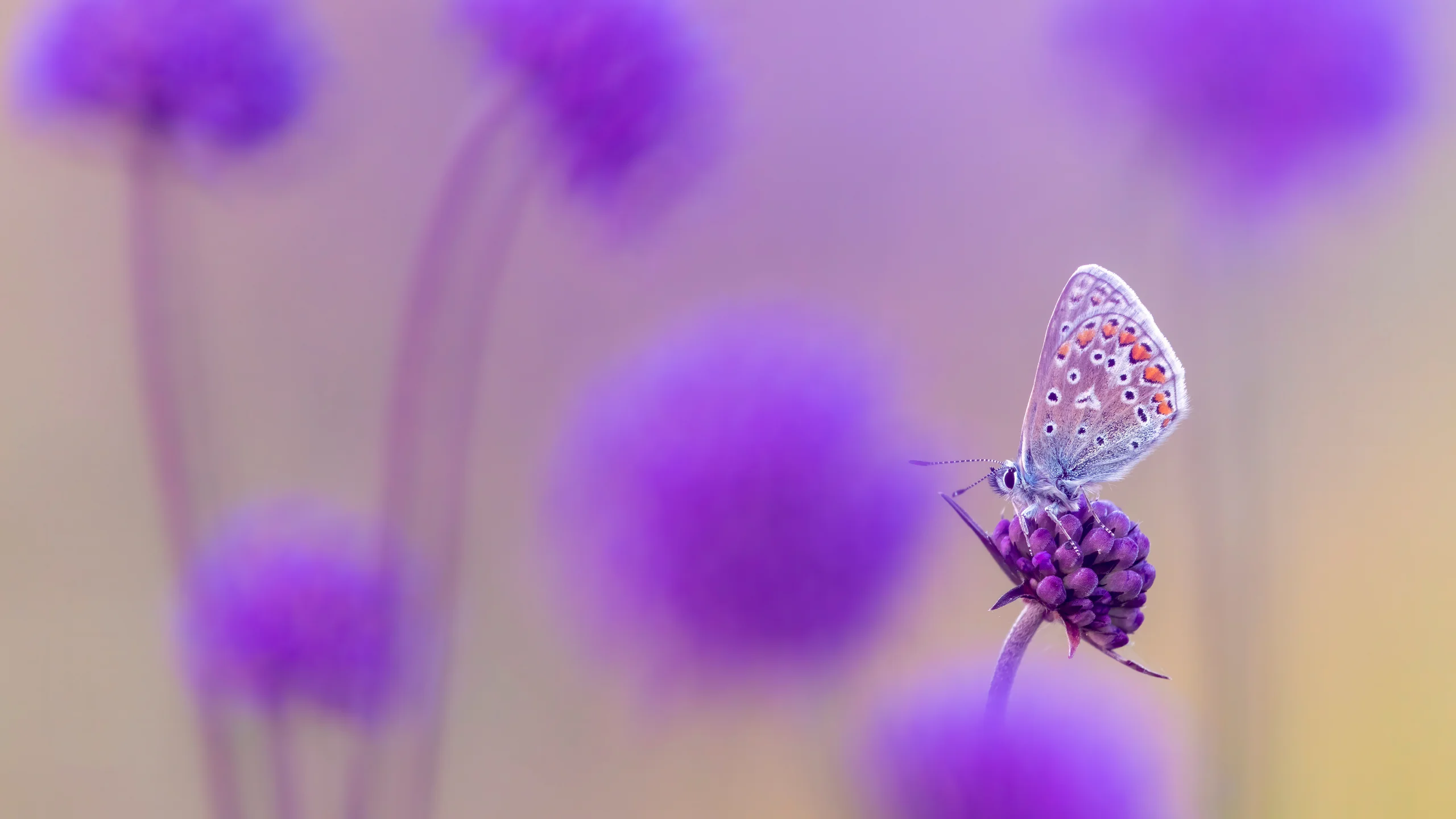
Image: Bing Wallpaper · Common blue butterfly, Devon, England (© Ross Hoddinott/Nature Picture Library) · View the original Bing image

Open Bing's Chinese homepage today and a blue butterfly is waiting. The accompanying title is only six Chinese characters long: "Sky-blue wings."
The caption is just as suspiciously brief: common blue butterfly, Devon, England, photographed by Ross Hoddinott. Follow its related link and the search term is simply "common blue butterfly." There is no anniversary, international observance, or institutional milestone. Bing has not tried to invent a reason for today.
So take the picture on its own terms. The butterfly is reason enough. Its blue is among the most difficult colors for nature to produce, and it achieves it without pigment.
First, We Cannot Tell Whether It Is Male or Female
Bing's caption gives only species and location, not sex. Males and females look strikingly different, so there is no reason to guess from this photograph.
Both forms are worth knowing.
Butterfly Conservation calls the common blue the most widespread blue butterfly in Britain and Ireland. Males are bright blue throughout, conspicuous and active: exactly what most people picture when they hear "blue butterfly." Females are more subdued, usually brown with a row of orange-red crescents along the hindwing margins and deep violet-blue near the wing bases.
Female coloration also carries a geographical accent. The same species page says females range from "almost entirely brown" in southern England to "predominantly blue" in western Ireland and Scotland. Individuals within a small population can also differ greatly. Two butterflies, one blue and one brown, may well be the same species: one male, one female.
Identification depends less on the blue upper surface than on the underside. First Nature gives two practical marks: a row of orange spots near the outer margin and an extra round dark spot on the forewing, about 5 millimeters from the body, which helps distinguish the common blue from other blue butterflies. Butterfly Conservation adds another: the white fringe around the wing edge is not crossed by dark veins.
The species also has several Chinese names. Bing uses putong lan huidie, "common blue gray butterfly"; Chinese Wikipedia titles its article pulan yan huidie. Its scientific name is Polyommatus icarus.
There Is No Blue Pigment on It
Now for the difficult fact to believe.
An article from London's Natural History Museum about blue in nature opens with the paradox: blue seems to be everywhere, yet it is one of the hardest colors for nature to make with pigment. Fewer than one in ten flowering plants produces blue flowers. True blue pigments are even rarer in animals. Blue-footed boobies obtain the blue of their feet from fish in their diet; lobsters and starfish need a combination of pigment and protein to appear blue.
Birds and butterflies take another route. The museum article names two examples: the hyacinth macaw and today's common blue.
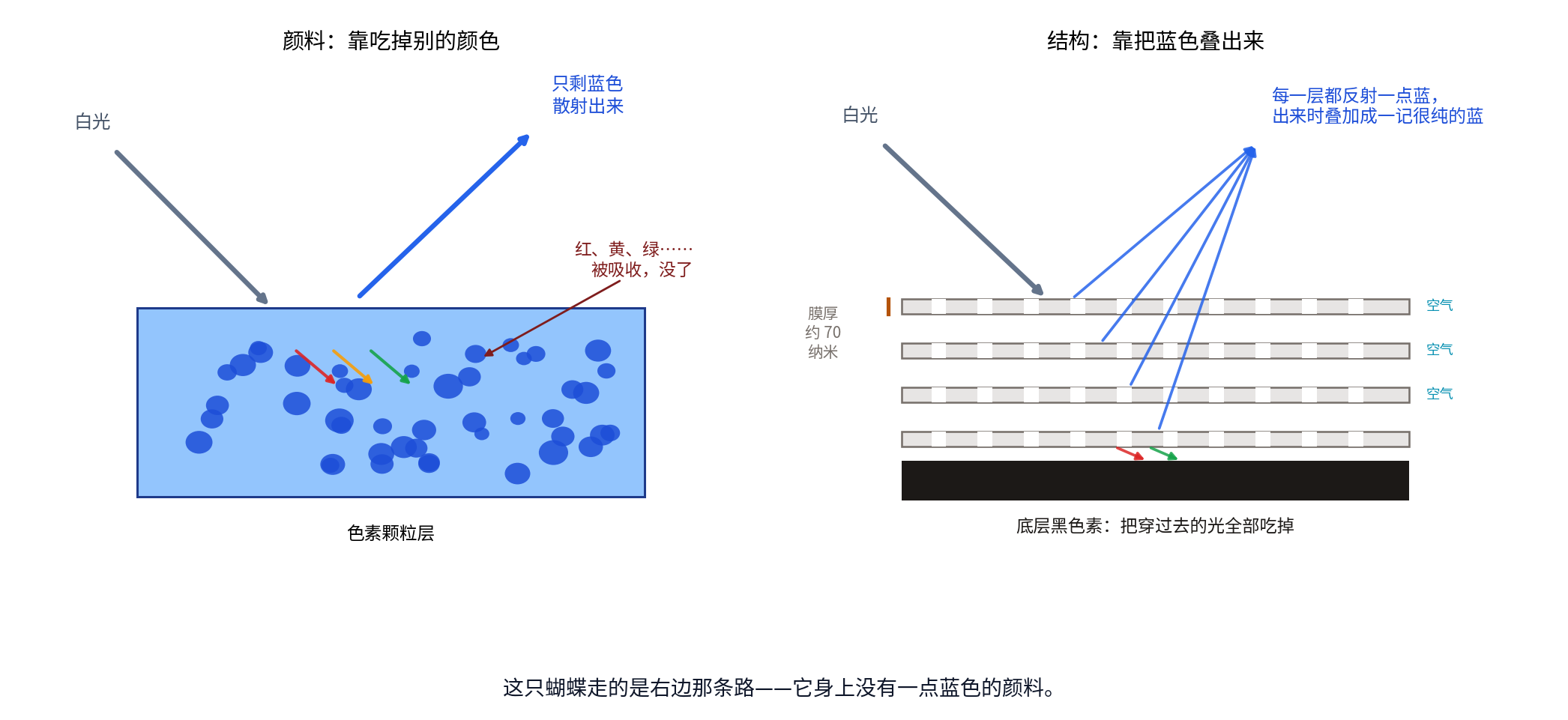
They use structural color. Pigment produces color by absorption, taking away unwanted wavelengths so that the remainder reaches the eye. Structural color works by reflection. Layers only tens of nanometers thick make particular wavelengths reinforce one another between surfaces and bounce back together. The rainbow on a soap bubble, an oil film on wet asphalt, or the back of a compact disc works by the same principle. None contains rainbow pigment.
A team at the Hungarian Academy of Sciences cut into the butterfly's wings to inspect the mechanism. A 2021 Scientific Reports paper by Piszter, Kertész, Bálint, and colleagues described the scales on the upper surface of male wings as a "pepper-pot" nanostructure: perforated chitin membranes stacked in layers, with mostly air between them and only scattered pillars holding them apart. That sequence of thin film, air, and thin film selects blue light.
How precise is it? In modeling reported by the same paper, thickening each chitin-rich layer from 67.5 to 97.5 nanometers - a change of 30 nanometers, less than one two-thousandth the diameter of a human hair - shifted the reflected color by a full 28 nanometers. The growing butterfly constructs its wings to that tolerance.
The same group reported in Insects in 2023 that the male's reflectance peak lies near 400 nanometers, at the violet edge of the spectrum where human vision is already fading. Melanin behind the structure absorbs the other wavelengths that pass through, leaving the blue unusually clean. It plays the role of a black ground beneath a painter's bright color: not to make it dark, but to make the layer above appear brighter.
In one sentence: there is no blue pigment on this butterfly. Its wings select blue light and return it to you by the same principle that makes a rainbow on a soap bubble.
One Species, Different Blues Across Eurasia
Structural color has a useful consequence that pigment does not: it can be measured with extraordinary precision. Film thickness determines color, and a spectrometer can read that color. A butterfly wing becomes a ruler.
In a 2019 Scientific Reports paper, Kertész and colleagues described measurements from 314 males collected across a range extending north to Scandinavia, west to England, south to Sicily, and east to Korea. European specimens clustered together and Asian specimens formed another cluster. Their reflectance peaks differed by about 20 nanometers, with the transition zone around Turkey. The researchers attributed the divergence to population bottlenecks during past ice ages.
Twenty nanometers is almost imperceptible to human eyes, yet it marks two versions of blue grown by the same species at opposite ends of Eurasia. Place a male from England and one from the Mongolian steppe beneath a spectrometer and the instrument could identify which side each came from. The instrument being read is the thickness of membranes only tens of nanometers deep in their own wings.
One qualification matters. The 2021 European study sampled only Burgundy in France, Hungary, and the eastern Carpathians in Romania. The study extending the range to Korea was the 2019 paper. No corresponding research measuring populations within China was found, so no conclusion is drawn for them here.
A Caterpillar That Hires Ant Guards
The wings occupy only the final, shorter part of the animal's life.
Its caterpillars eat legumes, chiefly common bird's-foot trefoil, Lotus corniculatus, a low yellow-flowered plant whose pods resemble a bird's foot. Butterfly Conservation also lists greater bird's-foot trefoil, lucerne, restharrow, white clover, and lesser trefoil as alternatives. When the Hungarian research group reared the species at scale in the laboratory, it grew bird's-foot trefoil for them too.
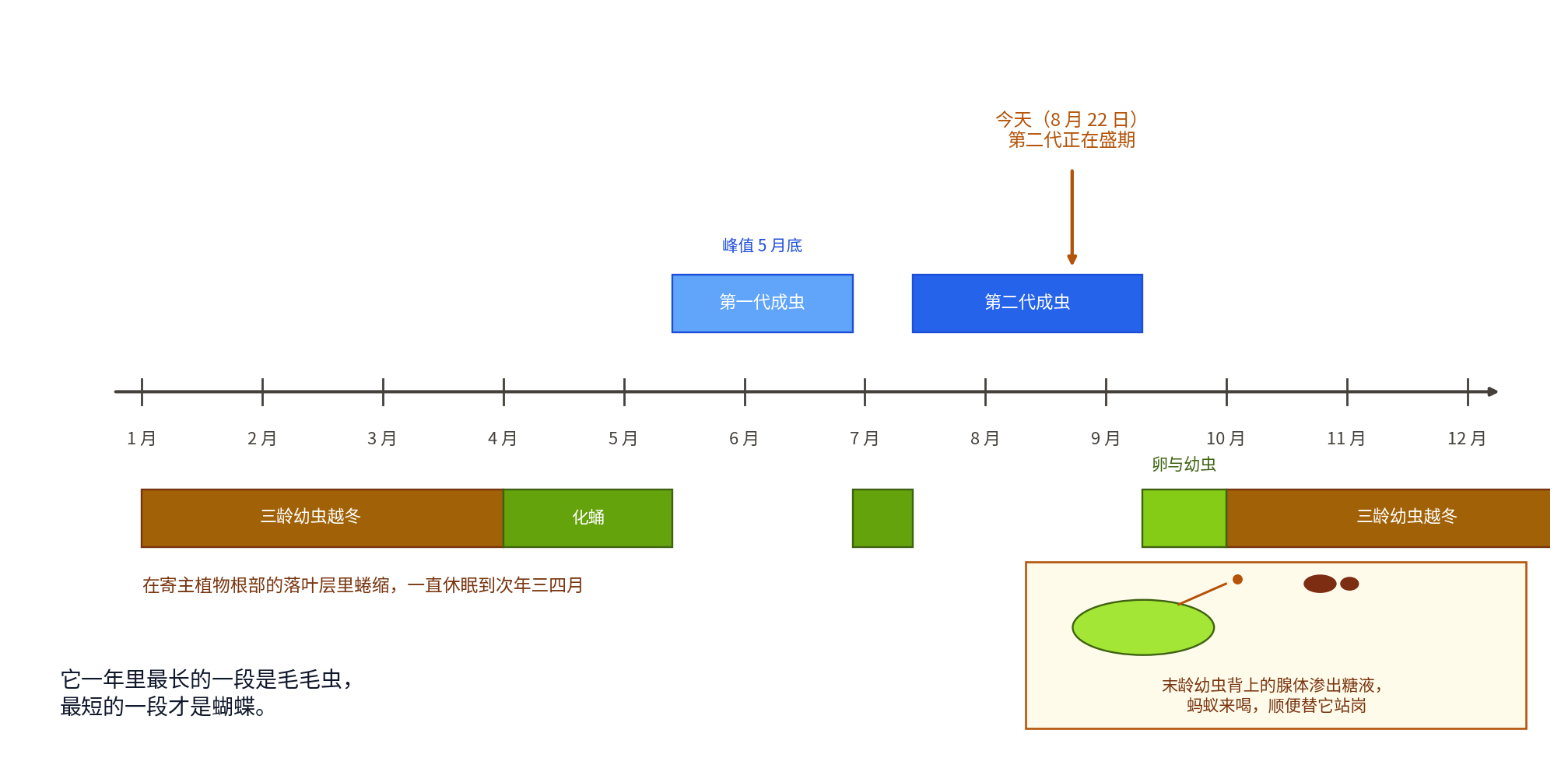
Butterfly Conservation's guide to blue-butterfly life cycles says the caterpillar develops slowly, taking more than a month and molting twice before pupating on the ground or in a shallow cell just below the surface. UK Butterflies adds the crucial seasonal detail: larvae hatching in autumn overwinter in their third instar, fully dormant in leaf litter at the base of the food plant until March or early April.
That dismantles the common claim that butterflies live for only a few days. The overwintering generation of this species spends most of its year not as a butterfly but as a caterpillar asleep among roots. The patch of blue seen above a meadow is the last and shortest stage of its life.
Its final larval instar does something more remarkable. UK Butterflies says the caterpillar begins attracting ants only in that last instar, and the pupa attracts them as well. Ants may even bury it in the soil.
Many lycaenid caterpillars possess specialized glands that secrete sugary fluid for ants to drink. In return, the ants patrol around them and drive away parasitoid wasps and predators. Entomologists call the relationship myrmecophily. For the common blue, this is not merely inferred from related species. Konrad Fiedler and Bert Hölldobler tested it directly in Oecologia, volume 91, in 1992. They had ants from two Lasius species tend the larvae, then weighed the insects. The result differed by sex: ant-tended males tended to reach a greater pupal mass, while ant-tended females tended to lose more mass during pupation. The authors concluded that myrmecophily brought male caterpillars a developmental benefit rather than a cost.
Ants circling a plump green caterpillar are not necessarily attacking it. They may be participating in this exchange.
Why Late August
Bing gave no reason for the date, but the butterfly has one.
UK Butterflies describes two generations a year in southern England. The first begins emerging in mid-May and peaks in late May. The second begins in mid-July and peaks in mid-August; especially favorable years may produce a third. Northern England and Scotland generally have one generation, appearing in June and peaking in July.
Devon lies in southwestern England, within the southern pattern. In late August, the second generation has just passed its peak and remains abundant in flight. It is one of the best times of year to encounter the species, though the window is beginning to close. That is the honest answer to "why now": not an anniversary, but phenology.
Devon is not merely a convenient backdrop. The official Devon Local Nature Recovery Strategy says 39 of Britain's butterfly species occur in the county. It highlights habitats including Torbay's limestone coast and the undercliffs of East Devon: unimproved, nutrient-poor, sunny slopes by the sea. Butterfly Conservation's habitat list for the common blue follows the same pattern: chalk downland, coastal dunes, undercliffs, roadside verges, acid grassland, woodland clearings, heathland, abandoned quarries, golf courses, and even old urban cemeteries. What they share is sun, shelter, and grass that has not been cut too short.
The Photographer
Ross Hoddinott is a veteran British macro and landscape photographer. According to the biography on his website, he began taking pictures at nine or ten, won the inaugural BBC Countryfile Young Photographer competition with a dragonfly close-up, became Young Wildlife Photographer of the Year at seventeen, and turned professional at eighteen. He later won multiple Wildlife Photographer of the Year awards and the overall British Wildlife Photography Awards title in 2009. He now lives in north Cornwall, next to Devon, where he and his wife have rewilded several acres around their home to attract wildlife.
The hard part of a photograph like this is not equipment, but timing. The species is most active only in sunshine, yet the easiest moment to photograph it is when it is least active. UK Butterflies records that in poor weather it rests head-down on grass stems, and several may occasionally roost together on the same stem overnight. The usual way to find a common blue willing to sit still is to go out early, before the Sun wakes it.
The UK Butterfly Monitoring Scheme
The species is called "common" in English and "ordinary" in one Chinese name, but it is less secure than either suggests.
Butterfly Conservation gives two long-term figures. Between 1976 and 2019, its abundance fell 17 percent; between 1972 and 2019, its distribution contracted 37 percent. It remains classed as Least Concern in the 2022 British Red List and has a low conservation priority.
Recent news is less reassuring. More than 125,000 people took part in the official 2025 Big Butterfly Count, recording 1.7 million butterflies and day-flying moths. The average 15-minute count rose from 7.2 in 2024 to 10.3, but the common blue was among the poor results. It recorded the third-worst showing in the survey's history, with a 54.3 percent decline over 14 years. On the same page, Butterfly Conservation's Dr. Richard Fox said that over 15 years, more than twice as many widespread species had declined significantly as had increased. The Devon strategy cites a broader figure: 80 percent of British butterfly species have declined in abundance, distribution, or both since 1976.
Butterfly Conservation has set the 2026 Big Butterfly Count for July 17 through August 9. The UK Butterfly Monitoring Scheme's transect season continues through September 29.
That monitoring system is itself an extraordinary story.
The UKBMS began in 1976. Its first formal transect was walked at Potton Wood in Bedfordshire on April 10 that year. According to the scheme's "UKBMS at 50" page, volunteers have completed about 715,000 surveys over five decades, walking roughly 950,000 miles and recording more than 41 million butterflies. More than 7,000 sites have been surveyed at some point, and over 3,000 are still walked weekly each year. These figures did not come from one laboratory. Thousands of ordinary people built them, summer after summer.
The official methods page calls this the transect method, named for its designer, Ernie Pollard. Observers follow a fixed route once each week for 26 weeks, from April 1 through September 29.
The introductory guide makes the rules more specific, and their care lies in the details. Count only butterflies inside an imaginary box extending 2.5 meters to either side and 5 meters ahead. On a sea cliff or woodland path with vegetation on only one side, a single five-meter side is acceptable. At temperatures from 13 to 17 degrees Celsius, at least 60 percent of the sky must be clear; above 17 degrees, any conditions without rain are acceptable. The preferred time is 10:45 a.m. to 3:45 p.m., though 10 a.m. to 5 p.m. usually qualifies. Later than that, butterflies stop flying. Walk slowly and steadily. Estimate the wind with the Beaufort scale and record it. These are British local times; on another route, use its own local time.
Those fussy-looking rules are the whole reason the data can span 50 years. The box, route, and weather thresholds remain fixed, allowing a count today to be compared with one from 1976.
China has a corresponding system. The Ministry of Ecology and Environment issued the national standard HJ 710.9-2014, Technical Guidelines for Biodiversity Monitoring - Butterflies, in 2014, and it took effect on January 1, 2015. It sets technical requirements and methods for observing butterfly diversity. The China Butterfly Diversity Observation Network, China BON-Butterflies, began in March 2016. A 2018 progress report by Ma Fangzhou and colleagues in the Journal of Ecology and Rural Environment, volume 34, issue 1, said that by then it had established 117 sampling areas and 629 transects across 31 provincial-level regions, totaling about 1,200 kilometers and producing more than 200,000 observation records per year. Participants came from 53 research institutes, universities, conservation organizations, and civic groups. The network is primarily institution-led, however, and no public sign-up route for individuals was found. For someone who simply wants observations to be used, a more practical destination is the iNaturalist project "Butterflies of China," which explicitly welcomes observations from anyone and states that all its data are public, verifiable, and traceable.
Sources: Bing Wallpaper (zh-CN, August 22, 2026); Butterfly Conservation common blue species page, Life Cycles of Common, Small and Holly Blue Butterflies, Big Butterfly Count 2025 results, and 2026 event page; UK Butterflies common blue species page; UKBMS methods page, introductory guide G1, and "UKBMS at 50"; Natural History Museum, London, Rainbow Nature: Life in Brilliant Blue; Piszter et al., Scientific Reports 11 (2021), on agreement between spectroscopy and phylogeography in European male common blue dorsal wing scales; Kertész et al., Scientific Reports 9 (2019), on biogeographic patterns in male common blue structural color; Piszter et al., Insects 14(8), 716 (2023); Fiedler and Hölldobler, Oecologia 91, 468-473 (1992); Devon Local Nature Recovery Strategy butterfly and moth page; Ross Hoddinott's website biography; Ministry of Ecology and Environment standard HJ 710.9-2014, Technical Guidelines for Biodiversity Monitoring - Butterflies; Ma Fangzhou et al., Journal of Ecology and Rural Environment 34(1), 27-36 (2018), on the China Butterfly Diversity Observation Network; Shanghai Morning Post (2018) feature on common urban butterflies in Shanghai; IISDW lesser grass blue species page; and the iNaturalist project "Butterflies of China."