
A bird, a cluster of false flowers, and a mechanism textbooks got wrong for more than a century.
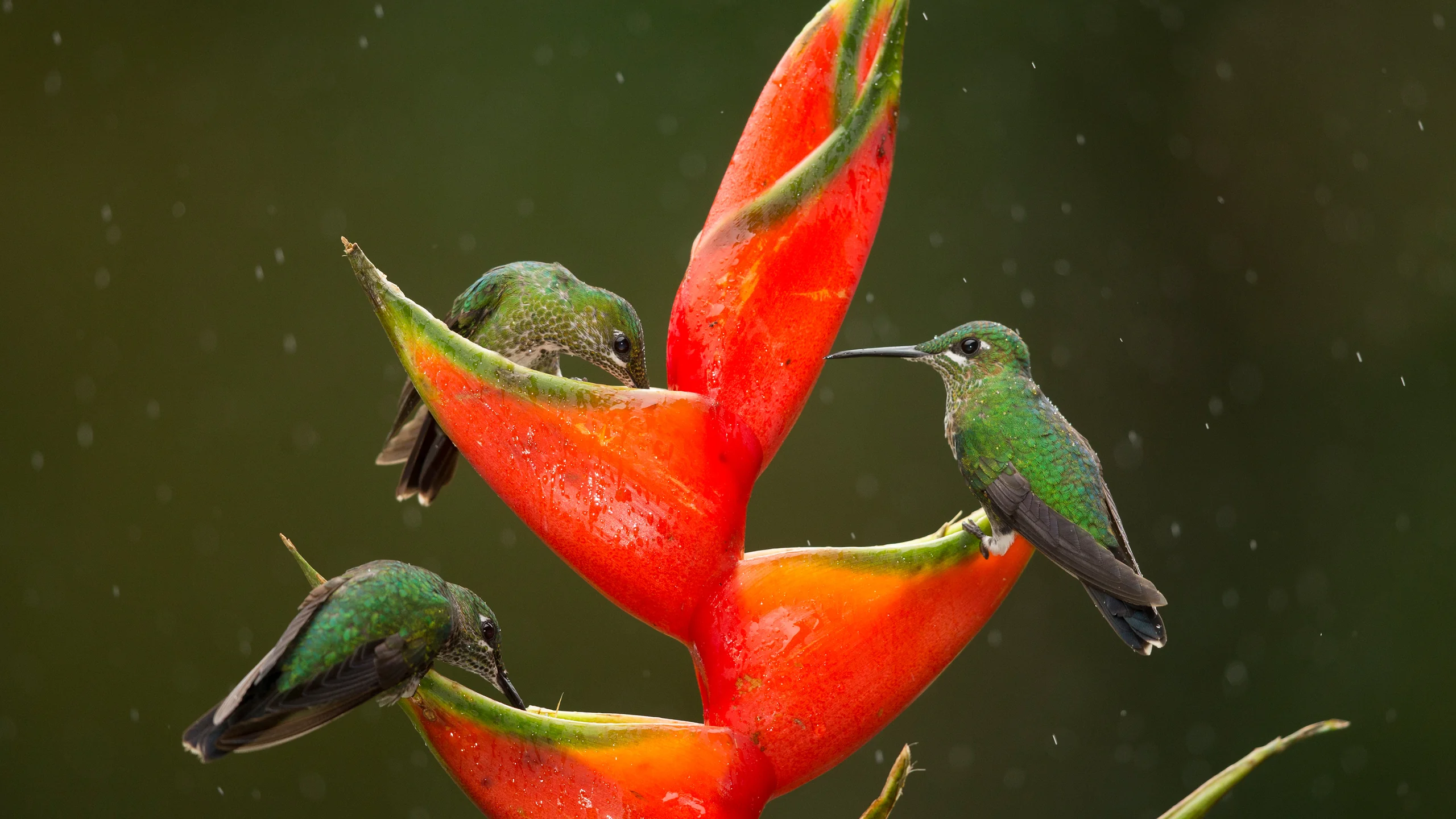
Image: Bing Daily Wallpaper | Green-crowned brilliant on a lobster claw flower, Costa Rica (© Paul Hobson/Nature Picture Library)
Open Bing's Chinese homepage today and you will find a tiny bird gleaming green, leaning into a cluster of red-and-yellow flowers. The title is "Small Bird, Big Impact."
You may instinctively complete the scene: wings blurred into a haze, body motionless in midair. That is what hummingbirds do, after all.
But look again. Both of this bird's feet are gripping the flower.
First, That Flower Cluster Contains No Flowers
The waxy red-and-yellow structure has several English names: lobster claw, toucan beak and false bird-of-paradise. It belongs to Heliconia, called the scorpion-tail banana genus in the Flora of China system. The genus contains about 194 species, almost all native to the tropical Americas.
The important point is this: every vivid patch of red, orange and yellow you see is a bract, not a flower. The true flowers are small and concealed in grooves along the inside of the bracts, with only their tips protruding. The showy cluster is a billboard, not the product itself.
And the billboard was built for hummingbirds. Heliconia is the oldest known lineage of hummingbird-pollinated plants, emerging about 39 million years ago - substantially earlier than the 22-million-year history of living hummingbirds. The relationship between flowers and birds can be extraordinarily precise. Hermit hummingbirds have long, curved bills; non-hermits have shorter, straighter ones. That difference in shape may have helped drive the two groups apart in the Miocene. The purple-throated carib of the Caribbean takes the division further: females have long, deeply curved bills matched to a long, curved Heliconia corolla, while males have short, straight bills matched to another species.
Costa Rica's Heliconia tortuosa is choosier still. It essentially recognizes only two pollinators: the green hermit and the violet sabrewing. The 2015 PNAS paper on the relationship was titled simply "Pollinator recognition by a keystone tropical plant."
Why Is It Not Hovering?
According to Birds of the World, the green-crowned brilliant (Heliodoxa jacula) usually clings to flowers while feeding rather than hovering. (That fact could be traced only through this one source chain, a limitation worth stating.)
It may look lazy. It is really a careful energy calculation. Hovering is extraordinarily expensive for a bird: figures from Animal Diversity Web put its metabolic cost at roughly ten times the resting rate. When a flower provides a perch, gripping it is like switching off an engine running at tenfold power.
This hummingbird is not especially small, either. A male is 12 to 13 centimeters long and weighs 7.4 to 12 grams. Its plumage flashes metallic green to blue-green, with a small violet-blue throat patch that appears only from certain angles. The female lacks that gleam but has a conspicuous white cheek stripe and densely spotted green markings on a white underside. The species lives in mid-elevation cloud forests, generally between about 700 and 2,200 meters in Costa Rica.
Its Tongue Is Not a Straw
This is the one fact from today worth keeping.
For more than a century, textbooks explained that a hummingbird's tongue worked like a fine straw, drawing nectar upward by capillary action. The idea was intuitive and convenient. Its only problem was that it was wrong.
In 2011, Alejandro Rico-Guevara and Margaret Rubega published a paper in PNAS with a title that read like a declaration of war: "The hummingbird tongue is a fluid trap, not a capillary tube." High-speed video captured the tongue tip moving in and out of nectar and showed that it is a dynamic fluid-trapping device whose shape changes dramatically as it enters and leaves the liquid. The strongest evidence was that the mechanism behaved exactly the same way in live and dead birds. In other words, it depends entirely on the mechanics of the structure and costs no muscular effort.
In 2015, the same research group presented the complete model in Proceedings of the Royal Society B: an elastic micropump.
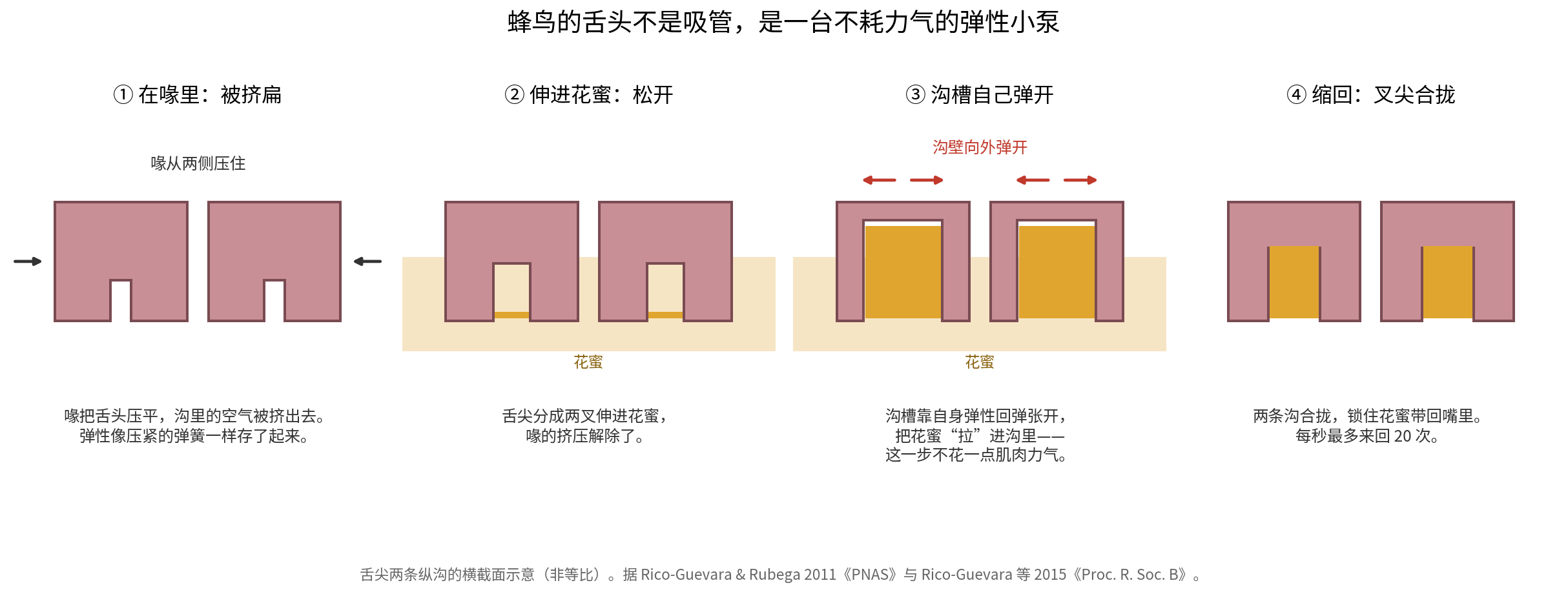
Here is how it works. While the tongue is retracted, the bill squeezes it flat, expelling fluid from its grooves and storing elastic potential energy like a compressed spring. When the tip enters nectar, the pressure is released and the grooves spring open, pulling nectar inside. As the tongue withdraws, its two grooves close and trap the nectar for the return trip into the mouth.
It does not suck. It springs.
Why does the distinction matter? A hummingbird can lick nectar up to 20 times per second. The researchers point out that capillary action simply cannot work fast enough at that speed. The bird would need another mechanism or it would have to slow down and sacrifice energy intake. They analyzed 96 feeding events from 32 individuals representing 18 species in seven countries. Across hundreds of licks, they observed capillary action only once.
An explanation printed in textbooks for more than a century lost to a few hundred high-speed videos.
A Bird That Shuts Down Every Night
A hummingbird's day works like this. The sugar concentration of nectar is not especially high: flowers pollinated by hummingbirds average only about 25% sugar, more dilute than many people imagine, so the birds must drink a great deal. The U.S. Fish and Wildlife Service says they consume nectar equal to about half their body weight each day. Their active heart rate can reach 1,260 beats per minute.
Night is the problem. They cannot feed, and such small bodies lose heat quickly.
The hummingbird's solution is torpor: it shuts itself down. One Caribbean species has been observed lowering its body temperature from 40 degrees Celsius to 18 and cutting its metabolic rate to one fifteenth of normal. A 2020 study in Biology Letters found an even more extreme case. Of 26 high-altitude hummingbirds captured in the Andes at elevations up to 3,800 meters, 24 entered torpor. A black metaltail lowered its body temperature to 3.3 degrees Celsius, only a few degrees above freezing and a record for birds. Torpor lasted five to ten hours.
Off every night; back on in the morning.
Then there are the wings. They trace a figure-eight path. A 2005 study in Nature found that hummingbirds produce 75% of their lift on the downstroke and 25% on the upstroke. Every other bird, when hovering or flying slowly, produces 100% of its lift on the downstroke. Generating lift on the return stroke is a hummingbird specialty, and it is what lets the bird fly backward or even upside down. Wingbeat frequencies range from about 12 per second in the largest species to 99 in the smallest; the ruby-throated hummingbird ordinarily reaches about 53. A frequency of 53 hertz lies within human hearing, so the hum is not a metaphor. It is a low note you can actually hear.
Why Today?
Because September 5 is the first Saturday in September, observed as National Hummingbird Day.
No authoritative origin for the occasion could be found. Every available page is a holiday aggregator quoting another one. Even National Day Calendar concedes that it cannot identify the founder and says there may be no single person or organization responsible. The International Hummingbird Society's website does not mention the day at all.
It seems less like a holiday someone founded than a date that grew by itself: no founder, no resolution, just many people independently deciding to look a little longer at hummingbirds.
China Has No Hummingbirds, but It Has Another Answer
First, be precise: there are no hummingbirds in the wild in China. A fact-check from Science China states it plainly. Hummingbirds live only in the Americas, from Alaska to Tierra del Fuego. In China, they can be seen only in specimen collections and natural-history museums.
Then what is that tiny creature in the neighborhood flower bed, hovering in front of a blossom with blurred wings and an audible buzz?
It is the coffee clearwing, a day-flying moth commonly called a hummingbird hawk-moth. One feature is enough to distinguish it: antennae. Birds have none; this moth has a pair of clubbed antennae about 11 millimeters long. Its body bears scales rather than feathers, its abdomen is stout, and its coiled proboscis rolls up like a mosquito coil when not in use. It also never lands on the flower. It always hovers.
The Chinese bird that truly parallels a hummingbird is the sunbird.
The fork-tailed sunbird (Aethopyga christinae) has a notable history. Its type locality is Hainan Island, where Robert Swinhoe collected a specimen on Limu Mountain in 1868 and published it the following year in the world's first scientific paper on Hainan's birds. Today the species occurs in Sichuan, Yunnan, Guizhou, Hunan, Guangxi, Guangdong and Fujian. It is about 10 centimeters long and weighs 5 to 7 grams - lighter than the Costa Rican hummingbird in today's wallpaper.
Sunbirds and hummingbirds look alike and live alike, yet they are only distantly related. Along with the honeyeaters of Australia, they represent three unrelated lineages that independently arrived at answers to the problem of drinking nectar. It is a standard textbook example of convergent evolution.
The three solutions are not identical. A sunbird has a brush-tipped, tubular tongue; a hummingbird has a forked tongue with elastic grooves. The same problem produced two entirely different pieces of engineering. Their feeding styles cross over as well. Sunbirds usually perch to drink but can hover briefly. This hummingbird, from a group famous for hovering, often grips the flower instead. Each crosses the boundary once.
There is a still more counterintuitive fact: the Old World did not fail to evolve hummingbirds. Its hummingbirds went extinct. The oldest known modern-type hummingbird fossil, Eurotrochilus, comes from Europe in the early Oligocene, about 32 million years ago. Hummingbirds later disappeared from Eurasia and North America. Every hummingbird alive today - 366 species interacting with about 7,000 plant species, according to a 2024 review in Biological Reviews - descends from the lineage that colonized South America and has occupied the New World for only 22 million years.
We missed them 30 million years ago.
Sources: Bing's China homepage and HPImageArchive metadata; Rico-Guevara and Rubega, PNAS (2011); Rico-Guevara et al., Proceedings of the Royal Society B (2015); Warrick et al., Nature (2005); Barreto et al., Biological Reviews (2024); Betts et al., PNAS (2015); the 2020 Biology Letters study of torpor in high-altitude hummingbirds; Cornell Lab's eBird and Birds of the World; the U.S. Fish and Wildlife Service; Animal Diversity Web; the South China Botanical Garden, Chinese Academy of Sciences; Science China / People's Daily; and the China Bird Report Center.