
Autumn changes the reedbed. It also changes how a small bird processes its meals.
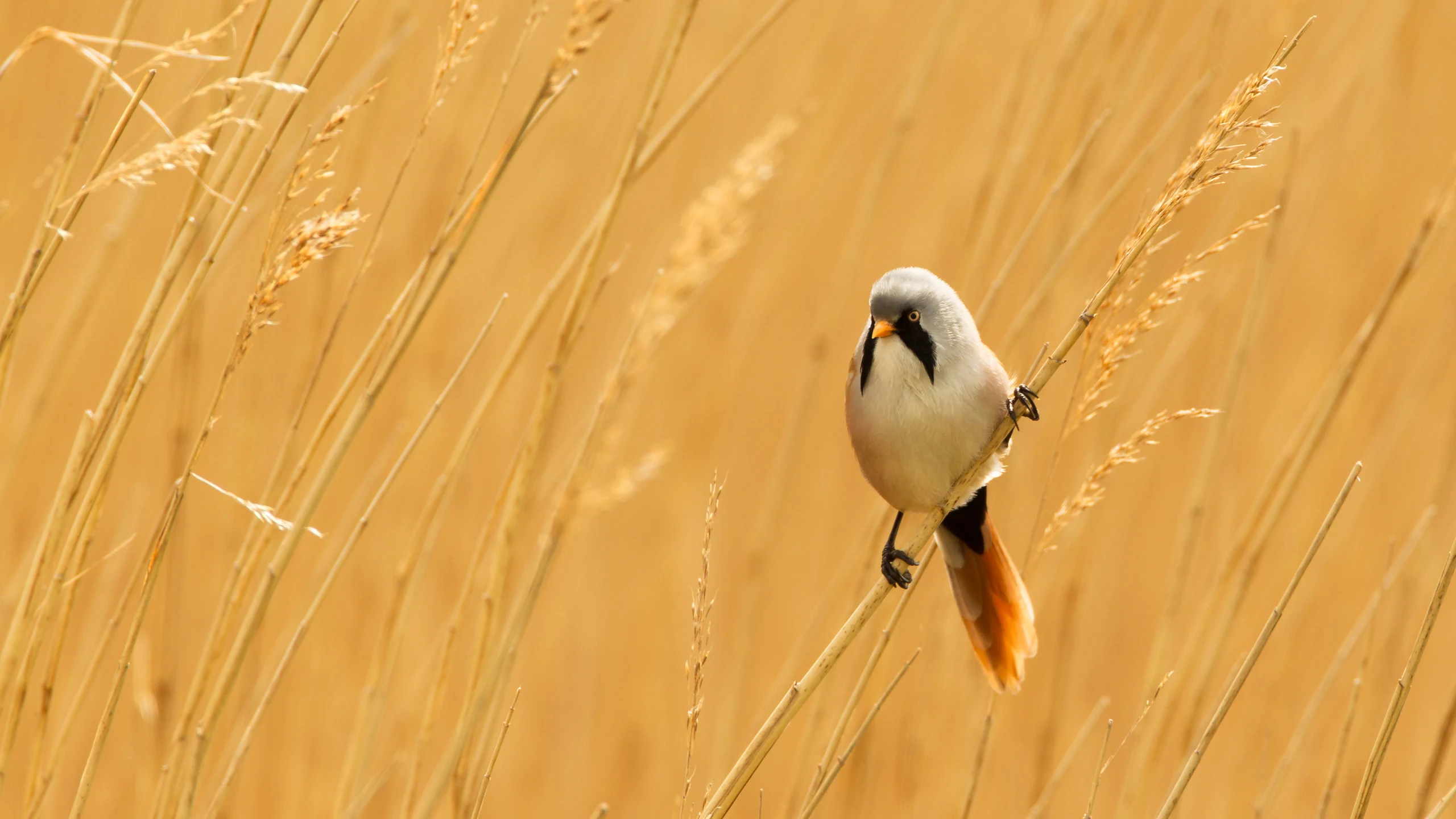
Image: Bing Wallpaper | Male bearded reedling, Norfolk, England | Copyright: Andrew Sproule/Shutterstock | Original page

The old English name, "bearded tit," gets two things wrong. The black facial markings are not a beard, and the bird is not a tit. Molecular research places it in its own family, with a single living species and its closest affinities among the larks.
Its most unusual equipment, however, is less visible than those markings.
Changing Tools for a Different Meal
In summer, bearded reedlings feed largely on insects and other invertebrates among the reeds. Those foods become scarcer in winter, when reed seeds provide an important alternative. Tough seed coats pose a problem for the bird's small bill.
The solution is a change in digestive work. Reedlings deliberately swallow grit and retain it in the gizzard, the muscular part of the stomach. As its walls move, the particles help grind the seeds. Songbird Survival describes the digestive changes as an adaptation to the seasonal switch in food.

Diagram: The Daily Backstory; not an anatomical scale drawing. Grit assists the gizzard in grinding seeds.
Grit trays at Britain's Leighton Moss reserve provide material for this behavior. The birds are not simply swallowing stones by accident. They use them to finish a job their bills cannot easily do.
A Resident Can Still Move
Dependence on large reedbeds does not mean that every individual stays in the same patch for life. Lendvai's 2023 review discusses dispersal and movement in the species, drawing on the long records that bird ringing makes possible.
A numbered leg ring turns an encounter into a record that can be linked to a later one. China's National Bird Banding Center was established in 1982. Its historical figures, through the end of 2010, report nearly 2.7 million birds ringed and released, with more than 1,200 marked birds recovered. Color-mark observations were recorded separately.
Those are historical figures, not today's national totals. They are not a survival rate, either. Meeting a bird again depends on where people look, whether they report it and what kind of mark they can read.
A reedling's seasonal adjustment may be hidden inside its stomach. Its travels emerge only when scattered encounters are assembled. A photograph preserves one moment; research connects moments into a life history.
Sources
Songbird Survival: bearded tit; Lendvai's 2023 review; BTO BirdFacts; National Bird Banding Center: historical figures.