
The sky is dark, but the distant horizon still shines - because it lies outside the shadow.
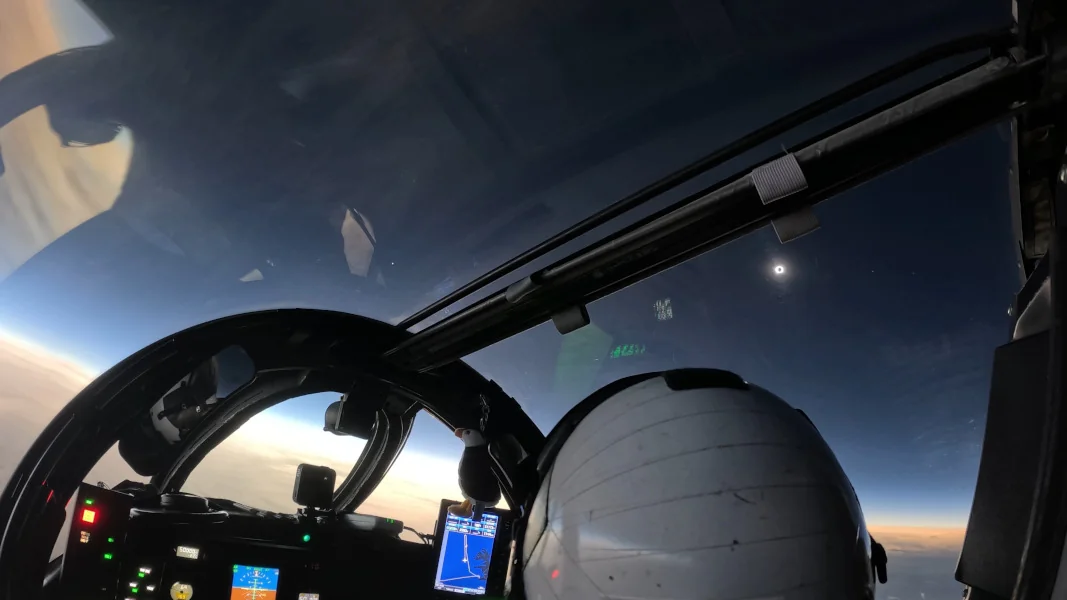
Image: NASA Astronomy Picture of the Day (APOD) | Image credit: NASA | Today's page
Today's NASA Astronomy Picture of the Day was taken from an aircraft cockpit.
At the top of the frame, the corona has just emerged, a pale, feathery ring in a dark sky. A bright point to the left is Venus. Jupiter and Mercury can just be made out to the right of the Sun.
But the detail that stops you is at the bottom of the image: the distant horizon is still bright.
That is not an exposure error. It is the edge of the Moon's shadow. The aircraft is inside the shadow, while places hundreds of kilometers away have not yet been swept by it and remain in daylight. You rarely get to see where a shadow ends.
That Day
The date was August 12, 2026. A total solar eclipse crossed Greenland, Iceland, northern Russia and the Atlantic, finally reaching parts of Spain and Portugal. Reykjavík entered totality at about 5:48 p.m. local time. León, Spain, had to wait until 8:28 p.m.
The eclipse was invisible from all of China. The global event ran from 15:34 to 19:58 UTC, or 11:34 p.m. on August 12 to 3:58 a.m. on August 13 in Beijing. It was night in China, with the Sun on the other side of Earth.
The longest totality anywhere occurred off northwestern Iceland, at 65 degrees 49.8 minutes north, 25 degrees 29.1 minutes west. On the centerline it lasted 2 minutes 18.23 seconds.
Two minutes and 18 seconds. That was the best anyone on Earth could get.
NASA decided to stretch it.
How Fast Does the Shadow Move?
To understand the mission, begin with one number.
NASA published minute-by-minute coordinates for the eclipse centerline. Take two entries four minutes apart. At 17:44 UTC the centerline lay at 66 degrees 11.1 minutes north, 25 degrees 37.8 minutes west. At 17:48 it had reached 64 degrees 10.1 minutes north, 24 degrees 45.4 minutes west.
The great-circle distance between the two points is 228 kilometers. Four minutes.
That puts the Moon's shadow over the sea near Iceland at about 3,400 kilometers per hour - roughly 2.8 times the speed of sound at sea level. (NASA does not state that speed directly; it was recalculated here from the agency's path table. A check using a longer, 16-minute interval produces the same result.)
NASA lists the cruising speed of its WB-57F high-altitude research aircraft as 410 knots, or about 760 kilometers per hour.
It had barely one fifth the speed of the shadow. It could never catch it.
So why chase it?
A Curve You Can Draw With Elementary Division
Failing to catch the shadow does not mean the chase is pointless.
If the shadow moves at speed V and you travel in the same direction at speed v, its speed relative to you falls to V minus v. The factor by which totality is extended is:
1 / (1 - v/V)
Insert the numbers. 760 divided by 3,400 is 0.222. One minus 0.222 is 0.778. One divided by 0.778 is 1.29.
The 2 minutes 18.2 seconds available on the ground therefore becomes roughly 2 minutes 58 seconds in the air - a gain of about 40 seconds.
(To be clear, NASA has never published a figure for how much totality was extended. Its two official articles describe the effect only qualitatively. The estimate above uses NASA's published cruising speed and path table and assumes the aircraft remained on the centerline, flew in the direction of the shadow at its nominal cruising speed, encountered no wind and gained nothing from its altitude of 50,000 feet. It is a reproducible calculation, not a NASA conclusion.)
Forty seconds does not sound like much. But look at the shape of the curve:
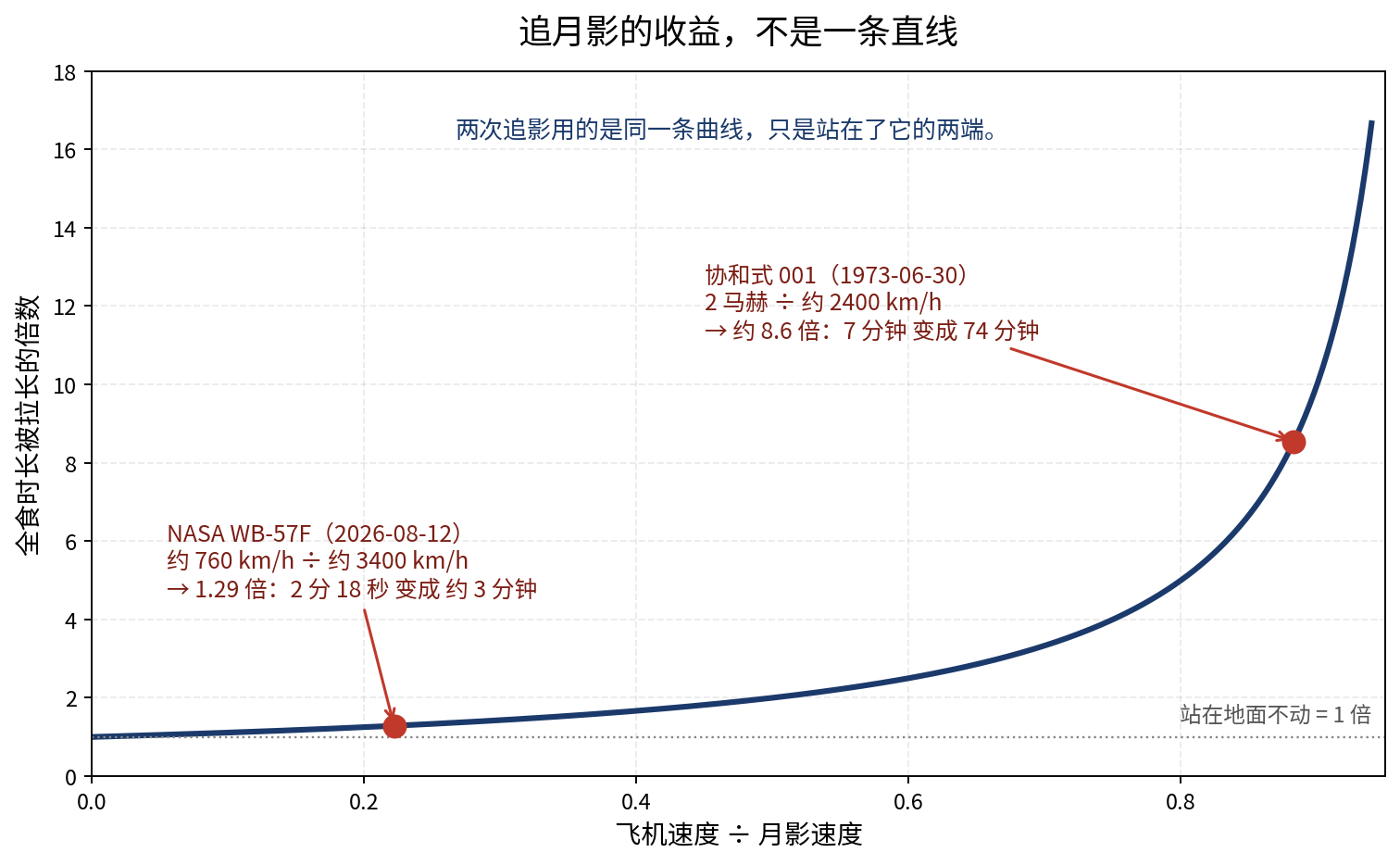
This is not a straight line but a hyperbola. The closer you come to the speed of the shadow, the more sharply the reward rises. At one fifth its speed, you gain 40 seconds. At nine tenths, the result is another story entirely.
In 1973, Someone Reached the Other End of the Curve
On June 30, 1973, the Concorde 001 prototype took off with four specially built windows in its roof, infrared and optical cameras, and a group of astronomers aboard.
Flying at Mach 2, about 2,120 kilometers per hour, and 58,000 feet above the ground, it followed the path of totality across Mauritania, Mali, Niger and Nigeria before landing in Chad.
At any fixed point on the ground that day, totality could last no more than 7 minutes 4 seconds.
Concorde saw 74 minutes.
A 74-minute total solar eclipse. The record remains unbroken and will be difficult to beat now that no supersonic passenger aircraft is in service. Concorde's trick was no mystery; it lay in the same curve. The aircraft traveled at nearly nine tenths the speed of the shadow, yielding a multiplier of about 8.6.
The results appeared in Nature in 1973 under the plain title "Eclipse Flight of Concorde 001."
Why Did NASA Fly at All?
If the aircraft could gain only 40 seconds, why not set up a telescope on the ground in Iceland?
Because extending totality was never the main purpose. NASA gave a different reason:
At roughly 50,000 feet, the WB-57F flies above most clouds, dust and water vapor. That altitude reduces atmospheric interference and allows scientific instruments to observe infrared wavelengths that are almost entirely absorbed in the lower atmosphere.
Fifty thousand feet is 15.24 kilometers. In the standard atmosphere, pressure there is only about 11.6% of sea-level pressure, meaning roughly 88% of the atmosphere's mass lies below the aircraft. (That figure was calculated here from the standard atmosphere table; it is not a quotation.)
Most of this eclipse's path crossed the sea. Amir Caspi of Southwest Research Institute, the mission's principal investigator, put the practical problem plainly: the area is often cloudy, and without an airborne platform those valuable wavelengths would be inaccessible.
Two people were aboard: a pilot and a sensor-equipment operator. Throughout totality, operator Cary Klemm watched the camera system, adjusting focus and exposure and tracking structures of interest. He described each image as a piece of data that might reveal something new about the Sun.
They Were Chasing a Question That Still Has No Answer
What exactly were they trying to see?
NASA's official article states the enduring mystery in its opening line: why is the Sun's outer atmosphere so much hotter than its visible surface?
The layer we ordinarily see, the photosphere, is about 5,500 degrees Celsius. Above it lies the corona, normally drowned in glare and visible only during a total eclipse, at roughly 2 million degrees Celsius.
NASA's fact sheet offers a wonderfully direct analogy: it is like walking away from a campfire and getting hotter.
The same page calls the cause of coronal heating a major unsolved puzzle in solar research.
That remains true today. In 2024 the Parker Solar Probe brought progress, but it should be read as an exclusion, not a solution: observations showed that the dissipation of ion cyclotron waves is not the dominant heating mechanism in the outer corona. One candidate has been eliminated; the mystery remains.
If We Have Coronagraphs in Space, Why Wait for an Eclipse?
The answer lies in a few numbers.
The LASCO coronagraph on the SOHO spacecraft has three channels. C1 had the innermost field of view, covering 1.1 to 3 solar radii, but it was permanently lost after SOHO's loss of contact in June 1998. The channels still operating are C2, which covers 1.5 to 6 solar radii, and C3, which covers 3.7 to 30.
That means SOHO can now see inward only to 1.5 solar radii. The region between the Sun's surface and that boundary is hidden behind the instrument's own occulting disk.
A total eclipse is different. The magnitude of this eclipse was 1.0386, meaning the Moon appeared only 3.9% wider than the Sun. The lunar edge fitted almost exactly over the solar edge, exposing the inner corona that a coronagraph cannot reach during those 2 minutes 18 seconds. (The occulting radius is a measured fact; the resulting blind zone is an inference made here.)
A priceless spacecraft cannot do what a rock 380,000 kilometers away, emitting nothing at all, accomplishes casually.
Two Clues From China
One is in the sky. During the great Yangtze eclipse of July 22, 2009, the path of totality crossed Chengdu and Chongqing, then Wuhan, Hefei, Hangzhou and Shanghai. A China Eastern flight from Wuhan to Shanghai reportedly altered course to follow the eclipse path and extend observing time for scientists aboard. (This account comes from the English-language Wikipedia and is secondary; no contemporary Chinese primary report was found to corroborate it.)
The other is on paper, and carries far more weight. Modern astronomy uses ancient records of celestial events to reconstruct long-term changes in Earth's rotation. The method is direct: take an eclipse record with a known date and place, compare it with a calculated model, then adjust the assumed rotation rate until the modeled path of totality falls over the recorded observation site.
In a Royal Society paper, Stephenson and colleagues explicitly describe their systematic use of records from Babylon, China and Greece, spanning 720 BCE to 2015.
Their conclusion: the length of Earth's day increases by about 1.78 milliseconds per century. Tidal friction alone predicts 2.3 milliseconds.
The two numbers do not agree. The gap shows that something besides the Moon's tidal drag is changing Earth's rotation. Ancient observations are not ornamental additions to modern astronomy; they reveal the part the theory cannot calculate.
One repeatedly cited Chinese record is the phrase tian zai dan in the Bamboo Annals: during a sunrise eclipse in 899 BCE, "the sky dawned twice." Three thousand years ago, someone watched the Sun rise, darken and brighten again and wrote it down. Three thousand years later, that sentence became a measurement of how much Earth had slowed.
When Can We See One Ourselves?
There is a specific date: September 2, 2035.
The path of totality will cross northern China, including Beijing, then graze the northern Korean Peninsula and Japan. Totality in Beijing will last 1 minute 35 seconds, with greatest eclipse at 8:33:37 a.m. Beijing time - the middle of the morning commute.
Nine years remain. Children reading this today may be at university by then.
In the near term, 2026 had only two lunar eclipses: the total eclipse of March 3 and the deep partial eclipse of August 28. Both have passed. No solar or lunar eclipse remains this year.
But one rule is worth learning now. NASA's instruction is explicit:
Do not look at the Sun through a camera lens, telescope, binoculars or any other optical device while wearing eclipse glasses or using a handheld solar viewer. Concentrated sunlight can burn through the filter and cause serious eye injury.
The filter must be fixed to the front of the lens, blocking sunlight before it enters the optical system. For families with children, the best method needs no filter at all: pinhole projection. Pierce a small hole in one piece of card, let sunlight pass through it and project the image onto a second sheet. It produces a safe image of the Sun at no cost and with no risk.
Finally
The easiest detail to miss in today's photograph is still that bright horizon.
It reminds you of something simple: you are sitting inside a shadow, and that shadow has an edge. More than 200 kilometers wide, it is sweeping across the Atlantic at 3,400 kilometers per hour. In a few minutes it will leave you behind and return you to daylight.
An aging aircraft whose design entered service in the 1970s flew from Houston to Iceland to spend 40 extra seconds inside that shadow.
And all the mathematics supporting the chase comes down to one division: 760 divided by 3,400.
Sources: NASA Astronomy Picture of the Day for September 5, 2026; NASA Johnson Space Center, "NASA Johnson Pilots Chase Moon's Shadow for Eclipse Science"; NASA eclipse and solar fact sheets at science.nasa.gov; the NASA Airborne Science WB-57F aircraft page; NASA Goddard's centerline path table for the August 12, 2026, eclipse; EclipseWise eclipse elements; Beckman et al., Nature (1973); Stephenson, Morrison and Hohenkerk on Earth's rotation; SOHO/LASCO instrument specifications; and materials on the eclipses of July 22, 2009, and September 2, 2035.