
A wasp that cannot sting you, and 289 presses of the shutter.
Screenshot: National Geographic Photo of the Day | Original page
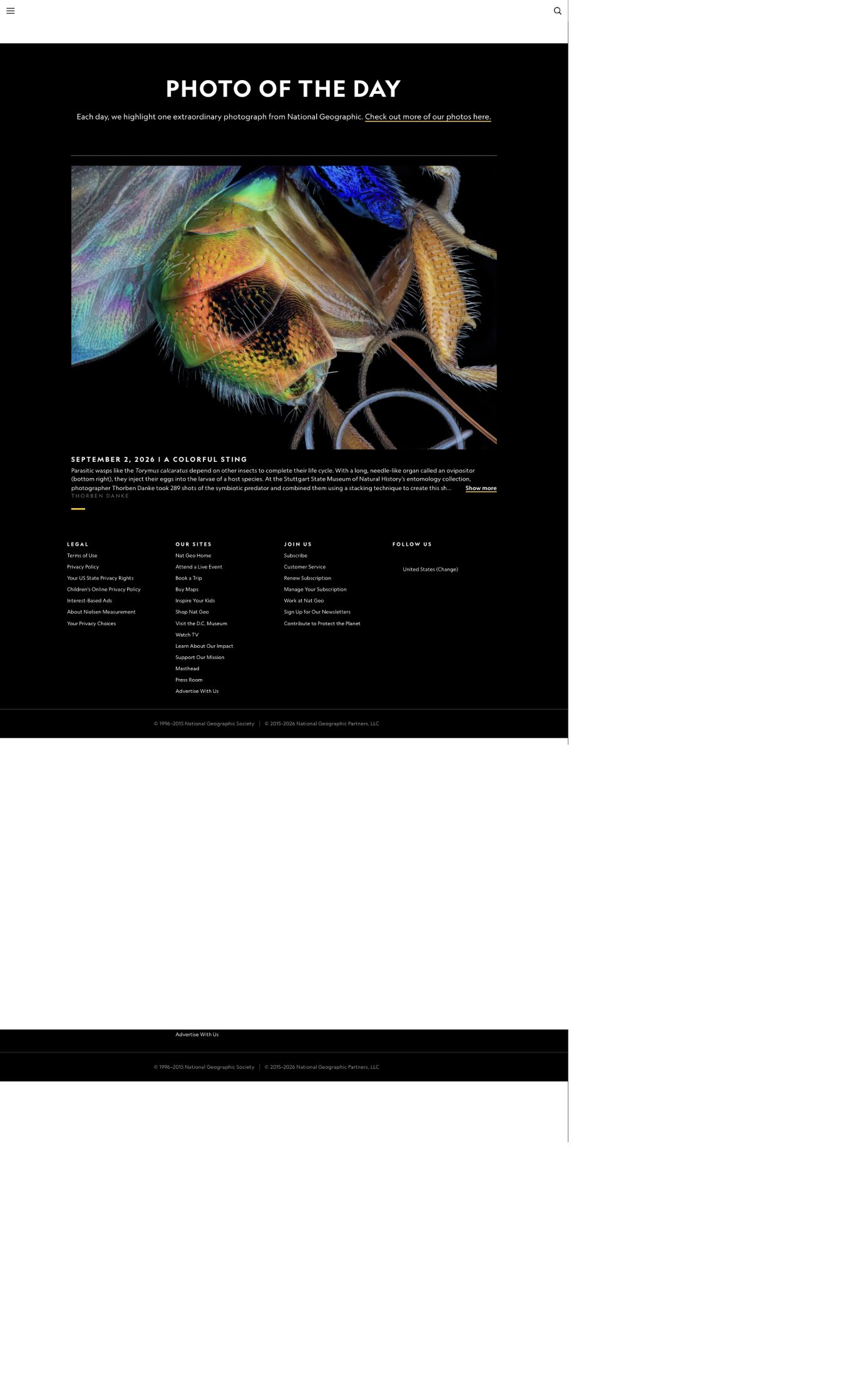
National Geographic's Photo of the Day shows a wasp. Its body shines like colored metal, and a long, straight needle extends from its abdomen. The caption titles the image "A Colorful Sting."
The most interesting thing about the photograph, however, does not depend on seeing the picture first.
Its key lies not in what is pictured, but in how many times the shutter opened.
289
The caption says photographer Thorben Danke made 289 photographs of this wasp in the entomology collection of the State Museum of Natural History Stuttgart, then combined them with a stacking technique.
289 is not an arbitrary number. It is the answer to a division problem.
The problem is depth of field.
In ordinary photography, a broad region in front of and behind the focus point can appear sharp. At high magnification, that sharp layer collapses rapidly. Nikon's official microscopy teaching materials provide a table:
At 4× magnification, the sharp layer is 55.5 micrometers thick. At 10×, it shrinks to 8.5 micrometers. At 40×, it is 1 micrometer. At 100×, just 0.19 micrometers.
A human hair is about 70 micrometers thick.
At 10×, a single exposure therefore captures a sharp layer less than one-eighth the thickness of a hair. At 40×, it is one-seventieth.
The wasp's body is several millimeters thick from front to back, or several thousand micrometers.
Several thousand micrometers divided by one to eight sharp micrometers per frame:
The answer is hundreds.
Every Individual Frame Is Blurry
The Quekett Microscopical Club in Britain, founded in 1865, explains focus stacking plainly. Make a sequence of digital photographs of the same subject at different focal planes, then use software to select the sharp portion of each and combine them into one image with enormous depth of field. The society also warns that successive steps need enough overlap to sweep smoothly through the subject's full thickness, just as ordinary focusing would.
Now put the two facts together.
In each frame, only a band one to eight micrometers deep is clear. The wasp is thousands of micrometers thick. Software keeps the thin sharp strip from each photograph and discards everything else.
More than 99 percent of any individual frame is therefore blurry.
It also means that none of the 289 frames is this photograph.
The finished image does not exist in any one shutter release. It exists only in the intersection of 289 exposures.
Danke did not begin with 289. In an interview with a biological communication group, he said his second successful image was a careful stack of 11 frames made at different focus points.
From 11 to 289.
The Caption Needs Two Corrections
The rule of this column is simple: when checking reveals an error, report it, even when the original source made it.
First, this wasp cannot sting you.
The title "A Colorful Sting" makes the long needle look like a stinger. It is not.
The Natural History Museum in London is unequivocal: chalcidoid wasps do not sting. The long, straight point at the end of the female's body is her egg-laying apparatus, the ovipositor.
This species, Torymus calcaratus, belongs to Torymidae within the chalcidoid wasps, not the aculeate group whose members have stingers. It is harmless to people. Put out a hand and it can do nothing to you.
The needle is not a weapon. It is a drill.
There is a reversal more interesting than a mere pun. Although it does not sting humans, it does inject venom, but into the host larva. A 2021 paper in Scientific Reports identified 143 proteins in the venom of the related Torymus sinensis, most of them hydrolytic enzymes. The paper explains that ectoparasitoid wasps inject a complex mixture of proteins and peptides to regulate their host's physiology for the benefit of their offspring.
The word "sting" works functionally, fails anatomically, and is wholly wrong in relation to humans.
Second, it does not inject the egg into the larva's body.
The caption says the egg is injected inside the host larva. For Torymus, that is incorrect. The same Scientific Reports paper is explicit: T. sinensis is an ectoparasitoid. The female inserts her ovipositor into a newly formed gall and lays the egg on the gall's inner wall or on the surface of the host larva.
After hatching, the larva eats the host from the outside.
The distinction may sound small, but it changes the scene. The wasp does not burrow into its victim. It drills through a wall and leaves an egg beside the unsuspecting neighbor within.
The terminology matters too. It is neither a predator nor a parasite but a parasitoid. Cornell University's biological-control guide defines a parasitoid as an organism whose immature stage develops in or on a single host and eventually kills that host. The guide notes that people often call parasitoids parasites, but the technical term is more accurate.
The dividing line is easy to remember. A parasite needs its host alive; a flea does not kill the dog. A parasitoid always kills its host. It kills only that one in its lifetime, and the killing is how it grows up.
It is an animal that eats one prey in a lifetime, beginning its meal inside a gall.
How Does the Needle Drill Through a Hard Wall?
The ovipositor does not pass through something soft. A gall is a wall grown from plant tissue.
No relevant study of Torymus itself was found. Measurements do exist for fig wasps, fellow members of Chalcidoidea. A 2014 paper in the Journal of Experimental Biology reported the following:
The ovipositor's tip region contained 7.19 percent zinc by weight, while the distant section contained less than 1 percent. The tip had a hardness value of 0.50, significantly higher than 0.32 farther back. Its diameter was 14.32 micrometers, five times thinner than a human hair.
The paper also recorded a vivid detail. During one puncture, the ovipositor buckled periodically at several points.
It does not simply force its way forward. Like a fine drill, it bends slightly as it advances.
A separate 2013 paper in PLOS ONE found zinc, manganese and copper in the ovipositors of gall wasps and their associates, with all three metal concentrations increasing as the substrate grew harder. The samples did not include Torymus, so those figures are not assigned to today's wasp.
What produces the metallic color on its body? Is it structural color, like a soap bubble, or pigment?
No one has studied it.
Scientists have dissected other wasps. In cuckoo wasps, six cuticle layers, each 185 nanometers thick, produce the angle-dependent metallic green. In scelionid wasps, researchers found that the black-and-orange coloration came from pigment, with no multilayered structure at all.
No paper was found on the color mechanism in Torymidae or the genus Torymus.
A tiny insect that may live not far from you carries a color whose mechanism no one has yet explained.
Only 58 Records in the World
The Global Biodiversity Information Facility contains 58 public records for Torymus calcaratus.
France has 38. Germany, Croatia, Italy, Sweden and Ukraine have two each. Belgium, Switzerland, Spain and the Netherlands have one each.
The entire world. Every public record.
That is not because the wasp is rare. It is because almost no one looks down.
It lives in European oak woods, a few millimeters long, passing through its years. Humanity has left only 58 public observations of it.
How the Wall Is Built: A Plant Understands a Six-Letter Password
The gall is the second heart of this story.
A gall begins when an insect lays an egg on a plant and the plant starts building a house for it.
North Carolina State University Extension describes an oak apple gall this way: a female wasp deposits an egg in oak-leaf tissue, and "secretions from the larva that hatches cause the gall to form." A hollow sphere grows around the larva, providing room and food. The galls "usually do not harm the oak."
An educational article from the Kunming Institute of Botany, Chinese Academy of Sciences, gives more detail. Through chemical or physical stimulation during egg-laying and feeding, insects cause accelerated plant-cell growth and abnormal differentiation. The relationship follows a striking rule: a given gall-inducing insect makes its gall on a particular part of a particular plant.
The article ended with an open question: what substance allows a larva to direct the differentiation and transformation of plant tissue so precisely?
That question was answered in August 2025.
A paper in Plant and Cell Physiology reported a family of CAP peptides whose highly conserved core sequence contains only six amino acids. Researchers synthesized the peptide, combined it with auxin and cytokinin, and applied it to plants. Gall-like structures grew on the roots of Arabidopsis and the shoot tips of a Veronica species. These artificial galls contained all the structural features of natural ones: a central cavity, protective outer tissue and vascular bundles.
The abstract described this as an extended phenotype, a trait expressed in a host that has been manipulated by a parasite.
In plain language:
Scientists found the password an insect speaks to a plant. It is six letters long. They copied it and recited it to a plant that had never met an insect. The plant obeyed and built an empty house with no tenant.
The peptide came from the aphid that makes Chinese gallnuts.
A Gallnut Aphid Needs One Tree and One Patch of Moss to Complete a Year
This brings the story to China, where the scale is far greater than it first appears.
China's National Forestry and Grassland Administration says that the country produces more than 95 percent of the world's Chinese gallnuts.
A Chinese gallnut is a gall, a house the Chinese sumac aphid builds on the leaves of a sumac tree. It is the natural plant tissue with the highest tannin content. Gallnuts from Youyang, Chongqing, contain as much as 68 percent tannin, the highest level among China's 14 principal producing counties. The Wuling, Wumeng and Qinba mountain regions account for more than 90 percent of national production.
The aphid's year is the part worth telling a child.
It needs two completely different hosts.
In summer it lives inside its gall on a sumac tree, producing about three generations from May through October. In late October, winged aphids emerge and fly down to moss on the ground, where they spend the winter and produce another generation. In early April, they fly back to the tree.
Tree → moss → tree.
Without either host, Chinese gallnuts would not exist.
Farmers in Youyang therefore do not merely raise insects or plant trees. The National Forestry and Grassland Administration says they plant specific mosses to attract the autumn migrants for overwintering.
Human beings plant a moss for the sake of a tiny insect. One of the world's rarest agricultural systems rests on that three-way relationship. In nomenclature, the Chinese Pharmacopoeia system uses Melaphis chinensis, while current international taxonomy uses Schlechtendalia chinensis for the same aphid; Melaphis is the older genus name.
One Gall, Two Uses at Opposite Ends of the Silk Road
Here is the story's finest symmetry.
In Europe, oak galls were used to write.
The British Library explains that iron gall ink contains three ingredients: tannin from oak galls, iron sulfate and gum arabic. It was used for important manuscripts and legal documents for "thousands of years." The American Institute for Conservation gives a range from the fifth through the nineteenth centuries.
Documents made with it include Magna Carta, the Lindisfarne Gospels and Leonardo da Vinci's manuscripts.
The British Library also describes the ink's destructive side. It "burns" into paper or parchment, leaving a mark insoluble in water and alcohol. Over time, it can corrode the sheet beneath, embrittling the material until whole sections of writing disappear.
Two chemical processes are involved. The ink's high acidity promotes hydrolytic cleavage of cellulose. Iron also catalyzes oxidation: ferrous iron reacts with hydrogen peroxide to produce hydroxyl radicals in the Fenton reaction. A specialist website led by the Netherlands Cultural Heritage Agency concludes that deacidification alone is insufficient; soluble transition-metal compounds must also be removed to stop deterioration.
Europe's most consequential words for more than a thousand years were written with a house a small wasp made an oak build. The force that wrote them is also the force now consuming them.
In China, the same gall followed another path.
The Compendium of Materia Medica includes an entry for the medicinal gall known as wushizi, also called moshizi and machaze. Li Shizhen cites the Tang scholar Su Gong, who said it grew in the sandy wastes of the Western Regions on a tree resembling tamarisk. Duan Chengshi's Tang miscellany Miscellaneous Morsels from Youyang is more specific: the gall came from Persia, on a moze tree six or seven zhang tall with peach-like leaves. Li also cites the Unified Gazetteer for its occurrence throughout Dashi, the medieval Chinese name for the Arab world.
Its principal action was recorded in six characters: "Benefits blood and engenders essence; darkens beard and hair."
The same gall. Europeans used it to write Magna Carta; Chinese people used it to darken hair.
Neither side likely knew that the object in its hand was a house a tiny wasp had persuaded a tree to build.
The Problem Came From China, and So Did the Answer
The final thread concerns a different species in the same genus as the photographed wasp. That distinction is the easiest fact in this article to get wrong.
The wasp in the image is Torymus calcaratus. No record was found of its use in biological control. It has never been documented working on humanity's behalf.
Its relative Torymus sinensis, however, accomplished something extraordinary.
The European and Mediterranean Plant Protection Organization says the Asian chestnut gall wasp Dryocosmus kuriphilus is native to China. It appeared in Japan in the 1940s, then reached Korea and the United States between 1941 and 1999. Europe first reported it in 2002.
Its reproduction is extreme: it uses thelytokous parthenogenesis, producing females with no known males, and has one generation a year. It attacks chestnut buds and shoots, inducing galls that destroy fruiting branches.
People searched for a solution for decades.
The answer was to return to China's mountains.
Field surveys there in the 1970s found Torymus sinensis, a highly host-specific parasitoid whose life cycle was perfectly synchronized with the gall wasp. Japan began releases in the late 1970s. Italy first released it in 2005, and France in 2010. A 2008 paper recorded the Italian scale: 2,117 wasps were released over two years, reared from roughly 64,000 galls collected in the wild.
EPPO reports that chestnut gall-wasp populations fell sharply in Italy and France. The program has been called one of the most successful examples of classical biological control against a forest pest.
The problem came from China, and so did the answer.
China has investigated its own communities as well. A 2019 paper in Scientia Silvae Sinicae examined galls of the oak gall wasp Trichagalma acutissimae on cork and sawtooth oaks in Linzhou, Henan. One of the three dominant parasitoids inside was a torymid in the genus Torymus.
You do not have to search a museum drawer in Stuttgart. Galls grow on oaks in the mountains of northern China, and wasps from the same genus as the photographed species live inside them.
For context, a compilation of FAO data puts China's 2023 chestnut crop at roughly 1.7 million tons, more than 80 percent of world production. This is not merely someone else's problem.
Darwin's Letter
One hundred and sixty-six years ago, these wasps deeply troubled one observer.
On May 22, 1860, Charles Darwin wrote to Asa Gray:
"I cannot persuade myself that a beneficent and omnipotent God would have designedly created the Ichneumonidae with the express intention of their feeding within the living bodies of caterpillars."
Precision matters. Darwin referred to Ichneumonidae, many of which are endoparasitoids whose larvae feed inside living caterpillars. That was the image that shook him. Today's Torymus belongs to Chalcidoidea and is an ectoparasitoid of gall-wasp larvae hidden inside plant galls, not caterpillars. They are two distinct major branches of Hymenoptera and must not be conflated.
The contrast still holds, and it carries weight.
Darwin looked at parasitoid wasps and concluded that a creator could not be benevolent. More than 160 years later, members of this group helped save Europe's chestnuts and reduce pesticide use.
The same biological fact moved, over a century and a half, from theological dilemma to ecological answer.
Finally
The photographer is German, 42 years old, and lives in Besigheim, a wine-growing town north of Stuttgart. Thorben Danke is an industrial electronics engineer who taught himself macro photography and works in a home studio.
Where do the specimens come from? Friends and relatives find dead insects and leave them on his kitchen windowsill. Followers on social media mail him insects. Biodiversity researchers and natural-history museums send specimens they do not need.
Danke built his own macro rail and programmed it for micrometer-scale steps. He spent more than a year learning how to soften the wings of a death's-head hawkmoth.
Two of his statements belong at the end.
"You don't have to travel to the tropics to discover the beauty of insects."
"Insects form the biological foundation of our ecosystems."
His credo has four words:
See - Know - Appreciate - Protect.
The order cannot be reversed. People do not protect what they do not appreciate, do not appreciate what they do not know, and do not know what they have never seen.
This wasp came from a drawer. The Stuttgart museum's entomology collection holds 5.5 million specimens. Of those, 4.8 million dry specimens occupy more than 22,000 insect drawers, and Hymenoptera accounts for 350,000 specimens. Torymus calcaratus is one of those 350,000.
Only 58 public observations of it exist worldwide.
Danke made it one finished image built from 289.
Image: National Geographic Photo of the Day | Photograph by Thorben Danke | Original page
Sources
National Geographic Photo of the Day, September 2, 2026; Nikon MicroscopyU materials on depth of field; Quekett Microscopical Club guide to focus stacking; Natural History Museum, London, "Dangerous Beauties"; 2021 Scientific Reports study of Torymus sinensis venom proteins; 2014 Journal of Experimental Biology research on fig-wasp ovipositor mechanics; 2013 PLOS ONE research on metals in gall-wasp ovipositors; Cornell University biological-control guide; GBIF species and distribution records; North Carolina State University Extension oak apple gall page; Kunming Institute of Botany, Chinese Academy of Sciences, educational article; August 2025 Plant and Cell Physiology paper on CAP peptides; National Forestry and Grassland Administration, May 4, 2025; 2020 Scientific Reports research on the Chinese sumac aphid life cycle; Science Popularization China; source definition in the Pharmacopoeia of the People's Republic of China; British Library collection-care blog; American Institute for Conservation Wiki; Netherlands iron-gall-ink specialist website; Compendium of Materia Medica, wushizi entry; EPPO Asian chestnut gall-wasp data sheet; 2008 BioControl study of releases in Italy; two papers in Scientia Silvae Sinicae from 2018 and 2019; Darwin Correspondence Project, DCP-LETT-2814; interviews with Thorben Danke in Smithsonian Magazine and by the Biocommunication Group; and the State Museum of Natural History Stuttgart's official entomology collection page.