
One name, three continents and two hours of darkness.
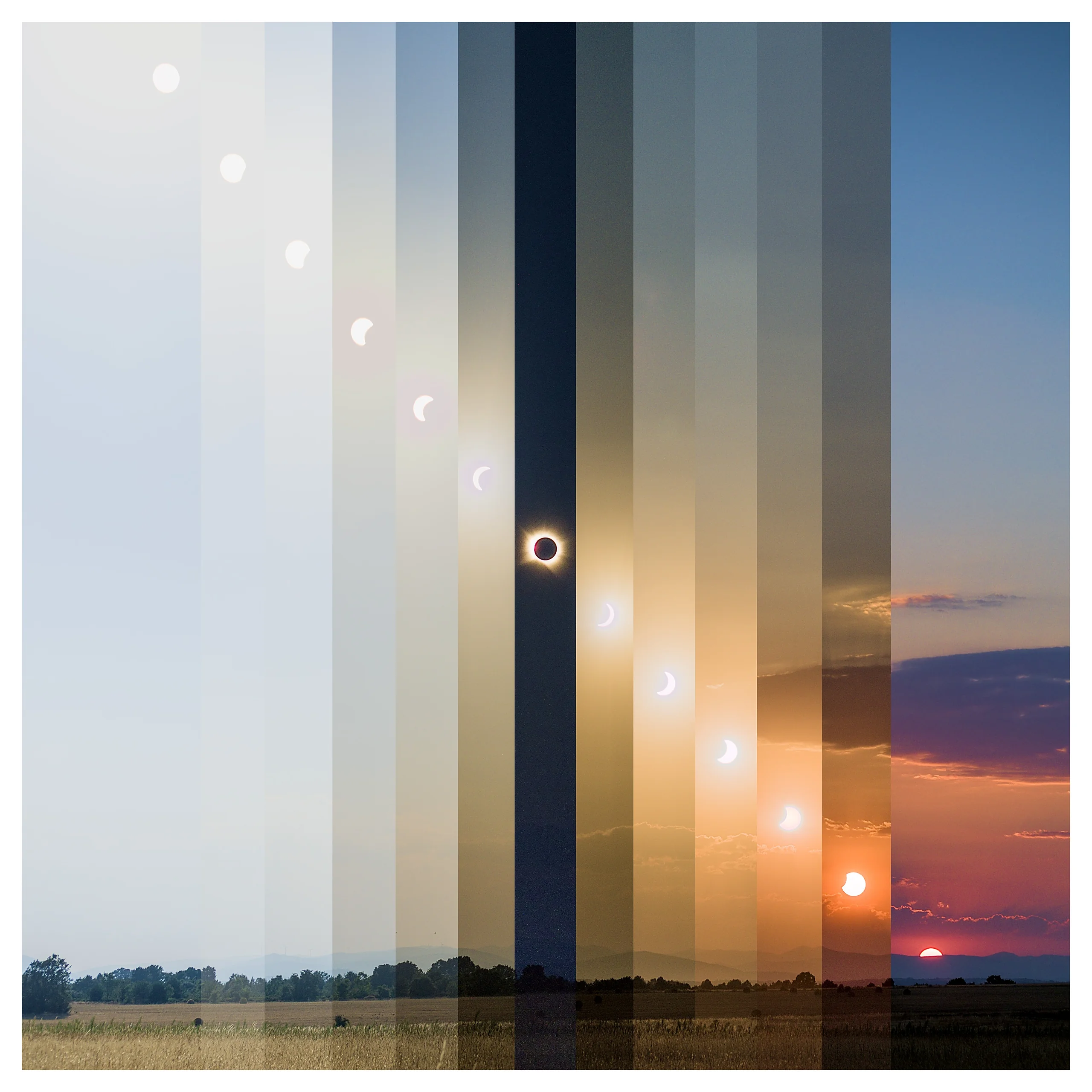
Image: NASA Astronomy Picture of the Day (APOD) | Image credit and copyright: Javier Castro; text: Keighley Rockcliffe (NASA GSFC, UMBC CSST, CRESST II) | Today's page
Today's APOD begins unusually. Before explaining anything, it asks you to pretend you know nothing:
"Pretend you've never heard of an eclipse."
The Sun has been predictable all your life. It rises, it sets, and it is there every day. Then, one day, the sky begins to change, as it does in today's image.
The picture is a composite. NASA's caption describes it precisely: the frame is divided into vertical strips, each containing a photograph of the Sun in the sky. From left to right, the Moon gradually devours the Sun and each strip grows darker. Totality occupies the central strip. Then the Sun returns while sinking toward the horizon.
Two hours are compressed into a single image. It records the total solar eclipse of Wednesday, August 12, 2026, when the Moon's shadow crossed Siberia, Greenland, Iceland, Spain and Portugal.
The Sun vanished, leaving a bright, empty ring.
What would you think?
The Answer Is Hidden in the Name: The Sun Skipped Work
APOD says the word eclipse comes from the Greek ékleipsis, meaning "abandonment." The ancient Greeks believed that an eclipse expressed divine anger: the Sun had abandoned humanity.
That is broadly true, but the dictionaries reveal something more interesting.
The first definition of ékleipsis in the authoritative Greek-English Lexicon known as LSJ is indeed "abandonment," but its examples from Herodotus concern the abandonment of ships and cities - people abandoning things, not celestial objects abandoning people. The word combines ek, "out," with leipein, "to leave," and literally conveys "a failing" or "forsaking." In its second group of meanings, alongside solar and lunar eclipses, the dictionary lists "failing, cessation."
LSJ specifically notes that this sense, when applied to the Sun and Moon, comes from the intransitive use.
That makes the Sun the subject. The Sun did not abandon us; the Sun itself failed to report for duty.
The most natural modern rendering of the ancient Greek name might therefore be: the Sun skipped work. In other settings, the word could describe a public official's dereliction, a defendant's failure to appear, or the exhaustion of one's strength. It was not a mythological term but an ordinary one: something expected to appear did not.
The oldest Chinese name took a different path.
Diviners of the Shang dynasty carved a single word into turtle plastrons: shi, "to eat."
NASA's own history of eclipses translates the oracle-bone inscription this way: "The Sun has been eaten."
Notice what is absent: there is no dog.
The story of the "heavenly dog eating the Sun" is so widespread that many people assume it is China's oldest explanation. But East China Normal University folklore professor Tian Zhaoyuan, writing about Chinese eclipse culture, concludes that the legend "probably arose quite late and appears to be connected with outside cultures." Earlier heavenly dogs - the creature in the Classic of Mountains and Seas and the meteor in the astronomical chapters of the Records of the Grand Historian - do not eat the Sun. Treating them as the source of the later story is a popular but mistaken connection.
No academic paper located for the source article identifies the first book or date in which the exact phrase "the heavenly dog eats the Sun" appeared. The most honest account is this: China's earliest name for an eclipse contains no dog, only the word "eat." The dog was added later, and no one has established when.
Two ancient civilizations: one said the Sun was eaten, the other that it failed to show up. Both names remain with us in the Chinese term for a solar eclipse and the English word eclipse.
Astronomers Still Use Those Oracle Bones
The next layer is even more intriguing.
NASA's page continues: scientists used five Shang-dynasty eclipse records - from 1226, 1198, 1172, 1163 and 1161 BCE - to study Earth's rotation. Their conclusion was that over the past 3,200 years, the length of an Earth day has increased by 0.047 second.
A sentence carved into a turtle shell became a data point in modern geophysics 3,200 years later.
The Chinese scholarship adds another complication: researchers have argued for 80 years over the dates of those same oracle bones, and the argument is not over. An article from National Taiwan University's Center for the Advancement of Science Education says bluntly that the dates of the lunar-eclipse inscriptions "have been disputed in scholarship for nearly eighty years, without a conclusion to this day." The dates of the solar-eclipse inscriptions remain unresolved because they depend in part on the identity of "Father Ding" and the chronology of King Wu Ding's reign.
NASA uses the inscriptions to measure Earth's rotation while scholars continue arguing about which year each one describes. There is no contradiction. This is what science looks like: use what the evidence can support, and continue debating what it cannot yet settle.
The Eclipse in the Book of Songs Has Resisted the Calendar for Two Millennia
The first stanza of "At the Turn of the Tenth Month," from the Book of Songs, reads:
At the turn of the tenth month, on the first day, a xinmao day, the Sun was eclipsed - a thing of great ill. The Moon was made dim, and now the Sun is dim; the people below are indeed in great sorrow.
Here "great ill" means something profoundly inauspicious. The poem records an eclipse and supplies a date: the first day of the tenth month, on the day named xinmao in the sexagenary cycle.
Chinese calendrical astronomers then began trying to determine the year.
Across roughly a thousand years, the Liang-dynasty scholar Yu, the Sui astronomer Zhang Zhouxuan, the Tang astronomers Fu Renjun and Yixing, and the Yuan astronomer Guo Shoujing made their own calculations. They identified the sixth year of King You of Zhou, September 6, 776 BCE. Modern scholars later compared that result with Austrian astronomer Theodor von Oppolzer's Canon of Eclipses, which confirms that an eclipse was visible in Asia that day.
Other scholars argue for the thirty-sixth year of King Ping of Eastern Zhou, November 30, 735 BCE. That eclipse had a greater magnitude and was visible from the Zhou capital, they say, making it a better match for the poem's description of "great ill." A lunar eclipse shortly beforehand would also fit the poem's line about the Moon being dimmed.
(The Institute of Archaeology at the Chinese Academy of Social Sciences still hosts an abstract for Feng Shi's "A Study of the Eclipse in the Book of Songs," which begins by calling it a Western Zhou eclipse. The full text was not accessible for the source article, so its conclusion is not cited here.)
A poem gave astronomy a date; astronomy has tried in return to date the poem. After two thousand years of cross-checking, the two still do not align.
That effort is more beautiful than any answer. Yu, Yixing, Guo Shoujing and Oppolzer lived across more than a millennium and half a world, yet all calculated the same shadow on the same afternoon.
An Argument at the Court of Lu in 525 BCE
China's response to eclipses became, very early, not fear but procedure.
The Rites of Zhou lists this duty for the master of drums: "When rescuing the Sun or Moon, he instructs the king to beat the drum." Elsewhere in the same text, the official called the tingshi is equipped with "the bow for rescuing the Sun and the arrows for rescuing the Moon."
The Zhou had a complete system of ritual implements devoted to "rescuing" the Sun and Moon. This was not folk superstition. It had posts, equipment and process.
The Zuo Tradition, under the seventeenth year of Duke Zhao, records an argument that arose from that system.
On the first day of the sixth month in the summer of 525 BCE, there was a solar eclipse. The invocators and scribes came to ask how much silk should be offered.
Zhaozi said: perform the rite. "When the Sun is eclipsed, the Son of Heaven does not dine in full and beats the drum at the altar of the soil; the lords offer silk at the altar of the soil and beat the drum at court. Such is ritual."
Ji Pingzi said: do not perform it. "Stop. Only on the first day of the first month ... is beating the drum and using silk proper ritual. At other times it is not." Only an eclipse on the first day of the first month required the ceremony, he argued.
The grand historian replied: this was precisely the month for it. He quoted the Documents of Xia: "When the celestial bodies do not meet properly in the mansion Fang, the blind musicians beat the drum, the officers hurry, and the common people run about." In other words, when Sun and Moon fail to meet properly among the stars, musicians drum, minor officials rush and ordinary people scatter.
Ji Pingzi refused to listen.
After the meeting, Zhaozi withdrew and made a grave remark: "The master will harbor other intentions; he no longer treats his ruler as ruler."
Two thousand five hundred and fifty-one years ago, a solar eclipse triggered not panic at the court of Lu but an administrative argument about which rule applied. Beneath that argument lay power.
There is also a fine point of textual history here. The story in which the officials Xi and He become drunk, fail to predict an eclipse and are punished comes from "The Punitive Expedition of Yin" in the Book of Documents. That chapter belongs to the forged Old Text chapters, exposed by the Qing scholar Yan Ruoqu and generally regarded by modern scholarship as a Wei- or Jin-era fabrication.
But the 16 words quoted by the grand historian in 525 BCE - celestial bodies failing to meet, blind musicians drumming, officials hurrying, common people running - are at least seven centuries older than that forged text.
The forgery copied a genuine old sentence. Even a forger needs real bricks. The drunken-official story can be told as a story, but not as reliable history; those 16 words really are ancient.
Stop: Three Continents Responded the Same Way
Now we reach APOD's central point.
The first continent was Asia Minor.
In Book I, section 74 of Herodotus's Histories, the Lydians and Medes have fought for six years without either side prevailing. During a battle in the sixth year, "day was suddenly turned into night."
Herodotus continues: when the Lydians and Medes saw day become night, "they ceased from fighting, and both were the more zealous to make peace with one another."
He also says that Thales of Miletus had foretold the event to the Ionians, naming that year.
(The eclipse is commonly dated to May 28, 585 BCE, about 2,611 years ago. But Herodotus gives no year in the original text. The date is a later reconstruction and remains disputed.)
The second continent was West Africa.
APOD says the Batammariba people of Benin and Togo understand an eclipse as a fight between the Sun and Moon, and that the community therefore encourages people to make peace with one another.
This claim proved difficult to trace, and its limits should be stated plainly. UNESCO has a World Heritage page for Koutammakou, the Land of the Batammariba, inscribed in 2004 as site 1140. In their own Ditammari language, "Batammariba" means "those who shape the earth." Their celebrated mud-tower houses are called takienta and serve not only as homes but also as "temples to ancestors." The Metropolitan Museum of Art has a detailed essay as well.
Neither of those primary pages mentions eclipses at all.
The earliest traceable source for the claim is astronomer and anthropologist Jarita Holbrook, quoted in a 2013 National Geographic report. She says that in the story, the Sun and Moon fight during an eclipse, so people "encourage the Sun and Moon to stop fighting" and treat the event as a time to come together and resolve old feuds and anger. She adds that "the myth has endured to this day."
No original academic ethnography was located. This account should therefore be read as one scholar's retelling, not as a claim anchored here in a primary record.
The third continent was East Asia.
In China, the same event prompted drums, bows and arrows, and a court dispute about procedure.
Three groups of people who did not know one another saw the same thing in the sky and made the same move: they turned their attention back to humanity.
Stopping a war, settling old grievances and debating the rules look entirely different. At heart they are the same response. Trouble appears in the heavens, and people first inspect their affairs on Earth.
APOD's final sentence says that eclipses are one example of the long connection between astronomy and society.
More concretely: when the sky became unpredictable, humanity's first thought was of other humans.
Some People Choose Not to Look
Read this part slowly.
Around the world, children are taught how to watch an eclipse safely. One people's answer is: do not watch.
The Diné, also known as the Navajo, remain indoors during an eclipse. APOD summarizes the practice this way: the event is a time of renewal, and out of respect, as well as to avoid dangerous sunlight, Diné people stay inside until the Sun and Moon separate.
Sources from Diné people and their tribal government reveal a significant distortion in that summary.
It recasts reverence as protection from sunlight.
Every source from Diné people themselves speaks of respect and reverence. The observance goes far beyond not looking. A 2017 official release from the Navajo Nation Council lists traditional protocols including remaining indoors, especially for families in which someone is pregnant or has recently given birth; not eating, drinking or sleeping; and not watching through broadcast images.
Semira Crank, a Navajo woman interviewed by NPR, explained it in the first person: "An eclipse is considered a celestial event. I was taught from a young age to have respect for an eclipse. That means I should stay inside. I can't eat, I can't drink, I can't sleep. I also shouldn't look at any reflection or at the eclipse's shadow - because this goes back to our cultural origin stories."
She added something essential: the land around Bears Ears is the ancestral home of more than ten tribes, and "each tribe has its own distinct beliefs about the eclipse."
No one Indigenous practice should therefore be presented as what "Native Americans believe."
APOD omits another detail.
The Navajo term for a solar eclipse is jóhonaa'éí daaztsą́. Navajo historian Wally Brown translates it as "the death of the Sun."
Louise Tsinijinnie, a spokesperson for the Navajo Tribal Parks, describes an eclipse as "the rebirth and renewal of everything on Mother Earth." She says: "I don't see it as a negative thing. I see it as a positive thing."
The death of the Sun and the renewal of all things are one event.
During the annular eclipse of October 14, 2023, Monument Valley and every park operated by Navajo Tribal Parks closed from 8 a.m. to 1 p.m. "We're following what we know," Tsinijinnie said. "The eclipse isn't something to be viewed, and it isn't something Diné people should watch."
For the total solar eclipse of 2017, Navajo Nation Council Delegate Nathaniel Brown invited young people to Diné College for traditional teaching and prayer. He offered three principles, each with its Navajo expression:
Ádaa áháyá, reverence. Ádaa xáhwiindzin, respect. Ádaa ákohwiindzin, self-reflection.
This is not an argument that one response is more correct than another. This publication often encourages readers to look up, but looking is not humanity's only proper answer to the sky. Some people choose not to look - not from fear of injured eyes, but from reverence.
Knowing that choice exists is itself part of astronomical education.
A 400-Fold Coincidence
Having considered people, consider the sky itself.
The existence of total solar eclipses depends on an almost absurd coincidence. NASA explains it this way:
"Even though the Sun is about 400 times larger than the Moon, it's also about 400 times farther away. This makes the Sun and Moon appear nearly the same size in our sky."
Four hundred times larger and 400 times farther away: the two factors cancel. A celestial body 1.4 million kilometers across can be covered almost exactly by one only 3,474 kilometers across, revealing the corona around it.
The universe had no obligation to arrange matters this way. It simply did.
The arrangement is also temporary. NASA says the Moon is slowly moving away from Earth, "about one inch farther away each year" - roughly 3.8 centimeters, a figure measured with laser reflectors Apollo astronauts left on the lunar surface.
Writing in Eos, the publication of the American Geophysical Union, astronomer Jean Meeus calculated that total solar eclipses will begin gradually disappearing in about 620 million years, with the last one around 1.2 billion years from now. The same article notes that Earth may become uninhabitable long before then.
(To be exact: NASA says only that the Moon is receding. It does not itself connect that recession to the eventual disappearance of total solar eclipses. Eos and Meeus make that connection.)
NASA Goddard's Robert Tyler offered a reassuring comment: "The orbital changes are so slow, I don't think there's going to be any change in our eclipse experience for the foreseeable future."
In other words: you and your children still have time.
Suns in the Shadows of Trees
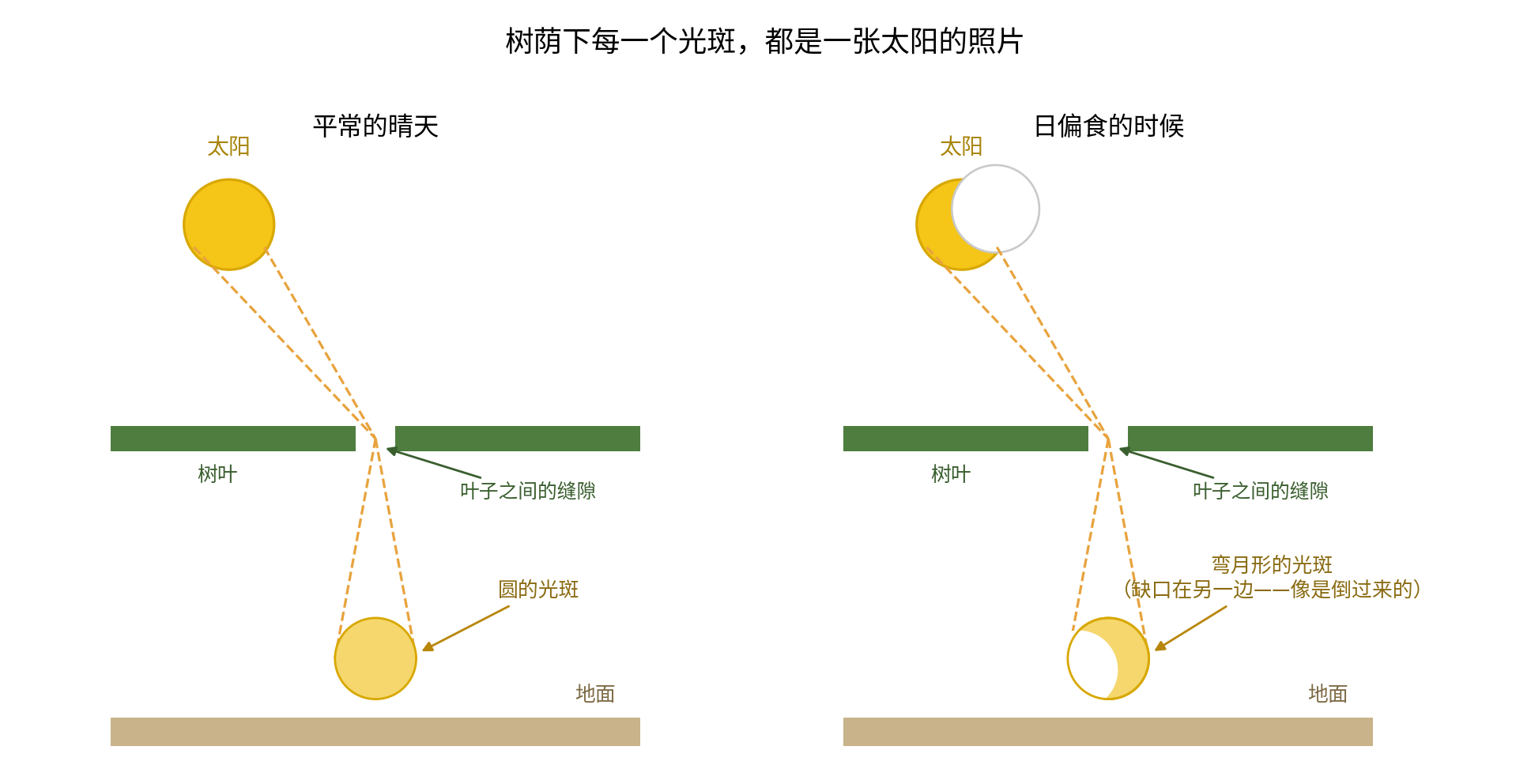
The gaps between leaves work like pinholes. During an eclipse, each patch of light on the ground is an image of the Sun with a bite missing. On an ordinary day, those round spots are complete images of the Sun. The rays cross at the gap, so the image on the ground is inverted.
Sources: APOD for September 2, 2026, and its October 15, 2023 feature An Eclipse Tree; NASA pages on eclipse history, geometry and safety; NASA Moon facts; the LSJ Greek-English Lexicon and Etymonline; Herodotus, Histories I.74, in Macaulay's English translation; "At the Turn of the Tenth Month" in the Book of Songs; the offices of master of drums and tingshi in the Rites of Zhou; the seventeenth year of Duke Zhao in the Zuo Tradition; "The Punitive Expedition of Yin" in the Book of Documents; National Taiwan University's Center for the Advancement of Science Education on oracle-bone records of solar and lunar eclipses; Tian Zhaoyuan, "A Brief Discussion of Chinese Eclipse Culture"; the Navajo Nation Council's 2017 official release; Navajo Times; NPR's October 2023 report; the Diné eclipse page created by the Exploratorium with the Indigenous Education Institute; UNESCO's Koutammakou World Heritage page (site 1140); National Geographic's 2013 report on eclipse traditions; Eos from the American Geophysical Union; timeanddate's eclipse database.