
A hand, a praying mantis, and a wild carrot flower. Here, tenderness is a measurable physical condition.
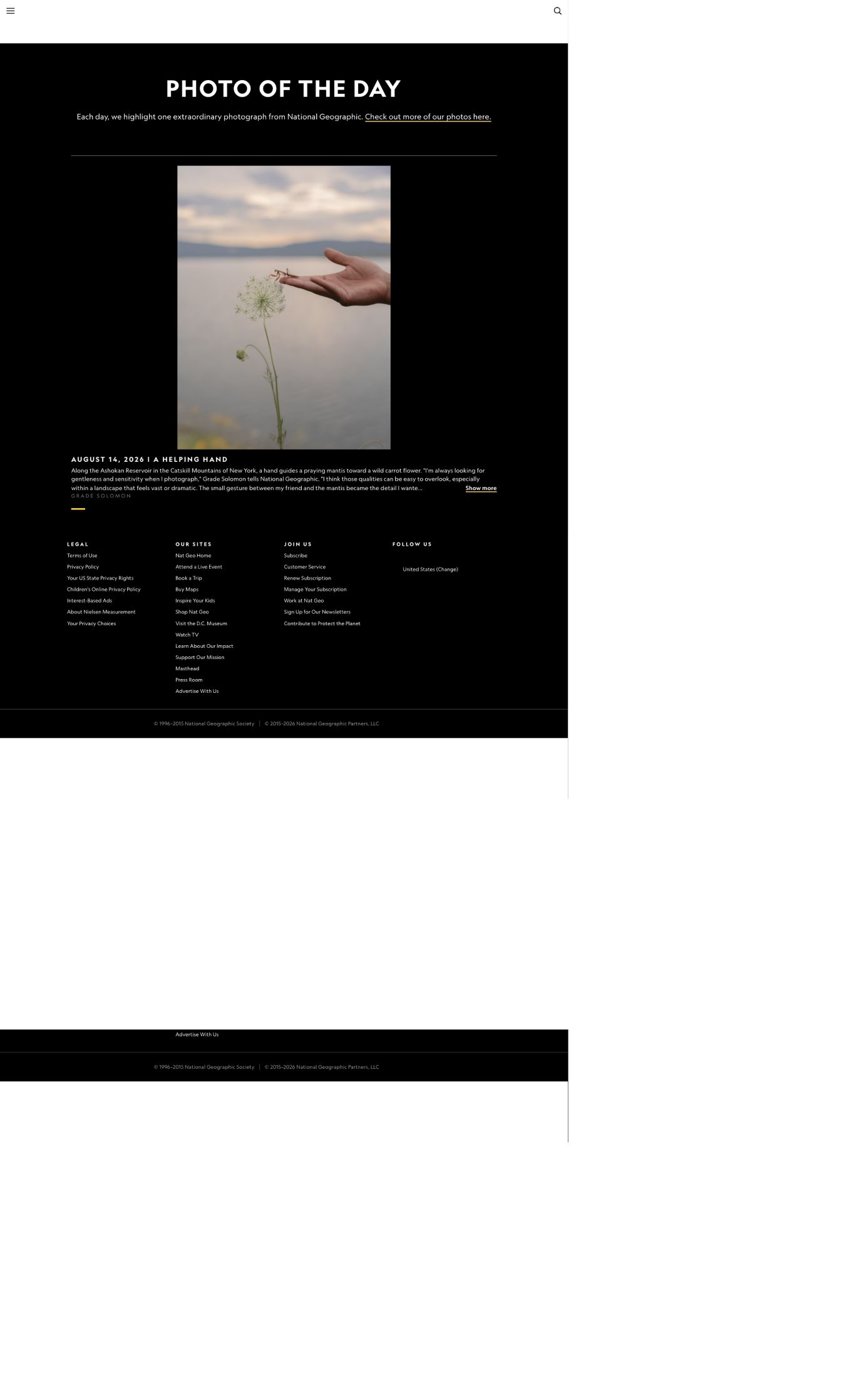
Screenshot: National Geographic Photo of the Day | Photograph: Grade Solomon | Original page
Today's National Geographic Photo of the Day has a three-word title: "A Helping Hand."
At Ashokan Reservoir in New York's Catskill Mountains, a hand is guiding a praying mantis toward a wild carrot flower. Photographer Grade Solomon told National Geographic:
With photography, I am always looking for tenderness and sensitivity, two qualities I feel are easily overlooked, especially in a landscape that feels expansive or grand. This small gesture between my friend and the mantis was the detail I wanted to hold onto.
At first, this seemed like a gentle story about tenderness. The research led somewhere harder.
The hand has to move. If it remains still, the mantis can barely see it.
That is not a metaphor.
Mantis Depth Perception Runs on a Different Algorithm
In 2016, a team at Newcastle University in Britain did something both funny and serious: they fitted praying mantises with 3D glasses.
They melted beeswax and rosin to attach two colored filters, one green and one blue, over the insects' left and right eyes. The mantises then watched virtual prey on a screen. When the display created the binocular disparity of prey floating in front of the screen, the mantises struck significantly more often than the controls. The paper appeared in Scientific Reports. Its conclusion was direct: the experiment definitively demonstrated stereopsis in mantises.
That was interesting enough. The real reversal came two years later.
In 2018, the same team published a follow-up in Current Biology titled "A Novel Form of Stereo Vision in the Praying Mantis." The researchers found that mantis depth perception does not work on the same principle as ours.
Human stereopsis works by giving each eye a slightly different image. The brain compares the patterns point by point, finds matching features, and calculates distance from their displacement. It is a powerful system, but it has a prerequisite: the patterns seen by the two eyes must match.
A mantis does not compare patterns. It does one thing: locates regions where brightness is changing in each eye's image, then compares those regions' positions between the eyes.
The consequences are deeply counterintuitive. Three findings from the paper's abstract deserve to be stated plainly.
First, mantises can judge depth in random-dot images that are entirely uncorrelated between the eyes, a problem human stereopsis cannot solve.
Second, there was no evidence that mantis stereopsis works for stationary images.
Third, when luminance patterns do not match between the eyes, mantises outperform human observers at judging depth.
Now return to the photograph.
A motionless hand barely exists to the mantis as an object in depth. Only when the hand moves does it spring into three dimensions. A slowly approaching hand therefore sits at a threshold in the mantis's visual world: slow enough not to trigger a strike or escape, yet still moving, because otherwise the insect cannot know how far away it is.
That is why tenderness here is a measurable physical condition. Slowness and motion are not photographic techniques. Together, they are the only solution allowed by the mantis's visual algorithm.
The mantis should not be called the only animal with stereopsis. Researcher Jenny Read's review describes it as the only insect so far shown to have stereopsis. Depth perception has also been demonstrated in cephalopods such as cuttlefish.
It Slows Down for Slow Prey
Another study fits precisely against that discovery.
A 2020 paper in Biology Letters by Rossoni and Niven used video recorded at 200 frames per second to analyze the predatory strike of a Madagascan marbled mantis, not a North American species. The median total strike duration was 100 milliseconds, with a full range of 60 to 290 milliseconds. The median approach phase lasted 67.5 milliseconds and the sweep phase 35 milliseconds.
More interesting than the speed was the structure. A mantis strike is not a fixed ballistic reflex. It changes with the prey's speed:
When prey approached slowly, the strike's approach phase was slower and included pauses. When prey approached quickly, the approach was fast and the pauses disappeared.
The proportions were specific. Pauses occurred in 56 percent of strikes at slow prey moving 200 millimeters per second, 25 percent at the intermediate speed of 330 millimeters per second, and only 9.4 percent at the fast speed of 730 millimeters per second.
A slowly approaching hand therefore does not provoke an all-out counterattack. It elicits a slower, watchful approach interrupted by pauses. The photograph's calm moment contains two parties slowing down.
The common comparison "faster than a blink" is omitted because a reliable duration for a human blink could not be verified.
It Has One Ear on Its Chest, Just for Bats
A praying mantis has one ear on the midline of its thorax, not a pair. It sits on the metathorax. David Yager and Ronald Hoy reported the discovery in Science in 1986 under the title "The Cyclopean Ear: A New Sense for the Praying Mantis."
According to National Geographic's own reporting, this ear in the center of the chest detects frequencies above 20,000 hertz, just beyond the range of human hearing. Bats use those frequencies. In response to a bat's echolocation calls, a flying mantis makes a steep, spiraling dive that the report said succeeds about 80 percent of the time. The same article described another strange finding by Yager and graduate student Jeffrey Triblehorn: 300 milliseconds before a bat strikes a mantis, the insect's auditory nerve falls completely silent.
The 80 percent and 300-millisecond figures could be traced only to National Geographic's account, not to the corresponding original papers, so they are attributed accordingly.
An insect evolved a single ear on its chest for a predator that appears only at night. Evolution does not build without a cost. That ear implies that bats killed enough mantises to make it worth having.
Which Mantis Is in the Photograph?
No source has identified the species in this photograph, so no identification can be made here.
Three mantises may be encountered in New York State in August.
The Carolina mantis (Stagmomantis carolina) is native, roughly 5 to 6 centimeters long, with shorter wings that leave more of the abdomen exposed.
The European mantis (Mantis religiosa) is about 7.5 centimeters long and was first found in Rochester, New York, in 1899. Its most reliable field mark is a spot on the underside at the base of the foreleg, close to the body. The spot may be solid black or black with a white center, the latter forming the familiar bull's-eye.
The Chinese mantis (Tenodera sinensis) is the largest of the three and the largest mantis in North America. It can exceed 10 centimeters, although sources measure it differently: some give 3 inches for males and 3 3/8 inches for females, while others say slightly more than 11 centimeters. Brown individuals often carry a pale green longitudinal stripe.
The Chinese mantis reached North America around 1896, accidentally arriving with nursery stock in Philadelphia's Mt. Airy neighborhood, reportedly brought in unknowingly by a nursery worker. University of Illinois Extension says it was "first noticed" in 1897. The one-year discrepancy probably reflects the difference between introduction and first recorded observation.
Its native range is China, Japan, and the Korean Peninsula.
That gives Chinese readers a small reunion: North America's largest mantis is Chinese in origin. The large mantis once seen in childhood grass or on a window screen may well have been this species. A photograph made in New York is not entirely a foreign encounter.
Praying mantis boxing, or tanglangquan, is traditionally said to have been created in Shandong by Wang Lang. The date itself has two versions: most traditions place Wang at the end of the Ming and beginning of the Qing, around 1650, while another places the art in the Song dynasty. Many martial-arts scholars doubt that Wang Lang existed and regard the style as a fusion of several Shandong systems. Some lineages even insert fictional figures from Water Margin into its ancestry. Its basic principle is to deflect first, then strike with precision, using whip-like circular movements to shed a direct attack before hitting vital points quickly.
The high-speed study above found that real mantises slow down and pause for slowly approaching prey, reserving full speed for fast targets. The old martial idea of judging when to yield and when to accelerate was quantified centuries later by a 200-frame-per-second camera. This is an illuminating analogy, not evidence that ancient practitioners knew the modern result.
A 70-Year-Old Myth
The claim that killing a praying mantis brings a fine, or that mantises are legally protected, is a myth. It has never been true.
Lois Miklas, area coordinator for Penn State Extension's Master Gardener program, put it plainly:
The rumor that killing a praying mantis carries a fine began in the 1950s and is still circulating. It is not true, and it never was.
The myth's survival is revealing. Searches for it are dominated by content farms and pest-control SEO pages that copy one another while disagreeing. The rumor survives because entomologists do not occupy the search results. University extension services, museums, and government agencies are more reliable sources for inherited claims about nature.
Another common claim also needs correction: New York's state insect is not a mantis. It is the nine-spotted lady beetle (Coccinella novemnotata), designated in 1989. The irony belongs instead to Connecticut, whose state insect has been the European mantis since October 1, 1977. Connecticut's own page acknowledges that the mantis is not native to the state, but to North Africa, southern Europe, and temperate Asia.
A state chose a nonnative insect as its emblem and says so openly.
Darwin Guessed at the Purple Dot, and No One Has Settled It
The flower is wild carrot (Daucus carota), also called Queen Anne's lace. It is the wild ancestor of the cultivated carrot. In North America it is not native; colonists brought it as a medicinal plant, and it later became naturalized.
Its flat-topped umbel can hold as many as 1,000 minute white flowers. At the center of that white expanse there is often one dark purple floret.
What does it do?
Science still has no settled answer. That is what makes it worth noticing.
Darwin regarded it as a functionless, vestigial remnant. Later hypotheses proliferated. It might mimic an insect, persuading a passing insect that another is already feeding there; a 2009 paper in Plant Species Biology asked directly in its title whether it was insect mimicry. It might be an attractive signal at long or short range, a repellent signal, or an anti-herbivore defense. A 2013 paper in the same journal put three competing hypotheses in its title: attraction, guidance, or repulsion?
An experimental study published in the Journal of Pollination Ecology in 2018 answered: it depends. At the population's average height of 120 centimeters, the presence or absence of the dark floret made no difference to visitation. At the lowest height, 81 centimeters, umbels retaining the dark floret received significantly more visits. The researchers concluded that umbel height rather than diameter mattered, and that the floret's function depends on ecological context, including the local visitor community and the predominant phenotype of surrounding flowers. Different visitor groups responded differently to removal of the floret at different sites, and even in different years within the same population.
A question debated since Darwin, without consensus after roughly 150 years, sits at the center of one of the commonest roadside flowers. Its unresolved evidence is visible: some wild carrot umbels have the purple dot and some do not, and insects do or do not land on it.
A Rule That Can Save a Life
Wild carrot has a close relative that can be fatal when misidentified.
Poison hemlock (Conium maculatum) resembles wild carrot. Both are white-flowered members of the carrot family. The most reliable distinction is on the stem:
Wild carrot stems are densely covered with coarse hairs. Poison hemlock stems are smooth and hairless, with red or purple blotches. On mature plants the blotches may merge until the whole stem appears purple. Penn State Extension says wild carrot "rarely exceeds two feet in height," while second-year poison hemlock can reach 3 to 6 feet. Poison hemlock also lacks the dark central floret. Another deadly lookalike is water hemlock (Cicuta maculata).
The shortest rule is that hairy stems belong to wild carrot; smooth, purple-blotched stems do not. The safer baseline is not to pick or eat an unidentified member of the carrot family, or smell a broken stem. The hand in the photograph may guide a mantis, but it should not touch a plant it cannot identify.
Penn State's page says only that poison hemlock is toxic to people and animals and does not identify a specific toxin, so none is named here.
The Landscape Is a Filter for Nearly Ten Million People
The photograph's location is itself a story about why wild land is protected, told through tap water.
Ashokan Reservoir is owned and managed by the New York City Department of Environmental Protection. Construction began in 1907, and the reservoir entered service in 1915 after Esopus Creek was dammed. At full capacity it holds 122.9 billion gallons. It lies 73 miles north of New York City and sends water toward the city through the 92-mile Catskill Aqueduct. Outside drought periods, it supplies about 40 percent of the city's daily drinking water. New York State's Department of Environmental Conservation gives a surface area of 8,315 acres, 44.3 miles of shoreline, a maximum depth of 180 feet, and 5.5 miles of dams and dikes.
The name Ashokan means "place of fish." It was a name about water even before the valley was flooded.
The cost was specific: about 2,000 residents were displaced and 12 communities inundated. In the west basin alone, 504 homes, 9 blacksmith shops, 35 stores, 10 churches, 10 schools, 7 sawmills, and 1 gristmill were demolished or moved. Nearly 12.5 miles of railway were relocated, and cemeteries were reinterred. Some communities survived after rebuilding on the shore, including West Shokan, Olivebridge, Ashokan, and Shokan. Others, such as Brown's Station, are now represented only by a roadside historical marker.
Then comes the arresting fact.
New York City's tap water is unfiltered.
The National Academies' 2020 Review of the New York City Watershed Protection Program calls the combined Catskill/Delaware system the largest unfiltered water supply in the United States. Its main treatments are chlorination and ultraviolet disinfection. The system supplies about one billion gallons a day to more than 8.5 million people in New York City and roughly one million in nearby counties. Gravity alone carries the water from 2,000 square miles of land in three upstate watersheds. An April 2026 NYC DEP release put the service population at "nearly 10 million."
The exemption has a formal name, the Filtration Avoidance Determination. It is issued by the New York State Department of Health, not the Environmental Protection Agency, because New York has delegated enforcement authority. A 1997 memorandum of agreement established its requirements. The National Academies reviewed the program in 1999 and again in 2020. NYC DEP is now consulting with the state health department on another ten-year renewal.
Why does that matter?
New York avoided building a filtration plant, but in return it must keep the forests upstream as forests.
The water is not cleaned in a factory. It is cleaned among roots, in soil, moss, and streams. A billion gallons of drinking water each day depends on Catskill woodland.
The soil beneath the wild carrot in this photograph is part of the filter for nearly ten million people.
Here, protecting wild country is not a sentiment. It is a bill that comes due every day.
And the Watershed Is Open to the Public
New York City did not simply fence off this source of drinking water. The Ashokan Rail Trail opened in fall 2019.
It runs 11.5 miles, about 18.5 kilometers, along the reservoir's north shore from West Hurley to Boiceville. It was planned and built through a historic partnership between Ulster County and NYC DEP. The trail is free, open from sunrise to sunset year-round, and requires no DEP access permit. Its permitted uses include walking, leashed dogs, cycling, running, nature observation, cross-country skiing, and snowshoeing. Its three trailheads are Woodstock Dike, Ashokan Station, and Boiceville Bridge.
Fishing or boating in the reservoir does require a free DEP watershed access permit. The water contains brown trout, rainbow trout, smallmouth bass, white perch, and walleye, among other fish. More than 16,000 brown trout are stocked each spring. Ice fishing is prohibited. The surrounding area is also a place to observe bald eagles.
A city lets the public walk beside its vital water supply because helping people care about a place can itself help protect it.
The Photographer
One discovery about Grade Solomon makes the photograph suddenly coherent.
He is not a wildlife photographer.
Born in 1999, Solomon is a Korean American portrait and editorial photographer living in Ridgewood, Queens. He earned a BFA from Virginia Commonwealth University in 2022. He received a 2026 Hopper Prize, and his work was selected for the Smithsonian National Portrait Gallery's Outwin Boochever Portrait Competition and its traveling exhibition from 2022 to 2024. His photographs have appeared in The New York Times and New York magazine. His book Twist is held by the Aperture Foundation and Pratt Institute; other institutional collections include Harvard's Fine Arts Library and the New York Public Library.
A 26-year-old portrait photographer had entered the collections of the National Portrait Gallery and Harvard. When he turned his camera toward an insect, he still photographed a relationship. The subject is not the mantis alone but the gesture between a hand and a mantis. Solomon said it was the small gesture between his friend and the insect. The hand belongs to his friend. This remains a photograph about a person.
No one needs to become a naturalist before looking closely at something. This image required only attention, a crouched perspective, and a hand willing to slow down.
But the hand had to move. Otherwise the mantis could not see it.
Image: National Geographic Photo of the Day | Photograph by Grade Solomon, Nat Geo Image Collection | Original page.
Sources
National Geographic Photo of the Day, August 14, 2026, "A Helping Hand"; Nityananda et al., Scientific Reports (2016), on 3D glasses for mantises, and Current Biology (2018), on the new mechanism of mantis stereopsis; Read, Philosophical Transactions of the Royal Society B (2022), review; Rossoni and Niven, Biology Letters (2020), on strike speed and structure; Yager and Hoy, Science (1986), on the mantis's single ear, and National Geographic reporting on mantis hearing; University of Illinois Extension and North Carolina State Extension on mantis identification and egg cases; University of Kentucky Entomology; Utah State and Kansas State extension assessments of mantises as biological control; Penn State Extension on poison hemlock, and Lois Miklas's account of the mantis-fine myth as reported by LancasterOnline; Connecticut's official state-symbol page and Statesymbolsusa on New York's state insect; University of Wisconsin-Madison Extension and the North Carolina State plant guide on wild carrot; Goulson et al. (2009) and Polte and Matthies (2013), Plant Species Biology; Gonzalez et al., Journal of Pollination Ecology (2018), on the context-dependent dark floret; Nyffeler et al., Wilson Journal of Ornithology (2017), global review of mantises preying on birds; NYC DEP's Ashokan Reservoir page and April 2026 release; the New York State Department of Environmental Conservation's Ashokan Reservoir page; National Academies, Review of the New York City Watershed Protection Program (2020); Wikipedia's Ashokan Reservoir entry; the Ashokan Rail Trail website and Ulster County materials; the Lost Ladybug Project and Cornell University's 2011 report on rediscovery of the nine-spotted lady beetle; "When Citizen Science Highlights Alien Invasive Species in France" (2020); the iNaturalist "Mantis Mania" project; and Grade Solomon's website and profiles in Booooooom, WhiteWall, LensCulture, and Musée Magazine.