
A composite photograph, a field of flowers facing the wrong way, and a question about thresholds.
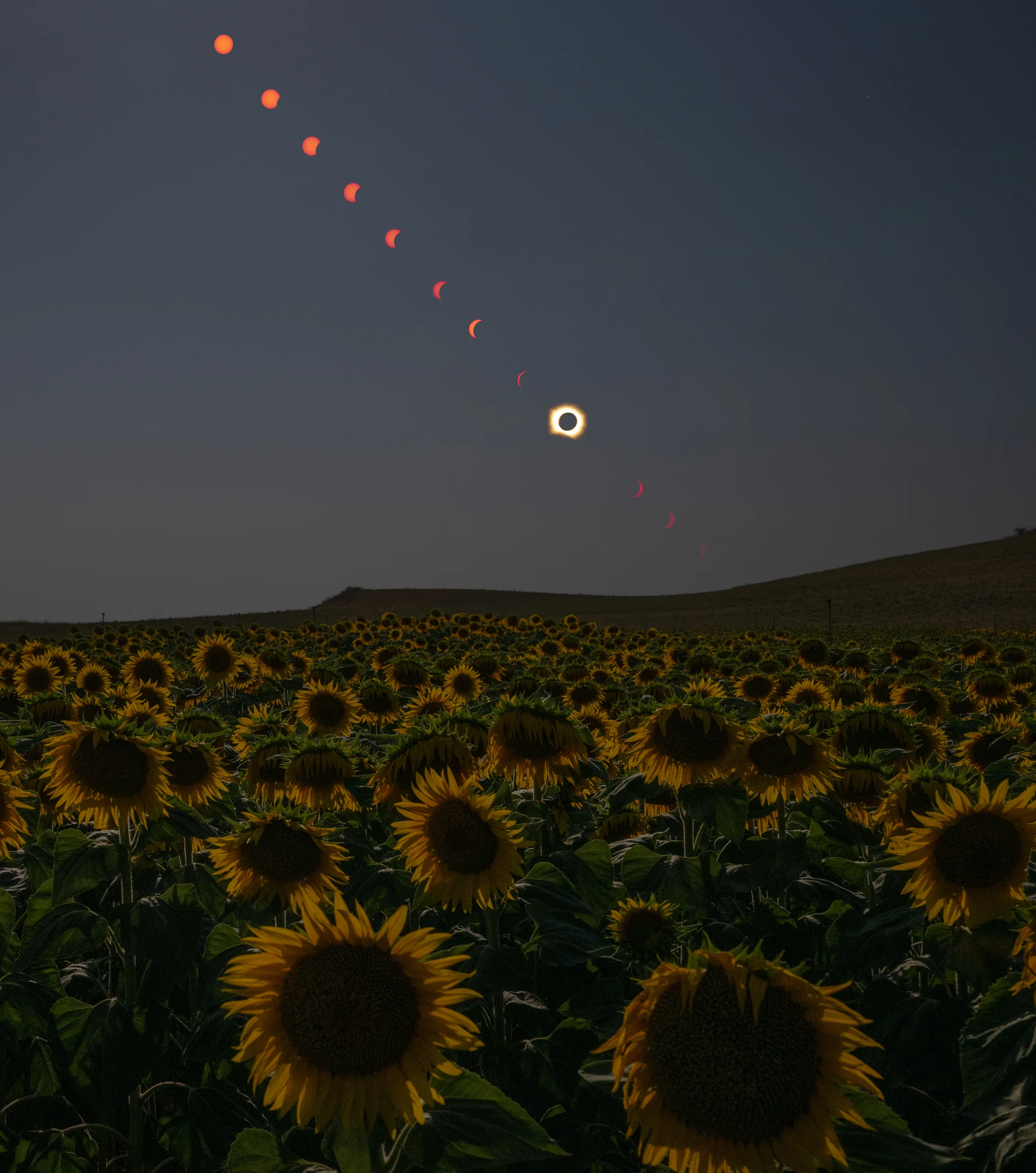
Image: NASA Image of the Day | Image credit: NASA/Bill Ingalls | Image page
NASA's photographers brought back hundreds of images from the August 12 total solar eclipse, whose path crossed Greenland, Iceland, northern Russia, the Atlantic, Spain and a corner of Portugal. They photographed the solar corona, enormous prominences and a silver-white ring above Zaragoza's Basilica of Our Lady of the Pillar.
Two days later, NASA selected one photograph for Image of the Day. It was not the most spectacular frame.
It chose a sunflower field.
What Is in the Picture
This is a composite photograph. A sequence of suns moves from left to right, beginning as a complete disk, slowly bitten away until it becomes a black circle, then slowly restored. On the ground is a field in northern Spain, flower heads packed together all the way to the horizon.
The place is San Millán de los Caballeros, about 40 kilometers south of León in the Esla River valley. According to 2004 census data cited by Wikipedia, the village had 179 residents. It appears in NASA's image collection for one reason: most of this eclipse's path of totality lay over the sea, and this village happened to stand on one of the few pieces of land it crossed.
The photographer was Bill Ingalls. A senior contract photographer at NASA Headquarters since 1989, he has photographed Kennedy Space Center, the interior of an active volcano in Alaska, returning space capsules on the Kazakh steppe and Neil Armstrong's burial at sea. He was the second photographer to receive the National Space Club Press Award; the first was Edward R. Murrow.
NASA's Earth Observatory records the timing in León. The partial eclipse began at 19:32 local time, totality began at 20:28 and lasted about two minutes, and the eclipse ended at 21:22. In Beijing time, those moments were 01:32, 02:28 and 03:22 on August 13. The eclipse therefore happened close to sunset, with the vanishing Sun low in the western sky.
Remember the direction. Everything that follows depends on it.
An Entire Field Was Facing the Other Way
Almost everyone remembers one fact about sunflowers: they follow the Sun.
That statement is only half true, and it is the less important half.
On August 4, 2016 - exactly ten years ago - Benjamin Blackman of the University of California, Berkeley, and Stacey Harmer of the University of California, Davis, published a study in Science that explained what sunflowers actually do:
The seedlings turn. The flowers do not.
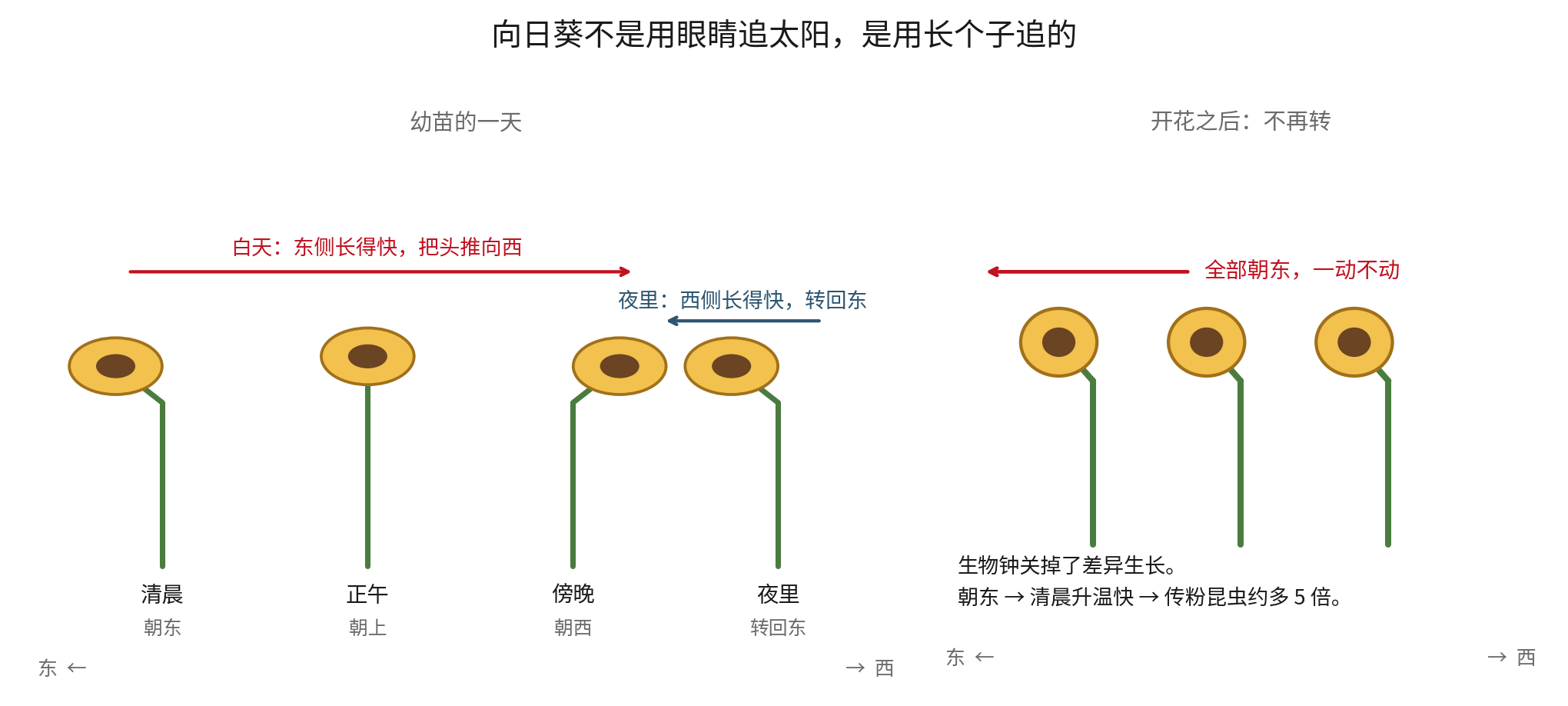
Young sunflowers really do track the Sun all day, but they have neither joints nor muscles. They move by making the two sides of the stem grow at different rates. During the day, the eastern side grows faster, pushing the tip west. At night, the western side takes over, slowly turning the head east again before dawn to await sunrise. When researchers immobilized plants or turned their pots in the wrong direction, the rhythm broke down; those plants accumulated less biomass and leaf area than companions that tracked the Sun normally.
Genes in the circadian clock control this movement. Once the plant matures and the flower head opens, the clock switches off that differential growth. The flower then faces east permanently and no longer moves.
Why east? An east-facing flower warms faster in the morning, and warm flower heads are far more attractive to pollinators. The study measured a difference of about fivefold.
Sunflowers follow the Sun as a way of growing, not as a way of watching it. The most important decision in their lives is the decision to stop.
Now place the two facts together. By mid-August in León, most sunflowers in the field would have matured and bloomed. At 20:28, during those two minutes of totality, the Sun hung low in the west.
If the field was indeed mature - as sunflowers in Spain generally are by mid-August - then while every person looked up at the western sky, an entire field of sunflowers stood quietly facing east and did not move.
But the Plants Were Fooled
The flower heads did not turn, but that does not mean nothing happened.
An eclipse presents plants with a peculiar event. Light disappears over tens of minutes and returns over tens of minutes, at the time of day when neither should happen. Researchers have used several eclipses to watch the response.
During the total solar eclipse of March 29, 2006, a team measured seven field-grown cereal and legume crops, publishing the results in Atmospheric Chemistry and Physics. In some species, photosynthesis fell below one fifth of its earlier rate, reaching minima between 3.13 and 10.13 μmol CO2 m^-2 s^-1. The real surprise involved the stomata. The sudden loss of light and the resulting rise in carbon dioxide inside the leaf both should have told them to close, but they did not. The authors concluded that photosynthesis had stalled at the photochemical stage, not at the stomata.
The plants stopped cooking, but did not close their mouths.
During the American total solar eclipse of August 21, 2017, another team monitored big sagebrush in Wyoming. Their results, published in Scientific Reports, were more detailed. During totality, stomatal conductance fell by 83%, from 0.012 to 0.002 mol H2O m^-2 s^-1, while transpiration fell by 70%. Leaf water potential was -2.8 MPa 30 minutes before totality and rebounded to -2.3 MPa just after it. The researchers estimated that, across regions of the path dominated by big sagebrush, carbon assimilation for the day fell by about 14%.
The paper contains one especially revealing detail: changes in temperature and vapor-pressure deficit lagged changes in radiation by 9 minutes.
That is the fundamental difference between an eclipse and a cloud. Ordinarily, light and heat move together. A cloud blocks the Sun, the light dims and the air cools, so a plant's sensing systems receive the same message. During an eclipse, the light is completely removed within two minutes while air and soil have not yet had time to cool. Thermal inertia delays the temperature message by a full 9 minutes. For once, the plant received two contradictory signals, and its response fell out of step. The paper also notes that photochemical efficiency (Fv'/Fm') recovered to only 87% of its dark-adapted state during such brief darkness. Two minutes was not enough to complete a genuine switch into night mode.
Birds Responded Only to the Final 1%
A 2024 eclipse study pushed the idea toward an even more interesting conclusion.
During the April 8, 2024, total solar eclipse across North America, researchers used Haikubox, a public-science network of small acoustic monitors that automatically identify bird calls. They selected 344 stations with no human voices during the eclipse and published the results in Scientific Reports.
The conclusion was strikingly clean:
Only at stations where the Sun was more than 99% obscured did birdsong decline by a statistically significant amount - an average of about 3.49 fewer vocalizations per 180 seconds, with p = 0.0493. The decline began around totality and lasted about 12 minutes. Stations with less than 99% coverage showed no measurable change. Weather variables - temperature, humidity, wind, cloud cover and latitude - together explained only 11% of the difference.
The same species also behaved in opposite ways at different sites. An American robin sang straight through at one station. A pine siskin fell completely silent at maximum eclipse at another. Black-capped chickadees produced opposite responses at two locations.
This is the word "threshold" made visible.
A Sun that is 99% covered sounds nearly gone. But the Sun is so bright that the remaining 1% still lights the sky like an overcast day. Birds do not think it is night; insects do not begin calling; flowers do not close. Nothing happens. Only when the last trace of light is removed does the world click into another state.
A partial eclipse and a total eclipse are therefore not two degrees of the same event, but two different events. This is why eclipse chasers cross half the world to stand inside a band only tens of kilometers wide: outside the path, the event resembles weather; inside it, the world switches modes.
In Nine Years, the Path Will Cross Beijing
This eclipse was not visible from China, but the country will lie beneath another path of totality in nine years.
According to media summaries of the timetable, on Sunday, September 2, 2035, a path of totality will run east from Xinjiang through Gansu and Inner Mongolia, crossing northern Shanxi, Hebei, Beijing, Tianjin and southern Liaoning. Beijing will experience about two minutes of totality. Several reports call it the city's first total eclipse in nearly four centuries, but no authoritative source for the specific earlier year was found.
An earlier eclipse will cross China on March 20, 2034. Its path of totality lies across remote, high-altitude areas of northern Tibet and southwestern Qinghai. Totality will last about 1 minute 40 seconds and occur close to sunset, making observing conditions demanding.
Nine years is a long interval. A child now in primary school will probably be in high school when the 2035 shadow reaches Beijing.
Sources: NASA Image of the Day, "Total Solar Eclipse in Sunflower Field"; NASA Earth Observatory, "A Sunflower's View of Totality"; Wikipedia entry for San Millán de los Caballeros; Bill Ingalls's personal biography; Atamian et al., "Circadian Regulation of Sunflower Heliotropism, Floral Orientation, and Pollinator Visits" (Science, 2016), and the University of California, Berkeley, research release; a 2008 Atmospheric Chemistry and Physics paper on the effects of the 2006 eclipse on field crops; a 2019 Scientific Reports paper on big sagebrush hydraulic and photosynthetic responses during the 2017 eclipse; a 2025 Scientific Reports study of avian eclipse responses using the Haikubox acoustic network; Sina Finance reporting on the schedule of total solar eclipses over China in 2034 and 2035.