
Sunrise at Lake Magadi, Kenya. Today is World Lake Day.
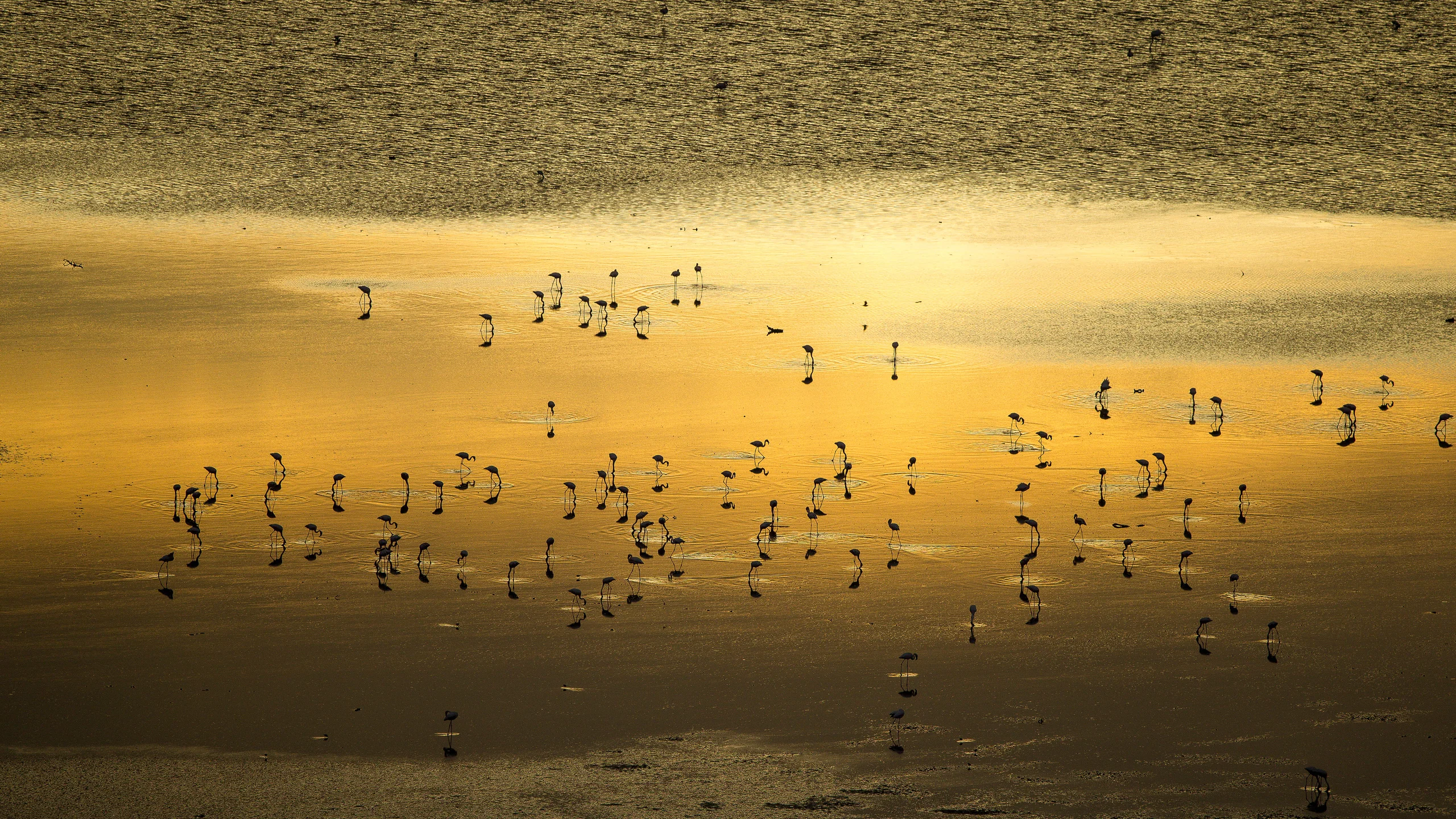
Image: Bing Daily Wallpaper · Lesser flamingos at sunrise, Lake Magadi, Kenya (© Denis-Huot/Nature Picture Library) · View on the Bing homepage
Open Bing today and the homepage is pink. Dawn has barely arrived. Light comes in at an angle, the water is almost perfectly still, and thousands of birds stand in the shallows with reflections as sharp as their bodies. The whole image looks not quite awake.
This is Lake Magadi in southern Kenya. The birds in the water are lesser flamingos.
Water Almost Nothing Can Live In
Begin with something that does not sound like a landscape photograph: this water is alkaline enough to burn human skin.
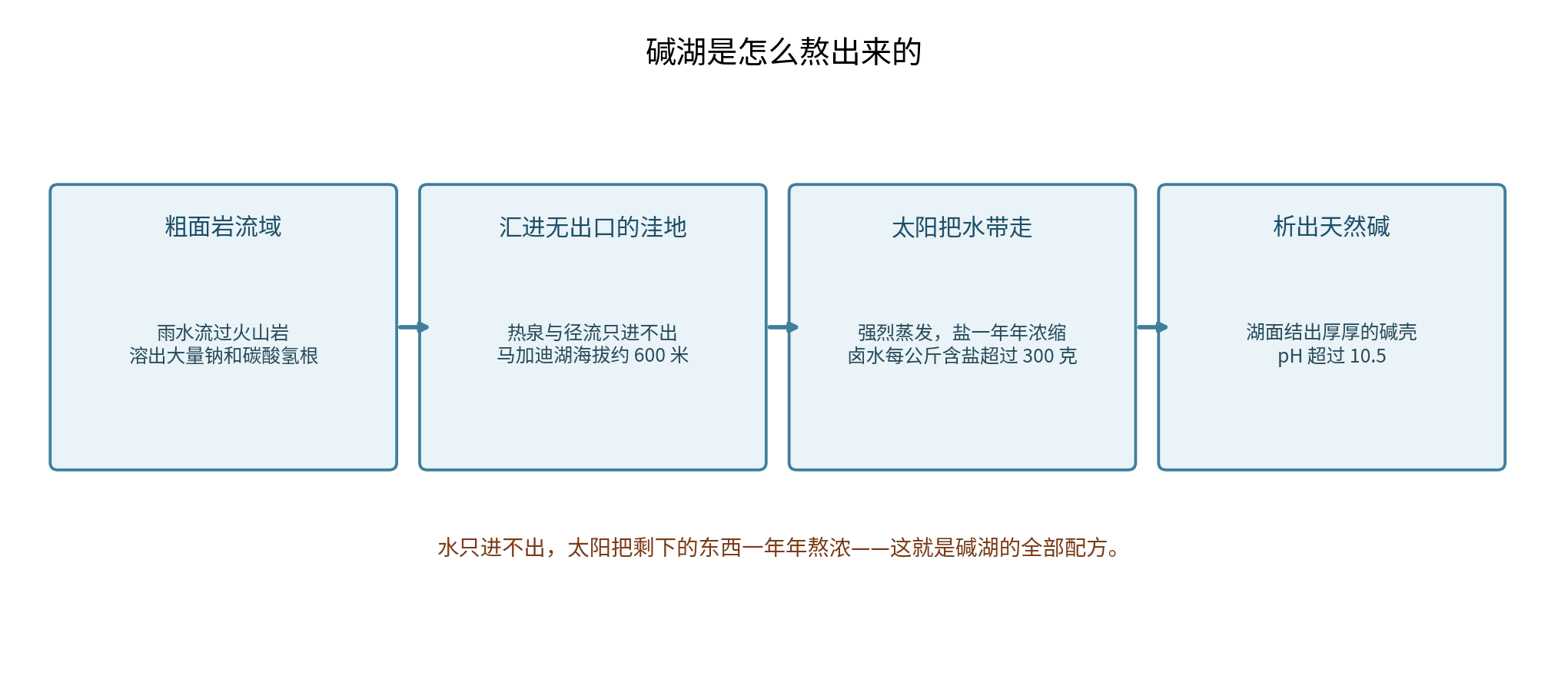
Lake Magadi sits on the floor of the East African Rift at an elevation of roughly 600 meters. It occupies an undrained basin: water enters but does not leave. The surrounding volcanic rock is mostly trachyte. Rainwater and underground hot springs leach large quantities of sodium and bicarbonate ions from that rock and carry them into the basin. Then the Sun takes over. The water disappears, the salts remain, and the solution grows more concentrated year after year. Dilute inflows contain less than 0.1 gram of salt per kilogram; residual brines on the lake bed contain more than 300 grams per kilogram, several times the salinity of seawater. The pH exceeds 10.5.
A white layer forms across the surface: natural trona, or sodium sesquicarbonate. This is not a metaphor but a hard mineral crust, tens of meters thick in places. People have mined it here continuously since 1911. Strangely, this is a mine that grows back. The hot springs keep delivering fresh alkali.
Measured spring temperatures along the lake shore are just above 45 degrees C. Farther north, around Little Magadi, spring vents can reach 86 degrees C.
Scalding, more alkaline than detergent and bitter with salt: it sounds like water in which nothing should survive.
Yet It Is the Safest Nursery in the World
Now turn the problem around.
No animal that comes to eat a lesser flamingo can survive here.
NASA's Earth Observatory puts the advantage of these alkaline lakes plainly: predators avoid them, leaving the chicks in peace. The caustic water is a moat, except this moat was not dug. It was evaporated into being.
Why are the flamingos unharmed? Their legs are covered by thick, leathery skin. Limnologist David Harper, who studies African lakes, is explicit: flamingos evolved skin that can withstand this water; people did not, and a person's legs would die if immersed for too long. The widespread claim that soda water burns flamingo legs is therefore a misunderstanding. It burns everything else, not the flamingo.
Salt glands in the head discharge excess salt through the nostrils. When thirsty, the birds can even drink water close to its boiling point.
But that is not the cleverest part. The substance that makes this water so hostile is also exactly what nourishes the flamingo's only food.
It Eats What the Alkaline Water Grows
Lesser flamingos eat almost one thing: filamentous cyanobacteria in the genus Arthrospira, commonly called spirulina, with a small amount of benthic diatoms. That remarkably narrow diet was the conclusion after more than 150 samples across 44 habitats in seven countries.
Spirulina thrives precisely in highly alkaline water. In other words:
The alkali is both wall and dining room.
The lake excludes almost every competitor and grows food that only the flamingo can exploit. It is hard to imagine a more complete arrangement.
The pink also comes from that meal. Spirulina contains carotenoids. The red pigment passes from food into feathers, so the field of pink in the photograph is, at bottom, the color of an entire lake of algae.
Feeding With More Precision Than a Machine
The way it eats is worth a detour.
A feeding flamingo holds its head upside down, with the upper bill underneath. Unlike our upper jaw, its upper bill is not rigidly fused to the skull. Once inverted, the "upper" bill is the part opening and closing. Rows of horny lamellae line the bill and work much like baleen in a whale's mouth: water flows in and food is strained out. The lesser flamingo has the finest filter in the family, capable of trapping single-celled algae less than half a millimeter across.
The tongue works like a piston, pumping water back and forth as many as four times a second.
A 2025 study in the Proceedings of the National Academy of Sciences added another ingenious layer. High-speed video and fluid experiments showed that flamingos actively make small vortices with their heads, bills and feet, drawing in fast-swimming prey. Bill chattering occurs at about 12 times per second, while the head retracts at roughly 40 centimeters per second. Chattering alone increased the capture rate about sevenfold. The experiment involved living zoo flamingos but did not identify the species, so strictly speaking, whether lesser flamingos share the technique remains to be demonstrated.
A Fish Lives in 45-Degree Alkaline Water Too
If the bird seems extreme, consider the fish.
The Lake Magadi tilapia, Alcolapia grahami, lives nowhere else. Its water can reach pH 10, a measured maximum temperature in the wild of 45.6 degrees C, and a salinity about 60 percent that of seawater.
Most bony fish convert nitrogenous waste into ammonia and let it diffuse directly through their gills. When the surrounding water approaches pH 10, that route is blocked. The ammonia cannot escape and would poison the fish.
This fish takes another route: it converts all of its nitrogen to urea and excretes that instead. A peer-reviewed paper uses an uncompromising phrase: it is 100 percent ureotelic under all circumstances. That is exceptionally rare among bony fish.
Its metabolic rate is so high that the paper compares it to a small mammal. The International Union for Conservation of Nature lists the species as vulnerable. One of its threats is, surprisingly, heavy rain: a single flash flood once washed roughly 8,000 tonnes of sediment into the lake. The mud buried the cyanobacteria on which the fish depends.
Why Today?
Because today is World Lake Day.
It is a new observance. On December 12, 2024, the United Nations General Assembly adopted by consensus a resolution designating August 27 as World Lake Day. The first observance was in 2025. This is the second.
Why August 27? On that date in 1984, the first World Lake Conference opened beside Lake Biwa in Shiga Prefecture, Japan. A meeting more than four decades ago became a day observed around the world.
Several UN figures deserve repeating. Earth has more than 117 million lakes, a number drawn from a 2014 global inventory using high-resolution satellite imagery and counting bodies of water larger than 0.2 hectares. Together they cover about 3.7 percent of Earth's nonglaciated land area. They hold roughly 90 percent of the planet's unfrozen surface fresh water.
Do not drop the word "unfrozen." Glaciers and ice sheets contain more than two hundred times as much water as lakes, and groundwater contains far more as well. What makes lakes remarkable is not simply how much water they hold. It is that the water is at the surface, fresh, and within reach of people and animals.
The same UN page gives a graver figure: over the past 50 years, freshwater species have declined by 85 percent.
The Pink in the Photograph Is Thinning in Reality
One less picturesque fact matters more.
Three days before this wallpaper appeared, on August 24, 2026, Nature Kenya released the results of its 2026 lesser flamingo census. On July 18, the Kenya Wildlife Service, National Museums of Kenya and Nature Kenya counted birds simultaneously at six lakes, including Magadi.
The report's description of Magadi was stark: large parts of the eastern and southern lake were extremely dry, and only scattered flamingos remained in the shallow water.
An earlier waterbird census, from March 2026, found that water levels were generally high across the Rift Valley lakes, but Magadi was moving in the opposite direction. About 60 percent of its surface had become a dry salt pan. Lesser flamingo numbers had declined broadly across their main feeding lakes.
The photograph is real, but it does not necessarily show the present moment. Perhaps the meaning of World Lake Day lies in that gap in time.
China Also Has a Lake That Must Remain Alkaline
Soda lakes may sound like an African curiosity. China has them too, including one whose alkaline character is protected by law.
That lake is Chenghai, in Yongsheng County, Yunnan. The Regulations of Yunnan Province on the Protection of Chenghai, revised in 2023 and effective from December 1 that year, contain an unusual requirement: protect the lake to Class III surface-water standards while maintaining its naturally alkaline character.
Consider the weight of that language. In most lakes, alkalinity is treated as a condition to remedy. At Chenghai, alkalinity is part of the lake's identity, and the law says not to remedy it away. The lake is also the place of origin for the protected geographical indication "Chenghai Spirulina," the same kind of algae eaten by lesser flamingos. Arthrospira platensis also grows naturally in some soda lakes on the Ordos Plateau in Inner Mongolia, where Chinese researchers have studied its photosynthetic physiology.
How many lakes does China have? A 2022 report from the Nanjing Institute of Geography and Limnology, Chinese Academy of Sciences, counted 2,670 natural lakes larger than one square kilometer, covering 80,700 square kilometers in total. A popular-science page from the CAS Institute of Geographic Sciences and Natural Resources Research, citing the Encyclopedia of China, gives "more than 2,800" and about 80,000 square kilometers. Both are official figures; the difference comes from survey dates and methods.
Flamingos have been recorded in China, though rarely. On November 4, 2012, a greater flamingo was recorded on the Yazi River in Guanghan, Sichuan. It later appeared as a new provincial record in a published revision of the Sichuan bird list. The government website of the Xinjiang Uygur Autonomous Region has also mentioned flamingo records in Xinjiang. One qualification matters: the greater flamingo does not appear on the 2021 List of National Key Protected Wild Animals. It was included under an older scientific name on the 2000 list of terrestrial wildlife of ecological, scientific and social value.
Sources: the United Nations official World Lake Day page; the International Lake Environment Committee (ILEC); Verpoorter et al. (2014), Geophysical Research Letters, global lake inventory; the US Geological Survey Water Science School; Renaut & Owen (2023), Lakes of the Kenya Rift; Jones et al. (1977), Geochimica et Cosmochimica Acta; Kambura et al. (2016), BMC Microbiology; the UNEP/AEWA International Single Species Action Plan for the lesser flamingo; Krienitz et al. (2016), Hydrobiologia; Ortega-Jimenez et al. (2025), Proceedings of the National Academy of Sciences; De Boeck et al. (2019), Conservation Physiology; NASA Earth Observatory; Nature Kenya's 2026 waterbird and flamingo censuses; the Regulations of Yunnan Province on the Protection of Chenghai (2023 revision); the Nanjing Institute of Geography and Limnology's Report on the Ecological Environment of China's Lakes; the 2020 revision of the Sichuan bird list in Sichuan Journal of Zoology; the UNESCO World Heritage Centre entry for Migratory Bird Sanctuaries along the Coast of Yellow Sea-Bohai Gulf of China; and the China Bird Report Center.