
A fair founded more than two centuries ago to promote better livestock, and a fact about horses' eyes that remains widely misunderstood.
Screenshot: National Geographic Photo of the Day · Original page
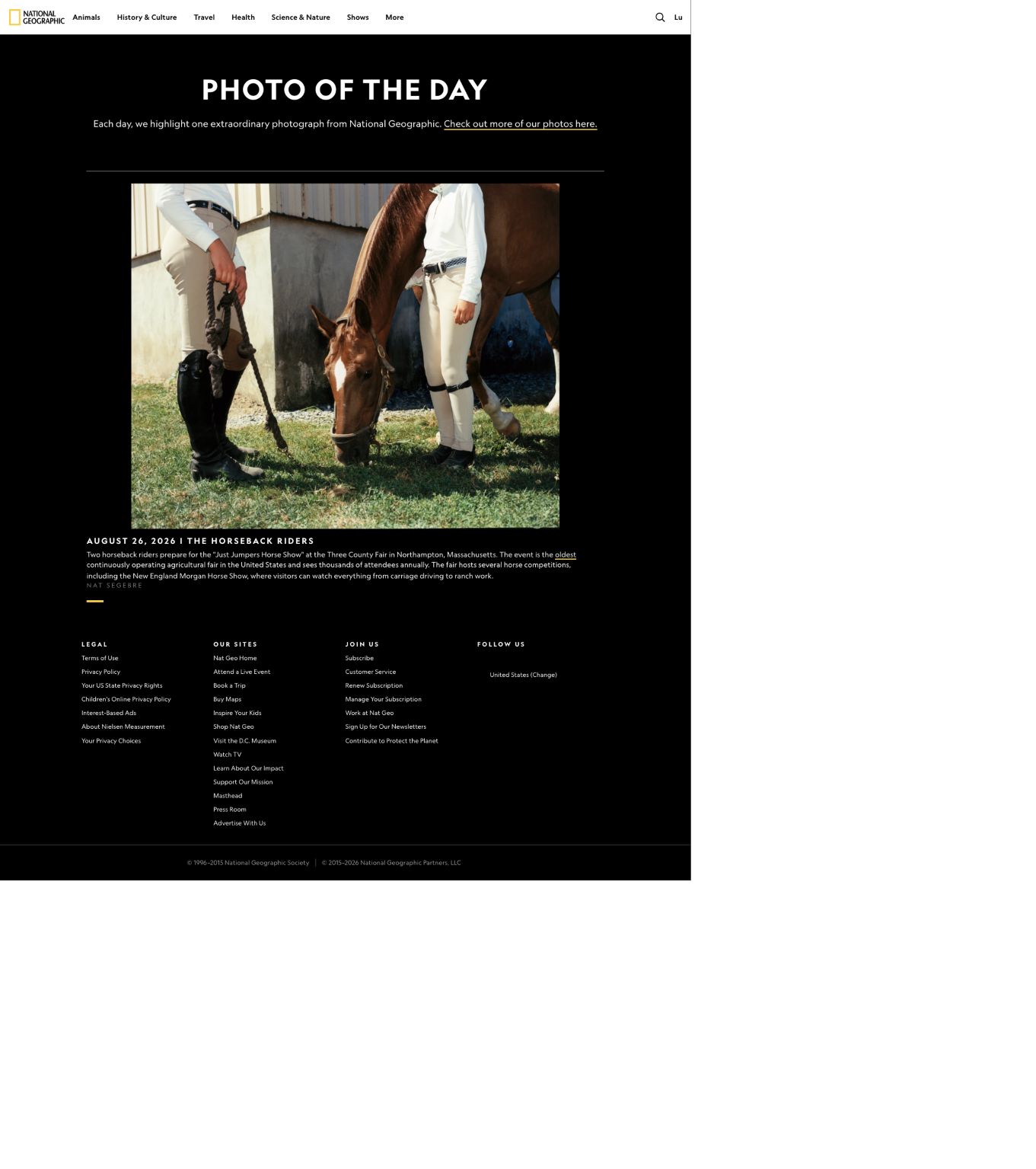
Today's photograph is titled "The Horseback Riders" and was made by Nat Segebre.
Two riders prepare for a "Just Jumpers" show at the Three County Fair in Northampton, Massachusetts, which calls itself America's longest continuously operating agricultural fair. Its caption says the event draws thousands each year, understating attendance by an order of magnitude: more than 30,000 people entered over Labor Day weekend in 2025.
The real subject here is the horse about to jump. Its eyes work very differently from ours.
A Horse Sees 350 Degrees, but Not Straight Ahead
The UC Davis School of Veterinary Medicine's Horse Report gives the first figure: a horse's visual field spans about 350 degrees, much wider than a human's, though perhaps with less detail. Eyes on the sides of the head create small blind areas directly in front and behind.
A 1999 study in the Equine Veterinary Journal provides the second number. The lower retina contains a narrow visual streak with a resolution of 16.5 cycles per degree; the peripheral region resolves only 2.7, a sixfold difference. The field is extremely wide, but only one narrow strip is sharp.
The study's key finding was that binocular overlap points downward along the bridge of the nose, while the area directly in front of the forehead is blind.
That explains why horses raise their noses to inspect distant objects. Textbooks once invoked the "ramp retina" hypothesis, claiming that a horse changed angle to find the retinal focus. The 1999 measurements overturned it: axial length differed by only 9 percent between the visual streak and dorsal periphery, and in the opposite direction from the prediction. The simpler explanation is that raising the head lifts the downward-angled binocular cone toward a distant target.
As a horse approaches a fence, the obstacle moves lower in its field. On the final stride, it has probably entered the frontal blind area. The horse therefore sees, remembers and judges the fence several strides earlier, then takes off through memory and proprioception.
Online accounts often say scientists have proved that a horse cannot see a fence at takeoff. No peer-reviewed paper has measured that act directly. It is a reasonable inference from visual geometry, but still an inference.
Another experiment shows that horses do watch during the approach. A 2019 study assessed the traditional orange markers at eleven British racecourses and found poor visibility and contrast against most backgrounds. Behavior supplied the strongest evidence: changing color altered jumping mechanics. Bright blue produced a larger takeoff angle, fluorescent yellow shortened landing distance, and white caused horses to take off farther away. The fence may vanish on the final stride, but the color seen earlier changes the jump.
The elegant rounded back and forward-reaching neck over a fence is called the bascule. No citable quantitative study was found, so it receives no numbers here.
Watch the ears too. In a 2014 Current Biology experiment, horses saw life-size photographs of companions and chose between two feed buckets. When researchers covered the photographed horse's eyes or ears, subjects could no longer use its head direction to choose. It was the first demonstration that an animal uses a cue humans do not possess - ears - to judge attention. The ears show where attention is directed; ears pointing in different directions mean the horse is monitoring both sides.
This Fair Began as a School
American agricultural fairs grew from technical education, and their beginning involves one man and one tree.
In 1807, Elkanah Watson moved from Albany, New York, to Pittsfield, Massachusetts, to raise Merino sheep. He bought two from Chancellor Livingston and displayed them beneath the great elm on Pittsfield's public square. The crowd inspired a question: if two animals drew so much attention, what might a large exhibition do?
On Monday, October 1, 1810, the town green hosted a Cattle Show and Agricultural Fair: 383 sheep, seven bulls, 109 oxen, nine cows, three heifers, two calves and one boar. The Pittsfield Sun announced it on August 8 over the names of "26 of the most respectable farmers and gentlemen in the county."
A plaque by the fountain in Park Square now marks "the site of the first agricultural fair in America, 1810; and of the Pittsfield Elm, 1524-1864."
In 1811, the Berkshire Agricultural Society formed and held the first cattle show with prizes totaling $70. A September 24 procession was led by sixty yoke of sturdy oxen pulling a plow. The distinction matters: 1810 was the first fair; 1811 brought formal judging and a society.
Watson's design had three durable parts. He used prizes, initially from his own pocket and later through fundraising, awarding engraved silver plates rather than cash. He opened the society across class and to women, unlike aristocratic European agricultural clubs. And it functioned as a school; a 2002 dissertation describes the Berkshire society as a popular institution of agricultural education.
It spread quickly. The International Association of Fairs and Expositions says most New England counties had agricultural societies by 1819 and the movement was reaching other states. The US National Institute of Food and Agriculture traces the Cooperative Extension System, formally established by the 1914 Smith-Lever Act, to early nineteenth-century agricultural clubs and societies.
The chain runs from fairs and prize judging in the 1810s, through agricultural journals from 1819, to land-grant universities under the 1862 Morrill Act - granting 30,000 acres per member of Congress to teach agriculture and mechanical arts - and finally the national extension system in 1914. Every fair ribbon and best-pumpkin prize is a fossil of that two-century-old incentive.
"Oldest" Is a Contest in Wording
The Three County Fair's claim to be America's longest continuously operating agricultural fair is self-description, repeated by its manager and local tourism authority, not a ruling by any agency, industry association or archive.
Connecticut's Brooklyn Fair began in 1809 and calls itself America's oldest agricultural fair. Massachusetts's Topsfield Fair formed its society in 1818, held its first cattle show in 1820, and calls itself the oldest county fair. Both paused during the world wars and in 2020.
Northampton preserved its claim in 2020 by holding a reduced, closed youth-livestock judging event. Yet the local Daily Hampshire Gazette said in 2025 that the fair had run "nearly every year" since 1818. That "nearly" offsets "continuously." There is no referee; the result depends on the definition. Whenever something is called first, oldest or longest, ask who is counting and what counts.
The additional claim that the grounds hold one of America's earliest racetracks could not be substantiated. Formal betting races in Northampton began only in 1943 and ended after the final race on September 11, 2005.
One Horse Founded a Breed
The grounds also host the New England Morgan Horse Show each July. The breed begins with one horse.
Figure, a small bay stallion, was born in 1789 in West Springfield, Massachusetts, according to official material from the Commonwealth's secretary. His owner, Justin Morgan, was a teacher, composer, businessman and horseman in Randolph, Vermont. Late in life Figure became known as "Justin Morgan's horse." He died in 1821 after an untreated kick from another horse.
The American Morgan Horse Association says only that his sire was "believed to be True Briton" and that his dam, of the Wild-air family, was medium-sized, heavy-chested and light bay. Its official text says nothing of the widely repeated Arabian, Friesian or Thoroughbred theories, so none is treated as fact.
What made Figure foundational was his ability to transmit distinctive traits not only to his children but through several generations. Breeders called this prepotency. Texas A&M defines it as a parent's ability to make offspring resemble that parent or one another more than usual, and identifies the mechanism: a homozygous dominant animal is prepotent. Inbreeding raises the share of homozygous gene pairs and lowers the heterozygous share.
At a homozygous locus, a stallion has only one allele to pass on regardless of the mare. Offspring resemble him and one another. A founder's apparent power is homozygosity plus founder effect, not mystery.
Prepotency is historical breeders' language rather than a standard term in modern quantitative genetics. The mechanism is a standard genetic inference, but no peer-reviewed population-genomic study supplies Morgan inbreeding coefficients or diversity figures, so none is given.
The Morgan was not America's first horse breed. The association says the extinct Narragansett Pacer came earlier, making the Morgan the second uniquely American breed. Its actual distinction is that every bloodline traces to one foundation stallion.
Joseph Battell established a Vermont stud in 1878 and published the first volume of the American Morgan Horse Register in 1894. In 1905, the US government created a Morgan breeding program at the University of Vermont to improve cavalry mounts. Battell gave his farm to the government in 1907; the military program continued into the 1950s. The university took over in 1951. It now keeps more than forty horses and offers public tours from May through October.
In Vermont the Morgan became the state animal in 1961; in Massachusetts, the state horse on May 14, 1970.
Its Ancestors Once Vanished from This Continent
Horses originated in the Americas, spread to Asia and Europe, and then became extinct in their homeland. The Smithsonian's National Museum of the American Indian says horses returned to the Western Hemisphere in 1493, with a herd of 25 on Columbus's second voyage.
A 2023 Science study combined archaeology and genomics. North American archaeological and modern horses show strong Iberian affinity, later British admixture and no Viking signal. Horses spread rapidly from the south to the northern Rockies and central Plains in the first half of the seventeenth century, probably through Indigenous exchange networks, and were deeply integrated into Indigenous societies before eighteenth-century European observers arrived. Horses ran on the Plains more than a century before Europeans recorded them there.
A June 2024 Nature study of 475 ancient horse genomes revised the deeper account. Reproductive control of the modern domestic lineage emerged around 2200 BCE, through close-kin mating and a reduction in generation time from about 7.4 to 3.5 years, roughly 2.1-fold. It followed a severe domestication bottleneck beginning no earlier than 2700 BCE and preceded a sudden expansion across Eurasia that nearly replaced every local lineage.
The paper overturned the familiar story that mass steppe migration around 3000 BCE traveled with great herds of horses. Botai in Central Asia did practice local horse management around 3500 BCE, even shortening generation intervals, but that lineage did not survive. All domestic horses today descend from another branch.
China's Version Has Run for More Than 1,300 Years
The Dali March Fair is national intangible cultural heritage project X-106, listed in the second batch in 2008 for Dali, Yunnan. The official register says it began in the Yonghui era of the Tang dynasty, evolved from a temple fair and was closely connected to Buddhism's spread in Dali.
It runs for seven days, from the fifteenth through twenty-first days of the third lunar month, drawing attendance "in the millions" from China and abroad. Traditional trade centers on medicinal materials, large livestock and daily goods. Activities include antiphonal singing, instrumental music, lanterns, ethnic dress, horse racing, crossbow shooting, swings, wrestling and dragon boats. A temple market centered on livestock and horse racing is effectively a Chinese agricultural fair, a millennium older than Watson's sheep.
The Naadam is national intangible cultural heritage project X-48, first batch, 2006, State Council document [2006] No. 18, submitted by Xilingol League, Inner Mongolia. It is classified as folk custom, not traditional sport. Its historical "three manly games" are wrestling, horse racing and archery; contemporary festivals add polo, equestrian events, athletics, ball games and Ulan Muqir performances.
The Ministry of Agriculture and Rural Affairs' Announcement No. 940 of October 27, 2025 lists ten horse breeds in the national livestock genetic-resource protection catalog: Debao pony, Mongolian, Oroqen, Jinjiang, Ningqiang, Chakouyi, Yanqi, Lichuan, Dali and Kazakh horses. The Ili and Hequ are absent. The Ili is a developed breed created since the late nineteenth century by improving Kazakh horses with introduced stock; Xinjiang's listed local breeds are Kazakh and Yanqi.
China's youngest such "fair" is only nine years old. The State Council's June 7, 2018 approval established the Chinese Farmers' Harvest Festival on the autumnal equinox each year, beginning in 2018, document [2018] No. 80. In 2026, the equinox falls on Wednesday, September 23.
Sources
National Geographic Photo of the Day, August 26, 2026; Three County Fair and reporting by the Daily Hampshire Gazette, The Reminder and New England Public Media; the Berkshire Agricultural Society; the Pittsfield 1810 marker and historical research; Ginder (2020), SUNY Albany honors thesis; Mastromarino (2002), College of William & Mary dissertation; International Association of Fairs and Expositions; US National Archives, the Morrill Act; National Institute of Food and Agriculture; American Morgan Horse Association; official Massachusetts and Vermont records; UVM Morgan Horse Farm; Texas A&M genetics glossary; UC Davis Horse Report; Harman et al., Equine Veterinary Journal (1999); Paul and Stevens, Applied Animal Behaviour Science (2019); Wathan and McComb, Current Biology (2014); Librado et al., Nature 631 (2024); Taylor et al., Science 379 (2023); Smithsonian National Museum of the American Indian, Horse Nation; China Intangible Cultural Heritage Network; Ministry of Agriculture and Rural Affairs Announcement No. 940; State Council document [2018] No. 80; and the Chinese Agricultural Museum.