
A blue crescent outlines a planet almost lost in darkness. Beside it hangs a smaller sliver of light. NASA's November 21 Astronomy Picture of the Day imagines a view from beyond Neptune's orbit, looking back toward the Sun: Neptune and its largest moon, Triton, have both become crescents.
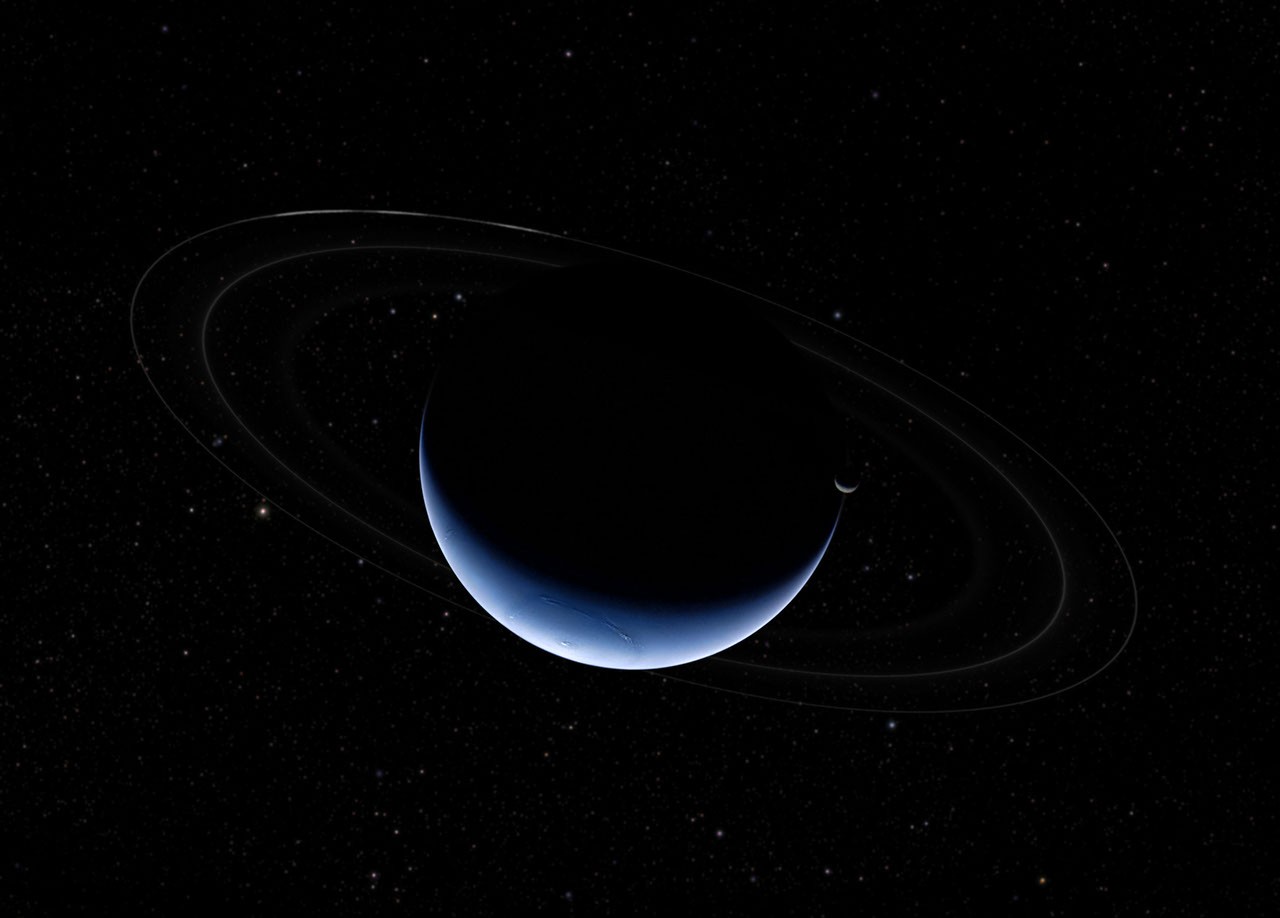
Image: Credit & Copyright: Assembly/Processing - Rolf Olsen; Data - Voyager 2, NASA Planetary Data System. Original page
The scene draws on Voyager 2's observations, but it is not one exposure taken at a single moment. Voyager 2 made its closest approach to Neptune on August 25, 1989. Rolf Olsen assembled this view using images recorded during the encounter and in the days that followed.
Why the crescents? The sunlight we see is reflected by Neptune and Triton. From a position on their far side relative to the Sun, most of each illuminated hemisphere faces away from us. Only a narrow portion remains visible. The angle between the light source, the object, and the observer determines the shape. Earth's Moon changes phase for the same reason; an ordinary crescent Moon is not being covered by Earth's shadow.
There is weather in that blue sliver, too. Cirrus clouds and a dark band encircle Neptune's south polar region, with a cloudy vortex above the pole. The bright edge contains more detail than a smooth outline suggests.
The faint lines around the planet have their own history. NASA's account of Voyager's discoveries explains that the encounter confirmed complete rings, rather than isolated arcs alone. In this composite, portions of the rings and three bright arcs draw on Voyager images; the faintest ring segments are modeled.
The stars form another layer. A sky-survey field centered on Camelopardalis spans 7.5 degrees and corresponds to Voyager's outbound viewing direction. The result brings several kinds of data into one reconstructed perspective. It does not show every star and every ring segment as they appeared together in an original camera frame.
Triton adds another puzzle. NASA describes it as the solar system's only large moon that orbits opposite its planet's rotation. That retrograde orbit is an important clue that Neptune may have captured it. Capture is an explanation inferred from evidence, not an event anyone watched happen.
Voyager 2 has continued onward into interstellar space. The close views used here still come from its 1989 encounter.
To explore the crescents yourself, illuminate a ball with a lamp in a dim room. Keep the lamp and ball still while you move around them. Watch the boundary between light and dark change, then return to the two similarly lit crescents in the picture.