
The air keeps moving. A clear view can be assembled from its better moments.
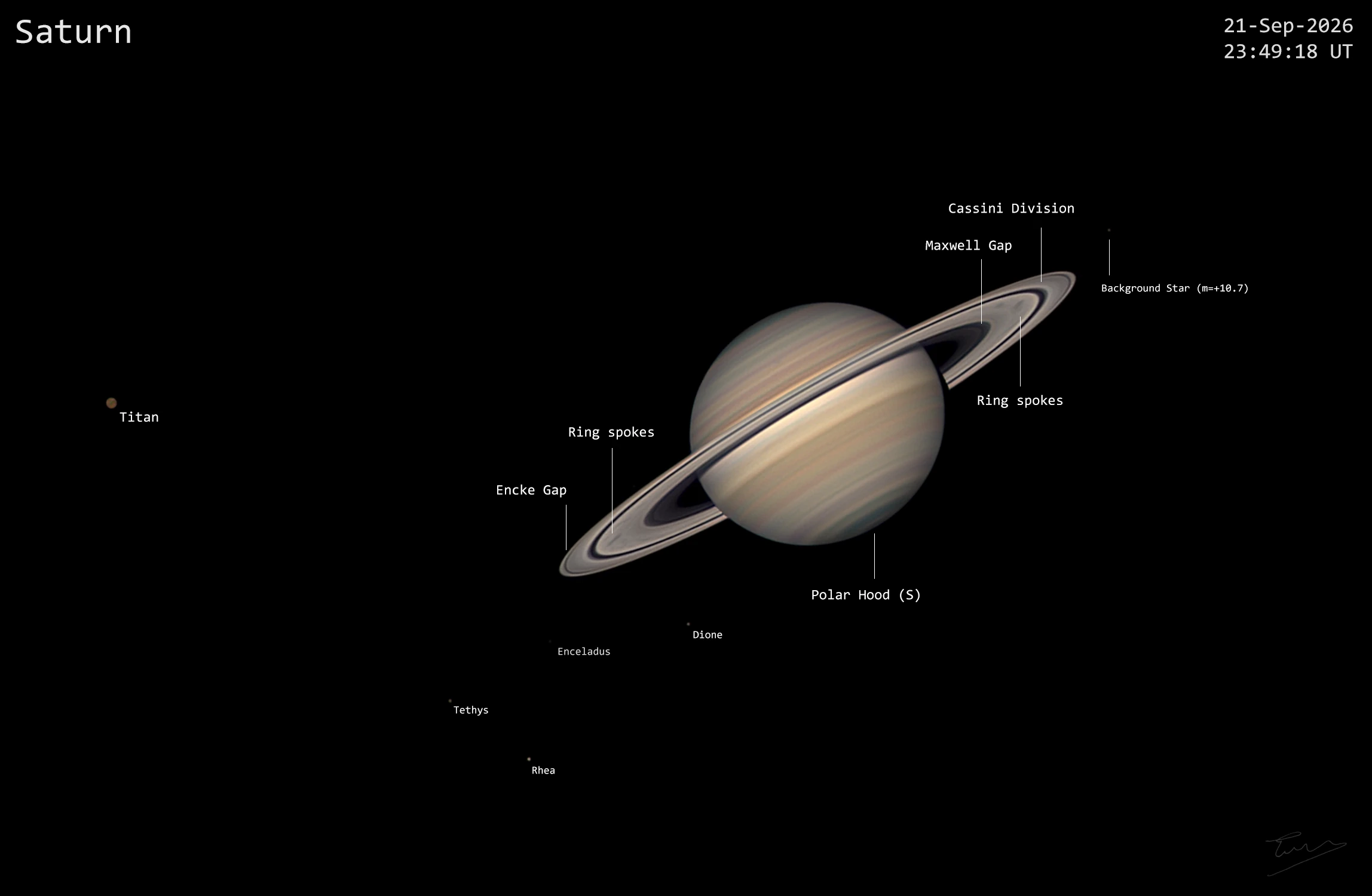
Image: NASA Astronomy Picture of the Day | Credit: Tom Williams | Original page.
One exceptionally steady night above the United Kingdom gave astrophotographer Tom Williams a detailed view of Saturn's system. NASA selected it as its Astronomy Picture of the Day for October 8, under a title that presents the planet, rings and moons as a smorgasbord.
A clear astronomical image requires more than an absence of clouds. Differences in air temperature and density bend light, while moving pockets of air make a telescopic planet wobble, distort and blur. Astronomers call these atmospheric imaging conditions "seeing."
Keep the Clearer Moments
Lucky imaging finds opportunities across many exposures.
A high-speed camera records thousands of short exposures in quick succession. Atmospheric disturbance varies from frame to frame, leaving some sharper than others. Selecting the better frames and stacking them reduces noise and brings out detail.
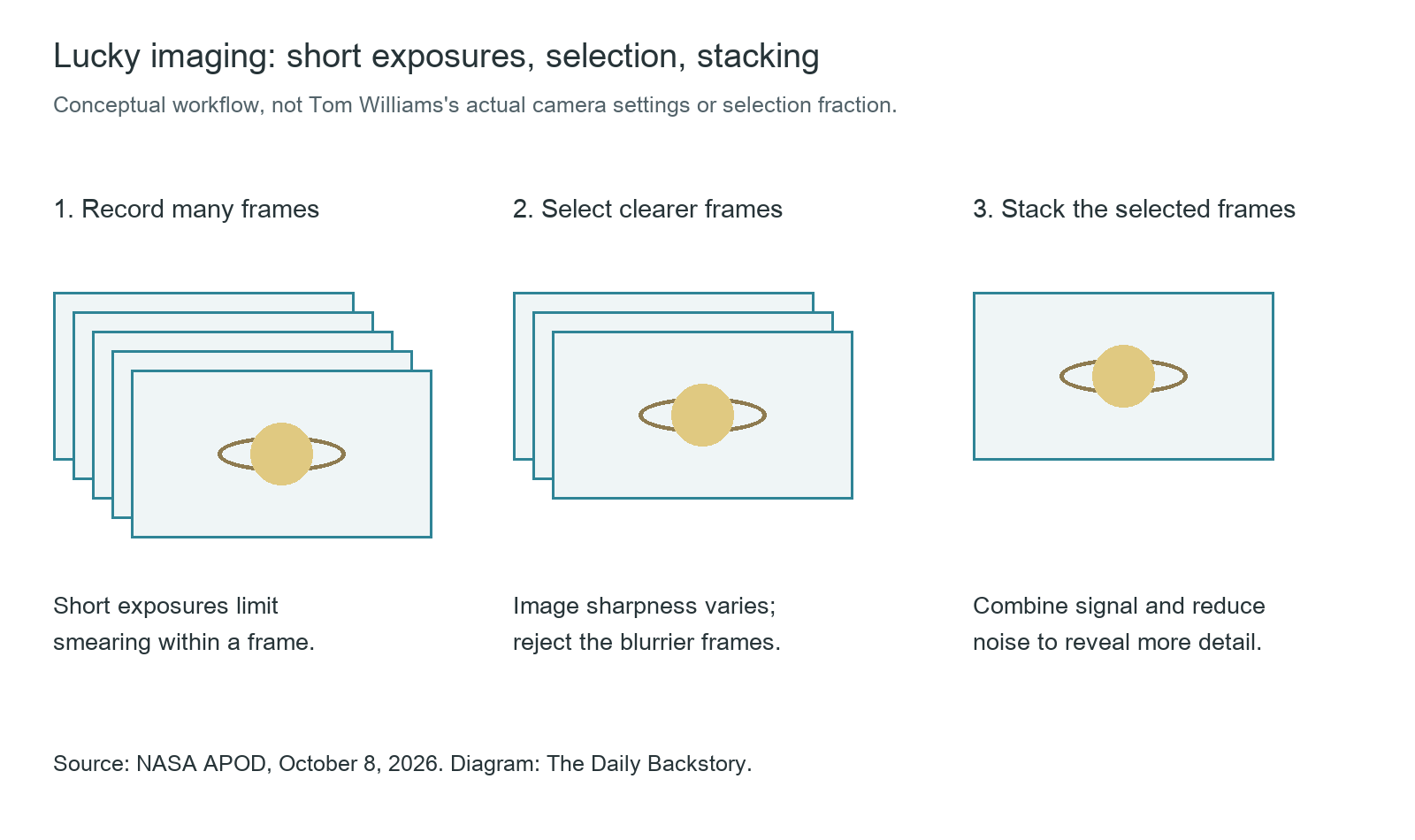
Diagram: The Daily Backstory, based on the October 8 NASA APOD | The illustrated frame counts do not represent the photographer's actual settings or selection fraction.
NASA confirms that Williams used the technique, without specifying exposure times, equipment or the percentage of frames retained. The night's unusually good atmospheric conditions mattered too. Selection can exploit clear moments; it cannot guarantee this result on any given night.
Why Opposition Helps
Saturn reached opposition on October 4, according to NASA. From Earth, it appeared opposite the Sun, with our planet between the Sun and Saturn. It rose around sunset and could be observed through much of the night.
Around opposition, Saturn is relatively close to Earth and its Earth-facing hemisphere receives full sunlight. That makes this a favorable observing period. Opposition and closest approach occur near each other, rather than necessarily at precisely the same instant.
The unaided eye sees Saturn as a point of light; a telescope is needed for its rings. Across China, the best observing hours depend on longitude, local sky conditions and obstructions. One fixed three-hour window in Beijing time cannot serve the entire country. Waiting until the planet is higher generally reduces the amount of low-altitude atmosphere in the light's path.
Short-Lived Spokes
The APOD also draws attention to gaps and spokes in Saturn's rings. Gaps belong to the ring system's structure. Spokes can form and fade within hours.
NASA's Cassini overview describes some spokes extending more than 16,000 kilometers, longer than Earth's diameter. Their origin is still incompletely understood. A leading explanation involves tiny icy particles temporarily lifted above the ring plane by electrical charging, with Saturn's magnetic field playing a role.
Hubble has followed the phenomenon over many years. NASA describes a seasonal pattern, with spokes becoming more prominent around Saturn's equinoxes. The most recent northern autumnal equinox occurred on May 6, 2025. The seasonal connection offers a clue, while leaving the detailed mechanism open.
The rings' angle toward Earth also changes as Saturn moves around the Sun. Near an edge-on view, the thin rings become difficult to see; a more open view makes their outline more conspicuous. They do not disappear for an entire year, and a single photograph cannot supply precise opening angles for every future year.
Williams's image brings together two clocks: the slow geometry of a planetary system and the brief intervals when the air settles. Lucky imaging gives those clearer intervals a lasting form.
Sources
NASA APOD: The Saturn System Smörgåsbord; NASA: October 2026 skywatching tips; NASA: Hubble and Saturn's spoke season; NASA Cassini: Rings.