
A bright arc can be a record of motion through almost-empty space.
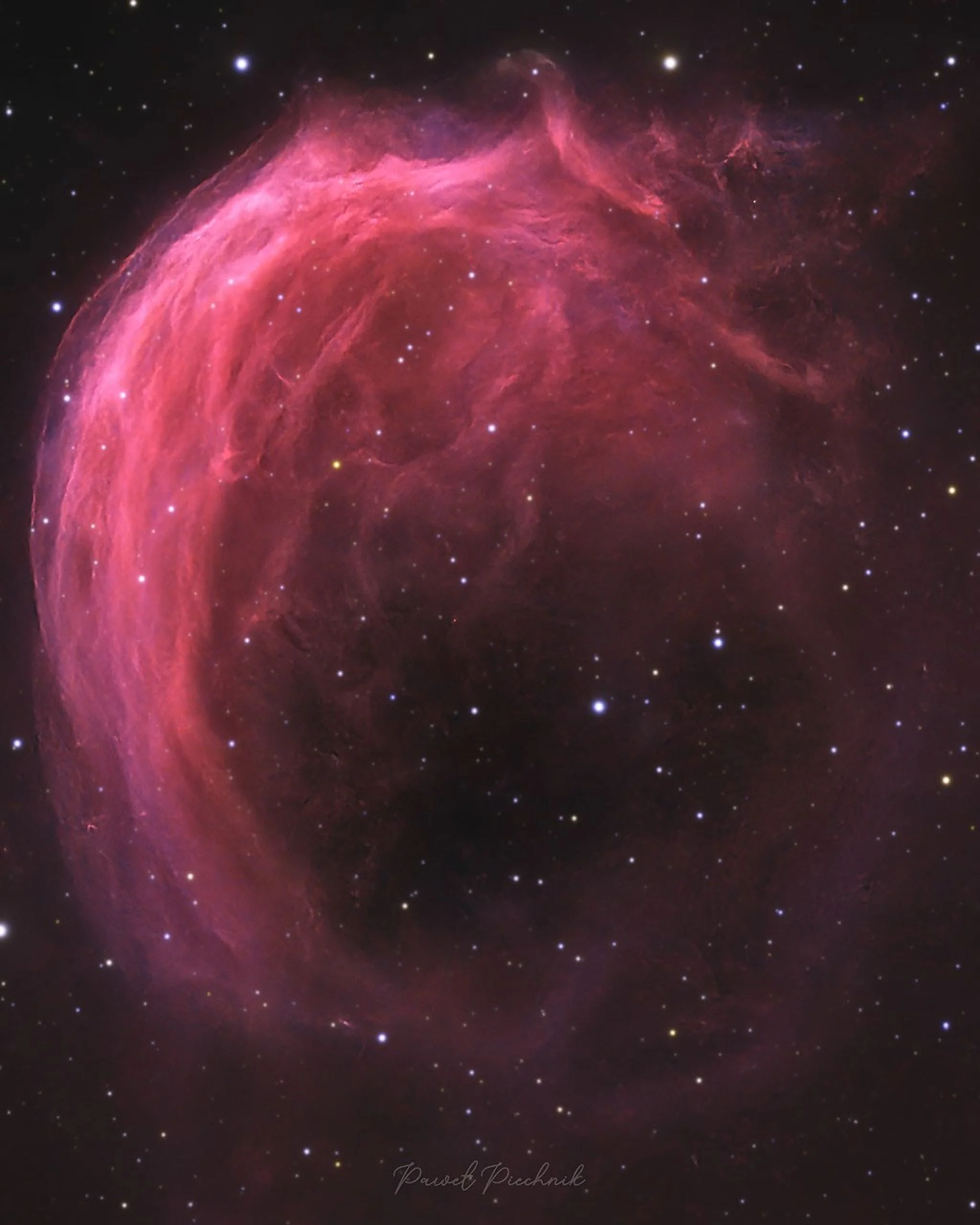
Image: NASA Astronomy Picture of the Day | Image Credit & Copyright: Pawel Piechnik | Original page
The subject of NASA's September 29 Astronomy Picture of the Day has acquired several animal nicknames. Its catalog designation is less fanciful: Sh2-188, an entry in the Sharpless catalog, often called the Shrimp Nebula.
It is a planetary nebula, a name left over from early telescopic observations. The object has nothing to do with planets. It is gas shed by an aging star, illuminated by the hot stellar core left behind.
How a Star Leaves a Shell
A star with a mass like the Sun's does not end its ordinary evolution in a supernova. It expands into a red giant and eventually loses its outer layers. The exposed core becomes a white dwarf; its intense ultraviolet radiation can make the surrounding gas glow.
A perfectly even outflow might make something resembling a spherical shell. Real planetary nebulae have many shapes, however, because more than one process can influence the gas.
Sh2-188 is particularly lopsided. One side is a bright curve; the material behind it is much fainter.
Motion Makes a Headwind
Interstellar space contains extremely diffuse gas and dust. A star moving through that material encounters a flow relative to itself, just as a cyclist feels a headwind on a still day.
For Sh2-188, the interaction compresses gas on the leading side into a bow shock. The bright edge is most conspicuous toward the upper left of this image. Fainter material trails downstream.
Hydrodynamic simulations by C. J. Wareing and colleagues found that a speed of roughly 125 kilometers per second relative to the interstellar medium could reproduce the observed structure. That figure is an inference from a model, not a direct speedometer reading. NASA likewise presents rapid motion as the likely explanation for the nebula's shape.
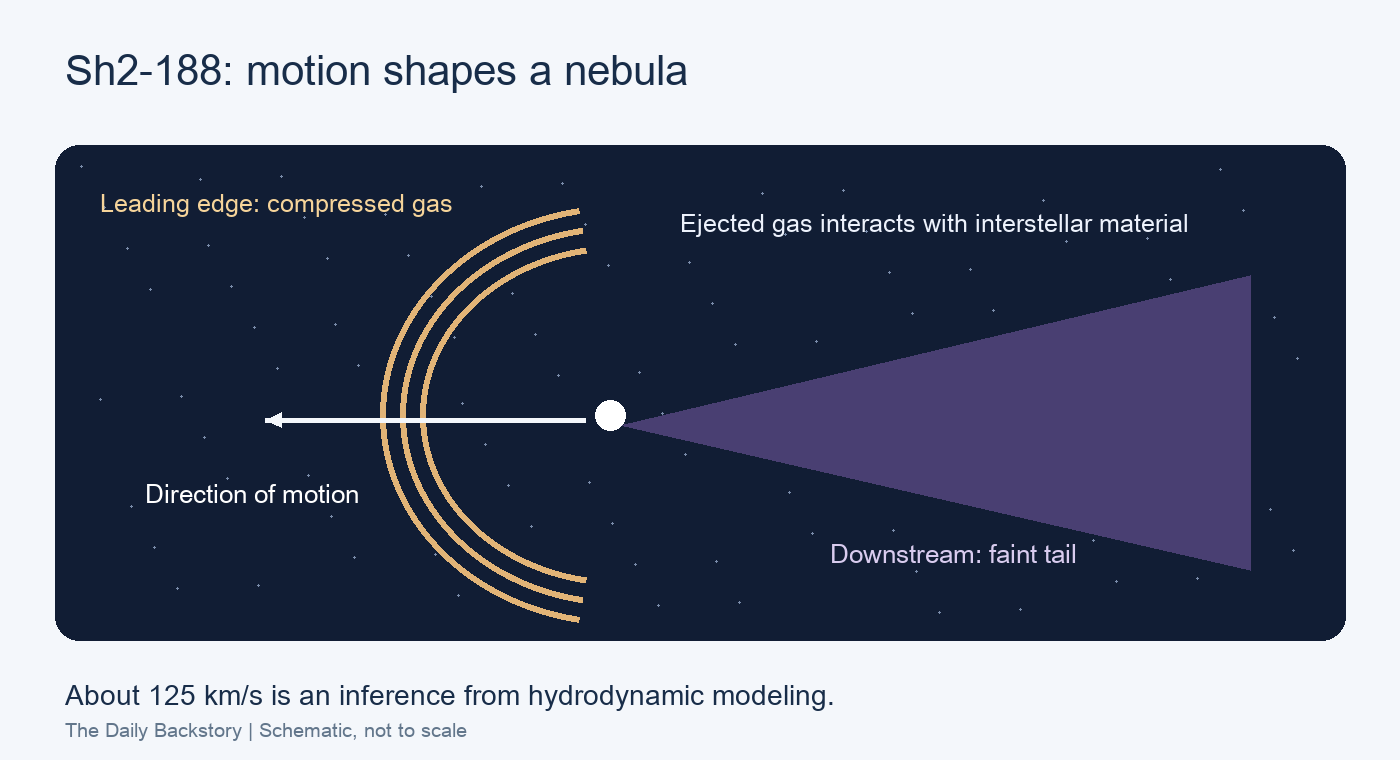
Diagram: The Daily Backstory; schematic, not to scale.
The nebula lies in Cassiopeia and spans about 15 arcminutes, roughly half the Moon's apparent diameter. Its large angular size does not make it easy to see: the gas is very faint.
Pawel Piechnik made this image with a backyard telescope in Krakow, Poland, recording light in hydrogen, sulfur and oxygen bands. The colors were then digitally adjusted to approximate the nebula's natural appearance.
Earth Has a Bow Shock Too
Bow shocks are not confined to distant nebulae. The solar wind, a flow of charged particles from the Sun, encounters Earth's magnetic environment and forms a shock on the sunward side.
The relative motion is reversed in the everyday description: around Sh2-188, we picture a star moving through gas; near Earth, we picture a wind arriving at the planet. In both cases, a moving flow encounters an obstacle.
China and the European Space Agency investigated near-Earth space together through Double Star. TC-1 launched on December 29, 2003, into a near-equatorial orbit; TC-2 followed on July 25, 2004, into a polar orbit. Their observations were coordinated with ESA's four Cluster spacecraft. Seven Double Star instruments were identical to instruments carried by Cluster.
Why use several spacecraft? A single instrument moving through a changing environment can struggle to distinguish a spatial boundary from a change over time. Coordinated measurements at different locations help separate those possibilities.
Sometimes progress comes from taking measurements in several places at once. A curved nebula and a fleet of satellites both remind us that space is a moving environment, not an empty backdrop.
Sources
NASA Astronomy Picture of the Day: Original page; Wareing and colleagues: shaping Sh2-188 through interaction with the interstellar medium; ESA: Double Star factsheet. Background: Constellation Guide: the Shrimp Nebula and Double Star mission.