
Once a basketball leaves the hand, the player cannot correct its course.
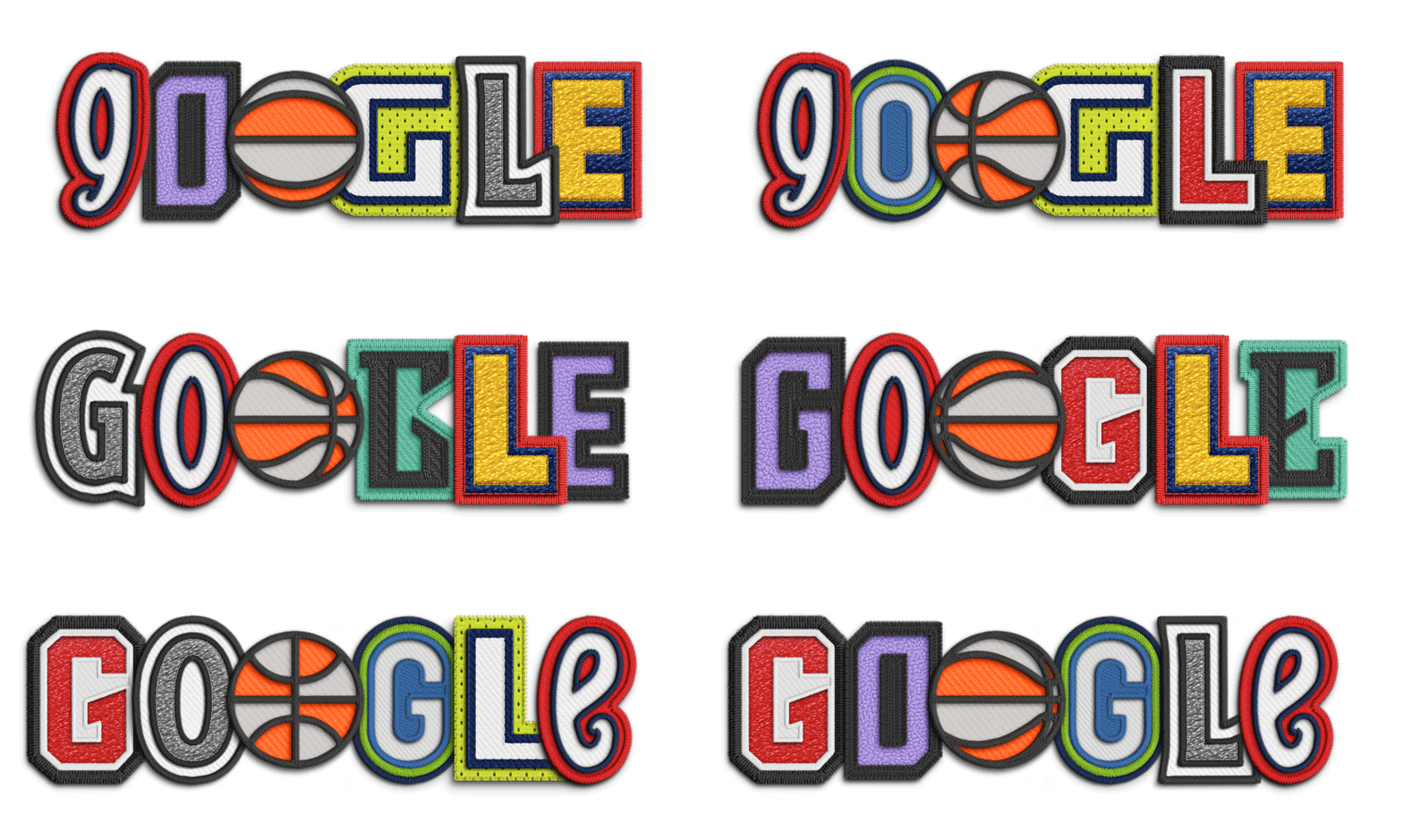
Image: Google Doodle, "WNBA Playoffs 2026" | Original page
Google's September 29 Doodle celebrates the 2026 WNBA playoffs, weaving participating teams' colors and jersey textures into its lettering. Eight teams are represented in the championship contest.
The image also offers a way into a smaller story: the roughly one second between a ball leaving someone's hand and reaching the hoop.
A Shot in a Computer
Release speed, angle and spin help determine a basketball's flight and what happens when it hits the rim. A useful model must also specify release height, direction and the ball's properties.
North Carolina State University engineers Chau Tran and Larry Silverberg ran hundreds of thousands of three-dimensional simulations of free throws, including collisions with the rim and backboard. A free throw is a particularly manageable case: the distance is fixed, and no defender intervenes.
Their study used a men's basketball and a release height of seven feet, about 2.13 meters. That matters in a story prompted by the WNBA: these results are not a universal optimum for every player or every ball.
The researchers recommended three things under their modeled conditions:
- A release angle of about 52 degrees. The best trajectory depends on the shot's other conditions and the consistency of the release.
- About three revolutions per second of backspin. Over a flight of roughly one second, that is about three turns. Backspin changes how the ball rebounds from the rim or backboard, potentially helping it settle through the net.
- An aim point toward the back of the rim, allowing about five centimeters of clearance between the ball and the back rim. The university's account reports that aiming for the center reduced simulated success by almost 3%.
Those are comparisons within a model, not a promised improvement in any individual player's shooting percentage.
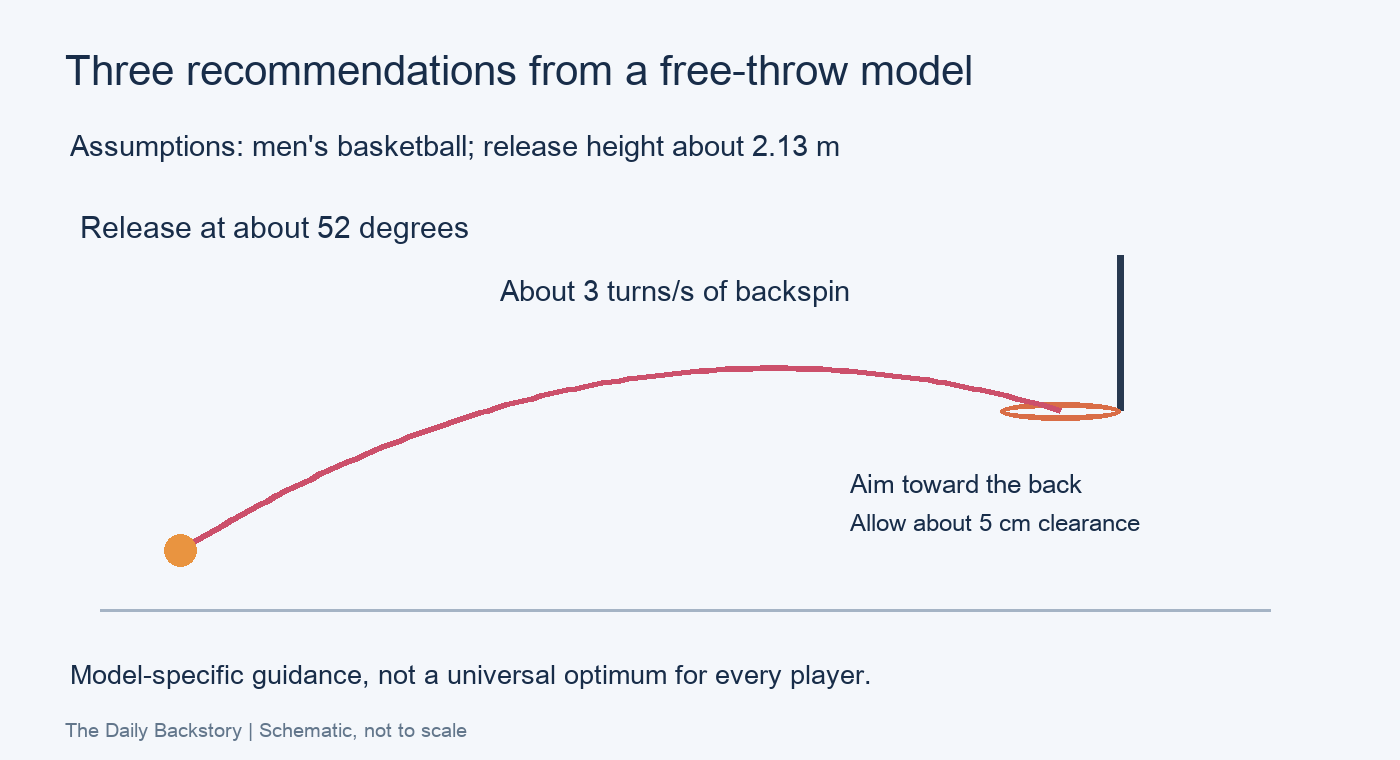
Diagram: The Daily Backstory; schematic, not to scale.
Keeping a Successful Throw from Bouncing Out
Long before basketball, people devised games around throwing something into an opening. The Chinese Book of Rites, or Liji, describes touhu, an arrow-tossing game associated with banquets.
Its rules specify different arrow lengths for different settings: five fu indoors, seven in a hall and nine in a courtyard. The commentary defines a fu as four cun. Even the equipment had a written specification.
One instruction is especially practical: put small beans inside the vessel to prevent the arrows from bouncing back out.
In modern mechanical terms, the beans can move, rub against one another and redistribute the incoming arrow's energy. An arrow entering a hard vessel need not rebound with all the energy it brought in.
This is an analogy to basketball, not an identical mechanism. Backspin changes a ball's interaction with the rim; loose beans change an arrow's interaction with a vessel. Both draw attention to the same easily overlooked moment: reaching the target is only part of the problem. What happens at contact matters too.
Sources
Google Doodles: Original page; NC State College of Engineering: the physics of free-throw shooting; The Conversation: the mathematics of free throws; Chinese Text Project: Liji, Tou Hu; additional Chinese commentary on Tou Hu.