
A circle that closes at 32 degrees, a pair of fruit baskets fetched by a janitor, and an angle you can verify with a piece of cardboard.
Screenshot: National Geographic Photo of the Day | Original page
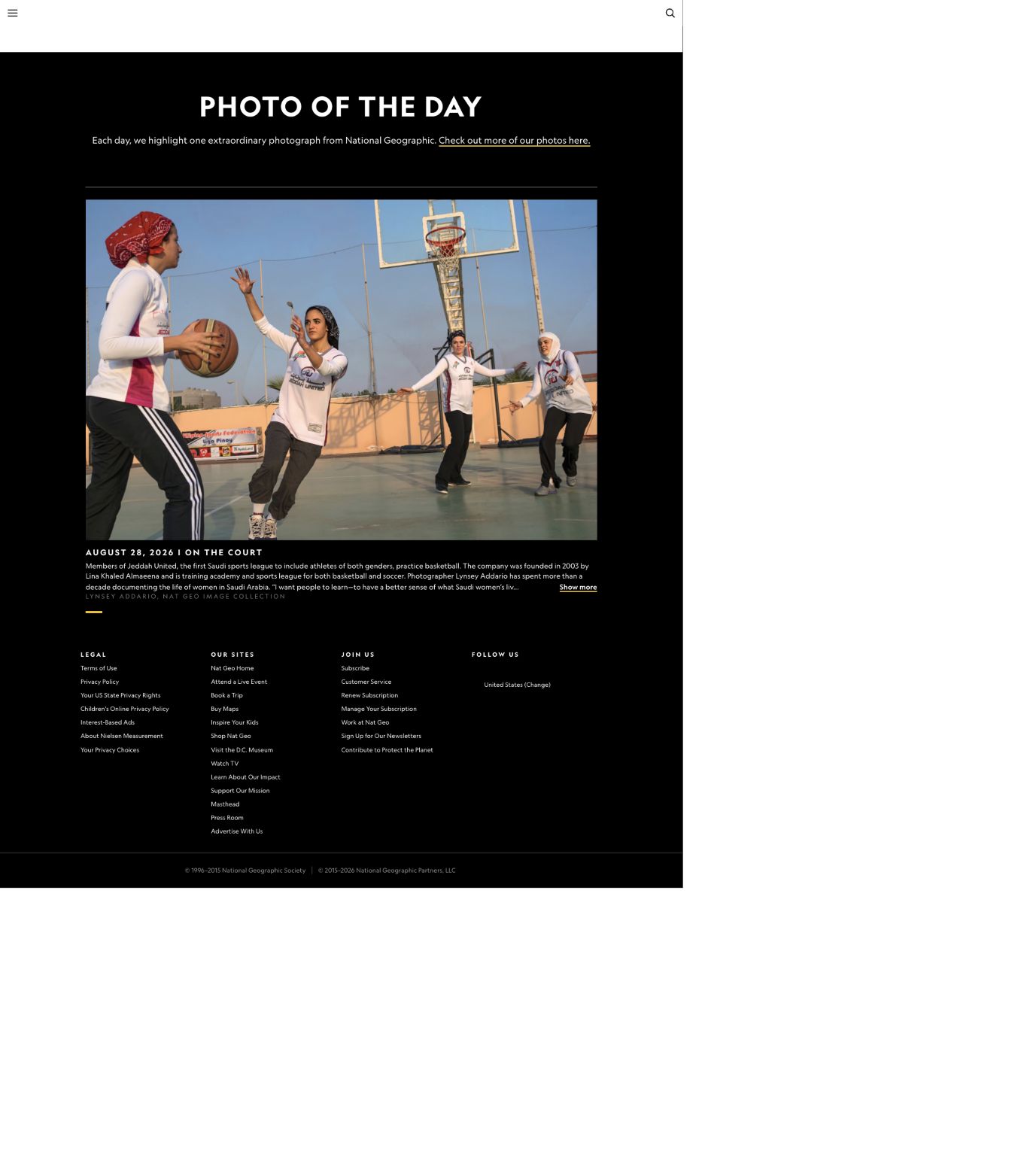
National Geographic's Photo of the Day is titled "On the Court."
The photograph shows members of Jeddah United practicing basketball. Based in Jeddah, Saudi Arabia, the organization was founded in 2003 and co-founded by Lina Khaled Almaeena. The National Geographic caption quotes the photographer from a decade ago: "I hope people learn something and get a clearer sense of the lives of Saudi women."
This article, however, is about the problem the ball in the photograph must solve in midair. Its answer is an angle of 32 degrees.
First, the Photographer
Lynsey Addario is an American photojournalist, born November 13, 1973, in Westport, Connecticut. She has spent much of her career covering conflict, humanitarian crises and the lives of women in Afghanistan, Iraq, Libya, Lebanon, Darfur, South Sudan, Somalia, the Democratic Republic of the Congo, Yemen, Syria and Ukraine.
Her two most consequential honors deserve precise wording.
In 2009, she was part of the New York Times team that won the Pulitzer Prize for International Reporting. The official Pulitzer record names the winner as the staff of The New York Times, citing its "masterful, groundbreaking coverage of America's deepening military and political challenges in Afghanistan and Pakistan, reporting frequently done under perilous conditions." No individuals appear in the official listing. The accurate statement is that she was a member of the winning team, not that she personally won a Pulitzer. In 2023, she was individually named a finalist for the Pulitzer Prize for Breaking News Photography. The citation described her single image of a Ukrainian mother, her two children and a church member lying dead after a mortar strike on an evacuation route outside Kyiv, a photograph that made clear Russia was attacking civilians.
In 2009, she received a MacArthur Fellowship. Its official citation praised her for "creating a powerful visual record of the most pressing conflicts and humanitarian crises of the twenty-first century." She was 35. Her memoir, It's What I Do, appeared in 2015.
For this story, however, the beginning of her career matters most, because it may be the best part to tell a child.
When Addario was about 12, her father gave her a used Nikon FG that one of his clients had given him. She bought a photography book and taught herself to use it. Too shy at first to photograph people, she photographed flowers, cemeteries and the night sky.
She later studied international relations and Italian at the University of Wisconsin. After moving to Buenos Aires in 1996, she kept visiting the offices of the Buenos Aires Herald until its editors challenged her to photograph Madonna, then filming Evita. She did, and the paper hired her at ten dollars a photograph.
Her first rule for the craft is simple: "Patience is everything." The rest, she says, is light and making people feel comfortable.
A 12-year-old with an old camera and a book she bought herself began with the night sky. Thirty years later, she made this photograph on a basketball court.
Now, the Ball
One of basketball's virtues is that it turns a central lesson of school physics, projectile motion, into something hundreds of millions of people do every day.
It also contains a more interesting twist than most textbooks do.
A textbook will tell you that 45 degrees is the launch angle for maximum range. Many people therefore assume the ideal angle for a basketball shot must be less than 45 degrees.
That is wrong.
The 45-degree result holds only when the launch point and target are at the same height, with air resistance ignored. A basketball shot is different. A player's release point is roughly 1.8 to 2.3 meters high, while the rim is 3.050 meters above the floor. The target is above the hand, not below it. Raising the target lifts the best release angle above 45 degrees.
What does measurement suggest? 52 degrees.
That figure comes from Larry Silverberg and Chau Tran, two mechanical and aerospace engineering researchers at North Carolina State University. Their work used hundreds of thousands of three-dimensional computer simulations and appeared in volume 26, issue 11 of the Journal of Sports Sciences in 2008. Silverberg put the result this way: a release angle of "about 52 degrees is best" because it requires "the lowest launch speed and gives the ball the highest probability of going in."
Notice the reasoning. The goal is not to travel farthest. It is to use the lowest launch speed while maximizing the chance of scoring.
The same research produced two more practical numbers.
Use three revolutions of backspin per second, so the ball completes three full rotations between release and the basket, a flight of roughly one second. In a separate popular account, Silverberg added that more spin provides no further benefit. The primary sources reviewed for this article did not clearly explain why backspin helps, so the number is given here without inventing a mechanism.
For the aiming point, leave "nearly 5 centimeters, or about 2 inches" between the ball and the back of the rim. Silverberg's explanation was pragmatic: "The back of the rim is more forgiving than the front."
A 2011 follow-up study ran more than one million three-dimensional trajectories. It found that within 12 feet, or about 3.7 meters, a bank shot was about 20 percent more effective than a direct shot from many angles. The best backboard targets formed a V shape around the top center of the painted square. Beyond 12 feet and from straight in front, a direct shot was better.
The Hoop Shrinks
Those are research results. The next result can be calculated directly from two numbers in the official rules. It is the heart of this article.
The official FIBA rules specify that:
The rim has an inside diameter of at least 450 millimeters and at most 459 millimeters.
Its top edge is horizontal at a height of 3,050 millimeters, with a maximum tolerance of ±6 millimeters.
A size 7 ball, used in men's basketball, has a circumference of 750 to 770 millimeters and a mass of 580 to 620 grams.
A size 6 ball, used in women's basketball, has a circumference of 715 to 730 millimeters and a mass of 510 to 550 grams.
Now consider the geometry.
To a ball falling vertically from directly above, the hoop is a circle 450 millimeters across.
To a ball arriving on a slant, it is not a circle. It is a flattened ellipse because the ball crosses the hoop's plane obliquely. The width along the ellipse's narrow axis is:
450 millimeters × sin(angle of entry)
For the ball to pass cleanly through, that narrow width must be at least as large as the ball's diameter:
sin α ≥ ball diameter ÷ 450
Using the midpoint of the official size 7 circumference range, 750 to 770 millimeters, the diameter is circumference ÷ π, or 241.9 millimeters:
sin α ≥ 241.9 / 450 = 0.538, so α ≥ 32.5 degrees.
That is the whole answer. The shallowest possible arrival angle is about 32 degrees. One degree flatter and the ball strikes the rim, however perfect the aim.
That is why every good shooter sends the ball high. It is not habit or style. At 32 degrees, the ellipse closes.
How much room does a vertically descending ball have? 450 minus 242 equals 208 millimeters, leaving about ten centimeters on each side. The real margin is not simply that the hoop is much larger than the ball. It is that the hoop is much larger than the ball provided the ball comes from above.
The formula can be checked in reverse. For an 18-inch rim, the effective opening at a 45-degree entry angle is 18 × sin 45 = 12.73 inches. At 30 degrees, it is 18 × sin 30 = 9.00 inches. Published effective-opening measurements from commercial shot-sensor makers are exactly 18, 12.7 and 9.0 inches. The formula agrees.
The Ball in This Photograph Has a Slightly Easier Target
Only this photograph makes the next comparison possible, because it depends on ball size.
A size 6 ball used in women's basketball has a circumference of 715 to 730 millimeters and a midpoint diameter of 230.0 millimeters. Substituting it into the same formula gives:
sin α ≥ 230.0 / 450 = 0.511, so α ≥ 30.7 degrees.
The critical angle is 32.5 degrees for a size 7 ball and 30.7 degrees for a size 6, a difference of 1.8 degrees. On a vertical descent, the size 6 ball has 220 millimeters of space inside the rim, 12 millimeters more than a size 7 ball.
The target the players in the photograph are shooting at is just a little more forgiving than the one an NBA player faces. By 1.8 degrees and 12 millimeters.
It is the kind of difference visible only in the numbers, but it is real.
Ten Feet, Because That Was Where the Balcony Happened to Be
The origin of that 3,050-millimeter height is not grand.
According to the official history from Springfield College, where basketball was born, in the winter of 1891-92 James Naismith was a physical education teacher and second-year graduate student at the institution, then called the International YMCA Training School. His supervisor, Luther Halsey Gulick, gave him an assignment: devise a "new indoor game that would be interesting, easy to learn, and easy to play indoors and by artificial light in the winter."
The problem was that the students refused to exercise. Once the fall sports season ended, no one wanted the mandatory gymnastics class. Naismith's conclusion is worth remembering:
"The trouble is not with the men, but with the system that we are using."
Then came the famous detail, whose accurate version is better than the legend.
Naismith asked the janitor for two 18-inch square boxes. The janitor had no boxes and brought back two peach baskets. Naismith nailed them to the gymnasium's second-floor balcony.
That balcony stood ten feet above the floor.
The height of the basket was an accident. It was simply the height of the balcony. One hundred and thirty-five years later, the FIBA rulebook says 3,050 millimeters.
Ten feet is 3.048 meters. A janitor's improvised substitute became a worldwide standard.
The first game had nine players on each side: three forwards, three centers and three backs. There were 13 rules. The strangest, as reproduced in the NCAA rulebook, said:
"A player cannot run with the ball. The player must throw it from the spot on which he catches it, allowance to be made for a man who catches the ball when running at a good speed."
In other words, the original game had no dribbling.
One more timeline is worth remembering. Backboards appeared in 1896-97. The bottom of the net was left open in 1913-14.
For the first 22 seasons, someone had to retrieve the ball after every basket. The rulebook does not say when peach baskets gave way to metal rims, so this article does not guess.
Women's basketball has its own beginning. According to the Smith College Libraries, Senda Berenson watched a YMCA game in Springfield in 1893 and decided Smith's women could play too. She directed physical training at Smith from 1892 to 1911. The first game was played on Wednesday, March 22, 1893, between students from the four classes. The sophomores won 5-4. Berenson later wrote Basket Ball for Women, in editions dated 1903 and 1908.
Five to four. Scoring was that low when basketball was new, because no one yet knew the right angle.
A Few Dates
For the history of Saudi women's participation in sports, the facts and dates below come only from the official Saudi Press Agency article "Saudi Women in Sports: From Vision to Victory." They are presented without commentary.
In 2012, Saudi women competed in the Olympics for the first time, in London, "with Wojdan Ali Seraj in judo and Sarah Attar in athletics."
In 2019, a decision established dedicated women's sports clubs.
In 2021, the women's national football team was formed.
In 2022, the team played its first international match and beat Seychelles 2-0.
On October 13, 2022, the first season of the Women's Premier League in football opened with eight teams.
The same Saudi Press Agency article gives these participation figures, quoted according to its wording: participation has risen "more than 150 percent" since the launch of Vision 2030; more than 330,000 girls are registered in various sports; more than 70,000 girls participate in school leagues; there are 37 women's national teams and 97 licensed female coaches; and there are more than 400 women's clubs.
Women first entered a Saudi stadium to watch a football match on Friday, January 12, 2018, at King Abdullah Sports City in Jeddah. This detail comes from the local newspaper Arab News, whose report did not give the announcement date or issuing authority, so neither is supplied here.
An official Quality of Life Program PDF under Saudi Vision 2030 gives several quantitative targets. The share of the population exercising weekly had a 2017 baseline of 31 percent, a 2023 target of 35.9 percent and a 2030 target of 40 percent. The sports industry's share of GDP was to rise from 0.1 to 1.0 percent. The number of Olympic participants was to increase from seven in 2016 to 50 in 2030.
One point about Jeddah United itself requires correction, and its own wording is more cautious than National Geographic's caption.
The caption calls it "Saudi's first sports union to include athletes of both genders." No equivalent claim appears on Jeddah United's own site, in FIBA's reporting or in Saudi local press.
Jeddah United describes itself as "an accredited sports academy with Class A certification in Saudi Arabia." FIBA uses consistent language, adding that it promotes basketball and sports for women, young people and men and has "incubated around ten academies and training groups, nine of which remain in operation."
Its own, more specific firsts include Saudi Arabia's first women's street basketball tournament in 2006; the first local women's team to compete under the Saudi Basketball Federation at the Arab Women's Sports Tournament in 2018; and six Jeddah United players on the first Saudi women's national basketball team in 2019.
Co-founder Lina Khaled Almaeena was appointed by King Salman to the Shura Council in 2016, according to Saudi media; that fact could not be confirmed on the council's own website. She earned a bachelor's degree in communications at George Mason University and a master's degree in psychology at the American University in London.
One fact could not be established: neither the Saudi Press Agency's women's-sports timeline nor FIBA reporting identified an official Saudi women's basketball league. The women's national basketball team formed in 2019 can be confirmed. The verified official league is in football, so no basketball league is claimed here.
The China Connection
According to FIBA's official record, the Chinese women's basketball team made its Olympic debut in 1984 and won bronze. It took silver at Barcelona in 1992, its best Olympic result. China also reached the final of the 2022 Women's Basketball World Cup. Its governing body is the Chinese Basketball Association.
For where children play, three official documents from China's Ministry of Education provide direct figures.
The first group, designated in document Jiao Ti Yi Ting Han [2017] No. 49 on October 27, 2017, named 1,976 primary and secondary schools, beginning with Hepingli No. 1 Primary School in Beijing's Dongcheng District, as the first national youth campus basketball specialist schools.
On November 30, 2018, document Jiao Ti Yi Ting Han [2018] No. 89 named 1,942 primary and secondary schools, beginning with Beijing No. 171 Middle School, as national youth campus basketball specialist schools.
On October 23, 2020, document Jiao Ti Yi Ting Han [2020] No. 34 named 2,796 traditional sports specialist schools for basketball. The category had changed by then, and basketball, volleyball and ice-and-snow sports were announced together.
The program began in 2017. These were three independent rounds of recognition, and the naming convention changed in 2020, so the totals are not added together here.
Three-on-three basketball made its Olympic debut at the Tokyo Games, held in 2021, according to FIBA. This article could not verify China's specific results and program details from official sources, so they are omitted.
Finally
In the winter of 1891, a physical education teacher wanted to get a group of unwilling students moving. He asked for two boxes, received two peach baskets, and nailed them to a balcony. The balcony happened to be ten feet high.
One hundred and thirty-five years later, that height appears in the FIBA rulebook to the millimeter: 3,050.
Every ball that passes through the rim must obey the same geometry. A hoop is a circle only when you drop through it from directly above. Approach at an angle and it becomes an ellipse. Flatten that angle to 32 degrees and it closes.
The players in the photograph are finding the angle again and again. They do not need to know the number 52. Their bodies will find it, because that is where the shot asks the least effort and has the greatest chance of going in.
Image: National Geographic Photo of the Day | Photograph by Lynsey Addario, Nat Geo Image Collection | Original page
Sources
National Geographic Photo of the Day, August 28, 2026; National Geographic magazine, Becky Harlan, "Being Modern - and Female - in Saudi Arabia," January 22, 2016, and Cynthia Gorney, "The Changing Face of Saudi Women," February 2016; Lynsey Addario's official website; Academy of Achievement interview archive; official Pulitzer Prize winner and finalist records; MacArthur Foundation; North Carolina State University News; Tran and Silverberg, Journal of Sports Sciences 26(11), 2008; Silverberg, Tran and Adams, Journal of Quantitative Analysis in Sports 7(1), 2011; Scientific American; Barzykina, arXiv:1702.07234, 2017; FIBA Official Basketball Rules and basketball equipment specifications; Springfield College; NCAA men's basketball rulebook, historical section; Smith College Libraries; Jeddah United; FIBA news; Arab News; Saudi Press Agency; Saudi Vision 2030 Quality of Life Program; NASA educational materials, Museum in a Box: Ball Launcher; Ministry of Education of the People's Republic of China, documents Jiao Ti Yi Ting Han [2017] No. 49, [2018] No. 89 and [2020] No. 34; and the Chinese government website.