
A bright stellar nursery can be hidden by the planet beneath your feet.
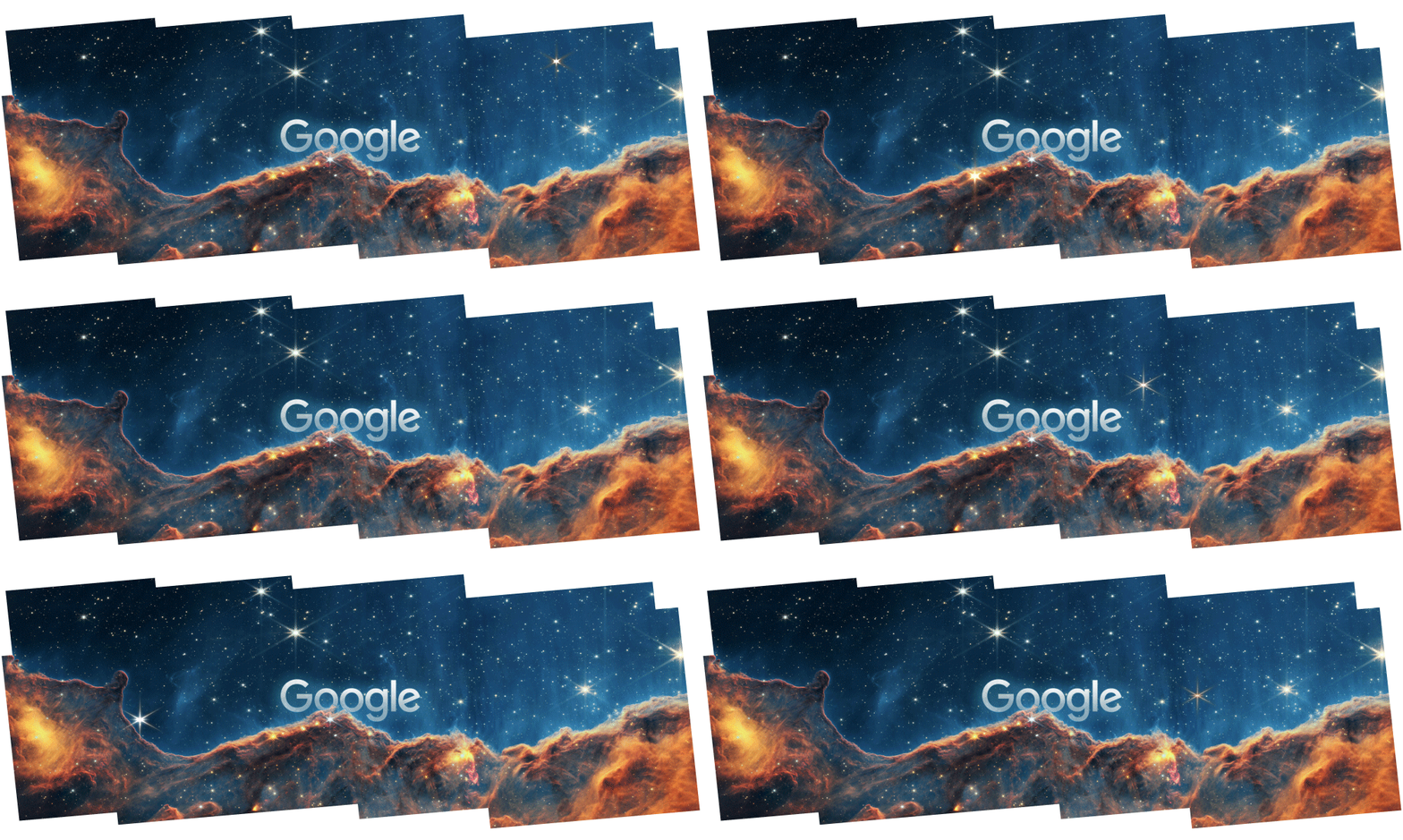
Image: Google Doodle, "World Space Week 2026: The Carina Nebula" | Google attributes the image to NASA's James Webb Space Telescope | Original page.
On October 8, Google's second World Space Week Doodle brings the Carina Nebula to its homepage. Google says the work celebrates the technology that makes astrophotography possible, using an image Webb captured in September.
Gas and dust surround young stars in an enormous stellar nursery. Google's description gives a span of more than 300 light-years and a population of more than a dozen O-type stars. These hot, luminous stars exert a powerful influence on their surroundings.
A Week Between Two Dates
The United Nations designates October 4-10 as World Space Week. Its endpoints commemorate two events: Sputnik 1's launch on October 4, 1957, and the Outer Space Treaty's entry into force on October 10, 1967.
In 2026, those anniversaries are 69 and 59 years old. The week connects the technology of reaching orbit with the rules governing what happens there.
Bright, but Far South
The European Southern Observatory places the Carina Nebula about 7,500 light-years away and describes it as larger and brighter than the Orion Nebula. Published distances and dimensions differ with measurements and the regions being described; a small Doodle cannot establish the boundary of the entire cloud.
Under a sufficiently dark southern sky, the nebula is visible to the unaided eye. For many readers in China, however, the difficulty comes before darkness: it is a matter of position.
The nebula's reference declination is roughly 60 degrees south. Declination works rather like latitude on the celestial sphere. The farther south an object lies, the harder it is to see from a northerly location. Beyond a certain latitude, even its highest daily position remains below the horizon.
Ignoring terrain and atmospheric refraction, its maximum altitude is 90 degrees minus the absolute difference between the observer's latitude and the object's declination.
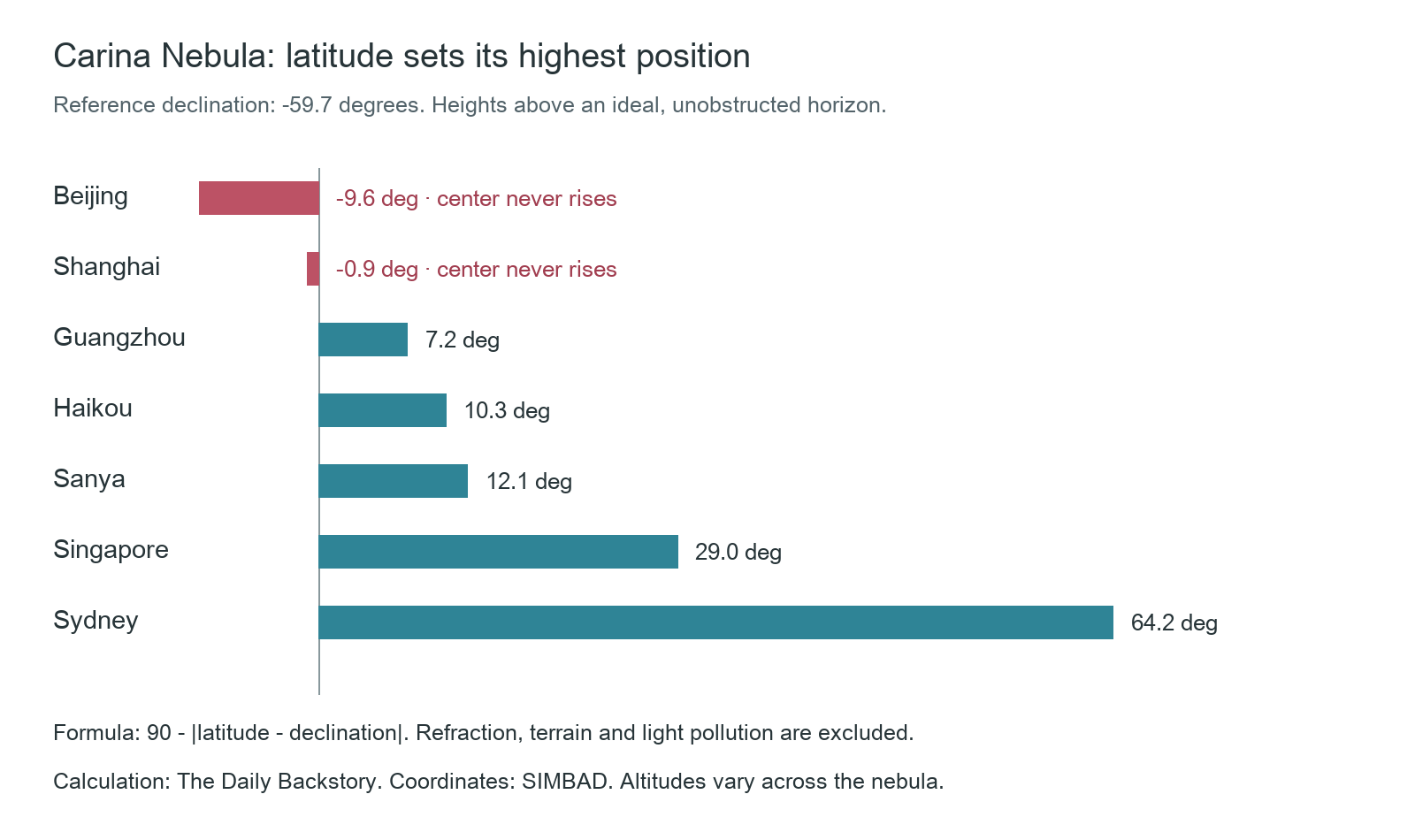
Calculation: The Daily Backstory | Uses SIMBAD's NGC 3372 reference declination, approximately -59.7 degrees. Terrain, refraction and light pollution are excluded. Different parts of the extended nebula reach slightly different heights.
From Beijing, the reference position stays roughly 10 degrees below the horizon; from Shanghai, about 1 degree below it. Guangzhou gets approximately 7 degrees of altitude and Sanya about 12. Those positive numbers allow a theoretical appearance, but thick low-altitude air, terrain and city lights make observation difficult.
Sydney gets about 64 degrees. The same cloud climbs high into the southern sky.
Nicolas Louis de Lacaille recorded the nebula from the Cape of Good Hope in the 1750s. An observer's location shapes both the visible sky and the astronomical experience of a place. Low northern latitudes can see some southern objects, so the whole Northern Hemisphere should not be treated as one viewing location.
Another Light for These Evenings
For observers in China, seeing Carina calls for a lower latitude, a suitable nighttime season and a clear southern horizon. Brightness cannot overcome geometry.
The evenings of October 8 and 9 offer a different possibility: the Draconid meteor shower. NASA's Meteoroid Environment Office forecast lists its 2026 maximum at October 9, 02:10 UTC. That is October 8 at 10:10 p.m. EDT, or October 9 at 10:10 a.m. in Beijing. The adjacent evenings give Chinese observers nighttime opportunities around the forecast maximum.
Expect a quiet shower. The forecast predicts a peak zenithal hourly rate of about three under ideal conditions, with no outburst predicted this year. Actual observers generally see fewer meteors, and a forecast time is not a promise of minute-by-minute precision.
A nebula and a meteor offer very different scales of light. One has traveled for thousands of years and still asks us to stand in the right place. The other lasts an instant, giving us a reason to linger after dark.
Sources
Google Doodles official page; United Nations: World Space Week; ESO: Strong Winds over the Keel; ESO: Stars v. Dust in the Carina Nebula; SIMBAD: NGC 3372 coordinates; NASA Meteoroid Environment Office: 2026 meteor shower forecast.