
At noon yesterday, over the small French village of Cessy, a planet emerged from behind the Moon. A photographer pressed the shutter.
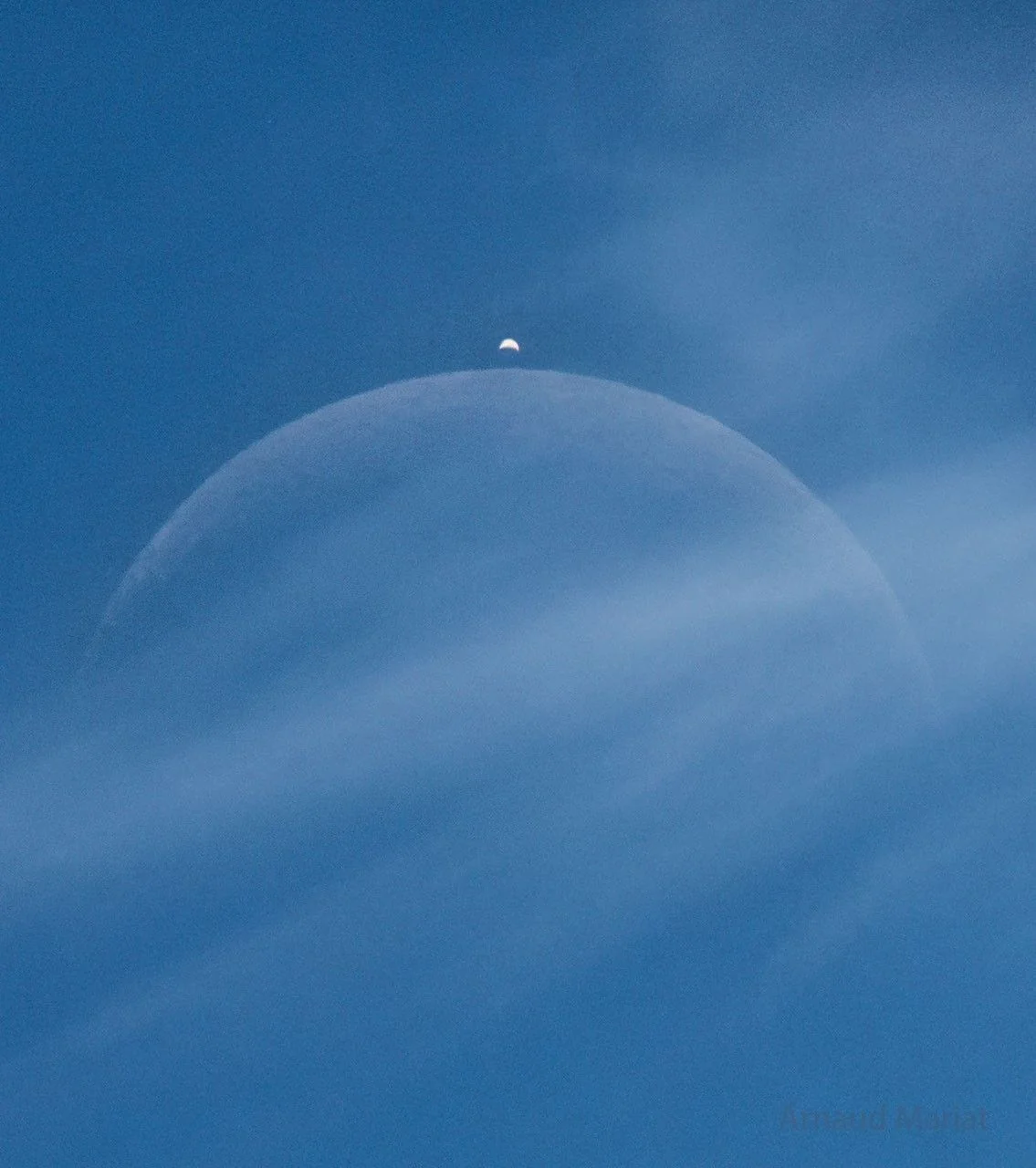
Image: NASA Astronomy Picture of the Day (APOD) | Image credit and copyright: Arnaud Mariat | Daily page: science.nasa.gov
There is something behind the clouds.
That is how APOD's official description begins. Look closely and you will see the Moon, barely visible above Cessy around noon yesterday. Soon it was no longer alone. A bright point suddenly emerged from behind it: distant Venus.
Astronomers call this an occultation, when one celestial body passes in front of another. It is not the same as an eclipse. An eclipse involves one body's shadow falling on another; an occultation is a simple obstruction. APOD uses eclipse poetically in its title, not as the technical term. This was not a "daytime lunar eclipse."
What Happened Yesterday
The date was Monday, September 14, 2026. The closest geocentric approach came at about 11:34 UTC, when the geocentric angular separation between the Moon and Venus narrowed to 0.48 degrees.
Few places could see it. All of Europe, the United Kingdom, eastern North Africa, the Middle East and western Asia saw it in daylight. North America could not see it at all: both the Moon and Venus were below the horizon there during the occultation. APOD says it was visible from only about 10% of Earth's surface, most of that in daylight. The figure holds up: a point-by-point global grid calculation puts the share of Earth's surface where the Moon was above the horizon during the event at about 10.4%.
In Cessy, the sequence went like this, in local daylight time, UTC+2: the Moon rose at about 11:03 a.m.; Venus disappeared behind it at about 11:27, when the Moon was only 2.6 degrees above the horizon; and Venus reappeared on the other side at about 12:37 p.m., when the Moon had climbed to an altitude of 12 degrees.
At disappearance, the Moon was barely more than two degrees high. Southeast of Cessy, across the Geneva basin, stand Mont Saleve and the Alps; the terrain almost certainly hid that half of the event. The photographer therefore caught the reappearance. APOD's own phrase is that the point of light "suddenly emerged" from behind the Moon, not that it slowly slipped away.
APOD's "near noon" is exact enough: it was 12:37 p.m. locally.
The Part Many People Will Misread
Both the Moon and Venus are crescents in this photograph. But Venus has the much fuller crescent.
At the time, about 12% of the Moon and 29% of Venus were illuminated. APOD gives approximate figures of 10% and 25%, both a little low; two independent sources in the United Kingdom and Germany give 12% and 29%. The difference does not affect APOD's conclusion, but 12% and 29% are more accurate.
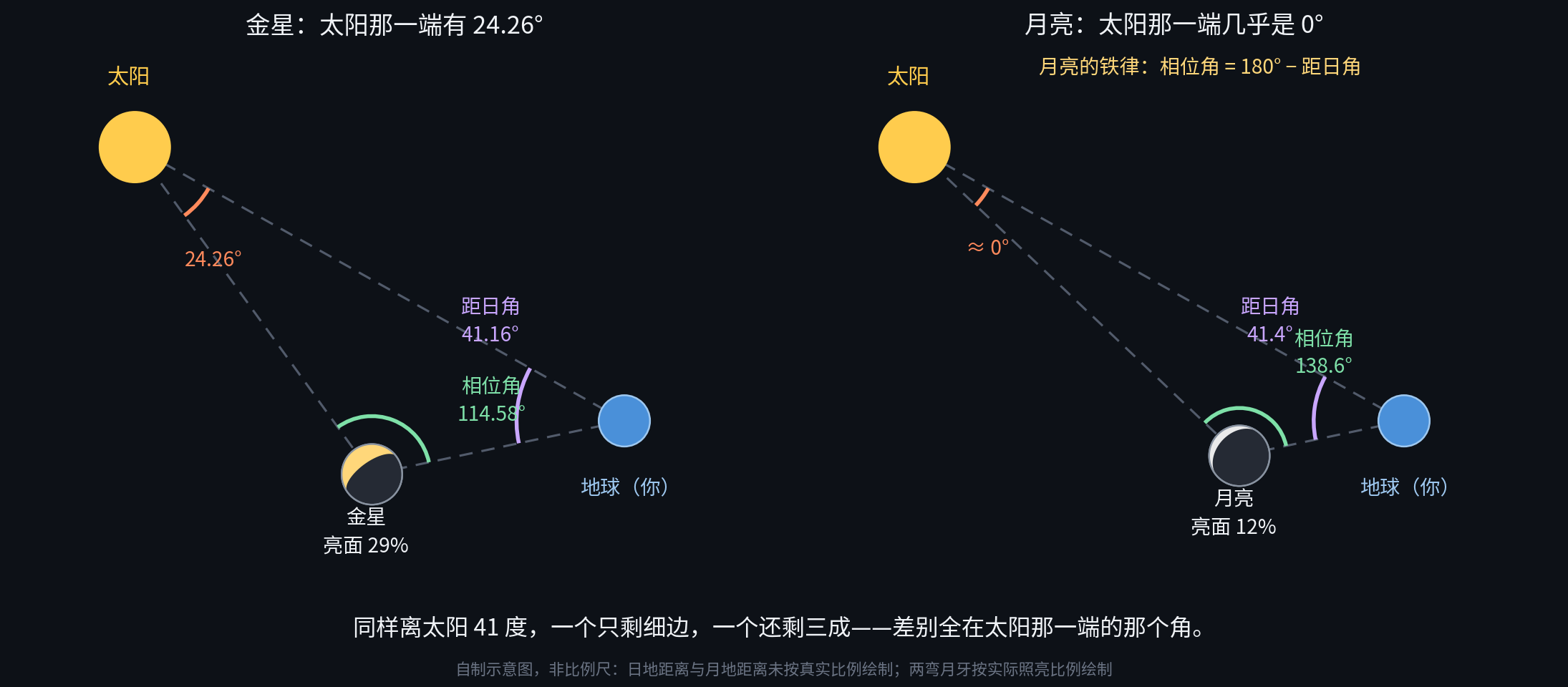
That is the puzzle. Both bodies appeared about 41 degrees from the Sun. Under the same lamp and at the same apparent angle, why were their crescents so different?
The answer lies in the shapes of the triangles.
Join the Sun, Venus and Earth into a triangle. Its internal angles were 41.16 degrees at Earth - the elongation we saw in the sky - 114.58 degrees at Venus, the phase angle that determines how much of the bright side we see, and 24.26 degrees at the Sun. Together they make exactly 180 degrees.
Now consider the Sun-Moon-Earth triangle. The Moon orbits the Sun alongside Earth, so its distance from the Sun is almost exactly one astronomical unit, just like Earth's. The triangle is therefore extraordinarily flat, and the angle at the Sun is almost zero. That imposes a strict rule:
The Moon's phase angle = 180 degrees - elongation
Substitute the numbers: 180 minus 41.4 gives 138.6 degrees. The illuminated fraction is (1 + cos 138.6 degrees) / 2, or about 12.5%. The measured value was 12.1%. The rule holds.
The same 41 degrees means completely different things for these two spheres.
The Moon is far from the Sun - one astronomical unit away. Being 41 degrees from the Sun in our sky therefore means that sunlight reaches it from 139 degrees behind, leaving only a fine bright edge.
Venus is closer to the Sun, at 0.73 astronomical units, and closer to us too, at 0.45 astronomical units, or about 68 million kilometers. It lies between the Sun and Earth but has stepped to one side. Its apparent separation of 41 degrees means that sunlight reaches it from 115 degrees behind and to the side, leaving almost three-tenths of its face illuminated.
That 24-degree angle at the Sun is Venus's true sideways displacement relative to the Sun. For the Moon, the corresponding angle is nearly zero. The entire difference is there.
In terms a child can follow: the Moon and Venus are two balls lit by the same lamp, but they stand in different places. The Moon stands far away, almost behind the lamp, so only a thin rim remains. Venus stands closer and has moved to one side, so the light can still reach part of its face.
Four centuries ago, this difference helped overturn a universe. Through his telescope, Galileo saw Venus pass through a full set of phases, from a thin hook to an almost full disk. That was impossible under a model in which everything orbited Earth. The two unequally full crescents in yesterday's photograph are a modern link in the same chain of evidence.
The Star Visible in Daylight
Why did almost all of this occultation take place in daylight? It was not a coincidence.
For an occultation, the angular separation between the Moon and Venus must fall to zero. Venus was 41 degrees from the Sun, so when the Moon caught it, the Moon also had to be 41 degrees from the Sun. A point in the sky only 41 degrees from the Sun crosses the meridian roughly two hours and 45 minutes later. When the Sun is up, it is up too. At European longitudes, that placed it in the sky between roughly 9 a.m. and 1 p.m.
Can Venus be seen with the naked eye during the day? Yes. The essential requirements are knowing exactly where to look and having clear air.
Why Venus rather than another planet? The numbers explain it. According to NASA's planetary fact sheets, Venus has a geometric albedo of 0.689, while the Moon's is only 0.12, a 5.7-fold difference in reflectivity. Solar irradiance at Venus is 2,601 watts per square meter, compared with 1,361 at the Moon, a 1.9-fold difference in illumination. Multiply the two: each unit of area at the top of Venus's clouds returns about 11 times as much light as the lunar surface.
APOD's statement that Venus looks brighter because it is closer to the Sun and because its clouds reflect more light than the Moon's dark surface is physically correct.
One distinction matters. In total brightness, the Moon, at about magnitude -7.6, was more than ten times brighter than Venus at about -4.46. Venus has the greater surface brightness, or brightness per unit area. That is why it looks like a piercing point in the photograph.
Safety warning: Never look directly at the Sun, and never sweep binoculars or a telescope near it. If looking for Venus in daylight, first stand where a tree trunk or building completely blocks the Sun.
The Moon's Edge Is a Knife
Occultations have long been useful astronomical tools for a simple reason. The Moon has no atmosphere, so its edge is clean and sharp, and its motion can be predicted precisely. An occultation turns the difficult problem of angular resolution into the much easier problem of time resolution: one need only record exactly when something disappears and reappears.
The best-known example is the quasar 3C 273.
On May 15 and August 5, 1962, Cyril Hazard and his colleagues used Australia's 64-meter Parkes radio telescope to observe the Moon passing in front of 3C 273. From the diffraction fringes produced during the occultations, they separated the radio source into two components and fixed its position to arcsecond precision. The March 16, 1963 issue of Nature carried four related papers: Hazard and his colleagues supplied the position, and Maarten Schmidt decoded the spectrum, finding a redshift of 0.158.
The causal chain deserves precision. The occultation did not itself discover quasars. It told astronomers where to point the telescope. The position led them to the object that looked like a 13th-magnitude star; its spectrum revealed the redshift; and the redshift showed that it lay two billion light-years away.
Occultations have also measured stellar diameters. In the 1950s and 1960s, observers in South Africa used lunar occultations to measure angular diameters of 0.040 arcseconds for Antares and 0.023 arcseconds for μ Gem. In 1968, the Narrabri intensity interferometer independently measured Regulus and matched the earlier lunar-occultation result. Two entirely different methods produced the same answer, one of astronomy's most satisfying forms of cross-check.
There was an earlier observer too. On March 9, 1497, Copernicus observed the Moon occult Aldebaran from Bologna. It is the first astronomical observation he left on record, made to test Ptolemy's lunar theory.
Fourteen Centuries Ago, China Called This Taibai Crossing the Sky
Chinese observers have recorded the visibility of this daytime star for two thousand years.
Its ancient name was Taibai. Seeing it by day was called Taibai zhoujian, "Taibai seen in daylight." When it crossed the meridian in broad daylight, hanging high in the southern sky, the stronger and rarer phrase was Taibai jingtian, "Taibai crossing the sky."
The astronomical treatise in the Book of Han attached this omen to the sight: "When Taibai crosses the sky, all under heaven is transformed and the people change their ruler; order is thrown into chaos and the people are displaced. Seen by day, it contends in brightness with the Sun; strong states weaken, small states grow strong, and a female ruler flourishes." It foretold a change of dynasty. Every daytime appearance of Taibai was therefore entered into official history as a major political event.
The most famous appears in the annals of Emperor Gaozu in the New Book of Tang. In the sixth month of the ninth year of Wude: "On the dingsi day, Taibai crossed the sky." Three days later: "On the gengshen day, Prince Shimin of Qin killed Crown Prince Jiancheng and Prince Yuanji of Qi" - the Xuanwu Gate Incident.
Does the record survive a modern astronomical calculation?
It does. Ephemerides for Chang'an in late June 626 show Venus as a morning star 45 degrees from the Sun, at magnitude -4.3. It crossed the meridian at about 9 a.m., when the Sun had already climbed to an altitude of 47 degrees.
It was literally Taibai crossing the sky. In full daylight, the star crossed the meridian. The Tang court astronomers were not recording an imagined sign, but a real and physically plausible observation.
Another category in the chronicles is the Moon occulting Taibai: the Moon covering Venus, exactly what the photographer in France captured yesterday. A comprehensive collection of ancient Chinese astronomical records contains 211 lunar occultations of planets. Thirty-four include timing information; the earliest dates to the Eastern Han and the latest to the end of the Qing, with the greatest concentration in the Ming. Modern astronomers really do use these records - not to revise lunar calendars, but to study long-term changes in Earth's rotation.
One example appears in the Veritable Records of the Ming. On the night of the xinmao day in the eleventh month of the eighteenth year of Yongle, the Moon occulted Venus. In the Gregorian calendar, that was December 31, 1420. A calculation of Nanjing's predawn sky puts the minimum separation between the centers of the Moon and Venus at 225 arcseconds, while the Moon's apparent radius was 991 arcseconds. Venus was indeed inside the lunar disk. It was about 5:30 a.m. local mean time; the Moon was 20 degrees high and the sky was still completely dark.
On a winter dawn 606 years ago, someone in Nanjing looked up, saw the Moon cover Taibai and entered it in the record. Recalculate that night 606 years later, and the record tells the truth.
Meanwhile, Yunnan Saw the Other Half Last Night
APOD says most of the occultation's visible area was in daylight. That was true in Europe, but not in southwestern China.
A point-by-point ephemeris calculation shows that the disappearance was visible from Yunnan, Guizhou, Guangxi and Hainan on the evening of September 14, 2026, around 8:30 p.m. Beijing time, after the sky was fully dark.
In Tengchong, Venus disappeared at 8:32 p.m., with the Moon at an altitude of 8.4 degrees, and reappeared at 9:00 p.m., with the Moon at 2.5 degrees. Both halves were visible. In Lijiang, disappearance came at 8:37 p.m., at an altitude of 5.2 degrees, and reappearance at 8:52 p.m., at 2.1 degrees. Kunming, Jinghong, Nanning and Sanya could see the disappearance, but the Moon had set by reappearance. Chengdu, Lhasa, Beijing and Shanghai saw no occultation; the Moon and Venus merely passed one another.
These are ephemeris predictions. At altitudes of only one or two degrees, terrain and atmospheric extinction are extremely important, so actual visibility depended on the local horizon.
One occultation: in France, people saw Venus emerge in the noon sky; in Yunnan, people saw it disappear low in the night sky. One side of the world saw the ending, the other the beginning.
How Venus's Phase Will Change in the Coming Months
Yesterday's 29% Venus is growing thinner. It is now an evening star, its elongation shrinking as it approaches inferior conjunction on October 23-24, 2026, passing between the Sun and Earth. During the preceding month it will draw closer to us and appear larger, while its illuminated fraction shrinks into an ever-finer crescent.
Visibility and phase from Beijing, calculated from ephemerides:
- September 20: 24.7% illuminated, apparent diameter 40.7 arcseconds, visible for about 62 minutes after sunset
- September 30: 15.9% illuminated, apparent diameter 47.9 arcseconds, about 41 minutes after sunset
- October 10: 7.3% illuminated, apparent diameter 55.6 arcseconds, only about 13 minutes after sunset
- Around October 20: too close to the Sun to see
- November 9: returns as a morning star, 8.1% illuminated, about 117 minutes before sunrise
- November 29: 26.1% illuminated, about 203 minutes before sunrise
Venus will also reach its greatest brightness in this cycle as an evening star around September 18, 2026, at about magnitude -4.8.
Within a month, it will shrink from a 25% crescent to a 7% hook while its apparent disk swells by a third. Then it will vanish for two weeks and return in the eastern dawn, this time growing fuller and smaller.
These are the same phase changes Galileo observed in 1610. His telescope was far less capable than an ordinary pair of modern binoculars.
The next lunar occultation of Venus comes on November 7, 2026, but it will be visible only at high southern latitudes: Antarctica, the South Pacific and the southernmost part of South America. China will not see it. To watch the Moon swallow Venus from China, the next opportunity is the morning of March 30, 2028, and requires a trip to Xinjiang. To see one from home elsewhere in the country, the wait is until dawn on May 9, 2032. For predictions precise to the minute, consult the professional forecasts issued nearer the time.
Finally, the Village
Cessy is a village of more than 5,800 people in France's Ain department, beside Geneva, at an elevation of roughly 500 meters.
One hundred meters beneath its southeastern edge sits a 14,000-ton machine: the CMS detector, one of the Large Hadron Collider's four major experiments.
So this is what happened there at noon yesterday. Standing directly above the largest particle collider in the world, a person raised a camera toward the southeastern sky, only two degrees above the horizon, and photographed the instant a planet emerged from behind the Moon.
One hundred meters below his feet, humanity was taking matter apart at its smallest scale. In his lens was the profile of a planet 68 million kilometers away.
The same afternoon. The same village.
Sources: NASA Astronomy Picture of the Day at science.nasa.gov for September 15, 2026; the BBC's Sky at Night and sterngucker.de forecasts for the September 14, 2026 lunar occultation of Venus; Universe Today; EarthSky on Venus's greatest brightness and daytime observing methods; NASA NSSDC fact sheets for Venus and the Moon; the CMS experiment website and CERN community pages; CSIRO Parkes Observatory's Fifty Years of Quasars archive; the IntechOpen review Lunar Occultation; the astronomical treatise in the Book of Han; the annals of Emperor Gaozu in the New Book of Tang; Li Yong, "A Study of 34 Timed Lunar Occultations of Planets in Ancient China," Studies in the History of Natural Sciences, no. 4 (2007); A Comprehensive Collection of Records of Celestial Phenomena in Ancient China (Beijing Observatory, 1988). Positions, phases, visibility and historical calculations in the article were independently computed with PyEphem and cross-checked against the sources above.