
There are two people in this photograph. What makes it worth a long look is the room behind them, and a question almost everyone answers incorrectly: why did this building have to be so tall?
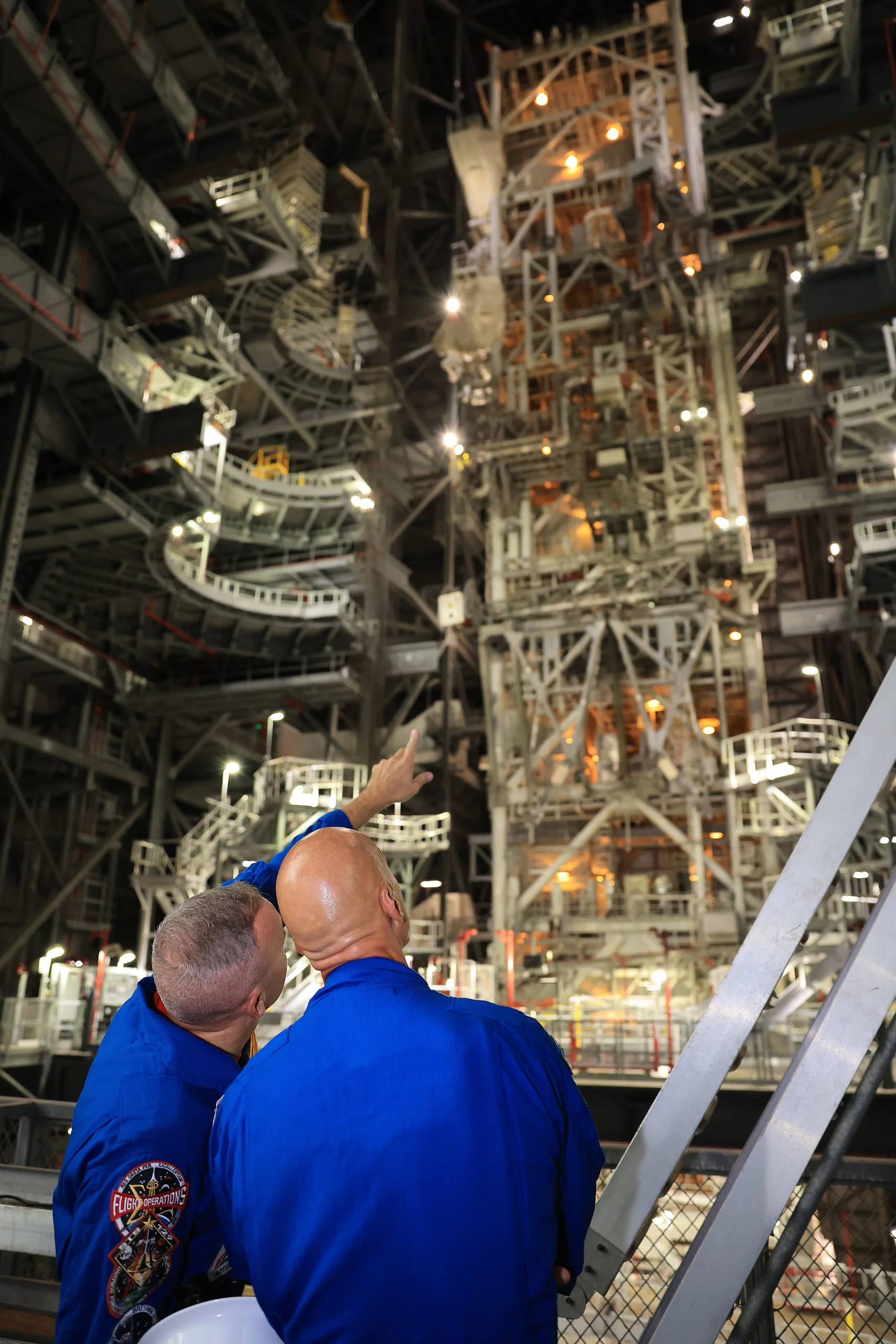
Image: NASA Image of the Day | Image credit: NASA/Kim Shiflett | Image page
Wednesday, September 2, 2026. NASA astronaut Randy Bresnik, at left, and European Space Agency astronaut Luca Parmitano stand in High Bay 3 of the Vehicle Assembly Building at Kennedy Space Center in Florida, looking up at the progress of solid rocket booster integration.
They are the commander and pilot of Artemis III. The whole group was there that day: Bob Hines, Andre Douglas and Frank Rubio joined them as the prime and backup crews visited Kennedy together for the first time. They went to three places: High Bay 2 to see the core stage, High Bay 3 to see the boosters, and then the Orion spacecraft.
Inside Orion, the five took turns signing a liner panel that covers the environmental control and life support system inside the crew module. The panel will be reinstalled and hidden behind other components. No one will see the names, but they will fly with the spacecraft.
Today, though, the subject is not the astronauts. It is the room.
A One-Story Building 160 Meters Tall
The Vehicle Assembly Building, or VAB, stands 160.0 meters (525 feet) high and 157.9 meters wide, covers eight acres and contains about 3.66 million cubic meters of interior space.
Its name has a story of its own. It began as the Vertical Assembly Building. During construction in 1965, it became the Vehicle Assembly Building. The abbreviation VAB remained unchanged, but the V acquired a new meaning.
The VAB is often called the world's largest building. It probably held that title for little more than a year. The Boeing Everett Factory opened in 1967 and, after several expansions, reached 13,385,378 cubic meters - 3.65 times the VAB's volume. Guinness World Records now lists it as the largest factory by volume. NASA's own current wording is more restrained: the VAB is "one of the largest buildings in the world by volume" and the largest launch-vehicle integration facility in the space industry.
NASA's current documents do not entirely agree about its volume. Some give 3,664,883 cubic meters and others 3,684,883. An official 1970 caption gives an imperial figure of 129,428,000 cubic feet, which converts to about 3.665 million cubic meters and agrees with the first number. The difference between a six and an eight has survived for decades in two sets of specifications.
Why Does It Have to Be So Tall?
The instinctive answer is "because the rocket is tall."
That answer is wrong, or at least less than 70 percent right.
The Space Launch System rocket is about 322 feet tall. The building is 525 feet. Where did the extra 200 feet go?
The answer is in the hook.
Kennedy Space Center's public asset inventory gives the VAB's crane specifications: two 250-ton bridge cranes with a hook height of 460 feet, and two 325-ton bridge cranes with a hook height of 462.5 feet. The building contains 71 cranes and lifting devices in all.
Think about stacking blocks. To place one block on top of a tower, your hand must first rise above the entire tower before it can lower the block into position.
A rocket works the same way. To lift one section, suspend it directly above another and lower it gently into place, the hook must rise above the top of the assembled rocket - plus the length of the suspended section and its rigging.
The rocket accounts for 322 feet; the hook reaches 462.5. The 140 feet between them is not wasted space. It is the space required by the action of placing one section on another. The remaining 60-plus feet between the hook and the 525-foot roof house the crane and its girders.
The building was not designed around the rocket's height. It was designed around the hook's height.
The same principle governs its four doors, two on the east and two on the west. Each is 456 feet (139 meters) high and takes about 45 minutes to open or close fully. They remain the world's largest doors. Their height is not set by the rocket alone, but by the combined height of the rocket on its mobile launcher as the entire stack rolls outside.
It Does Not Rain Inside
The most famous story about the VAB says it is so enormous that it makes its own weather, producing indoor clouds, fog or even rain when humidity is high.
It is a wonderfully visual claim. It is also untrue.
The story did not originate on the internet. An official Kennedy Space Center article dismisses it with revealing wording:
"Contrary to reports circulated during construction, the VAB - most of which is not air-conditioned - does not create its own weather; reports of indoor rain, clouds or fog are myths."
The phrase "circulated during construction" matters. The legend is as old as the building, passed along since the 1960s for six decades.
The truth is more interesting.
In the same article, project manager José Pérez Morales, who worked at Kennedy until 1985, explained:
"Because of the tremendous mass of steel in the building and the volume of the structure, temperatures inside the VAB can fluctuate with the outside weather from very cold to very hot."
"To prevent the transfer aisle from becoming a wind tunnel on windy days, procedure calls for closing the south and north doors."
The building does not make weather of its own. It amplifies the weather outside. The thermal inertia of more than 98,000 tons of steel can leave the interior colder or hotter than the air outdoors.
The real hazard is not rain but wind. Giant doors stand at both the north and south ends of the transfer aisle. Open them together and the building becomes a tube more than 150 meters long. The standard response on a windy day is not to keep rain out. It is to close the doors so the entire building does not become a wind instrument.
Beneath It Are 205 Kilometers of Steel Pipe
The VAB stands on Merritt Island, Florida, a place of sand, water and shells without a slab of rock near the surface strong enough to carry its foundation directly.
NASA's official construction history is specific. Thirty-six meters below the surface lies a limestone layer only one meter thick. Even that is not bedrock; true bedrock lies about 12 meters farther down.
Engineers therefore drove 4,225 steel pipe piles, each 41 centimeters in diameter, through the thin limestone and down to bedrock, a depth of about 50 meters.
Placed end to end, those pipes would extend 205 kilometers.
A building with 205 kilometers of steel pipe buried beneath its feet: no other number makes its weight so immediately comprehensible.
The wind design standard is 200 kilometers per hour. In winds of 100 kilometers per hour, the top of the 160-meter building moves less than 15 centimeters.
In 2004, One-Fifth Was Torn Open
Then came Hurricane Frances in September 2004.
NASA's formal release that month described the damage calmly:
"The VAB lost nearly 850 aluminum exterior panels (each 14 feet by 6 feet), exposing approximately 20 percent of the interior to the elements."
At about 7.8 square meters per panel, 850 panels amounted to more than 6,000 square meters of skin torn away. One-fifth of the interior of a 160-meter building lay directly open to the sky.
The next sentence in the release is the one that brings the story to a stop:
"The two external tanks stored inside were not damaged, nor was the Columbia debris stored on the 16th floor of Tower A."
Space shuttle Columbia was lost in 2003. Its debris has been stored in this building ever since, on the 16th floor of Tower A.
A year later, a hurricane tore open one-fifth of the building. The debris remained unharmed.
The VAB does more than assemble rockets. It also keeps the program's grief. That meaning is waiting in the second paragraph of a 2004 damage report.
The Flag on the South Wall Was Painted for the Bicentennial
A giant American flag and NASA's circular insignia, known to space enthusiasts as the "meatball," cover part of the VAB's south wall.
The flag is 209 feet (63.7 meters) high and 110 feet (33.5 meters) wide; each stripe is 9 feet wide, and each star is 6 feet in diameter. The NASA insignia covers 12,300 square feet.
They were painted in 1976 for the U.S. bicentennial. An easily missed detail is that NASA consulted the U.S. Army Institute of Heraldry to make certain that the world's largest American flag followed heraldic rules precisely.
The images were repainted in 1998 for NASA's 40th anniversary and refreshed again in May 2020 by two painting companies from Titusville, Florida. The same meatball and flag went back on the wall.
There is a small contradiction that space enthusiasts appreciate. In 1976, NASA was officially adopting its sleek "worm" logotype, while the VAB received the temporarily retired meatball. The meatball officially returned in 1992, but on this wall it had never left.
The Machine That Walks on 456 Feet
Once a rocket has been assembled, it must travel from this building to the launch pad. The crawler-transporter does the walking.
It weighs about 6.65 million pounds (3,016 metric tons) and can carry 18 million pounds (8,165 metric tons).
Its eight tracks are mounted on four trucks. Each track carries 57 shoes, making 456 in total. Every shoe weighs about 2,100 pounds, or 953 kilograms, roughly as much as a family car.
The crawler walks on 456 cars.
Loaded with a rocket, it travels at 1 mile per hour (1.6 kilometers per hour). Empty, it can manage 2 miles per hour.
Its fuel economy is one of the least intuitive figures in engineering: 32 feet per gallon of diesel. In metric terms, one liter moves it 2.6 meters, not quite twice the length of an adult lying down. The fuel tank holds 5,000 gallons.
Launch Pad 39B is 4.2 miles (6.76 kilometers) from the VAB. The trip takes about eight hours.
Its Road Was Dredged from Alabama Rivers
This is the best detail in the story.
The 4.2-mile route is called the Crawlerway. Its surface is neither concrete nor asphalt but stone: a layer of rounded rock 20 to 30 centimeters deep, about 70,000 tons in all, taken from riverbeds in Alabama, Tennessee and Georgia. The most recent large purchase, in 2014, came from Jemison, Alabama.
The specification matters. The stones are primarily quartz, rounded and 7.6 to 10 centimeters across.
NASA's official account gives three reasons for choosing them, and the reasons are unusually candid when read together:
First, the stones "act as ball bearings, allowing the crawler to turn smoothly."
Second, they "absorb the energy of compaction, helping reduce ground vibration that could damage any flight hardware being transported."
Third, they are "readily available and inexpensive."
A rocket bound for the Moon completes the first leg of its journey on 70,000 tons of rounded stone dredged from Alabama rivers. Half the reason is precision mechanics. The other half is that the material is cheap and easy to obtain.
Two Weeks Earlier, the Same Motion Happened Across the World
Wenchang Space Launch Site on Hainan follows the same engineering philosophy, known in China as the "new three verticals": vertical assembly, vertical testing and vertical transport.
The figures invite comparison. Wenchang's Long March 5 assembly and testing building is 99.4 meters high, with one underground level and 14 levels above ground. Its door is 81 meters high and divided into four vertical sections. It is smaller than the VAB's 160-meter building and 139-meter doors, but it belongs to the same species of structure. Xinhua has described the Wenchang facilities as "two nearly 100-meter-high single-story buildings." The concept is the same as at the VAB: a one-story building almost 100 meters high feels like a contradiction.
Transport follows the same motion with different machinery. The VAB's crawler uses 456 track shoes to cover 6.76 kilometers to Pad 39B in about eight hours. At Wenchang, two straight rails run 2.8 kilometers to the launch position. Beneath the mobile launch platform are four groups comprising eight pairs, 16 giant wheels in all, and the journey takes two and a half hours. The platform moves at 4 meters per minute as it leaves the building, 15 meters per minute on curves and 25 on straight track.
Convert the last figure.
Twenty-five meters per minute is 1.5 kilometers per hour. The crawler-transporter carries its rocket at 1 mile per hour, or 1.6 kilometers per hour.
Separated by half a century and the Pacific Ocean, one traveling on tracks and the other on rails, both settle at roughly 1.5 kilometers per hour - about one-third of a person's walking speed.
That is not a coincidence. Both must obey the second reason for the Alabama river stones: vibration is the enemy. The more expensive, precise and tall the load, the less quickly it can move.
The timing creates another parallel. On August 19, 2026, the China Manned Space Agency announced that the Chang'e 7 spacecraft and Long March 5 Y14 launch vehicle had been vertically transported together to the launch area at Wenchang.
In other words, two weeks before Kim Shiflett made today's photograph, the same action had just occurred on the other side of Earth. The 81-meter door of a nearly 100-meter single-story building opened, and a vertical rocket crept along two rails for two and a half hours at about 1.5 kilometers per hour.
Sixty Years and a Handover
Test piling for the VAB began in 1963. Steel erection began in January 1964, the last structural beam went into place in 1965, and interior work finished in 1966. This year marks 60 years.
The building handled 14 Saturn V rockets and prepared 135 space shuttle missions. NASA summarizes its record this way: from 1968 through 2011, it assembled and housed every crewed launch vehicle in the United States.
James A. Carleton began work in 1978 and spent more than 30 years at Kennedy Space Center. In NASA's oral-history project, he described the handover from Apollo to the space shuttle in language that is persuasive precisely because it is so unromantic:
"At that time the VAB was still configured for Apollo ... so we had to modify and activate the low bay. We removed some stands and installed new stands, platforms and ladders so people could reach the solid rocket booster hardware."
Handing the building that assembled the lunar rockets to the next generation meant removing stands, installing stands, and changing platforms and ladders.
High Bay 3, the room in today's photograph, underwent the same kind of change beginning in 2014, when ten new levels of work platforms were added. The same building performed the same kind of work 40 years apart.
The VAB was added to the National Register of Historic Places in January 2000. In January 2020, the American Society of Civil Engineers designated it a National Historic Civil Engineering Landmark. It did not retire and then become a monument. It became a monument and kept working.
Finally, the Photographer
The credit reads NASA/Kim Shiflett.
In NASA's official image library, the photographs from that day all carry the code KSC-20260902-PH-KLS01. KLS is the photographer code. On September 2, from the VAB to the Prototype Development Laboratory and then inside Orion, more than 25 official photographs were all made by one person.
Only one person photographed that entire day. Today's image is the 23rd frame in that day-long narrative.
Sources: NASA, "Artemis III Crew Visits NASA Kennedy's Vehicle Assembly Building" image page; NASA Image and Video Library API, KSC-20260902 series; NASA, "NASA Marches Toward Artemis III Mission in 2027, Names Crew Members" (June 9, 2026); NASA, "Kennedy at 60: Vehicle Assembly Building Ready for New Era of Launch Vehicles"; NASA's VAB fact sheet and official infographic; NASA SP-4204, Moonport, chapters 11-12; NASA release 04-301 (September 16, 2004); NASA, "Restoring Old Glory and a Massive Meatball" and "NASA's 'Meatball' Logo"; NASA Crawler-Transporters fact sheet; NASA, "Rocks and Rockets: From Alabama Rivers to Kennedy's Florida Crawlerway"; Kennedy Space Center Partnerships asset page; NASA STS Recordation oral-history interview with James A. Carleton (July 13, 2011); China National Space Administration, "Exploring the Vertical Assembly and Testing Building at Hainan Wenchang Launch Site"; Xinhua, "Three Major 'Magic Devices' at Wenchang Space Launch Site Explained" (May 10, 2023); China Manned Space Agency announcement of August 19, 2026; Guinness World Records, "Largest Factory by Volume"; and the Kennedy Space Center Visitor Complex KSC Explore Tour page