
The tail lifts, water drains from its edges, and most of the whale has already slipped beneath the surface. Espen Bergersen photographed this humpback near Kvaløya, in Troms in northern Norway. It is Bing's November 20 wallpaper.
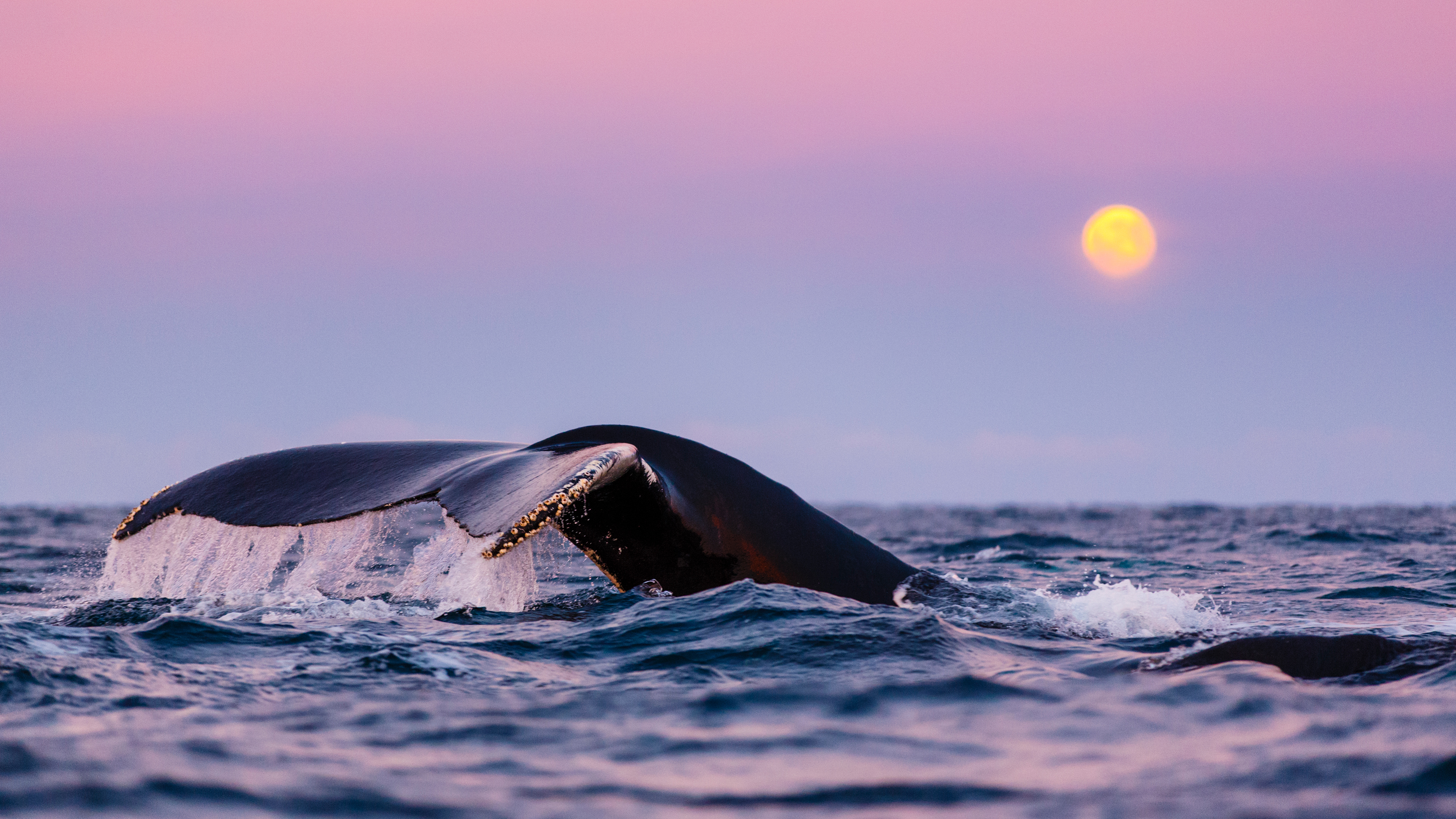
Image: © Espen Bergersen/Minden Pictures. Original page
A whale breathes with lungs and must return to the surface for air before diving again. The lifted flukes give an observer above the water a brief farewell between breaths.
A very large mouth for very small prey
NOAA Fisheries' species guide describes humpbacks as filter feeders, eating krill and other small crustaceans as well as small fish. Instead of chewing teeth, their mouths contain baleen plates. After taking in a mouthful of water and prey, they force the water back out while the food stays behind. Think of a strainer built into a mouth.
Humpbacks can use bubbles, sounds, the seafloor, and even their long pectoral fins to help gather prey. During coordinated bubble-net feeding, whales concentrate fish with curtains of bubbles before lunging into the dense gathering. This photograph shows no bubble net, however, so a raised tail cannot tell us which feeding technique the animal may have used.
Many humpbacks move between cold, productive feeding waters and warmer breeding and calving grounds. Routes and timing vary among populations, and an individual whale's itinerary cannot be read from one photograph.
Northern Norway adds a useful twist to that broad pattern. UiT The Arctic University of Norway explains that some southbound humpbacks pause along the coasts of Troms and Nordland for winter feeding on herring sheltering in the fjords. An original tracking study recorded different movements along this coast, including stays inside fjords, departures, and returns. The researchers proposed that some excursions might be searches for better feeding opportunities. That remains an interpretation to test, rather than a known motive for every trip. The setting connects this photograph to the research without supplying a travel diary for this particular whale.
A tail that can identify its owner
NOAA also explains how the black-and-white pigmentation and scars on the underside of a humpback's flukes help researchers recognize individuals. Natural markings can serve as a record that people follow across years.
Next time you see whale photographs, compare the tail shapes, patches, and notches. Those details are closer to the evidence researchers actually use than guesses about what a whale is thinking.
When watching whales in person, follow local guidance, avoid chasing them or blocking their path, and let the animals determine the encounter. Even a distant tail can mark a small part of a much longer journey between breaths.