
Look up into this photograph and white letters seem to branch across the blue sky. They belong to Body of Knowledge, a sculpture by Spanish artist Jaume Plensa at Goethe University in Frankfurt, Germany. The close crop turns part of a human figure into a canopy of writing.
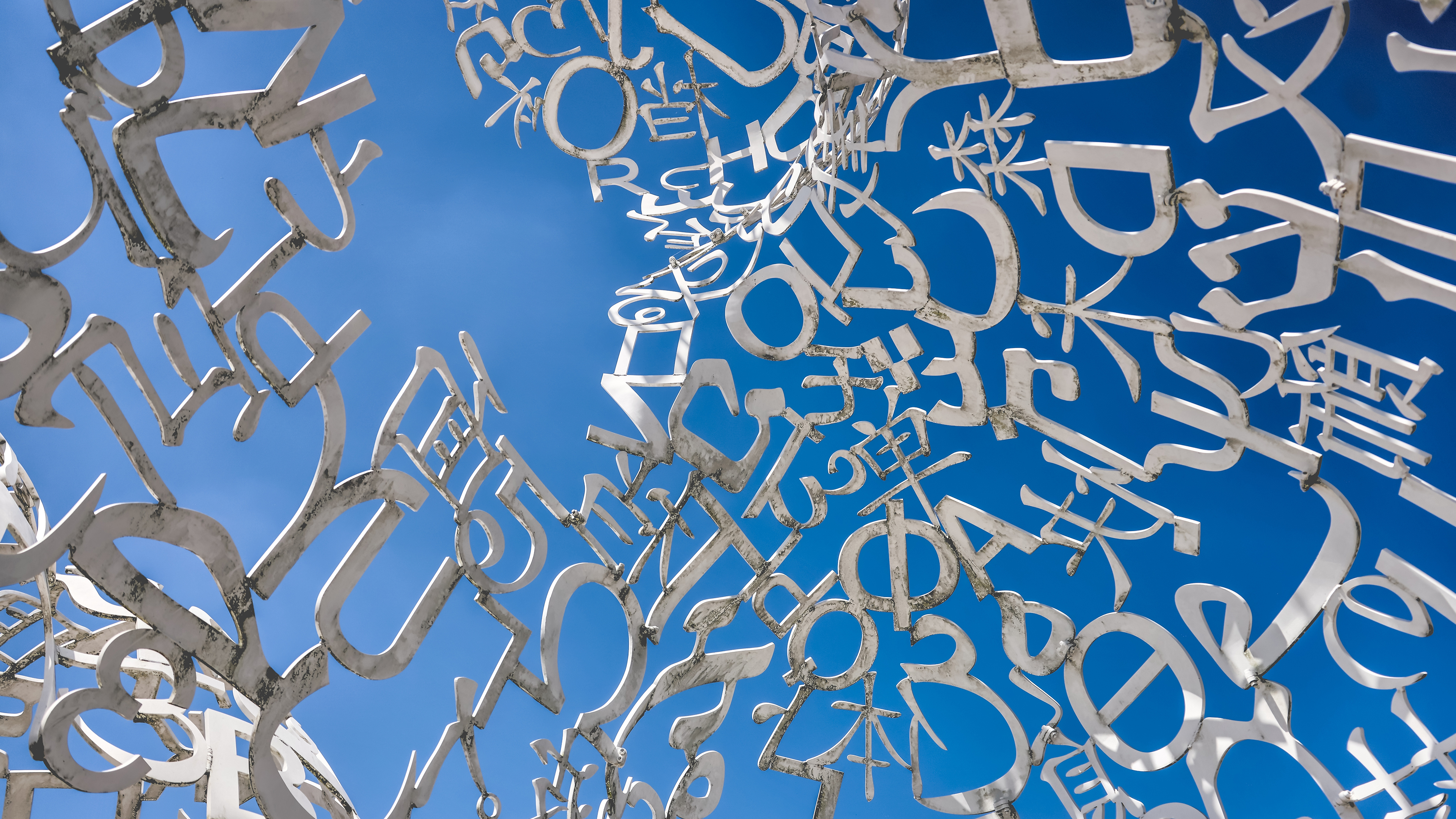
Image: © Todamo/Shutterstock. Original page
Step back from the sculpture itself and the whole seated figure becomes clear. Plensa's project archive dates the completed work to 2010 and describes its material as painted stainless steel. It stands eight meters tall, with a width and depth of 5.26 meters. That apparently weightless skin of letters is metal.
Space between the characters
Frankfurt's public-art catalogue says the figure consists of individual characters from eight alphabets. Eight writing systems need not mean eight languages: many languages can share the same alphabet.
The characters join to enclose a body while leaving gaps throughout its surface. Looking at the writing also means looking through it. In his account of the work, Plensa describes the body as a place where experiences meet and the university as an extension of that body, gathering people, ideas, tradition, and the future. A network of human knowledge has become something you can walk around.
Bing's choice for November 19 has a fitting connection to the calendar. UNESCO observes World Philosophy Day on the third Thursday of November, which falls on November 19 in 2026. Philosophy can begin with a small puzzle: why might learning more leave us less certain of our answers?
If you visit Frankfurt, the city's art catalogue places the sculpture at Theodor-W.-Adorno-Platz on the university's Westend campus. From home, try a smaller exercise with the photograph: find one character you recognize, then one you do not. They can belong to different systems and still help make the same human figure.