
A building rides a river, a wall tells a lie, and one leg gives it away.
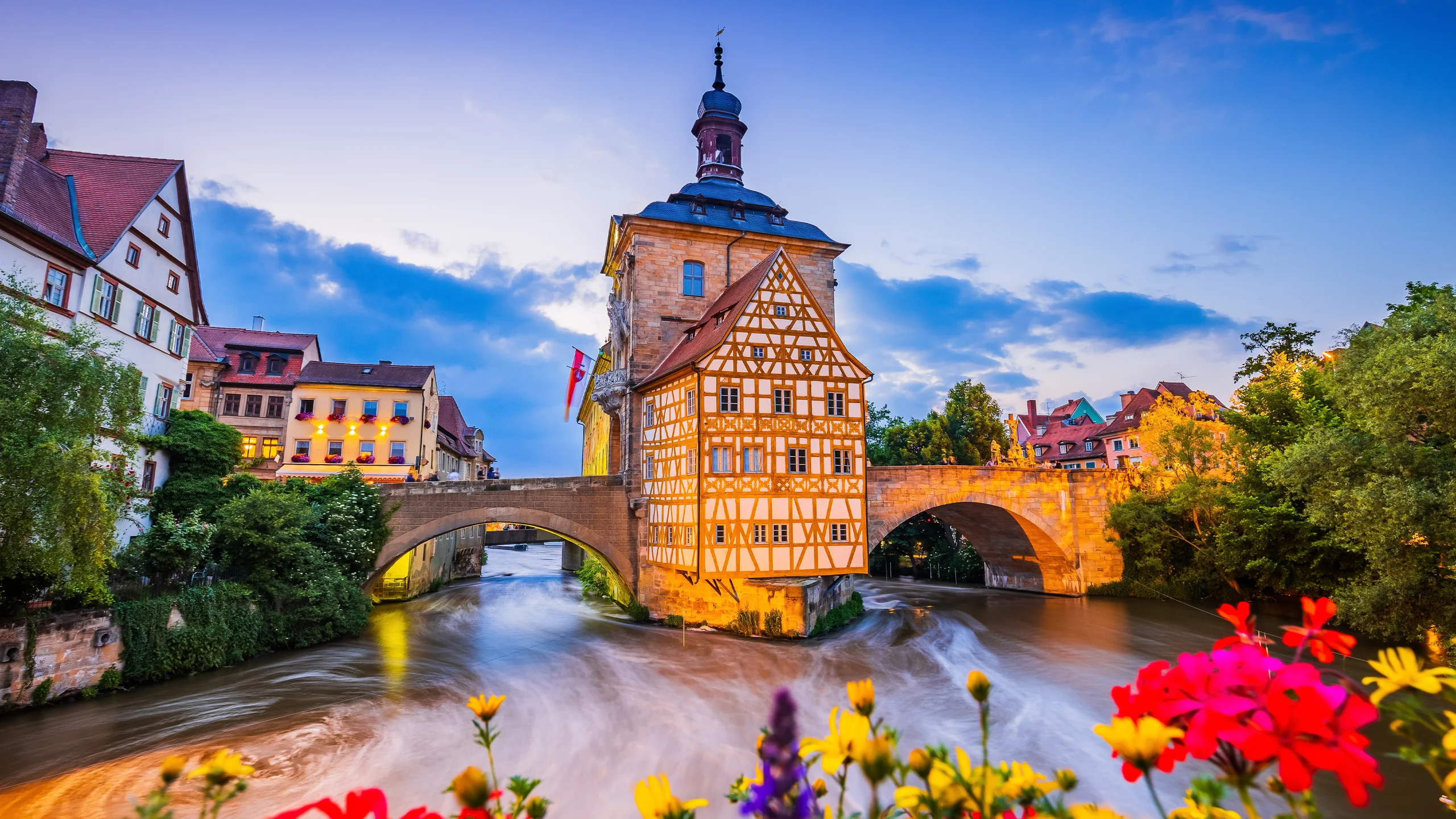
Image: Bing Daily Wallpaper | Old Town Hall, Bamberg, Germany (© SCStock/Getty Images)
Open Bing in China today and an unreasonable-looking building rises from the water.
It has no yard, no steps, not even a patch of ground of its own. It straddles the middle of a river, joined to a bridge at either end, like a ship that stopped and stayed. Bing calls the image Where History Flows Along the Canal. The city is Bamberg, in Franconia in southern Germany. The building is the Old Town Hall, with parts surviving from the early fourteenth century.
It is a rare kind of subject: stare at it and questions begin on their own.
A Town Hall Without Foundations
Bamberg's official tourism office tells the story this way. The prince-bishop refused the townspeople land on which to build a town hall. So they went into the Regnitz, drove piles into the riverbed, created a piece of ground that did not belong to the bishop and built there.
The story has circulated for centuries. It is satisfying, defiant and probably untrue.
German sources call it a Sage, a legend; official accounts never present it as history. German Wikipedia goes further, saying the boundary between episcopal and civic land was not mid-river at all but at the foot of Cathedral Hill, where a marker remains on the Katzenberg steps. That rebuttal currently has only Wikipedia behind it, and should be identified as such. Bavaria's cultural portal offers a simpler explanation: from the twelfth century onward, merchants crowded onto the river island and ran out of land along the banks.
What, then, is the real structure? It is not an island. It is a bridge.
Bamberg's official monument register records two adjacent bridges at this crossing by 1367. City architect Hans Vorchheimer built today's stone bridge from 1451 to 1456, replacing one that stood where the town hall now sits. The building did not grow on artificial land. It grew from a system of bridge piers.
Beside it hangs something stranger still. At the upstream end of the pier is a pointed triangle, a cutwater that splits the current and diverts logs and ice to protect the masonry. Old Chinese stone bridges often have them too. Bamberg placed a three-story half-timbered house on this purely hydraulic structure.
It is the Rottmeisterhäuschen, dated to the fifteenth century by the official register, though Wikipedia says 1668. The official record takes precedence here. Its name comes from Rottmeister, a guard captain who once lived or served there: a house riding the blade of a knife planted in the river.
The Meaning of Its Position
The legend may fail as history, but its underlying point survives.
Bamberg's official World Heritage center divides the city into the hill town, Bergstadt; island town, Inselstadt; and market-gardeners' town, Gärtnerstadt. The hill belonged to the bishops. Henry II founded the bishopric there in 1007, intending, in the official wording, to make Bamberg a "second Rome" in Franconia. For more than 800 years the hill was the city's religious and political center.
The island tells another story. From the fourteenth century, assertive citizens built their own center between two branches of the river. The heritage center calls it a story of trade and civic self-assertion, and the first building it names is the Old Town Hall.
The monument register adds that medieval commerce concentrated along the river, while the water also separated the two settlements.
That gives the town hall's position its force. It stands neither on the bishop's side nor safely within the citizens' quarter, but directly in the gap that divided them. Official sources do not interpret this as a spatial political declaration; that reading is the author's, not Germany's. But place the two official statements side by side and the implication is hard to miss.
The Whole Wall Pretends to Be Three-Dimensional. Only the Leg Is Real
The building's most delightful feature came in the eighteenth century.
Prince-Bishop Friedrich Karl ordered a Baroque remodeling between 1744 and 1756. The tower gained a story, the balcony received Rococo ornament by Bamberg sculptor Mutschele, and painter Johann Anwander completed the exterior around 1755.
(A widespread popular claim in Chinese and German sources credits architect Johann Jakob Michael Küchel with the entire conversion. An authoritative German academic biography says that even attribution of the tower alone is "uncertain," and Bamberg's monument register never names Küchel.)
Anwander did not paint history. He painted fake architecture. Bamberg's official English page says the murals give the facade a three-dimensional quality through trompe-l'oeil. Projecting columns, deep recesses and cast shadows are all flat. Up close, the wall is smooth as paper.
Then, on the east facade, one leg is real.
The official tourism page says one detail always makes visitors smile: a cherub's leg extends from the wall as a sculpture. The official German page says the same. Locals call it Das Bamberger Beinchen, the "little Bamberg leg."
Its wit lies not simply in projecting from the wall. One genuinely three-dimensional object certifies an entire facade of fake depth. The leg convinces your eyes, and they become willing to believe the columns and shadows beside it.
It is a public lesson in how vision can be fooled, displayed on a bridge free of charge for more than two centuries.
One caveat: today's paint is not the layer applied in 1755. In April 1945, the bridge's central arch was blown up and the adjoining Rottmeisterhäuschen badly damaged. Painter Anton Greiner reconstructed the murals from detailed surveys between 1959 and 1962. No official register, city source or tourism page identifies whether the leg is plaster, stucco or stone, so its material remains unstated.
Wood Is Afraid of Air, Not Water
The pile-driving legend raises an excellent question even if the history is doubtful: why does submerged wood not rot?
Common sense says damp timber molds, decays and collapses. Yet the foundations of many European cities, including Venice and Amsterdam, contain thousands of wooden piles immersed in groundwater and still standing centuries later.
The answer is oxygen.
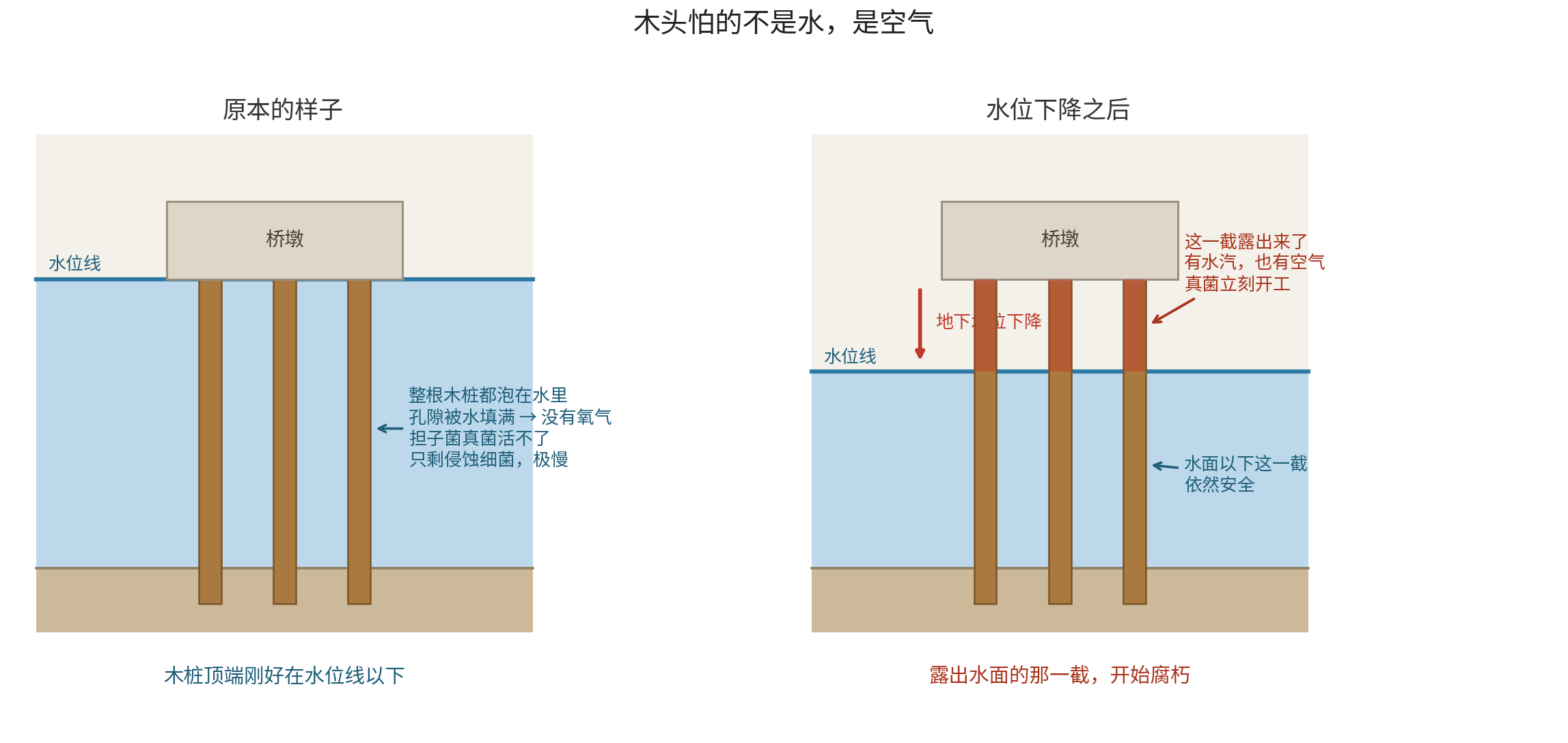
Basidiomycete fungi, the principal agents of wood decay, need it. When wood is completely waterlogged, water fills every pore in its cells and excludes air. A 2022 review in Forests states that timber exposed to highly humid conditions is generally not attacked by basidiomycete fungi because the wood tissue is saturated.
"Does not rot" needs qualification. Erosion bacteria can decompose wood without oxygen - but extraordinarily slowly. A 2024 paper by the same research group cites the wooden spears found at Schöningen, Germany. They emerged in excellent condition after 400,000 years underground because only erosion bacteria had reached them.
The accurate principle is not that submerged wood lasts forever. It is that driving timber below the permanent water table locks it in a safe with no oxygen.
That safe has a dangerous switch. Dutch researchers have long warned that when groundwater drops and the tops of piles meet air, fungi immediately begin work. Amsterdam's centuries-old foundations are now threatened by both falling groundwater and bacterial attack, an ongoing engineering problem.
For this wood, the dangerous day is not the flood. It is the day the water recedes.
The Canal and Its 180th Birthday
Bing's title, Where History Flows Along the Canal, is not casual. The Regnitz below the town hall is also the endpoint of two major waterways.
From 1836 to 1846, King Ludwig I of Bavaria built a 172-kilometre canal with 100 locks, joining the Main and Danube river systems. The Ludwig Canal crossed the European watershed at a water elevation of 417 metres. Its terminus was Bamberg, where it entered the Regnitz. Lock 100 was the final lock. It still exists and still works.
More than a century later, construction of the modern Main-Danube Canal began in Bamberg in 1960. It opened on September 25, 1992: 171 kilometres, 16 locks, and a summit 406 metres above sea level, the highest point in Europe's inland waterway network. For the first time, it created an uninterrupted shipping route between the North and Black seas. For its first six-plus kilometres, it uses the Regnitz riverbed itself. The canal did not bypass this river. The canal is this river.
The water beneath the building therefore reaches toward 1846 at one end and 1992 at the other.
An Anniversary Event on September 13
September 7 corresponds to no anniversary, festival or commemoration in Bamberg or Germany, and Bing's search term is simply the place name. The nearest related date is six days later. The Ludwig Canal marks 180 years of operation in 2026. German official sources variously date its full watering to August 1845 and its inauguration to July 15, 1846, so anniversary events span 2026. Bamberg's event in the series is the opening program for Germany's Open Monument Day on September 13, six days from now.
How a City Turns Water Into Foundations
There is a Chinese counterpart in Quanzhou's Luoyang Bridge.
Construction began in 1053, the fifth year of Huangyou under the Song dynasty, and ended in 1059, the fourth year of Jiayou, under Cai Xiang. Wind and waves at the mouth of the Luoyang River made piers difficult to secure. The Fujian provincial government's account explains the solution: stones were dropped along the bridge's centerline and spread to either side, forming a low underwater embankment more than 500 metres long and 25 metres wide. Modern bridge engineering calls this a raft foundation. Then came the remarkable step: oysters were cultivated in the surrounding water.
Oysters reproduce prolifically and occupy every gap, binding loose stones into a single mass. The overseas edition of People's Daily says Cai Xiang introduced biology into bridge building, and that this method of using oysters to consolidate foundations pioneered a technique in world bridge engineering.
The surviving Luoyang Bridge is about 731 metres long. In 2021, it became part of the UNESCO World Heritage property "Quanzhou: Emporium of the World in Song-Yuan China." The Quanzhou Prefectural Gazetteer called it "the foremost bridge under heaven."
The two cities answer the same problem in different ways.
Bamberg sinks wood in the river and uses the lack of oxygen to prevent decay.
Quanzhou grows living oysters in stone joints and uses their secretions to make loose rock cohere.
Neither city fought the water. Each found something within it and turned that thing into a foundation.
Sources: Bamberg's official monument register (denkmal-bamberg.de); Bamberg Tourism (bamberg.info); Bamberg World Heritage Center (welterbe.bamberg.de); UNESCO World Heritage property no. 624; Historisches Lexikon Bayerns; Bavarian House of History; Germany's Federal Waterways and Shipping Administration (WSA Donau-MDK); Flussparadies Franken; Singh et al., Forests 13(3):394 (2022) and Microscopy Today 32(6):50 (2024); Klaassen et al. (2000, TNO/SHR); the Fujian provincial government portal; the May 3, 2017 overseas edition of People's Daily, "Luoyang Bridge, Secure Through the Ages"; and Fujian Daily.