
The world commemorates an American event on May 1. America itself waits until September.

Image: Google Doodle, Labor Day 2026 | Official page
Today is Monday, September 7, 2026 - the first Monday in September. Above Google's search box in the United States is a new picture.
The official description is a single sentence, essentially the same every year: the annual Doodle celebrates Labor Day, a public holiday honoring workers' achievements and contributions. There is no guest-artist credit, creative note or Q&A. Google's archive contains two kinds of holiday Doodles: some invite artists to explain their ideas; others quietly hang for a day. This is one of the latter.
So let us consider the day itself.
It contains a striking mismatch: International Workers' Day on May 1 commemorates an event in the United States. The United States does not observe its holiday then.
A Parade That Nearly Failed
The story begins on Tuesday, September 5, 1882 - a normal workday, not a weekend.
New York's Central Labor Union, an umbrella group of local-union representatives, organized a great workers' parade. The U.S. Department of Labor gives a final turnout of 10,000 to 20,000; the Library of Congress says about 10,000. The route began at City Hall, passed a reviewing stand in Union Square and continued north to 42nd Street.
At first, it nearly collapsed.
The Department of Labor records that too few people appeared and there was no band: the few marchers had no music. The grand marshal was close to abandoning the event. Then Matthew Maguire arrived from Newark with 200 workers and a brass band.
The drums started the procession.
It ended at Reservoir Park. Later, nearly 25,000 union members and their families filled Wendel's Elm Park.
One detail requires a source label: the National Constitution Center says participants surrendered a day's pay to march. Neither the Department of Labor nor Library of Congress primary account includes the claim, so it is the wording of a congressionally chartered nonprofit rather than an official government position. Still, the parade did happen on a Tuesday.
Two Men With Almost Identical Names
Who first proposed a workers' holiday?
The Department of Labor has a section titled McGuire v. Maguire: Who Founded Labor Day? Its first answer is: it is not entirely clear.
One candidate is Peter J. McGuire, general secretary of the Brotherhood of Carpenters and Joiners and co-founder of the American Federation of Labor. Records show him proposing in 1882 a "general holiday for the laboring classes" to honor those "who from rude nature have delved and carved all the grandeur we behold."
The other is Matthew Maguire, a machinist - the man whose brass band rescued the parade. He was secretary of the Central Labor Union. The Department of Labor says recent research appears to support Matthew Maguire rather than Peter McGuire as the holiday's proposer. After President Cleveland signed the federal Labor Day law, Paterson's Morning Call argued that the commemorative pen belonged to local alderman Matthew Maguire, the "indisputable author" of Labor Day.
Their surnames sound almost identical, and both men attended the 1882 parade.
Another Labor Department article calls Matthew Maguire "probably the father of Labor Day." Yet in 2011, former department historian Linda Stinson said she did not know who deserved the credit.
The government can still offer only "probably" for the founder of a national holiday. That feels appropriate: collective progress is never one person's work.
Why America Chose September
On May 1, 1886, workers in Chicago and other cities launched a general strike for the eight-hour day. The Library of Congress says more than 400,000 Chicago workers joined the nationwide strike. May 1 and 2 were peaceful. On May 3, police fired on a crowd and violence broke out at a picket line. On May 4, a bomb exploded in Haymarket Square, followed by gunfire. Eight police officers died - another Library of Congress page says seven - along with an unknown number of civilians. Eight anarchists were tried; four were executed on November 11, 1887.
In July 1889, the Second International met in Paris and called for a "great international demonstration" on May 1, 1890.
That is the origin of International Workers' Day.
Chinese and American accounts differ slightly on the resolution's motive. Xinhua says the date was declared International Labor Day to commemorate the American workers' May 1 strike. The Smithsonian's National Museum of American History is more precise: the immediate purpose of the 1889 resolution was to coordinate with an American Federation of Labor action already planned for May 1, 1890.
The accounts are compatible: Chicago was the struggle's high point. Strictly speaking, one statement is historical fact and the other a commemorative narrative formed later.
Either way, the holiday observed on May 1 in more than 100 countries originated in the United States.
Why does America not observe it then? The answer has two layers, often reversed in Chinese accounts.
First, the chronology. The September date in 1882 preceded Haymarket in 1886 by four years. It cannot have been chosen to avoid an event that had not happened. McGuire's stated reason was prosaic: it fell roughly halfway between Independence Day and Thanksgiving. The weather was pleasant and the calendar had a gap.
Second came the separation. The National Museum of American History says conservative American unions, wary of any association with radicalism, abandoned May 1 and celebrated Labor Day in early September instead. The Smithsonian Center for Folklife and Cultural Heritage says union leaders and less radical labor activists chose to align themselves with law and order, distancing themselves temporally and ideologically from Haymarket and May Day.
The accurate sequence is: September was already there; after 1886, mainstream American unions let go of May.
Canada also observes Labor Day on the first Monday in September. Canada's government records a major Nine-Hour Movement strike in Toronto in 1872, when unions were still illegal and organizers were arrested for criminal conspiracy. Parliament then passed the Trade Unions Act, legalizing them. Strike, arrests, law changed: a remarkably clean chain of cause and effect. Canada made the holiday national in 1894, the same year as the United States. Library and Archives Canada says avoiding politically charged May Day was likewise one reason for the September date.
Six Days, and an Olive Branch
In May 1894, Pullman Company workers went on strike. A White House presidential proclamation gives the cause in one sentence: the Pullman Company cut wages without cutting the rent charged to workers for company housing.
The strike spread. At its height, the same proclamation says it affected about 250,000 workers in 27 states and disrupted federal mail delivery.
Then came suppression. The government obtained an injunction under the Sherman Antitrust Act, declared the strike illegal and, under President Cleveland, sent federal troops. The strike ended violently in mid-July, a defeat for labor with national repercussions.
How many died? Three official or quasi-official sources disagree: the Library of Congress says two, the Smithsonian about 26, and the National Park Service "dozens." No single number is selected here.
Federal Labor Day legislation passed in the middle of this conflict. Congress approved it on June 27, 1894, and Cleveland signed it on June 28, making the first Monday in September a national legal holiday. The Department of Labor dates both passage and signing to June 28; the White House proclamation separates the congressional vote on the 27th from the signature the next day, and that chronology is used here.
Oregon had become the first state to recognize Labor Day by law on February 21, 1887. New York introduced the first bill, but Oregon passed one first. By federal enactment in 1894, another 23 states had adopted the holiday.
The Library of Congress describes the legislation as a way to ease tensions after the deadly strike. The Smithsonian is blunter: six days after the strike's most violent phase, President Cleveland offered an olive branch by declaring the first Monday in September a national holiday.
Intriguingly, "Pullman" does not appear anywhere on the Labor Department's history-of-Labor-Day page. This is not an accusation. Every national holiday narrative selects its material. But what happened six days before a holiday's birth is worth knowing.
Fifty-Two Years From Slogan to Statute
"Eight hours for work, eight hours for rest, eight hours for what we will."
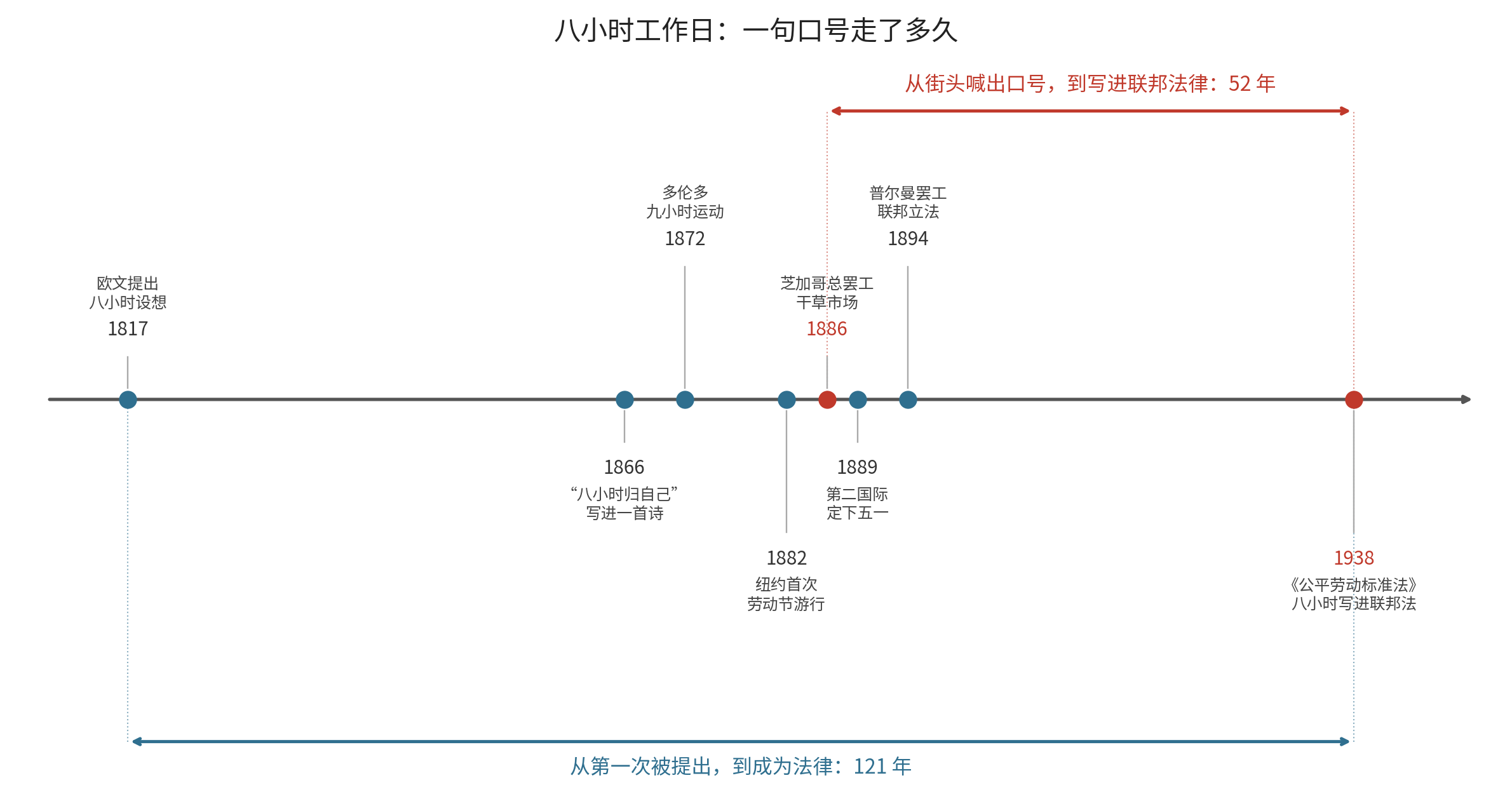
The slogan has two origins. In August 1817, Britain's Robert Owen proposed eight hours of labor, eight hours of recreation and eight hours of rest. Australia's National Museum and Xinhua agree on this account.
The American version changed the ending. I. G. Blanchard wrote the poem Eight Hours in 1866; it was set to music six years later. Its chorus promised eight hours of work, eight hours of rest and eight hours for what we will.
Owen offered "recreation." American workers demanded time whose use was theirs to decide. One phrase changes the spirit.
How long did people actually work? The U.S. Bureau of Labor Statistics reports that manufacturing employees averaged 53 hours a week in 1900.
Its child-labor figures are harsher. The 1900 census counted 1.75 million workers aged 10 to 15, 6% of the labor force. One child in eight worked in 1870; by 1900, more than one in five did. Between 1890 and 1910, no fewer than 18% of children aged 10 to 15 were working. Of nearly 100,000 southern textile workers in 1900, 25,000 were younger than 16. By 1904, the child-labor total had risen to 50,000, including 20,000 younger than 12. On farms, some children hulled berries at three; most child cranberry pickers were eight to 10.
Textile owners offered a stunning defense: 12-hour days, six days a week left children "no time to idle or engage in vice."
When did eight hours become law? Franklin D. Roosevelt signed the Fair Labor Standards Act on Saturday, June 25, 1938; it took effect on October 24. The law established a 25-cent minimum hourly wage, a 44-hour weekly ceiling, and a ban on oppressive child labor, prohibiting interstate shipment of goods made by children younger than 16.
Two qualifications matter. The original limit was 44 hours, not 40; the familiar rule of time-and-a-half beyond 40 hours came later. And the Labor Department's own history says the act initially covered only about one-fifth of the workforce.
From the Chicago slogan in 1886 to federal law in 1938 took 52 years.
From Owen's first proposal in 1817 to the 1938 law took 121 years.
Today's Numbers
Unions. The Bureau of Labor Statistics' February 2026 release for 2025 puts U.S. union membership at 14.7 million, or 10.0%. In 1983, the first year with comparable data, it was 17.7 million and 20.1%. In 42 years the rate was cut almost exactly in half: 10.0 / 20.1 = 0.498, calculated here, while the total labor force grew substantially.
Hours. International annual-hours estimates use differing methods and should not be mixed. Using only the 2025 Penn World Table's 2023 data, processed by Our World in Data, gives China 2,327.8 hours, the United States 1,788.9, Mexico 1,628.9 and Germany 1,335.3. Dividing by 52 here gives about 44.8 hours a week for China, 34.4 for the United States and 25.7 for Germany. The denominator includes part-time workers, so these are not full-time weekly schedules.
A closer comparison appears in a 2024 International Labour Organization study of working hours in China. In 2022, China's average week was 48.0 hours, against 36.6 in Japan, 37.9 in South Korea and 41.5 in Vietnam. Using 2018 data, more than half of China's urban labor force worked more than 48 hours a week.
May Day in China
China observes Labor Day on May 1, and its statute calls the holiday International Labor Day. The word "international" carries the history above.
The timeline is clear. On December 23, 1949, the eleventh meeting of the Government Administration Council of the Central People's Government adopted the Measures for National Holidays and Memorial Days, making May 1 a one-day national holiday. The State Council's first revision in 1999 expanded it to three days, creating the famous Golden Week. State Council Decree No. 513, effective January 1, 2008, reduced May Day to one day while adding Qingming, Dragon Boat and Mid-Autumn holidays.
State Council Decree No. 795, announced in November 2024 and effective January 1, 2025, restored two days for Labor Day, May 1 and 2. It was the fourth revision since 1999 and added a practical rule: consecutive working days around statutory holidays should generally not exceed six.
The earlier starting point was 1919. The People's Daily party-history channel records that on May 1, 1919, Li Dazhao published "Reflections on May Day" in a special Labor Day issue of Morning Post. On May 1 the following year, he published "A History of the May Day Movement" in New Youth, chaired a commemoration attended by more than 500 people in Peking University's Second Hall, wrote and distributed a Beijing Workers' May Day Declaration, and sent organizers to the Kailuan mining district in Tangshan. The official assessment is that this "opened the first page in the history of China's May Day movement."
Article 36 of China's Labor Law says the state shall practice a system in which laborers work no more than eight hours a day and an average of no more than 44 hours a week. Article 41 says overtime should generally not exceed one hour a day; for special reasons it may reach three hours, but must not exceed 36 hours a month.
One further layer is less widely known. The Labor Law says 44 hours, but implementation measures for the State Council's Provisions on Working Hours of Employees tightened the standard to eight hours a day and 40 a week. The rules were promulgated on March 26, 1995, and took effect on May 1, 1995.
Finally, one source discrepancy. A Xinhua article on May Day says the bloody Chicago struggle "ultimately forced the U.S. government to announce an eight-hour workday." American primary sources place federal hours legislation in 1938, with an original 44-hour ceiling covering about one-fifth of workers. This is a difference in narrative, not evidence that someone lied - but both original accounts deserve to be shown.
Sources: Google Doodles (doodles.google); U.S. Department of Labor, History of Labor Day, Labor Daze and FLSA 1938; Library of Congress; the White House presidential proclamation for Pullman National Historical Park; National Park Service; Smithsonian National Museum of American History and Smithsonian Center for Folklife and Cultural Heritage; U.S. Bureau of Labor Statistics; National Constitution Center; National Museum of Australia; the Government of Canada and Library and Archives Canada; International Labour Organization, Short Hours of Work, Long Hours of Work, and Work Hours Mismatch in China's Labor Market (2024); Penn World Table 2025 / Our World in Data; the Chinese government portal, including State Council Decrees No. 513 and No. 795 and the implementation measures for the Provisions on Working Hours of Employees; the State Administration for Market Regulation's republication of the Labor Law of the People's Republic of China; Xinhua; the People's Daily Chinese Communist Party News Network; Shenyang municipal government; Jingdezhen municipal government; National Development and Reform Commission; and Beijing municipal government.