
We are still finding new things in a photograph taken 11 years ago.
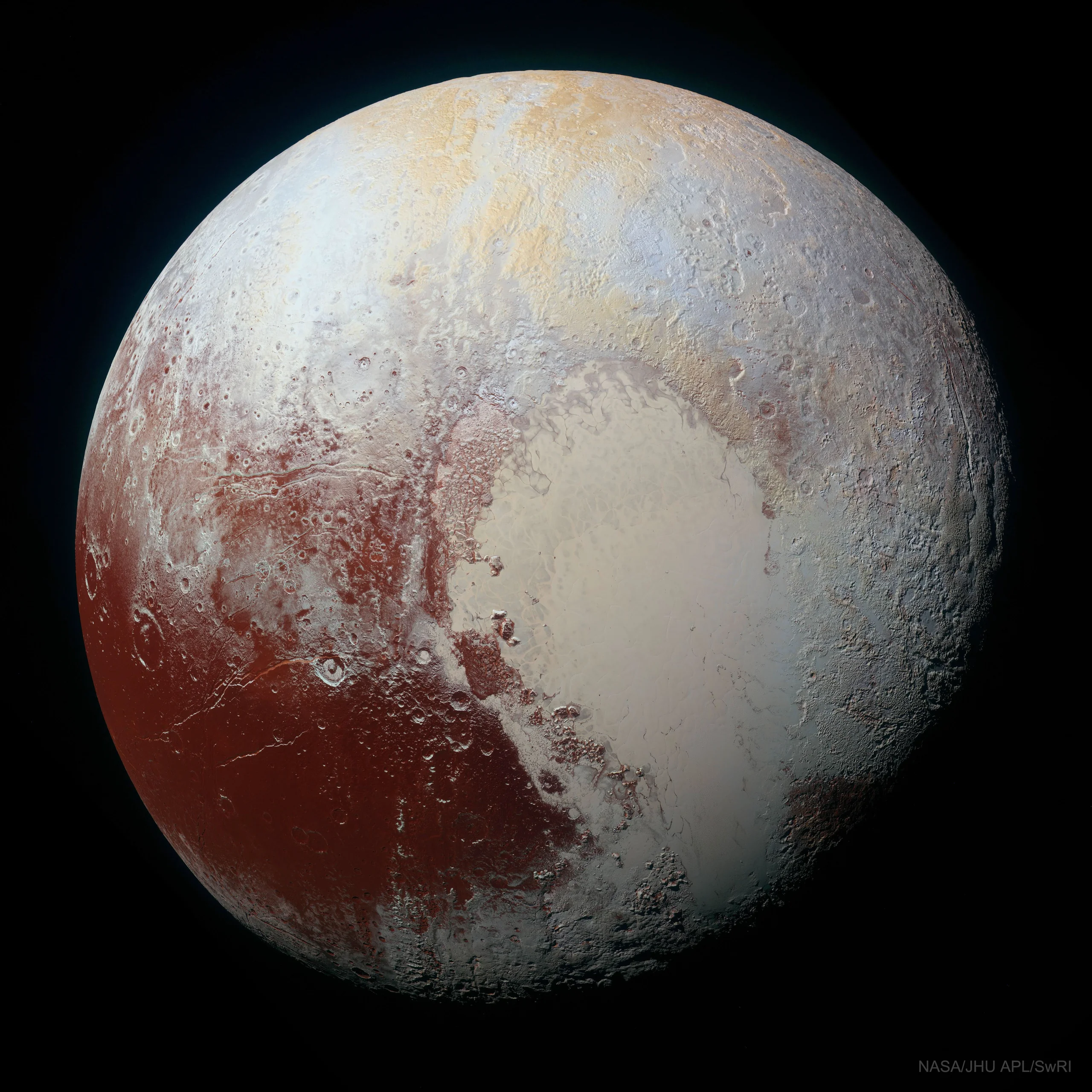
Image: NASA Astronomy Picture of the Day (APOD) | Image credit: NASA, Johns Hopkins Univ./APL, Southwest Research Inst. | Today's page
Humanity has seen Pluto close up only once. One pass, a few hours, no return.
At 11:49 UTC on July 14, 2015 - 7:49 a.m. EDT - New Horizons passed 12,500 kilometres above Pluto after flying for nine and a half years and roughly 5 billion kilometres, according to the official Johns Hopkins University Applied Physics Laboratory mission kit. It neither slowed nor entered orbit because it was moving too fast. At its launch on January 19, 2006, it was the fastest spacecraft ever launched: NASA quantified that as 36,400 miles, or 58,536 kilometres, per hour, the highest launch speed of a human-made object relative to Earth.
Everything captured during those few hours is the entirety of our close-range data about this world. Eleven years later, we are still reading new things from it. Today's enhanced-color APOD is one such image.
The most important feature lies at lower right: the heart.
What Color Is Pluto?
First, an easily misunderstood term: enhanced color.
NASA's September 24, 2015 description says this image combines blue, red and infrared views from the Ralph/Multispectral Visual Imaging Camera, at a resolution of 1.3 kilometres. It explains the enhancement this way:
Pluto's surface has a remarkable range of subtle colors, enhanced in this view into a rainbow of pale blues, yellows, oranges and deep reds. Many landforms have their own distinct colors, telling a complex geological and climatological story.
The colors already exist. Enhancement does not paint the photograph; it separates genuine differences too subtle for the eye, much as a medical scan colors differences between tissues. Every shift in hue marks a real change in surface chemistry. APOD likewise says the process distinguishes regions with different chemical compositions.
Pluto's true color is reddish brown.
The reason is more interesting than Mars's iron rust. NASA explained in July 2015 that cosmic rays and solar ultraviolet light interacting with methane in Pluto's atmosphere and surface create hydrocarbon molecules collectively called tholins.
Researcher Michael Summers made a startling observation:
This means the reddening of Pluto is happening even on the night side where there is no sunlight, and during the depths of winter when the Sun remains below the horizon for decades.
Ultraviolet light scattered through interstellar space is enough. In total darkness, a world quietly dyes itself red.
Not One Crater on the Heart's Left Half
The heart is formally Tombaugh Regio, after Pluto's discoverer. Its left half has another name: Sputnik Planitia.
McKinnon and colleagues reported in Nature in 2016 that this oval covers about 900,000 square kilometres - a quarter larger than Qinghai Province - and lies 3 to 4 kilometres below the rugged terrain around it. It contains molecular nitrogen, methane and carbon-monoxide ice, but is dominated by nitrogen: a sheet of solid nitrogen several kilometres thick and about 1,000 kilometres across, roughly the straight-line distance from Beijing to Shanghai.
Then comes the arresting sentence:
Impact craters have not been identified ... the crater retention age of Sputnik Planitia is very young, no more than about 10 million years.
The age of a surface in the Solar System is written in its craters. Lunar, Mercurian and Martian highlands preserve more than 4 billion years of impacts. Across nearly 900,000 square kilometres of this plain on Pluto, not one crater has been confirmed.
A world more than 4 billion years old has a face younger than 10 million. What keeps washing it clean?
One Turn Every 500,000 Years
The answer is the nitrogen ice itself.
McKinnon's paper states it in the title: a convecting layer of volatile nitrogen ice drives Pluto's geological vigor.
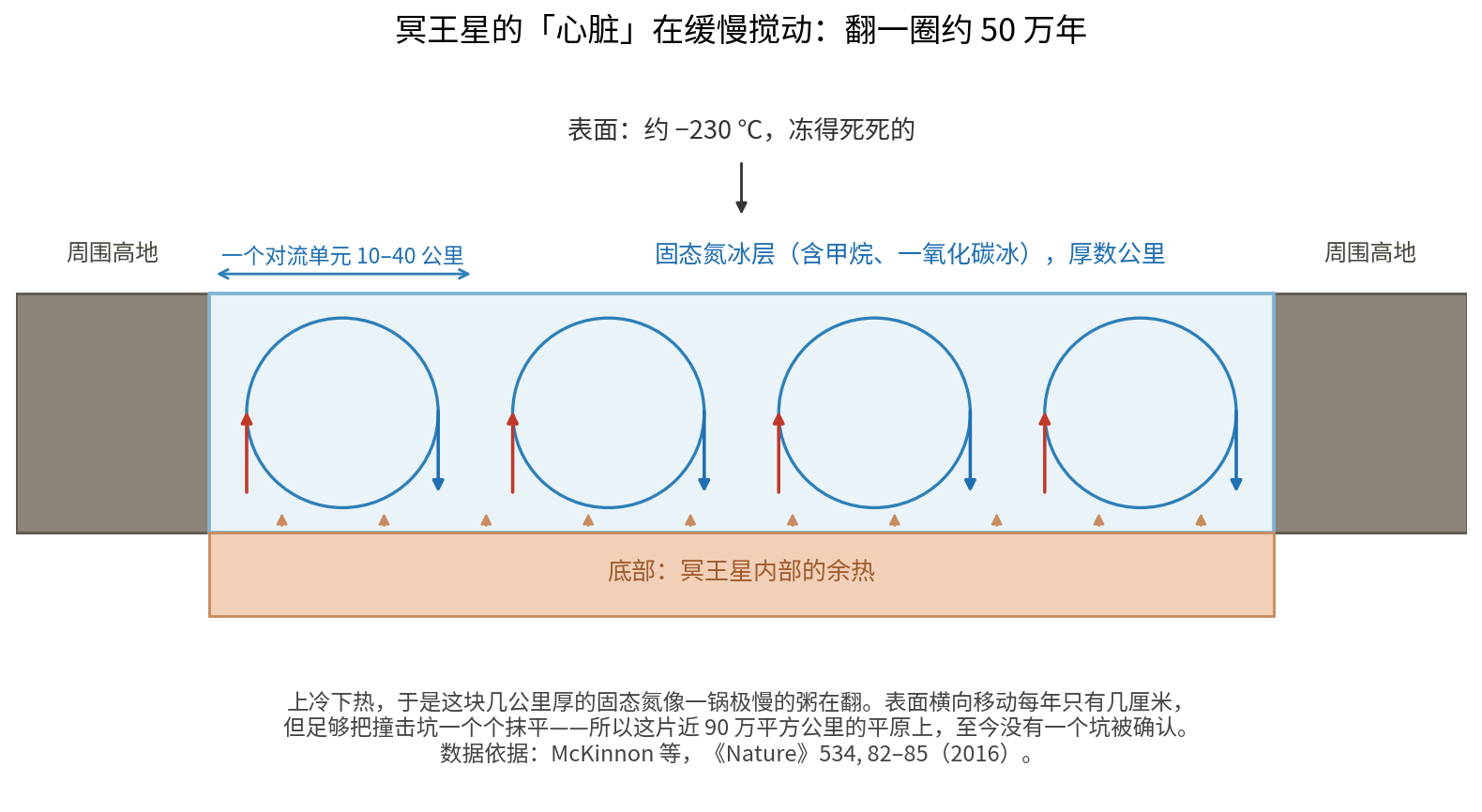
The mechanism is almost domestic. Space at -230 degrees Celsius freezes the top, while residual heat inside Pluto warms the bottom. Anything heated below and cooled above convects: warm material rises, cold material sinks.
Pluto's "porridge" turns extraordinarily slowly, but it turns. The paper gives the scale:
- Convection cells are typically 10 to 40 kilometres across.
- The surface moves laterally by a few centimetres per year. An independent estimate from sublimation-pit distributions by Buhler and Ingersoll found roughly 10 centimetres per year, the same order of magnitude.
- Surface transport or renewal takes about 500,000 years.
Half a million years for one turn.
Impacts still occur, but their craters are stirred away before anyone sees them. The 10-million-year upper age limit is just 20 convection cycles.
Convection is not the only proposed explanation. Another school attributes the youthful surface mainly to viscous relaxation, as ice slowly slumps under its own weight and craters collapse, as discussed by Wei and colleagues in The Astrophysical Journal Letters. Convection is the leading account and NASA's preferred one, but science can retain more than one candidate.
This Heart Turned the Entire World
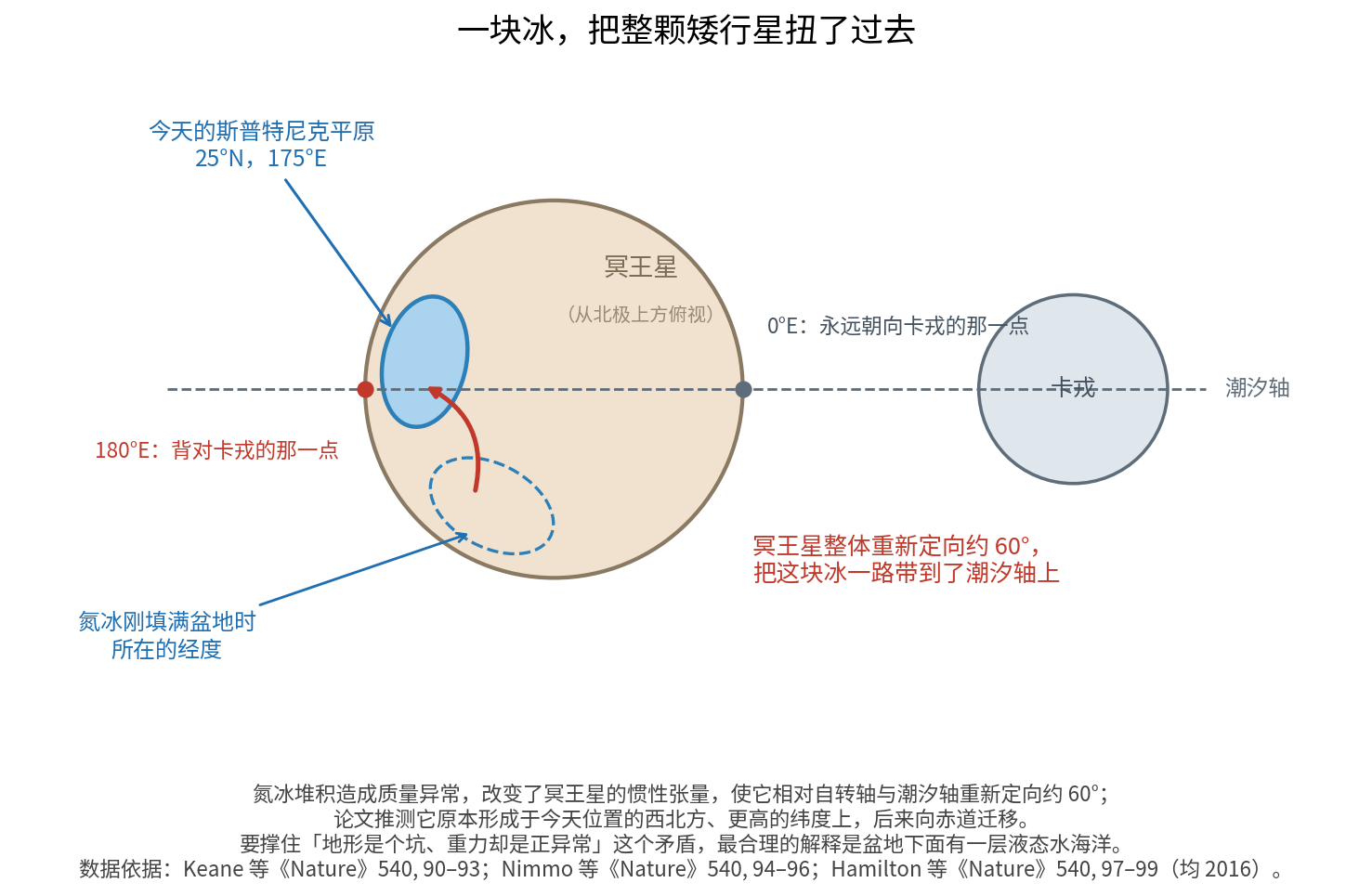
Sputnik Planitia's center is at 25 degrees north, 175 degrees east.
Pluto and its remarkably large moon Charon are tidally locked: Pluto always shows Charon the same face. Astronomers define the point facing Charon as longitude 0. Longitude 175 east is therefore almost exactly the opposite side.
Hamilton and colleagues wrote in Nature in 2016 that the plain lies almost exactly opposite Pluto's permanently Charon-facing hemisphere. Sky & Telescope reported that the statistical chance of its occupying precisely this position is only 5%.
Why is it there? Keane and colleagues offered a remarkable answer in the same issue of Nature: the plain did not travel there; the whole world turned beneath it.
Volatile ice accumulated in a basin this large could alter Pluto's inertia tensor enough to reorient the dwarf planet by about 60 degrees relative to its spin and tidal axes. In plain language, the ice became heavy enough to redistribute the world's mass. Rotation and tides pull heavy regions toward particular positions, so Pluto tipped by roughly 60 degrees and carried the ice onto its tidal axis. The paper suggests the basin began northwest of its present position at a higher latitude before migrating toward the equator.
Keane also found that this reorientation, the ice load and global expansion possibly caused by a freezing subsurface ocean would stress Pluto's lithosphere. The predicted global network of extensional faults closely matches the observed one.
The cracks on Pluto are, in that account, scratches left as the ice twisted the world.
Nimmo and colleagues added another layer in the same issue: Reorientation of Sputnik Planitia Implies a Subsurface Ocean on Pluto.
For reorientation to explain the ice's location, the basin must be a positive gravitational anomaly. Yet a hollow 3 to 4 kilometres deep should contain less material and produce weaker gravity. Something must compensate below.
If Sputnik Planitia is an impact basin and Pluto has a subsurface ocean, the positive anomaly follows naturally: the ice shell thins and denser ocean rises. Conversely:
Without a subsurface ocean, a positive gravity anomaly would require an implausibly thick layer of nitrogen ice - more than 40 kilometres.
The location of ice points to an ocean.
(All three papers use conditional language such as "may" and "if." The subsurface ocean is a strong hypothesis, not a confirmed fact. Nor is the basin's impact origin settled. Hamilton even proposed that the ice's own weight collapsed the crust and made its own basin.)
The Other Half of the Heart Still Has No Name
The heart's right half still has no separate official name. It also provides an elegant contrast: the left is a living sea of nitrogen ice; the right is old highland whitened by nitrogen frost, sublimated from Sputnik Planitia, carried through the atmosphere and deposited on higher ground.
(That account currently rests only on encyclopedia-level secondary sources; no primary paper was found.)
If correct, Pluto has a complete nitrogen "water cycle": nitrogen ice sublimates into the atmosphere, travels to eastern highlands, freezes out at night and slowly flows back. The logic mirrors evaporation, rain and runoff on Earth, with nitrogen replacing water and -230 degrees Celsius replacing 25.
Pluto also has cryovolcanic terrain. Singer and colleagues reported in Nature Communications in 2022 that Wright Mons stands about 4 to 5 kilometres high and 150 kilometres wide, while Piccard Mons reaches about 7 kilometres and spans about 225. Their conclusion:
Giant cryovolcanoes on Pluto are unique in the imaged Solar System and provide evidence of unexpectedly active geology late in Pluto's history.
Their existence means Pluto retained more heat, or more total heat, than expected before New Horizons. The age must not be confused with Sputnik Planitia's: this terrain has a crater-age upper limit on the scale of 1 billion years, not 10 million.
A small world 5.9 billion kilometres from the Sun, with a surface at -230 degrees Celsius, should have frozen into inert stone long ago. Instead it has a convecting ice sea, an atmosphere that transports nitrogen, ice volcanoes and perhaps a hidden ocean.
The Person Who Named It Was 11
Clyde Tombaugh discovered Pluto. China's National Space Administration uses the same Chinese rendering of his name and records the date: February 18, 1930.
Lowell Observatory says he was only 24. Born on an Illinois farm and raised on one in Kansas, he became fascinated with astronomy, ground his own mirrors and built telescopes. He sent drawings of planets to observatory director V. M. Slipher. After several exchanges, Slipher invited him to work at Lowell.
Two years later, he found a planet.
His tool was a blink comparator. The American Physical Society describes a machine that alternated the same patch of sky on glass plates taken days apart several times a second. Stars stayed fixed. Any point that had moved appeared to jump.
After months of searching, Tombaugh found several asteroids but no Planet X. Then, while scanning plates taken weeks earlier in February 1930, he saw something moving.
The announcement was set for March 13, 1930, deliberately marking both the anniversary of William Herschel's 1781 discovery of Uranus and Percival Lowell's 1855 birthday.
The planet was named Pluto, the Roman god of the underworld - a god who could make himself invisible. The proposal came from an 11-year-old girl in England, Venetia Burney.
NASA preserves her recollection. One morning in mid-March 1930, she was eating breakfast with her mother and grandfather, Falconer Madan, formerly head of Oxford's Bodleian Library. He read aloud that a planet had been discovered and asked what it should be called.
Her reason was wonderfully ordinary:
I just thought it was a name that hadn't been used and might be an obvious one to have.
An 11-year-old who had read mythology noticed that the underworld god's name was available and said it aloud. Her grandfather passed a note to Oxford astronomer Professor Herbert Hall Turner, who telegraphed the idea to Lowell Observatory.
(The widely repeated claim that she received a £5 reward is absent from NASA's page and appears only in secondary sources, so it remains "reportedly.")
Burney did not become an astronomer. She worked as an accountant and taught economics and mathematics in Britain. She died at home in Epsom, England, on April 30, 2009, aged 90.
Before that, in June 2006, the New Horizons team renamed its student-built and student-operated dust counter the Venetia Burney Student Dust Counter. In 2015 it flew past the world she had named. She knew: she lived to see her own name placed aboard a spacecraft bound for Pluto.
The JHUAPL mission kit also lists one object aboard New Horizons as a portion of Clyde Tombaugh's ashes and an inscription. Other cargo included a CD bearing more than 430,000 names; Florida and Maryland commemorative coins, for the craft's launch site and birthplace; a piece of SpaceShipOne; a U.S. flag; and the 1991 U.S. stamp reading "PLUTO: NOT YET EXPLORED."
On July 14, 2015, that stamp flew past Pluto too.
Two Kilobits per Second
How did the pictures return?
JHUAPL gives the post-flyby downlink rate as about 2 kilobits per second. A 56K dial-up modem was 28 times faster.
NASA says the Pluto-system data exceeded 50 gigabits. At an uninterrupted 2 kilobits per second, transmission alone would take nearly 290 days, calculated here from those two official figures. The Deep Space Network also served other missions, so the plan allowed 16 full months.
The final data arrived on October 25, 2016, at 5:48 a.m. EDT. New Horizons was then 5.5 billion kilometres away, with a one-way signal time of 5 hours 8 minutes. The last segment was a Ralph/LEISA observation sequence of the Pluto-Charon system.
Mission operations manager Alice Bowman said simply:
We have our pot of gold.
The craft is still flying. NASA reported on June 23, 2026, that New Horizons had completed its longest hibernation ever, 321 days from August 7, 2025. It was about 9.5 billion kilometres, or 63.5 astronomical units, from Earth, with one-way communication taking 8 hours 52 minutes. Bowman said every status report during hibernation was "green," meaning all was well aboard every week.
During its first three weeks awake, the Alice ultraviolet spectrograph observed hydrogen distribution in the outer heliosphere. Other instruments continue measuring solar wind, energetic particles and interstellar dust.
A spacecraft launched in 2006, beyond 63 astronomical units, still reports green every week.
Is It a Planet?
On August 24, 2006, the International Astronomical Union adopted Resolution B5 in Prague. A planet must (a) orbit the Sun, (b) have enough mass for its gravity to overcome rigid-body forces and assume hydrostatic equilibrium, or a nearly round shape, and (c) have cleared the neighborhood around its orbit.
Pluto fails condition (c): it inhabits the Kuiper Belt among many similar bodies.
The following Resolution B6 called Pluto a dwarf planet and identified it as the prototype of a new category of trans-Neptunian objects. Chinese accounts often mention only the first clause. The second is equally official: Pluto was not merely expelled; it became the head of another family.
The decision remains contested. New Horizons principal investigator Alan Stern objects that only 424 astronomers voted, less than 5% of the world's astronomers, and argues that "clearing" is unsound because Earth's neighborhood contains many near-Earth objects and Jupiter has 50,000 Trojan asteroids. Harvard's Owen Gingerich called the wording confusing and unfortunate, according to Space.com.
Stern's group favors a geophysical definition based on whether self-gravity makes a body round, which would produce more than 100 Solar System planets.
The disagreement is not over facts but rulers. The IAU uses a dynamical ruler: a planet dominates its orbit. Stern uses a geophysical one: a world's nature should not depend on its neighbors.
Pluto itself did not change. It still has a convecting nitrogen heart, a frost-carrying atmosphere, five moons and an outsized companion. JHUAPL says Charon is half Pluto's size; set side by side, the pair would span our Moon's diameter. From Pluto, Charon appears seven times larger than our Moon appears from Earth.
NASA's basic figures put Pluto's diameter at 2,377 kilometres, one-fifth Earth's width and two-thirds the Moon's, about the straight-line distance from Beijing to Urumqi. Its average solar distance is 5.9 billion kilometres, or 39 Earth-Sun distances. It orbits in 248 years, rotates in 153 hours and tilts by 57 degrees. Its average temperature is -232 degrees Celsius. Its mainly nitrogen atmosphere contains some methane and carbon monoxide; JHUAPL gives surface pressure as roughly three to 100 millionths of Earth's.
Tombaugh's Work Is Now Done by a Machine
Tombaugh spent months comparing two glass plates of the same sky, hunting the point that moved.
On September 17, 2023, China's Mozi Survey Telescope began operating at 4,200 metres on Saishiteng Mountain near Lenghu, Qinghai. According to a China Science Daily report republished by the Chinese Academy of Sciences, the 2.5-metre telescope has an effective field of view of 6.5 square degrees and was jointly built by the University of Science and Technology of China and Purple Mountain Observatory.
USTC states the scale most clearly: it can survey the entire northern sky once every three nights.
Its official goals include surveying Solar System bodies and searching for a ninth planet, as well as probing Galactic structure and dark matter. The same report says it will support China's space-power strategy through the search and monitoring of near-Earth objects and other Solar System bodies.
In 1930, a 24-year-old farm youth used a mechanical viewer switching several times a second to search thousands of fixed points for the moving one. After months, he found a planet. Lowell's target was called Planet X.
Since 2023, a telescope on a 4,200-metre plateau has scanned the entire northern sky every three nights with an official mission to find a ninth planet.
More than 90 years apart, the task is the same: find the moving point in the sky. Glass plates became pixels; the blink comparator became a survey repeated every three nights.
Sources: NASA Astronomy Picture of the Day for September 6, 2026; NASA's "The Rich Color Variations of Pluto" (September 24, 2015), "Pluto: The Other Red Planet" (July 3, 2015), Pluto overview, "New Horizons Returns Last Bits of 2015 Flyby Data to Earth," "New Horizons Spacecraft Wakes from Hibernation in Good Health" (June 23, 2026) and "Venetia Burney Phair (1918-2009)"; Johns Hopkins University Applied Physics Laboratory's New Horizons Pluto Flyby Press Kit, July 2015 and official FAQ; Weaver et al., "Overview of the New Horizons Science Payload"; McKinnon et al., Nature 534, 82-85 (2016); Keane et al., Nature 540, 90-93 (2016); Nimmo et al., Nature 540, 94-96 (2016); Hamilton et al., Nature 540, 97-99 (2016); Singer et al., Nature Communications 13, 1542 (2022); Wei et al., The Astrophysical Journal Letters; Buhler and Ingersoll, Icarus; IAU Resolutions B5 and B6 (2006); Space.com; Sky & Telescope; Lowell Observatory; the American Physical Society's APS News history column; China National Space Administration, "History of Planet Discovery"; the Chinese Academy of Sciences' republication of China Science Daily, "The Northern Sky's Most Powerful Camera Starts Work"; University of Science and Technology of China News; the Mozi Survey Telescope's official site; and TheSkyLive.