
Two barn owls perch on a log, their golden-brown backs catching warm light. Feathered rims frame their heart-shaped faces. Bing's photograph does not identify the location or the relationship between the birds, but their faces offer a clue to something we can explain: how an owl listens.
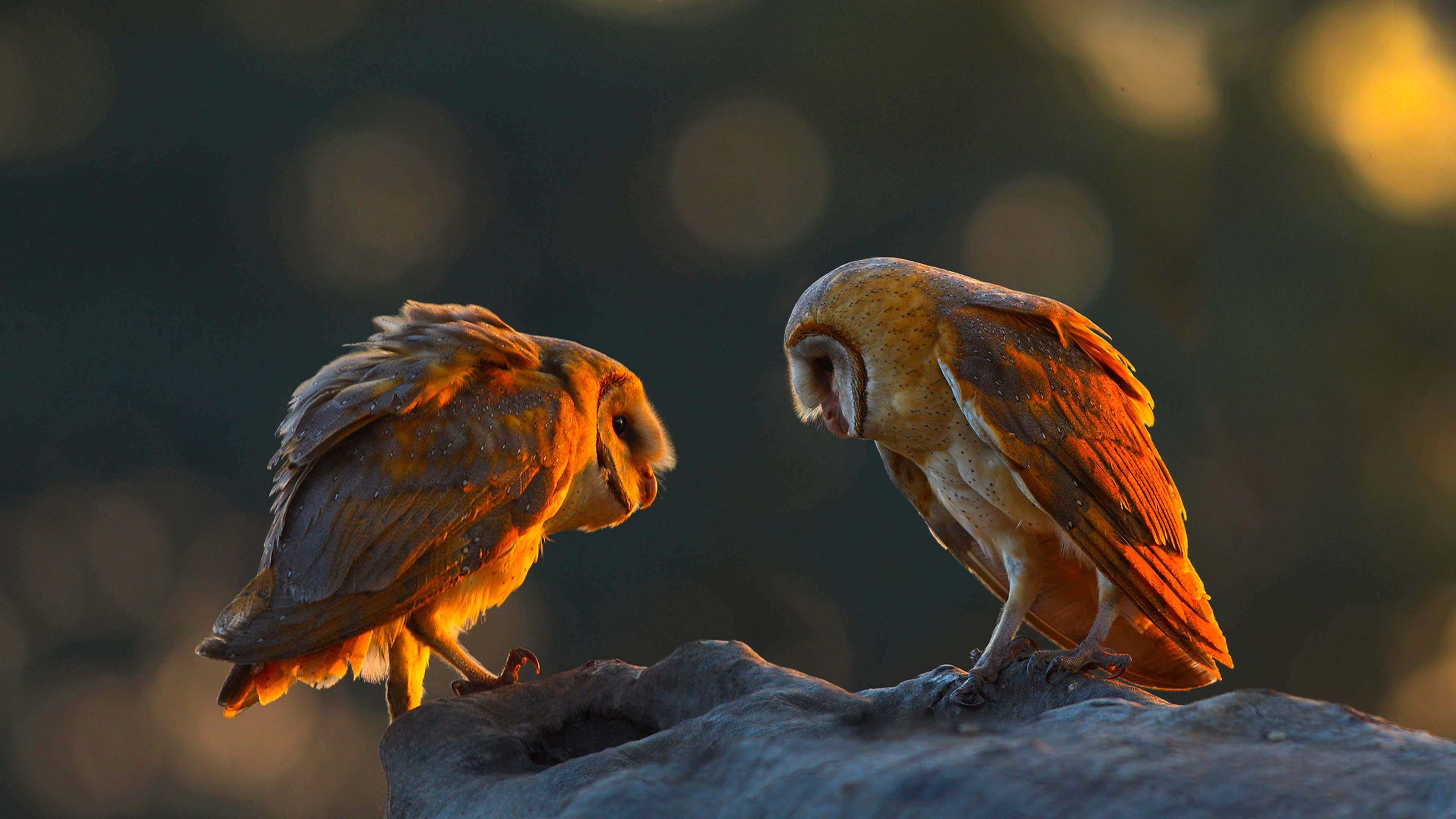
Image: A pair of barn owls (© Zahoor Salmi/Getty Images). Original page
Collect the sound, then locate it
The heart-shaped outline is called a facial disk. As the conservation organization Barn Owl Trust explains, those facial feathers collect sound and direct it toward ear openings hidden just behind the eyes. The face acts rather like a collecting dish around the ears.
The openings themselves differ in shape and sit asymmetrically, one higher than the other. A sound reaches the two ears differently, giving the brain information about where it came from. A small mammal concealed by grass can still give itself away by sound.
This is distinct from simply having good night vision. The Trust describes experiments in which barn owls captured prey in complete darkness using hearing alone. That establishes an ability; it does not mean every hunt in the wild relies only on sound.
Quiet wings make listening possible
Imagine trying to hear footsteps in the next room while running a hair dryer. Your own noise can hide the sound you want. A flying owl faces a similar problem.
Barn owl feathers are soft. Fine, hairlike structures on the flight feathers help maintain smooth airflow, while a row of small structures along the leading edge of the foremost flight feather helps soften the noise of air meeting the wing. Quiet flight serves two purposes: it makes the approaching owl harder for prey to detect, and it helps the owl keep hearing faint sounds below.
Large wings supporting a relatively light body also allow slow flight, giving the bird time to search and locate prey. Face, ears, feathers, and flight style work together.
There is a tradeoff. The Trust notes that barn owl feathers are less waterproof than those of many other birds. Wet feathers make flight noisier and less efficient, so barn owls generally avoid hunting in rain. A soft, quiet wing is not an all-weather raincoat.
To watch without approaching a nest, start with the Trust's barn owl webcams. Notice how the facial disk turns with the head as a bird attends to its surroundings. If you encounter an owl outdoors, keep your distance and let its search continue.