
On the left, a textured band of starlight rises through dark streaks. On the right, a green and red curtain glows above the bay. NASA's November 17 Astronomy Picture of the Day brings the Milky Way and an aurora into the same frame, like two answering arches.
Guillaume Scheib photographed the scene from Kvaløya in northern Norway about a month before the image appeared. November 17 is its publication date, not its capture date; NASA does not give a more precise date for the photograph.
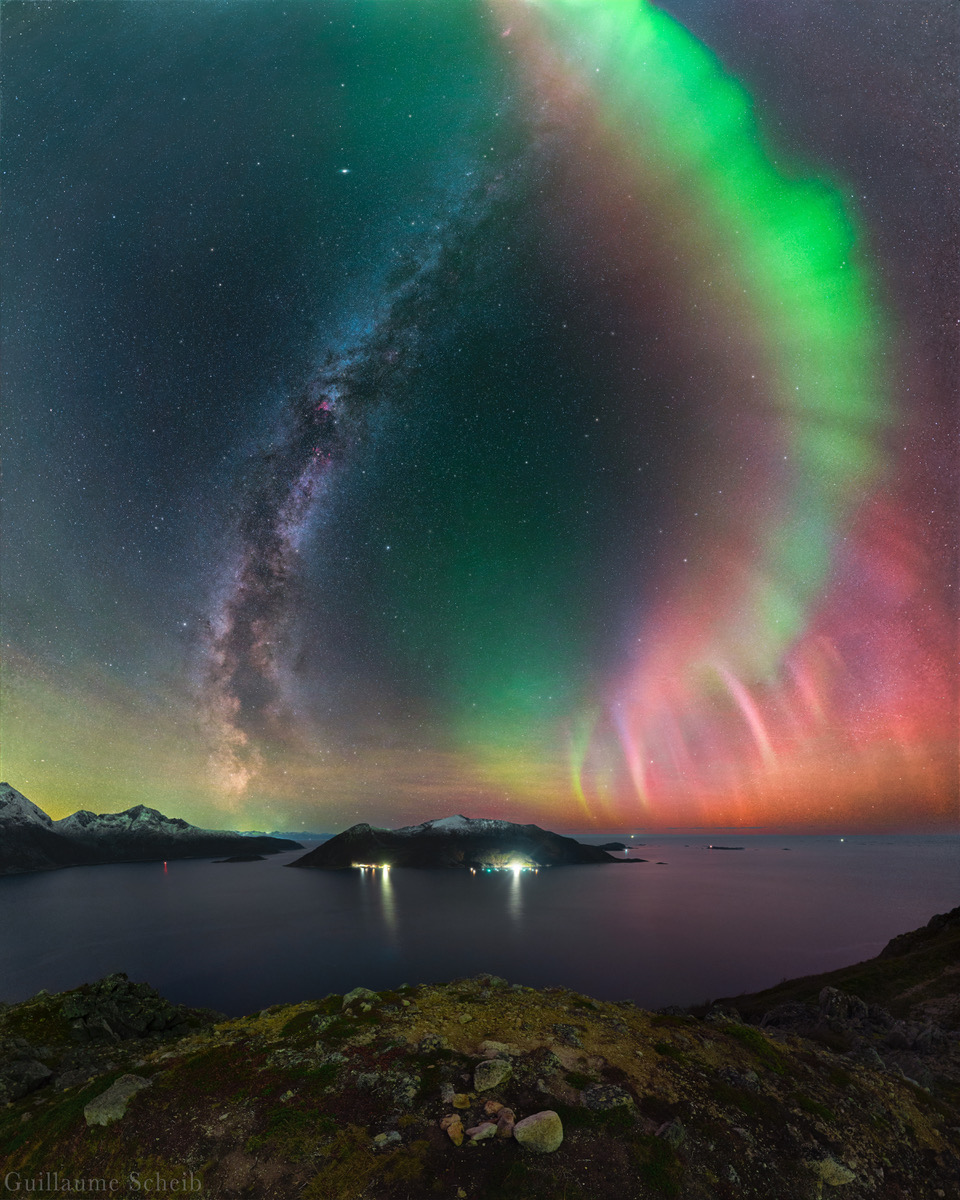
Image: Credit & Copyright: Guillaume Scheib. Original page
One comes from stars, the other from air
The Milky Way band is the view from inside our galaxy, looking through its stars, gas, and dust. In this photograph it has a grainy texture of starlight interrupted by dark, dusty lanes. The light comes from the distant galaxy around us, a system older than Earth.
The aurora forms in Earth's own upper atmosphere. It is neither another distant river of stars nor a green cloud reflecting sunlight. NASA's aurora guide explains how the solar wind interacts with Earth's magnetic field, allowing energy to enter the magnetosphere and subsequently be released into the atmosphere. Energetic particles excite atmospheric atoms and molecules, which then release energy as light.
Think of a musical note briefly raised before falling back, except that an atom releases light rather than sound. Different gases and heights contribute different colors. Oxygen can glow green or red, while nitrogen contributes blue and pinkish-purple emissions. Particle energy and overlapping emissions also affect the colors we see.
The two bright bands happen to line up in our view. One belongs to a distant galactic structure; the other is a temporary glow around our own planet. Their apparent widths in the photograph do not tell us their relative physical sizes.
Why does red light favor greater heights?
Color also depends on how long an excited atom can wait. NOAA's aurora tutorial explains that the oxygen state responsible for green light has a lifetime of about a second, while the state producing red light can last more than 150 seconds. A lifetime is a statistical scale, not a precise countdown that every atom must complete.
Lower down, where the air is denser, an excited oxygen atom may collide with another particle and transfer its energy before emitting red light. That oxygen emission can therefore survive more easily in the thinner air higher up. The atmosphere has no hard boundary sorting colors into neat layers, and a photograph can combine emissions from several heights. Color alone cannot measure this aurora's exact altitude.
The Sun connects both scenes
There is a link between these very different lights. The Sun is itself a member of the Milky Way, and the space environment driven by the Sun helps produce auroras around Earth.
NASA points out two more things to find: the Big Dipper lies behind the middle of the auroral arch, and the Andromeda galaxy is a bright spot near the top, slightly left of center. "Behind" describes a line of sight, not stars sitting close to the aurora. The camera places nearby atmosphere and a distant galaxy on one flat surface; we have to imagine the depth again.
Open the original page and switch between Original and Annotated above the photograph to find them. Recognizing the bands first makes the star patterns easier to pick out. And do not expect the unaided eye always to see such saturated colors: a camera's record of the night sky can differ from the brightness and color a person sees on the spot.