
A thin structure lifts above the Sun's edge like a tuft caught by the wind. Below it, the disk is crowded with fine textures, bright patches, and dark features. This monochrome image records solar activity on May 14, 2025; it became NASA's Astronomy Picture of the Day on November 18, 2026.
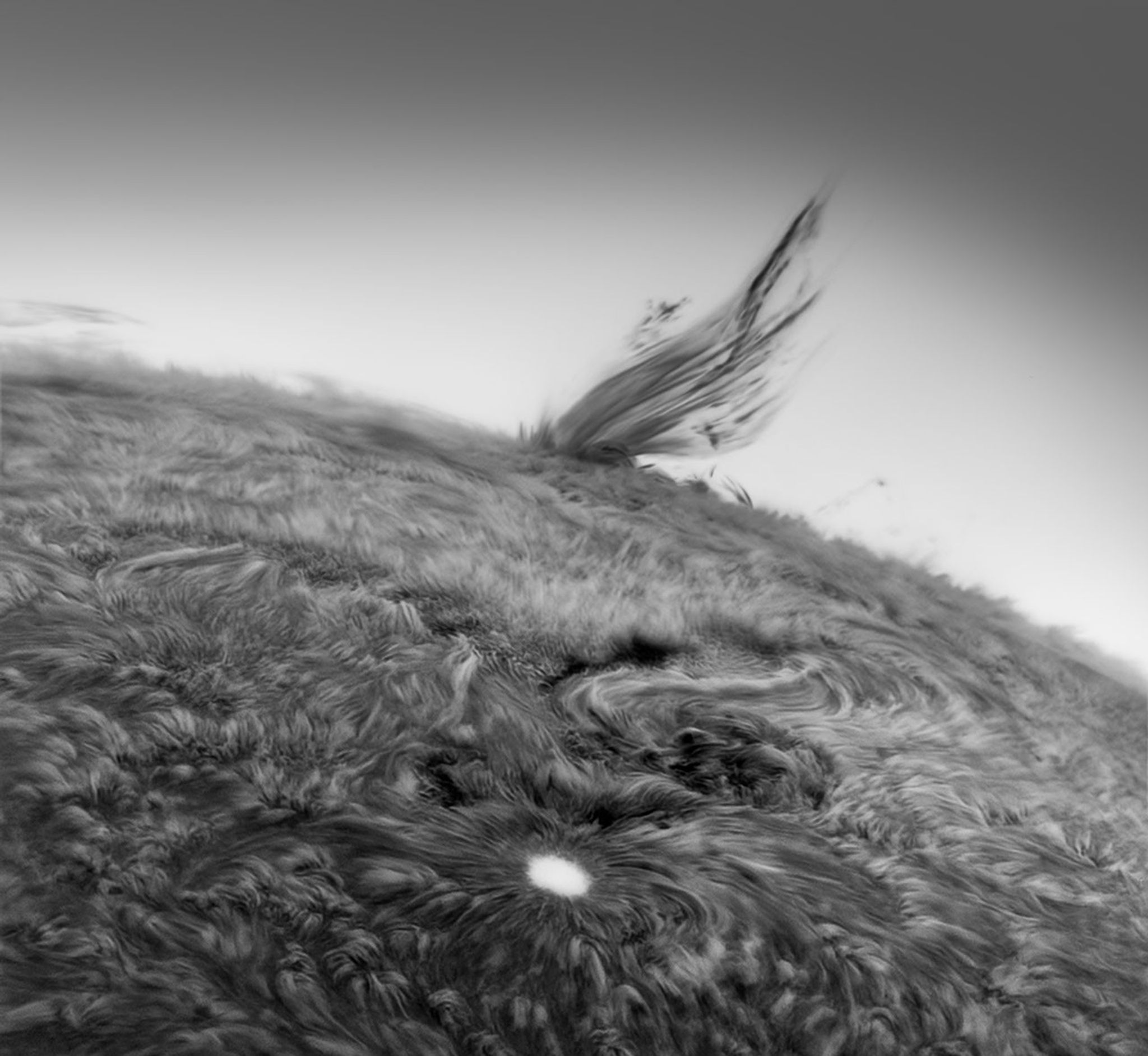
Image: Credit & Copyright: Mario Cogo. Original page
Mario Cogo combined a series of images taken over ten minutes. The result gathers a period of activity into one picture, so the fine structures should not all be treated as a single instantaneous arrangement.
Choose one kind of light
The photograph was made through an H-alpha filter, which selects a particular red spectral line of hydrogen. That narrow view reveals structures in the chromosphere, a layer of the solar atmosphere above the visible surface. Presenting the photograph in black and white does not mean the Sun itself has lost its colors.
Magnetic fields help shape these structures. Electrically charged material moves through the Sun, stretching and twisting the fields. When magnetic connections rearrange, stored energy can rapidly become heat, particle motion, and radiation. This is central to understanding a solar flare. A stretched rubber band suddenly relaxing offers a rough analogy for stored energy being released, although magnetic fields are not physical strings that snap and get thrown away.
What M1 tells us
NASA identifies this flare as M1 from GOES observations. The classification describes its peak soft-X-ray intensity. NOAA's radio-blackout guide associates M1 with the threshold for a minor R1 event: additional X-rays increase ionization on Earth's sunlit side, making some high-frequency radio signals more readily absorbed.
A flare, an outward ejection of solar material, and an energetic-particle event can be related, but they are different phenomena. An M1 label alone does not establish that a particular geomagnetic or radiation storm occurred. Nor does this photograph of a past flare predict today's conditions at Earth.
For another look at the Sun, explore NASA's current solar images and compare the features that brighten at different wavelengths. A planetarium's supervised H-alpha telescope can also show this atmospheric layer. Ordinary binoculars, telescopes, or camera optics must never be pointed at the Sun for unprotected viewing. NASA's observing-safety guide explains that optical equipment needs an appropriate solar filter secured over its Sun-facing end; eclipse glasses cannot take its place.