
Two people sit side by side on the coast of Hainan, looking out over the South China Sea. Above them, meteor trails cross Orion, with reddish Mars shining higher in the sky. NASA's Astronomy Picture of the Day for November 15 shows the Leonid shower of 2022, rather than a meteor storm that has just happened this year.
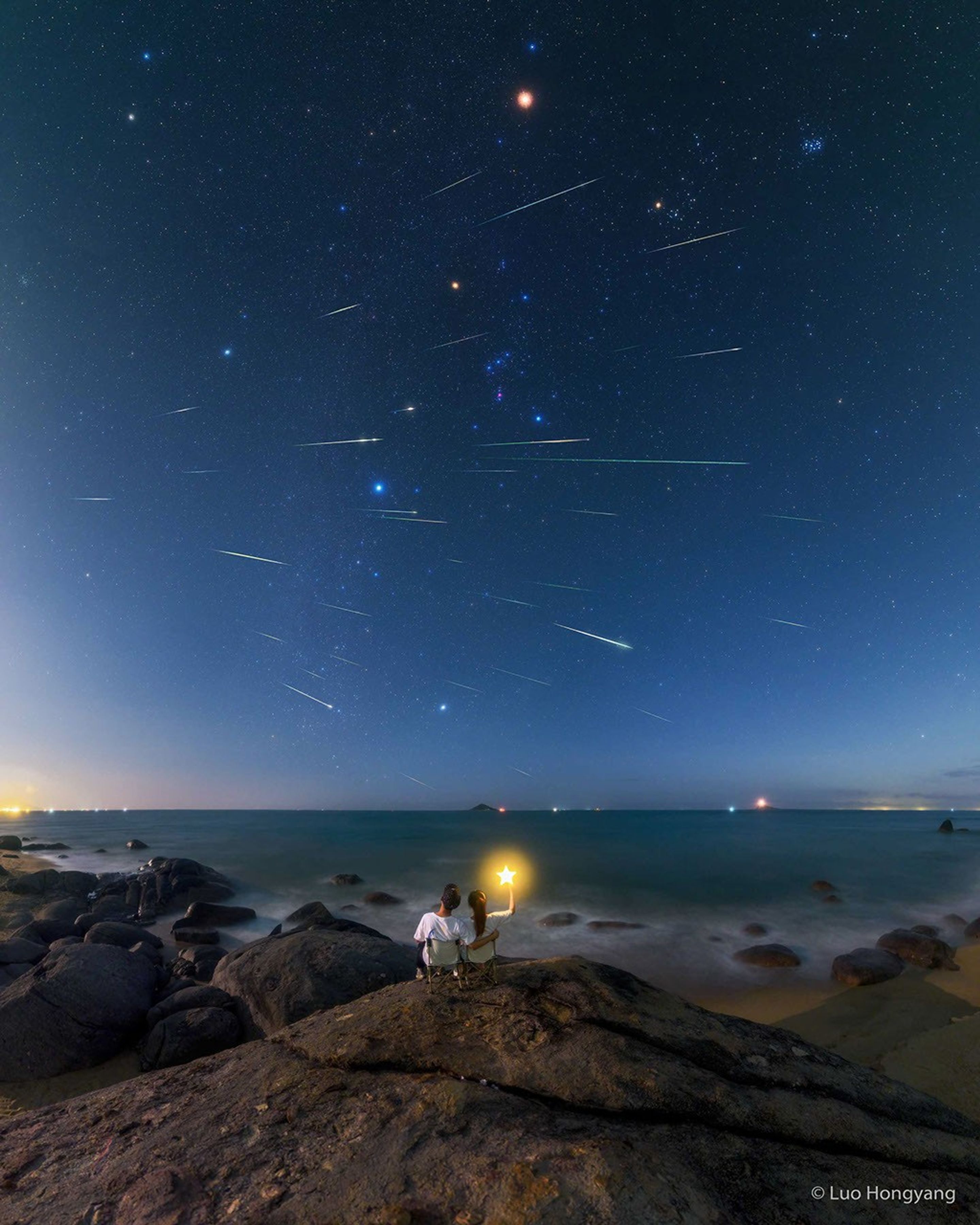
Image: NASA Astronomy Picture of the Day · Credit & Copyright: Luo Hongyang · Original page
The picture gathers time into a single frame. Meteor streaks recorded over a few hours were isolated and added to a foreground photographed earlier. The two observers did not see every meteor shown here at the same instant. NASA adds a human detail: the astronomy enthusiasts were celebrating birthdays in the same month, and later married.
But if the streaks cross Orion, why call them Leonids? A meteor shower takes its name from the direction its paths seem to converge on when traced backward. That direction is its radiant. The Leonids' radiant lies in Leo, though individual meteors can appear elsewhere in the sky.
Think of parallel railway tracks seeming to meet in the distance. A meteor shower produces a related perspective effect: many particles enter the atmosphere from similar directions, but to an observer on the ground their trails appear to fan out from one part of the sky. They have not traveled here from the distant stars of Leo.
Their actual source is debris left by comet 55P/Tempel-Tuttle. The comet circles the Sun roughly every 33 years, leaving dust along its orbit. When Earth passes through the debris, particles enter our atmosphere and produce brief streaks of light. The shower peaks each November; it does not have to wait for the comet to return near the Sun.
You can try watching this year's shower, which is already active from November 6 to 30. The International Meteor Organization's 2026 calendar predicts the regular maximum for November 17 at 23:45 UT: November 17 at 6:45 p.m. EST, or November 18 at 7:45 a.m. Beijing time. Another model places the maximum earlier, at 16:00 UT on November 17, or midnight at the start of November 18 in Beijing. For observers in China, the hours before dawn on November 18 offer a useful window. Local weather, moonlight, and your view of the sky will affect what you see.
The calendar gives a regular peak zenithal hourly rate, or ZHR, of about 15. That is a rate standardized to ideal conditions, including a radiant overhead, rather than a promise of fifteen meteors in your own hour outdoors. The additional dust-trail encounters listed for this year are not expected to produce a significant outburst. Nor should a composite of several hours set your expectations for a moment's glance upward.
You do not need a telescope. NASA recommends starting around local midnight, finding an open view away from artificial lights, lying back, and allowing about half an hour for your eyes to adapt. Dress warmly and watch a broad expanse of sky rather than staring only at Leo. While you wait, look for the three stars in a row that form Orion's Belt: they can help you find your way around the sky in the photograph.