
The three stars of Orion's Belt are easy to recognize. Look toward the hunter's sword and one patch of light seems less sharply defined than the stars around it. Your eyes have found a cloud where stars are forming.
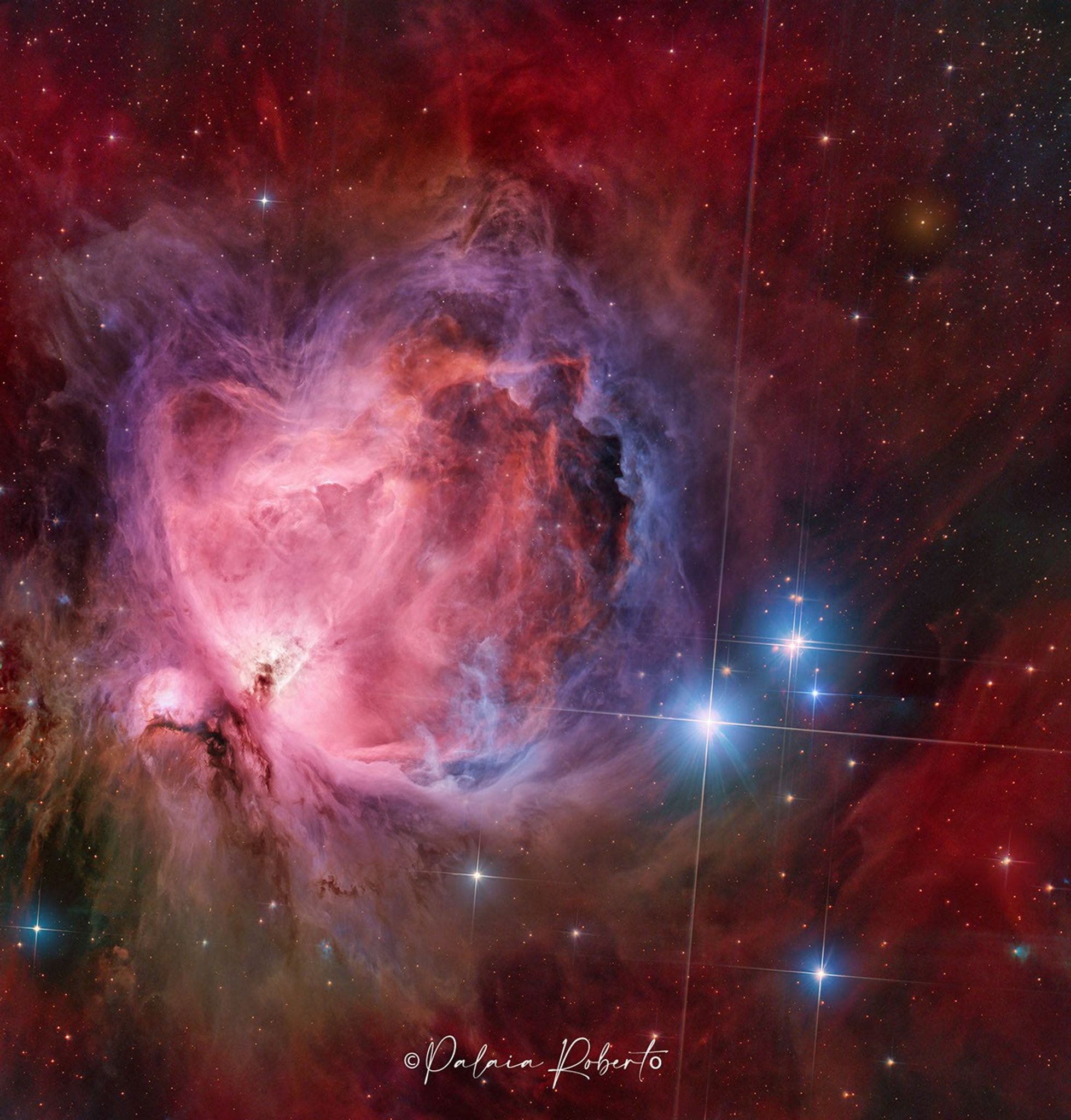
Image credit & copyright: Roberto Palaia. Original page.
NASA's October 26 Astronomy Picture of the Day features M42, the Orion Nebula. NASA gives its approximate distance as 1,500 light-years: the light reaching us now began its journey roughly fifteen centuries ago. The nebula spans about 40 light-years, a distance that light itself would take about forty years to cross.
This deep image uses assigned colors to emphasize emission from hydrogen. Pink and violet filaments and dark patches reveal layers of gas and dust. The palette does not promise an equally colorful view through your eyes. The photograph is credited to Roberto Palaia, rather than to Hubble or Webb.
Young Stars Light the Cloud
In the bright central region, young, massive stars form the famous Trapezium cluster. Its name comes from the small trapezoid traced by its central bright stars.
These stars release intense ultraviolet radiation. NASA's guide to emission nebulae explains the process: ultraviolet light strips electrons from hydrogen atoms. As electrons recombine with atoms and settle into lower energy states, they release light. The gas glows through atomic processes, without an ordinary fire.
The stars' radiation also carves a cavity in the cloud. Behind the bright and dark edges lies a volume of gas and dust, with depth that a flat photograph can only suggest.
Planet-Building Material Can Escape
Young stars are often surrounded by rotating disks of gas and dust from which planets can develop. Hubble has observed many such protoplanetary disks in Orion. Some have bright curved edges illuminated by nearby stars; others appear as dark silhouettes against the glowing nebula.
NASA's proplyd atlas brings these appearances together. Near powerful sources of radiation, gas around a disk is heated and illuminated. Bright cusps face the star supplying that radiation, revealing where the light comes from.
But NASA's close-up observations also show that heating can make material escape. Star formation, the gathering of planet-building material, and the loss of some of that material can occur in the same nursery. A disk is an opportunity for planets to form, rather than proof of a finished planetary system.
These small structures come from high-resolution observations. They should not be mistaken for individually resolved specks in today's wider view.
Start With the Blur
NASA's M42 observing guide recommends a dark sky and notes that January is an excellent observing season. Find the Belt, then the Sword. Binoculars can help you compare the nebula's diffuse glow with nearby points of starlight.
The U.S. Naval Observatory's phase table places this full Moon at 04:12 UTC on October 26, 2026, or 12:12 p.m. that day in Beijing. Bright skies around a full Moon wash out faint nebular detail. You can learn the location first and return when moonlight is less intrusive.
Your first observation need not reveal every filament in the photograph. Finding that small patch of light that refuses to sharpen into a star is already a way to locate a place where new stars are being born.