
Orange and yellow leaves cover the banks. Between them, water spills over a succession of rocky steps, trailing white ribbons through the woods. Bing's October 26 wallpaper takes us to an autumn waterfall near Sitovo in Bulgaria's Plovdiv Province.
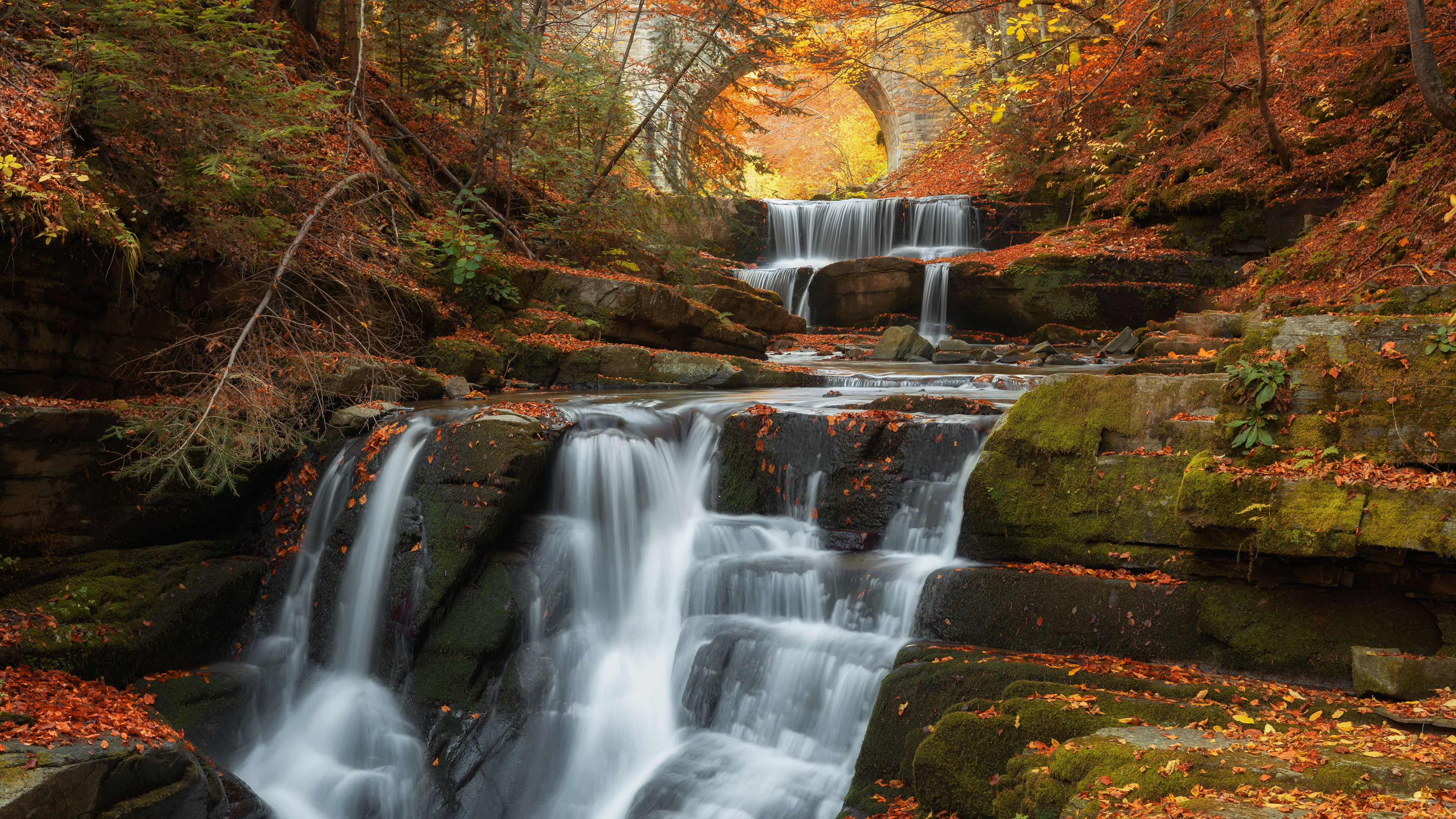
Image: Autumn waterfalls near Sitovo, Plovdiv Province, Bulgaria (© Nadya85/Getty Images). Original page.
Before looking at the leaves, follow the water. In quieter stretches, its surface looks dark and reflects its surroundings. Over a ledge, it turns bright white. Its ingredients have not changed in the space of a few feet.
Air Inside the White
Water tumbling over rocks churns air into bubbles. Light changes direction at the boundaries between water and air, and a mixture of visible colors reaches our eyes. The turbulent water looks white.
The Hong Kong Observatory's explanation of white breaking waves points out that the same effect occurs in rivers. Sea salt is unnecessary. A bubble is a thin film of water around air; compared with a solid water droplet of the same size, it contains much less water to absorb light.
The silky streaks in a photograph involve something else: how a camera records time. Nikon's long-exposure guide shows how a longer exposure can turn changing water into smooth ribbons. A photograph gathers movement over an interval while the actual drops keep flying apart. This wallpaper alone does not tell us the photographer's shutter speed.
Water Works on the Rocks
Rocks divide a stream into separate flows, and flowing water gradually changes the rocks. The National Park Service distinguishes weathering from erosion: rock breaks down physically or chemically, and water, wind, ice, and gravity carry material away. Sand and small stones carried by a stream can help abrade its bed.
Watch the swirling water at the foot of a waterfall. A Michigan Technological University teaching page uses a local waterfall to explain how falling water transfers energy to a plunge pool. Turbulence can deepen the hollow. Where lower rock layers wear away more readily, they can be undercut until the overhanging rock collapses and the waterfall retreats upstream. This is one way waterfalls evolve; the photograph cannot establish that every step at Sitovo formed that way.
The Leaves Feed a Stream Too
Fallen leaves enter another kind of flow. The Leaf Pack manual from Stroud Water Research Center explains how many shaded headwater streams receive an important supply of carbon from leaves. Fungi and bacteria grow on their surfaces, helping break them down and providing nourishment for aquatic animals. Shredders tear leaves into smaller pieces, and other animals can use the fine particles farther downstream. In a suitable stream, fallen leaves become part of a food web.
On your next walk, compare three places from a safe bank: a quiet stretch, the whitewater just beyond a rock, and a downstream patch where the bubbles have dispersed. Notice changes in color, texture, and sound. Stay off slippery rocks. A short stretch of stream can show you water, air, light, and stone at work together.