
NGC 4449 looks gloriously untidy. Blue points, pink patches and dark dust crowd together in an irregular cloud of starlight. The subject of NASA's November 4 image also belongs to a study that asks where galaxies' oxygen goes.
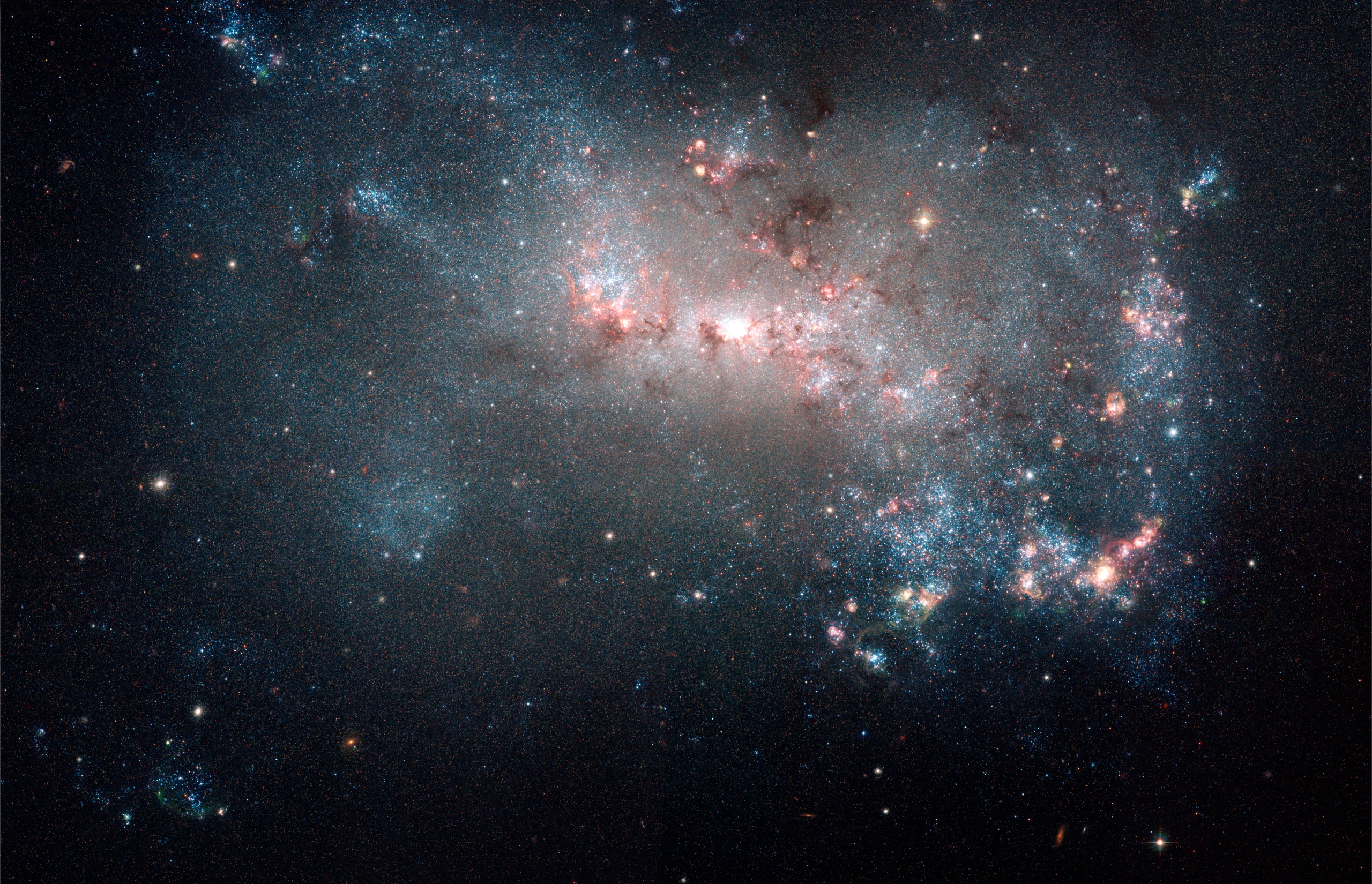
Image: NASA Image of the Day · Credit: NASA, ESA, Hubble Heritage-ESA/Hubble Collaboration, Alessandra Aloisi (STScI, ESA) · Original page
Using Hubble and other observatories, researchers studied 37 nearby dwarf galaxies. They compared the oxygen that stars should have produced with the amount still retained. The small galaxies held on to only a small fraction. This is an inventory of an element, not a claim that the picture once contained a breathable oxygen atmosphere.
Making an element does not mean keeping it
Massive stars manufacture elements including oxygen. Stellar winds and supernova explosions return material to their surroundings, and can give gas enough energy to leave a galaxy. Small galaxies have particular difficulty keeping that material.
NASA's account of the GLOW study describes work combining Hubble's stellar data with observations from Spitzer, the Very Large Array and the Australia Telescope Compact Array. Oxygen is relatively straightforward to measure, and its production is well understood, making it a useful tracer of how elements move through and beyond galaxies.
The full destination remains uncertain. Some missing oxygen may remain in diffuse gas around the galaxies; some may have traveled farther. This photograph is not an oxygen map, and a dark patch cannot be read as a place without oxygen.
The image appeared in the November 2 research release before becoming the November 4 daily selection. Neither date establishes when its exposures were taken. Compare the picture with the research account: which things can you see, and which require measurements and calculations beyond the image?