
Today's Astronomy Picture of the Day contains no stars, only a color-coded chart from chemistry class. But it is a chart about you.
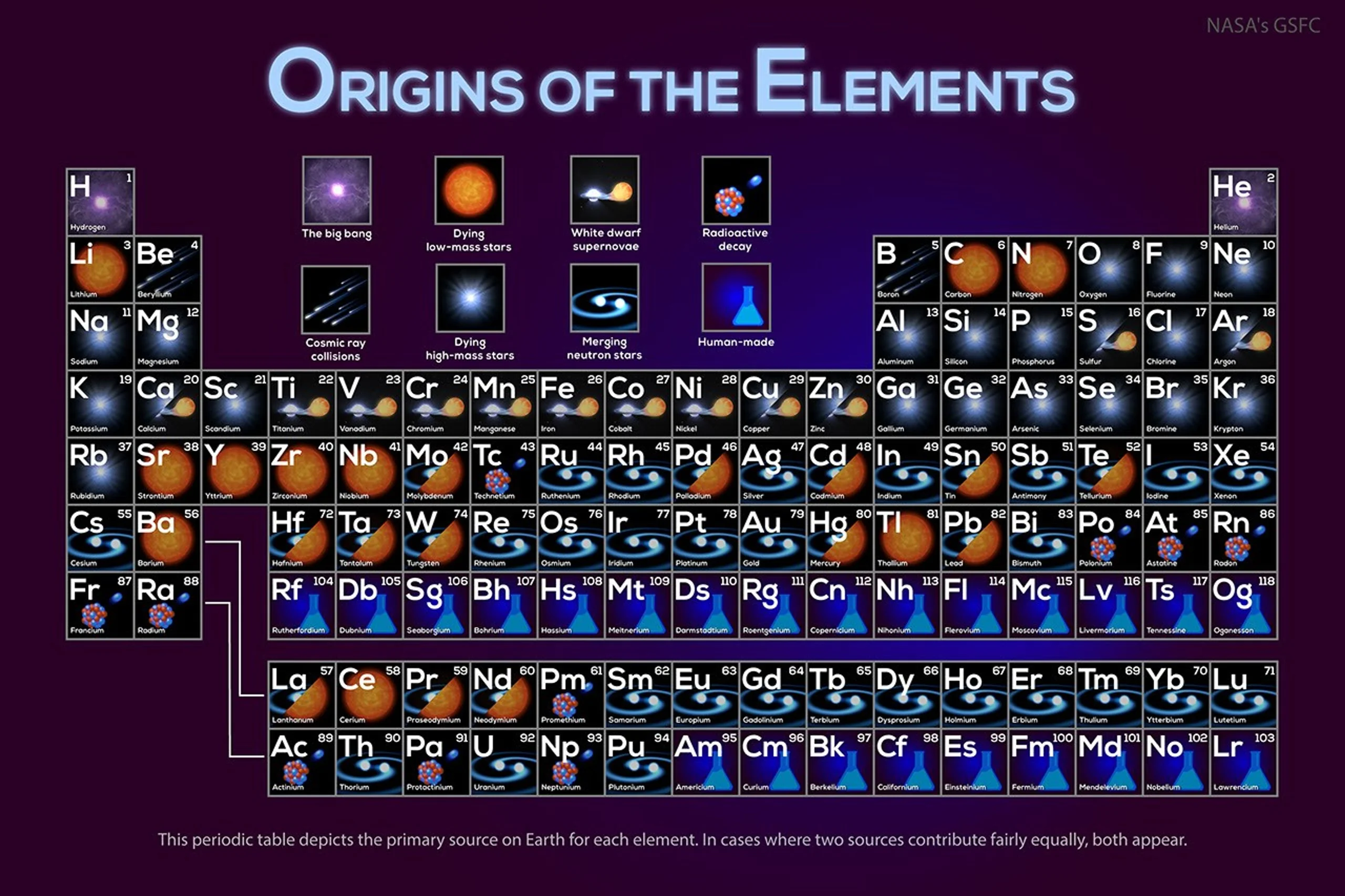
Image: NASA Astronomy Picture of the Day (APOD) | Image credit: NASA GSFC's SVS | Today's page
Today's NASA Astronomy Picture of the Day does not contain a single star.
It is a periodic table. Every square is colored, and some are divided among several colors. Those colors do not represent the elements' properties. They represent their origins: the places and processes in the universe that made each kind of atom.
The scientific data come from Ohio State University astronomer Jennifer Johnson; NASA Goddard Space Flight Center's Scientific Visualization Studio made the graphic. Today's APOD is titled "Where Your Elements Came From."
So let us begin by counting you.
First, Count Yourself
Imagine that you could take every atom from your body and count them one by one.
At the end, you would find that three out of every five are hydrogen - 62.3 percent, to be precise. Where did they come from? The first three minutes after the Big Bang. Nowhere else in the universe produces hydrogen in such quantities. Those atoms have spent decades in your body. Before that, they did very little but drift for more than 13 billion years.
Count by mass instead, however, and the picture flips. Hydrogen makes up only 10 percent of your body weight. The other 90 percent is oxygen, carbon, nitrogen, calcium and phosphorus: products of stars.

The same body, counted two ways, gives two almost opposite answers. By number, you are mostly among the universe's first products. By weight, you are mostly stellar ash.
The Universe Nearly Stopped at Helium
Return to those first three minutes.
According to the Particle Data Group's review, Big Bang nucleosynthesis produced only deuterium, helium-3, helium-4 and lithium-7, along with the hydrogen left unburned. Helium-4 has a mass fraction of about 0.245. In other words, ordinary matter in the universe is roughly one-quarter helium and three-quarters hydrogen, with everything else a rounding error.
Why did it stop there? The PDG gives a blunt reason: there are no stable nuclei with mass numbers 5 or 8.
The easiest route to heavier elements would be to add a neutron or proton to helium-4, whose mass number is 4, or to collide two helium-4 nuclei. But adding one gives 5, and combining two gives 8. Both rungs on the ladder are missing; anything formed there immediately falls apart. Add the electrical repulsion between nuclei, and the universe's first burst of element-making shuts down after three minutes.
The entire periodic table almost ended after its first three boxes.
Stars filled in the next several dozen.
Carbon, Oxygen, Iron and a Famous Half-Truth
Carbon is made by an act of nuclear acrobatics. Three helium nuclei must come together almost at once. The intermediate beryllium-8 nucleus, made from the first two, exists only fleetingly, so the third helium nucleus must arrive in that instant. The route works because carbon happens to have an energy level in just the right place. This was one of the central ideas in a foundational 1957 paper whose four authors' initials gave it the name astronomers still use: B2FH.
Oxygen follows when carbon captures another helium nucleus. Nitrogen cycles as a catalyst through the CNO cycle and gradually accumulates.
Iron requires a correction to a line that has become standard in popular science: "Iron comes from exploding stars." That is not wrong, but it leaves out half the story. A 2020 survey of the origins of every element from carbon to uranium concluded that roughly half of the iron-peak elements - chromium, manganese, iron, nickel, cobalt, copper and zinc - come from Type Ia supernovae.
A Type Ia supernova is not the collapse of a massive star. It is the thermonuclear destruction of a white dwarf that takes material from a companion until it goes too far and blows itself apart. One such explosion produces about 0.6 to 0.7 solar masses of iron. A massive star collapsing as a supernova produces an average of only about 0.058 solar masses - a difference of roughly a factor of ten. Core-collapse supernovae are far more common, however, so the two sources finish about even.
That means roughly half the iron atoms that make your blood red came from a white dwarf that fed until it exploded.
Gold: The Famous Story Needs More Caution
APOD says the gold in your jewelry probably came from neutron-star collisions, events that may appear as short gamma-ray bursts or gravitational-wave events.
The science behind that sentence deserves more precision than the popular version usually receives.
On August 17, 2017, humanity first both "heard" and "saw" two neutron stars merge. Two years later, a team reanalyzed the event's spectrum and identified one element: strontium. The 2019 Nature paper said the finding established the origin of a rapid neutron-capture element in a neutron-star merger.
Note the distinction: the element directly identified was strontium, not gold. Strontium, atomic number 38, belongs to the first abundance peak of the rapid neutron-capture process. Gold, atomic number 79, is in the third. "GW170817 proved that gold comes from neutron-star mergers" is memorable, but it goes too far.
The evidence for heavier elements advanced substantially in 2023. In the afterglow of gamma-ray burst GRB 230307A, the James Webb Space Telescope identified tellurium, element 52. The detection's lead author made the point memorably: more than 150 years after Mendeleev wrote the periodic table, we can finally begin filling in the last blanks that ask where its contents were made.
There is another turn in the story: neutron-star mergers are not the only workshop. Neutron stars must first form, then take a long time to spiral together and collide. That clock is too slow to explain why extremely metal-poor stars from the early universe already contain heavy elements. A 2019 study proposed that collapsars could contribute more than 80 percent. In 2021, another team found an abundance pattern in an extremely metal-poor star consistent with predictions for a single magnetorotational supernova.
The colors assigned to heavy elements in today's chart do not mark a closed case. They map an active argument.
Copper is a useful example. APOD singles it out: its nucleosynthetic site is "actually not well known" and remains a subject of observational and computational research. One reason is that copper has the odd atomic number 29. The yields of odd-numbered elements depend strongly on how many heavy elements their progenitor stars already contained. The same kind of explosion produces different amounts of copper at different eras in cosmic history. To account precisely for the trace of copper in your bloodstream, you must first get the chemical evolution of the entire galaxy right.
The Revision History of One Graphic Tracks a Field
This is not the first APOD titled "Where Your Elements Came From."
The title also appeared on January 25, 2016; October 24, 2017; and January 8, 2023. Those first three editions used a graphic made by a Wikipedia contributor from Johnson's data. Today's version comes from NASA's own Scientific Visualization Studio.
The more revealing changes are in the text.
In 2016, the sentence about gold ended by saying that neutron-star collisions might be visible as short gamma-ray bursts. Full stop.
On August 17, 2017, gravitational-wave detectors heard two neutron stars merge.
Sixty-eight days later, APOD ran the graphic again on October 24. The same sentence now ended by saying the collisions might be visible as short gamma-ray bursts or gravitational-wave events.
Those added words recorded a new piece of evidence. The 2023 and 2026 editions retained the sentence unchanged because no later result has yet required APOD to rewrite it.
The credit evolved too. In 2016 it named only the person who drew the chart. From 2017 onward, it added "Data: Jennifer Johnson (OSU)." The scientist behind the evidence was eventually named.
Why Today?
Today is September 14. Eleven years ago today, on September 14, 2015, humanity made the first direct detection of gravitational waves.
That event, GW150914, came from two merging black holes. It had nothing to do with the elements; black-hole mergers do not make gold. But it proved that the instrument could hear spacetime vibrate. In August 2017, the same kind of "ear" could therefore hear two neutron stars collide. Sixty-eight days later, APOD could quietly add those few words to this graphic's caption.
The beginning of that chain of cause and evidence was eleven years ago today.
China's Place in the Question
To understand how stars make elements in the sky, Chinese physicists went 2,400 meters beneath Jinping Mountain in Sichuan.
It is one of the world's deepest underground laboratories. The depth matters because cosmic-ray noise at the surface would overwhelm the exceedingly faint signals of stellar nuclear reactions. To understand the stars, the experiment must first hide from the sky.
The Jinping Underground Nuclear Astrophysics experiment, or JUNA, is led by the China Institute of Atomic Energy. It recreates and measures, one by one, nuclear reactions that otherwise occur inside stars. In October 2022, the team published in Nature a direct measurement of fluorine-19 capturing a proton to form neon-20. It pushed the measured energy down to 186 kiloelectronvolts and found a crucial resonance at 225 kiloelectronvolts. The paper consequently proposed a different route for explaining how calcium formed in the universe's first stars. Participating institutions included Beijing Normal University, the Institute of Modern Physics of the Chinese Academy of Sciences, the China Institute of Atomic Energy, Shenzhen University and Southern University of Science and Technology.
China has a share in the color assigned to box 20 of the periodic table.
Another part of the story happened above ground. In August 2018, a National Astronomical Observatories team used the Large Sky Area Multi-Object Fiber Spectroscopic Telescope, or LAMOST, at Xinglong in Hebei to find the most lithium-rich giant star then known. It contained 3,000 times as much lithium as an ordinary giant. Lithium is already an oddity on the periodic table: some came from the Big Bang and some comes from stars, yet stellar interiors usually destroy lithium rather than make it. Finding such an extraordinarily lithium-rich giant is like catching the culprit in the act and discovering it is producing the very thing it normally destroys.
The question mark in box 3 was placed there in part by a Chinese telescope.
Sources: NASA Astronomy Picture of the Day for September 14, 2026, and its API; NASA Goddard Scientific Visualization Studio entry 13873; Jennifer Johnson, "Origin of the Elements in the Solar System," SDSS science blog; Particle Data Group, Big-Bang nucleosynthesis review in the Review of Particle Physics; Burbidge, Burbidge, Fowler and Hoyle, Reviews of Modern Physics 29:547 (1957); Kobayashi, Karakas and Lugaro, The Astrophysical Journal 900:179 (2020); Weinberg et al., 2024 paper on stellar yields; Watson et al., Nature 574:497 (2019); Levan et al., Nature (2023), and the European Space Agency release; Siegel et al., Nature 569:241 (2019); Yong et al., Nature 595:223 (2021); Zhang, He et al., Nature 610 (2022), on the JUNA fluorine-19 measurement; the National Astronomical Observatories, Chinese Academy of Sciences, 2018 release on the LAMOST lithium-rich giant; Los Alamos National Laboratory's periodic-table entry for technetium; Merrill, The Astrophysical Journal 116:21 (1952); Astronomy & Astrophysics 693 (2024), on millimeter-wave observations of Chi Cygni; the AAVSO International Variable Star Index; Caltech/LIGO's official GW150914 page; and U.S. National Bureau of Standards Handbook 138 on elemental composition of the human body