
The news headline says "survival." The paper says "production." Those words are far apart.
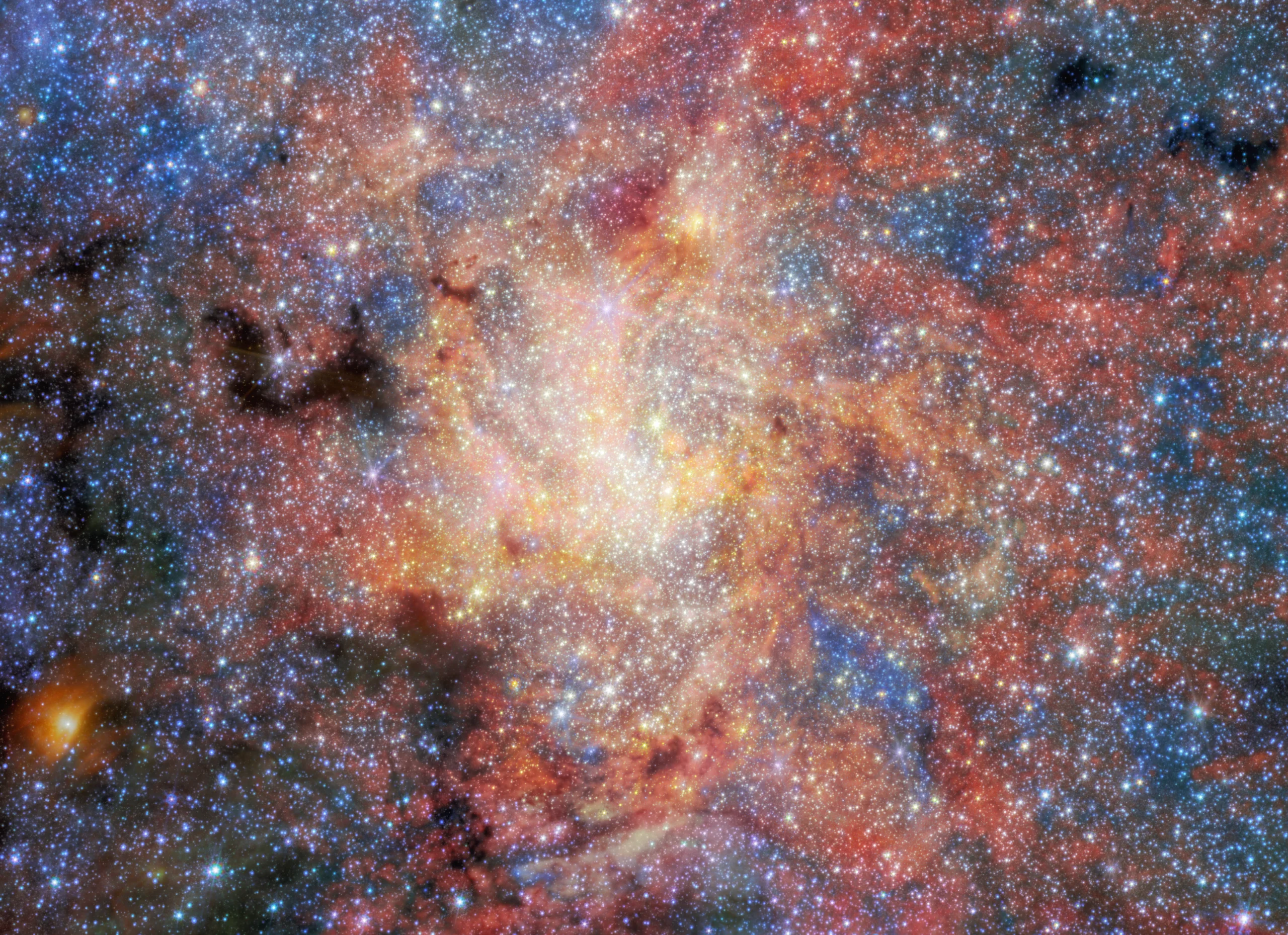
Image: NASA Image of the Day | Image credit: ESA/Webb, NASA & CSA, F. Peißker, J. Lu, F. Yusef-Zadeh, N. B. Sabha, C. Chan | Image page
Look at the photograph first.
The European Space Agency's official description reads like this: a dense star field fills the frame, with countless stars scattered over glowing clouds of red, orange, pink, white and blue. Near the center, a brilliant concentration of stars forms a bright, almost pure-white core, surrounded by tangled filaments of glowing gas and dust radiating outward. Opaque patches of dark dust interrupt those bright clouds irregularly, especially on the left, where they appear in silhouette against the luminous background.
You are looking at the center of the Milky Way.
Hidden at the heart of that nearly white concentration is Sagittarius A*, a supermassive black hole with about four million times the Sun's mass, roughly 27,000 light-years from us.
When the European Southern Observatory released its first image in 2022, it offered an official comparison I love: in our sky, the black hole appears about the size of a doughnut on the Moon.
But it is not today's protagonist.
The Headline Misled You, but the Paper Told the Truth
The news headline for this image reads: Webb Reveals Dust and Water Surviving Extreme Environment Near Galactic Center Black Hole.
The word "surviving" suggests a scorched landscape around the black hole, radiation sweeping away almost everything, with a little dust and water somehow hiding in a corner and escaping destruction.
That was how I understood it at first. I was wrong.
Read the paper's title and the wording is entirely different:
Dust production in the harsh environment of Sgr A: MIRI/Webb observations of the oxygen-rich AGB star IRS 3*
The key word is not "survival" but "production."
And the subject of the sentence is not the black hole. It is a star: IRS 3.
In projection, this star lies only 0.55 light-years from the black hole. The paper gives about 0.17 parsecs and explicitly calls it a projected distance; the true three-dimensional distance can only be greater. For scale, the Sun is 4.2 light-years from its nearest stellar neighbor. IRS 3 is less than one-seventh that distance from the black hole.
This is not an ordinary star. It is a dying star.
A Dying Star Is Still Stocking the Nursery
IRS 3 has reached what astronomers call the asymptotic giant branch, the last stage in the life of an intermediate-mass star. Here are its numbers:
- Mass: about six Suns
- Luminosity: about 60,000 Suns
- Age: about 72 million years
Pause over the last number. Seventy-two million years. The Sun is 4.6 billion years old and still middle-aged. This star is more than 60 times younger, yet it is already drawing its last breath. The more massive a star, the more fiercely it burns and the sooner it dies. It is one of the universe's simplest and harshest rules: the largest do not live the longest.
How is it dying? It is spitting itself out.
The paper gives a mass-loss rate of 6 x 10^-5 solar masses per year. In other words, it sheds the equivalent of an entire Sun about every 16,700 years. Stellar wind carries this material off the surface and piles it into nested shells extending to roughly 10,000 astronomical units, more than 300 times Neptune's orbital radius.
Temperatures across this envelope fall from about 1,200 K on the inside to about 100 K at its outer edge.
Using its mid-infrared spectrograph, Webb resolved two things inside it.
First: dust is being made here.
The paper identifies the dust as aluminum oxide plus amorphous silicates, based on the 9.7-micrometer silicon-oxygen stretching band and the 18.5-micrometer bending-mode absorption, whose optical depths have a ratio of 3.5.
The observation also overturned an earlier conclusion. The European Space Agency's release says plainly that previous studies had suggested this star might be carbon-rich, but the new observations reveal a different picture: it is oxygen-rich. Researcher García Marín said this was the first continuous mid-infrared spectrum ever obtained for the star, exposing the signature of silicate dust and revealing its true chemical identity.
A star observed for years changed identities when a new telescope looked at it.
Second: there is water here.
The paper's abstract says: "We report the first clear indication of water in the IRS 3 envelope."
To be precise, this means water molecules, gaseous H2O, not ice. Webb found absorption bands at 6.0-6.3 and 6.7-7.0 micrometers that match transitions of water molecules. The paper also adds, honestly, that it cannot fully rule out some contribution from ice to the spectrum.
The accurate statement, then, is this: there is water a little more than half a light-year from the black hole at the center of the Milky Way.
Why Is That Surprising?
The paper names one culprit: ultraviolet radiation.
The Galactic center is crowded with massive, extremely hot young stars that emit intense ultraviolet light. According to the paper, dust that should have been colder was photo-evaporated by ultraviolet radiation from the nuclear star cluster. In such a place, dust grains struggle to grow and molecules struggle to remain intact.
The conclusion says:
This finding shows that the harsh, radiation-dominated environment of Sgr A* does not inhibit dust formation or the survival of molecules such as water.
Researcher Peißker put it more personally:
With Webb, we can directly observe how stars behave under these conditions and see the remarkable resilience of dust production.
An honest qualification is necessary here: the official sources do not explain the mechanism by which the dust and water survive. They do not say what shields them or where they hide. They report only the observational fact: this environment does not stop the process.
I would like to offer a neat explanation, but no such explanation exists yet. Sometimes science can tell you only that something does happen, while the "why" remains suspended, waiting for an answer. That candor is itself part of learning how science works.
The Black Hole Is a Picky Eater, and the Man Who Said So Is in Shanghai
To understand why material can remain here at all, there is something many people do not know:
Sagittarius A* is remarkably quiet.
Compared with the voracious, brilliantly luminous active galactic nuclei at the centers of other galaxies, our black hole is almost starving. NASA's Chandra X-ray Observatory once reported the result in exact terms:
Less than 1% of the gas initially within Sagittarius A's gravitational grasp reaches the event horizon, or point of no return.*
Less than 1%. More than 99% of the gas is thrown back out just before it can fall in.
The scientist explaining that result in NASA's official release was Feng Yuan of the Shanghai Astronomical Observatory, Chinese Academy of Sciences. NASA quoted him directly:
Sagittarius A* is apparently finding much of its food hard to swallow.
And:
Most of the gas must be thrown out so that a small amount can reach the black hole.
I like seeing that line in a NASA news release: one of the most intuitive descriptions of the center of the Milky Way came from a researcher in Shanghai.
It also connects the whole story. Because the black hole eats little and makes little commotion, a factory can keep running at its door. Beside a more voracious black hole, the story might be different.
Chinese Telescopes Have Looked at This Black Hole Too
Two official accounts extend that thread.
First, Chinese researchers took part in producing the famous 2022 image of Sagittarius A*. The Shanghai Astronomical Observatory named Ru-Sen Lu, Wu Jiang and others in its announcement; Zhiqiang Shen served as the Event Horizon Telescope collaboration's coordinator in China. To be precise, no telescope in China participated in the 2017 observing campaign. China's contribution was to data analysis and the international collaboration. Shen also looked ahead: China was planning its own submillimeter very-long-baseline interferometry telescope so it could join continuous relay observations of Sagittarius A*.
Second, a Chinese telescope has measured this black hole independently. A result published by the National Astronomical Data Center states:
As the largest-aperture radio telescope in the East Asian VLBI Network capable of millimeter-wave observations, Shanghai's 65-meter Tianma Telescope has a collecting area greater than all the other telescopes combined.
Its result: the intrinsic structure of Sagittarius A* is almost circular. That indicates the rotation axis of its accretion flow points almost directly toward Earth. In other words, we are not looking at this black hole from the side; we are looking down from almost directly above it.
There is a newer development too. China's Einstein Probe satellite, called Tianguan in Chinese, launched on January 9, 2024. According to results released by the Chinese Academy of Sciences, it has detected 60 confirmed transients, more than 1,000 candidates and over 6,800 X-ray sources. It also found EP240222a, an intermediate-mass black hole tidally disrupting a star, which officials described as "achieving a breakthrough from zero for China's independently developed astronomical observing equipment in this field." Chief scientist Yuan Weimin offered a fitting line:
These early discoveries by the Tianguan satellite show that the transients we knew before may be only the tip of the iceberg.
Dust Is the Universe's Most Overlooked and Most Important Material
Now we reach the real point of this story.
In everyday language, "dust" means something gray, dirty and meant to be wiped away. In the universe, dust is raw material.
The first sentence of the paper's abstract is really the answer to the whole story:
Studies of the interstellar medium repeatedly reveal the imprint of dust produced in the envelopes of asymptotic giant branch stars, indicating a connection between the dust composition of the interstellar medium and that of these aging stellar envelopes.
In plainer language: much of the dust drifting through interstellar space was expelled by old stars.
The European Space Agency's release completes the next step. Aging stars like IRS 3 continue producing dust and other material, and that material is essential to the birth of the next generation of stars and planets.
This is the sentence to remember:
When a star dies, it does not simply vanish. It takes itself apart and returns the pieces. The heavy elements it forged over its lifetime - oxygen, silicon and aluminum - are blown away layer by layer in stellar winds. They drift into interstellar space and become dust. Much later, that dust is swept into another collapsing cloud and condenses into new stars and the planets orbiting them.
The silicon in the planet beneath your feet and the oxygen in your body were expelled long ago by dying stars. That is not poetry. It is what the first sentence of this paper's abstract describes.
What makes this photograph moving is that the process is unfolding at the door of the black hole in the center of the Milky Way.
In the place least like a maternity ward, a factory is still running.
The true surprise is not that something survived. It is that something is still being made there.
Two Widely Repeated Claims That Need Correcting
1. "Comets delivered Earth's water." The current evidence does not strongly support that simple claim. The European Space Agency's Rosetta probe measured the deuterium-to-hydrogen ratio in water on comet 67P and found it more than three times higher than in Earth's oceans. The project's principal investigator concluded that this ruled out the idea that Jupiter-family comets contain only Earth-ocean-like water and added weight to models in which asteroids were the principal delivery mechanism for Earth's oceans. The debate is not over: a 2024 study pointed the other way. The honest statement today is that the mainstream view favors asteroids, with comets contributing at most some portion, but the question remains open.
2. "The black hole's event horizon could fill Mercury's orbit." The direction is right, but "fill" is not. Using standard figures, Sagittarius A*'s event horizon is about 0.16 astronomical units in diameter, while Mercury's orbit is about 0.77 astronomical units across. The event horizon fills only about one-fifth of that orbit. (These figures lack a first-party NASA or European Southern Observatory page, so they appear here only as an order-of-magnitude guide. The three officially supported figures are four million solar masses, 27,000 light-years and a doughnut on the Moon.)
Why September 10? NASA Says There Is No Reason
This is worth stating plainly: the paper and the European Space Agency release both appeared on August 11, 2026. NASA selected the image for its daily feature on September 10, exactly 30 days later.
NASA's own first sentence says, "In this image taken by NASA's James Webb Space Telescope on Aug. 11, 2026..."
September 10 marks no news event and no relevant space anniversary. NASA simply brought back a good image from a month earlier for another look.
There is nothing wrong with that. Good photographs do not expire.
Sources: NASA Image of the Day for September 10, 2026; European Space Agency/Webb release weic2617 and image page weic2617a; Peißker et al., Astronomy & Astrophysics 712, A79 (2026), DOI 10.1051/0004-6361/202660243; NASA/Chandra X-ray Observatory's 2013 release; the Shanghai Astronomical Observatory, Chinese Academy of Sciences; the National Astronomical Data Center; the Chinese Academy of Sciences; European Southern Observatory release eso2208; the European Space Agency's Rosetta mission; the Department of Culture and Tourism of the Tibet Autonomous Region; People's Daily Online Qinghai; and EarthSky.