
An Independence Day Doodle made of cloth, and the dye vat behind it that needs bacteria to work.

Image: Google Doodle, "Indonesia Independence Day 2026" | Artist: Anindya Anugrah | Official page
Open Google in Indonesia today and the familiar multicolored logo above the search box has become a piece of cloth.
According to Google, the annual Doodle was created by Indonesian illustrator Anindya Anugrah and draws on tenun, Indonesia's traditional weaving craft and textiles. The craft, Google says, "weaves together the nation's history, heritage, and vibrant identity."
Calling a piece of cloth a nation may sound like a metaphor. But Indonesia is a country of more than 10,000 islands, and each island has its own patterns, weaving methods, and colors. A textile can nearly report the latitude and longitude of its birth. The choice is quite literal: in Indonesia, cloth is a map.
Why August 17?
Because of this day 81 years ago.
August 17, 1945 was a Friday. At 10 a.m. that morning, under Tokyo time then in use, Sukarno stood outside his own home at 56 Pegangsaan Timur in Jakarta and read a document with Mohammad Hatta beside him. PETA officer Latief Hendraningrat raised the red-and-white flag.
The Proclamation of Independence is astonishingly short: just two sentences of text, followed by a date and signatures.
The previous dawn reads like a film. A group of young activists, unwilling to wait any longer, took Sukarno and Hatta to Rengasdengklok outside Jakarta and pressed them to declare independence at once. Japan had just surrendered, opening a gap in power, and gaps close. The Latin-character typewriter used to prepare the proclamation was borrowed at short notice from Hermann Kandeler, a German naval lieutenant commander.
A borrowed typewriter, two sentences, one country. This is Indonesia's 81st Independence Day.
Across Indonesia today, the same event takes two forms from morning to night. The formal version consists of flag-raising ceremonies nationwide and the lowering of the flag at the Merdeka Palace at 5 p.m. Western Indonesian Time. The informal version is called lomba tujuhbelasan, or "seventeenth-day competitions": street games, most famously panjat pinang. Prizes hang at the top of a greased pole, ready for whoever can reach them. Almost no one can climb it alone. In the end, several people usually form a human ladder. The metaphor hardly needs explaining.
Follow the Cloth Back to the Vat
Now move the camera from the Doodle into the craft that inspired it, toward its dirtiest, slowest, and most beautiful stage: dyeing.
The deep blue in traditional Indonesian textiles comes from indigo, which comes from the leaves of Indigofera plants. That may sound like a matter of boiling leaves and dropping in cloth. It is nothing of the kind. Indigo does not dissolve in water.
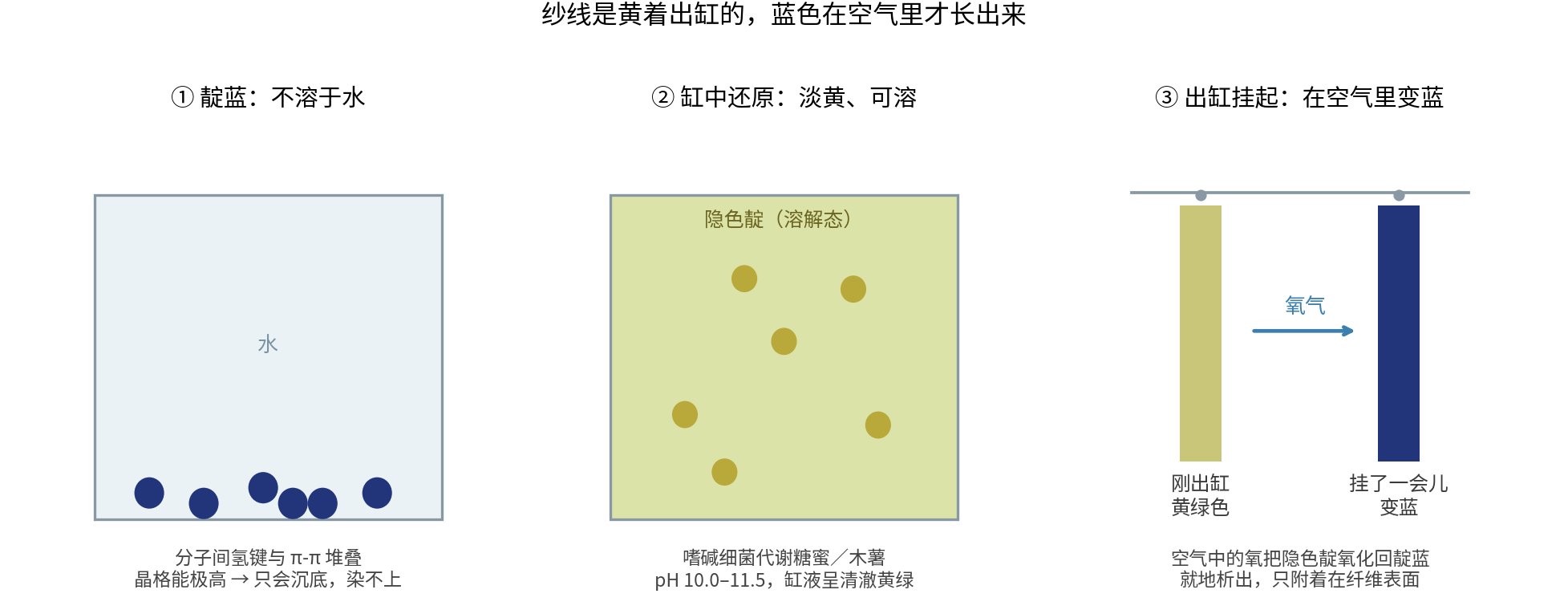
It resists water thoroughly. Hydrogen bonds and pi-pi stacking hold indigo molecules tightly together, giving the crystal lattice very high energy. In water, the pigment remains solid, sinks to the bottom, and will not dye the fiber. That is the dyer's problem: the color refuses to become a liquid.
The solution is to reduce it to a different molecule.
Fresh Indigofera leaves do not actually contain indigo. They contain indican, a water-soluble glucoside. When the leaves soak in mildly alkaline water, enzymes hydrolyze indican into indoxyl and glucose. Pairs of indoxyl molecules combine to make leuco-indigo. It is also called indigo white, but is actually pale yellow and, crucially, soluble.
To keep a vat active, the dyer must reduce any indigo that has already returned to its solid form. Fermentation does the work. Molasses, sugar, or cassava is added to an alkaline vat with a pH of 10.0 to 11.5. Alkaliphilic bacteria, including species of Clostridium, Pseudomonas, and Bacillus, metabolize the food and create a reducing environment. How can a dyer tell that the vat has "woken up"? By its color: once reduction is complete, the liquid becomes clear yellow-green.
Then comes the most counterintuitive moment. Yarn goes into the yellow-green vat and emerges yellow-green or blue-green. Hung on a bamboo rack, it begins turning blue in the air. Oxygen oxidizes the leuco-indigo back into insoluble indigo, which precipitates in place and clings to the surface of the fiber.
The blue is not applied in the vat. It grows in the air.
The Chemistry Problem Chinese Children Know by Heart
Chinese readers may already be thinking of the line.
From Xunzi's "Encouraging Learning": "Blue comes from the indigo plant, yet is bluer than the plant."
It is usually treated as an inspirational saying: a student can surpass the teacher. But read it literally. In classical Chinese, the word translated here as "indigo" names the plant, the dye-producing herb, while "blue" names the color produced from it. The sentence originally describes a specific process: the color comes from the plant, yet emerges bluer than the plant itself.
More than 2,000 years ago, its literal meaning was an observation of a chemical reaction. The saying became so useful as a metaphor that people forgot it began as a fact from the dye house.
Indigo dyeing never disappeared from China: there are the indigo vats and glossy cloth of the Dong and Miao peoples in Guizhou, Bai tie-dyeing in Dali, Yunnan, and blue calico from Nantong, Jiangsu. These traditions and Indonesia's vats developed their own bodies of experience independently. The chemistry at the bottom of the vat is the same.
How Much Time Indonesians Spend on This Blue
The deep blue of these islands does not come from a single dip. It comes from patience.
Dyers around the Lesser Sunda Islands cultivate several indigo plants: Indigofera tinctoria, I. suffruticosa, and I. arrecta. On Savu, they are called dao Havu, dao eda, and dao Hava. Weavers on Timor distinguish three varieties: tau kesa grows the largest but gives a weaker color; tau tiaum is the smallest but is considered the best; tau fu grows in the forest and is not used for dyeing. Notice the order: the variety that grows largest is not the one the weavers value most.
The time cost is more startling. In East Sumba, a first round of dyeing can take several months. Yarn soaks in the vat for one or two days, then dries in the sun for as long as two weeks, allowing oxidation to finish without letting the fibers rot. After five dips, a small section of the pre-tied yarn is untied to reveal pale blue, while the rest receives two more dips to deepen the color. On Api Island, some dyers seeking a shade close to black dip the yarn as many as 30 times, for two full days each time.
Thirty sunrises for one color in a piece of cloth. Any deep-blue section in today's Doodle carries that span of time behind it.
Your Jeans Are an Indigo Vat Left Open
You may be wearing this chemistry now.
Denim uses the same kind of indigo dye. As we have seen, oxidized indigo merely precipitates on the fiber's surface rather than penetrating its interior. That fact determines everything: when jeans fade white at the knees, along the pockets, and across the thighs, the fabric has not necessarily worn through. The blue coating has rubbed away, revealing white cotton thread underneath that was never dyed through.
Sources: Google's official page for the "Indonesia Independence Day 2026" Doodle; Wikipedia entries on the Proclamation of Indonesian Independence and Indonesian Independence Day; Asian Textile Studies features on indigo chemistry and dyeing methods in the Lesser Sunda Islands; Xunzi's "Encouraging Learning"; and Indonesian media coverage of this Doodle.