
Open Google in India today and there is a piece of cloth above the search box. The six letters have become six scraps of fabric, each from a different place.
Today is August 15. On this date in 1947, a Friday, India became independent from British rule. By the Indian government's count, this is the 80th Independence Day because 1947 counts as the first; in elapsed time, 79 years have passed. Both numbers are right. One counts the occasion, the other the years.
In India, the familiar multicolored Google logo has become a patchwork: six letters cut from six different textiles, their colors and patterns distinct, as if someone had sliced up a map and reassembled it in the shapes of the letters.
Today's entry has not yet appeared in Google's official Doodle archive. doodles.google has pages for India's Independence Day in 2023, 2024 and 2025, but none for 2026. The description here therefore comes from same-day Indian media reports, not official Google copy, and the official image URL is not yet public. Several Indian outlets, including The Tribune and The Free Press Journal, describe the patchwork as a reissued version of artist Namrata Kumar's 2023 Doodle with enlarged, rearranged letters. None says exactly where it appeared. Google itself has noted that different regions can see different Doodles at the same time. The most precise claim is therefore this: it is visible at least in India.
The official page for Kumar's 2023 original is still online. It describes a patchwork of Indian textile traditions including embroidery, weaving, printing, resist dyeing and hand painting. In Google's artist Q&A, Kumar says Indian textiles matter deeply to her because her mother was a textile designer.
This year's reports identify six traditions: jamdani from the Bengal delta; ikat; Ajrakh block printing from Kutch; Banarasi brocade from Varanasi; kani shawl weaving from Kashmir; and Kerala's gold-bordered kasavu cloth.
Of the six, this story follows just one. It contains the sort of secret that can stop a child mid-sentence.
Dye the Picture Into the Threads, Then Weave the Cloth
Ikat is not printing, embroidery or figured weaving.
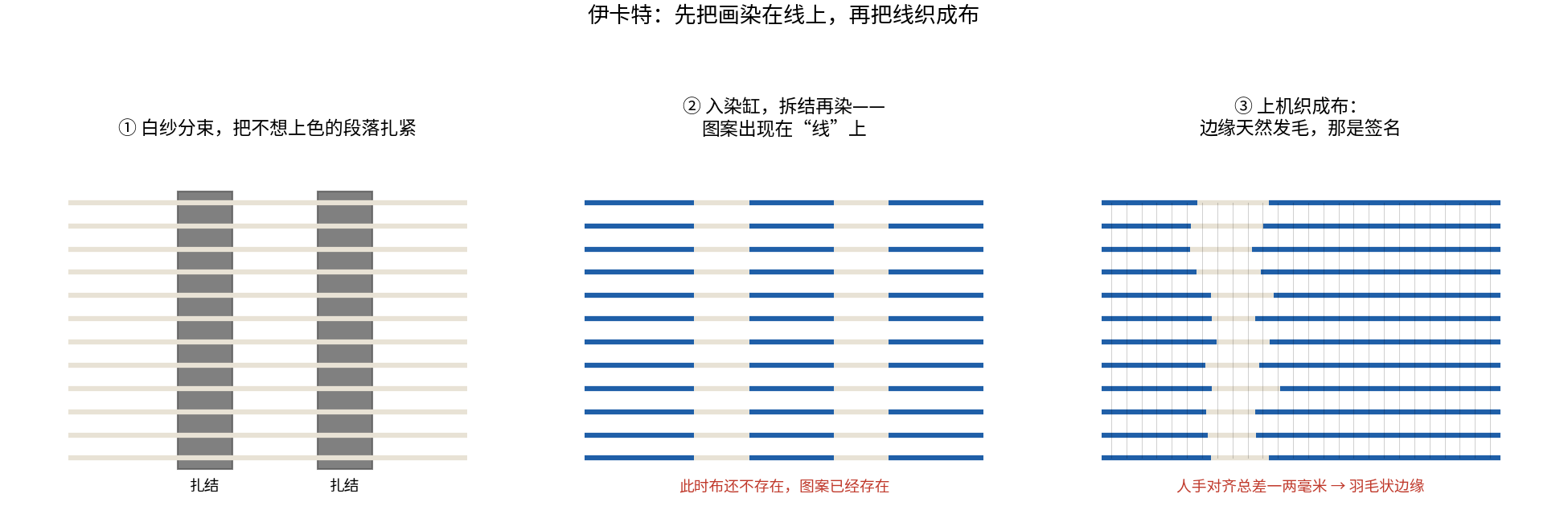
It works like this: before the loose yarn ever reaches a loom, it is divided according to the pattern. Sections that should resist the dye are bound tightly with rubber strips or cotton thread, and the whole bundle goes into a dye bath. Some ties are removed, others added, and the next color is applied, usually working from light to dark through many rounds. By the time the dyeing is finished, the complete picture already exists across a heap of threads. Only then are they mounted on the loom and woven into cloth.
Pause over what that means: the picture is finished before the cloth exists.
The next question is the one a child will inevitably ask: How can the threads possibly line up?
They cannot, not perfectly. And that slight misalignment is the craft's signature.
In weft ikat, where only the horizontal threads are dyed, the weaver must nudge the weft into position after every pass of the shuttle. Hand alignment always leaves an error of a millimeter or two. Thread after thread, those tiny discrepancies give the pattern a soft, fuzzy, feathered edge. It is not a flaw. It is an identity card. Printing stamps a pattern onto cloth and leaves a hard edge; ikat assembles a mosaic from dyed sections of yarn, so its edges inevitably blur.
The most demanding form is double ikat. Both warp and weft are resist-dyed in advance and must mesh precisely on the loom before the design appears. Today, double ikat is still practiced in only three countries: India, Indonesia and Japan. Patola saris from Patan, Gujarat, are one example. Two weavers work together, stopping every few inches to tease wandering outlines back into place with a needle.
The internet offers plenty of numbers for how slowly these textiles are made, but few reliable sources. Here is one that can be traced: in Kashmir, kani shawls are woven with small needle-like wooden bobbins, also called kani, each wound with a different color of weft. A single design may use 50 at once. The master weaver directs the work through a coded system called talim - a musical score for weaving. One shawl takes two weavers anywhere from six months to two years.
How the Two Sides of a Cloth Changed a National Flag
Now pull the camera back from the loom.
In 19th-century British India, hand textile production collapsed on a staggering scale. India's share of world manufacturing output fell from 24.5% in 1750 to 19.7% in 1800, 17.6% in 1830, 2.8% in 1880 and 1.4% in 1913. In Bihar, in the Ganges basin, the share of the population supported by cotton spinning dropped from about 10% in the early 19th century to less than 1.3% by 1901.
But fairness requires an important qualification, perhaps the one point adult readers should carry away. Economic historians divide that deindustrialization into two phases. From 1750 to 1810, the main force was actually the collapse of the Mughal Empire: India lost export markets before British factory technology became dominant. Only after 1810 did machine-made cloth from Lancashire pour into India's domestic market. The researchers conclude that domestic supply-side forces mattered more than external price shocks.
The real story, then, is not "a steam engine strangled a craft." It is "a collapsing empire collided with a steam engine that had just begun to turn." The second version is harder to tell, but closer to what happened.
Precisely because cloth had been devastated so completely, it became a weapon of the Indian independence movement. When Curzon partitioned Bengal in 1905, the Swadeshi movement urged Indians to buy domestic goods and boycott British ones; public burnings of imported cloth became one form of protest. Gandhi later turned the spinning wheel, the charkha, into a symbol of the whole movement. The coarse cloth spun and woven by hand was khadi.
At the center of the 1921 flag was a spinning wheel.
Then came July 22, 1947, and the Constituent Assembly. Nehru introduced the flag resolution. The final design was the tricolor used today, with a navy-blue, 24-spoked Ashoka Chakra at the center of the white stripe instead of a spinning wheel. His explanation for the change was unexpectedly technical:
On one side of the flag, the wheel and spindle appeared in one direction. Viewed from the back, the spindle would point the other way.
So the assembly decided to keep the wheel and remove the rest. A wheel remains a wheel from either side. Nehru took care to explain that the spinning wheel had not disappeared; it had merely changed form.
A technical judgment about cloth having a front and a back entered the resolution for a national flag. The spinning wheel remained in khadi, too: until India's Flag Code was amended in December 2021, the national flag had to be made from hand-spun, handwoven khadi, with specifications as exact as 150 threads per square centimeter.
One Last Thing: China Makes This Cloth Too
Atlas silk from Hotan, Xinjiang, is ikat.
The local name refers to warp-resist dyeing. The method mirrors those used in Patan and Odisha: bind tightly the sections that should not take color, soak the yarn in dye for different lengths of time, dry it, and repeat until every color is complete; only then does the weaving begin. Sophora flowers produce yellow dye and pomegranate flowers red, and one piece may contain as many as eight colors. In 2008, the Uyghur craft of Atlas silk weaving and dyeing was added to China's national intangible cultural heritage list as project VIII-109, submitted by Lop County. Jiya Township in Hotan City is known as the home of Atlas silk, with nearly 800 households engaged in weaving and dyeing.
It helps to distinguish this from a similarly named craft. The Bai tie-dyeing tradition of Zhoucheng in Dali, Yunnan, entered the first national intangible cultural heritage list in 2006 as project VIII-26. There, artisans bind cloth that has already been woven, so the pattern comes after the fabric. Atlas silk and ikat bind threads not yet woven, so the pattern comes first. Both crafts bind, dye and release. One draws on cloth; the other draws on thread.
Weavers in Patan and Hotan live on opposite sides of the Pamirs and may never meet, yet they arrived at the same idea: to put a picture on cloth, you do not have to draw on the cloth. You can draw it on the threads first, then weave the threads into fabric. In Chinese, the method is called "warp-resist dyeing." In Malay and Indonesian, mengikat means "to bind," and museums around the world adopted the shortened form: ikat.
India has other things underway today. At the ceremony at Delhi's Red Fort, two themes stand side by side: the 150th anniversary of Vande Mataram and a youth theme looking toward 2047. According to the official notice, Vande Mataram will be sung when the prime minister arrives at the Red Fort, for the first time in the history of India's Independence Day ceremonies.
On Google's homepage, meanwhile, a piece of cloth sits quietly for a day. Tomorrow the logo will return to normal. But perhaps the small patchwork has done its real work if, today, someone turns over a piece of fabric in their wardrobe and looks at the back.
Sources: Google's official page for the 2023 India Independence Day Doodle, including the artist Q&A; same-day reports by India's The Tribune, The Free Press Journal and News9; the Press Information Bureau of India's 2026 Independence Day release and feature page; the Indian Constituent Assembly debate of July 22, 1947; Impart, the Museum of Art & Photography in Bengaluru's encyclopedia project, on ikat, double ikat, patola, kani weaving, jamdani and Banarasi textiles; ClothRoads, "Fooled by Ikat"; Clingingsmith and Williamson, "India's Deindustrialization in the 18th and 19th Centuries" (NBER Working Paper 10586); Guangming Daily, "Hotan Atlas Silk in Xinjiang: A Millennium of Color Along the Silk Road"; and the China Intangible Cultural Heritage website's project pages for Atlas silk weaving and dyeing and Bai tie-dyeing.