
Seven rows, seven columns. Gray, reddish-brown, and pale tan rocks fill a grid, each with a small round hole. NASA's November 20 Image of the Day brings together 49 drill holes left by the Curiosity rover on Mars.
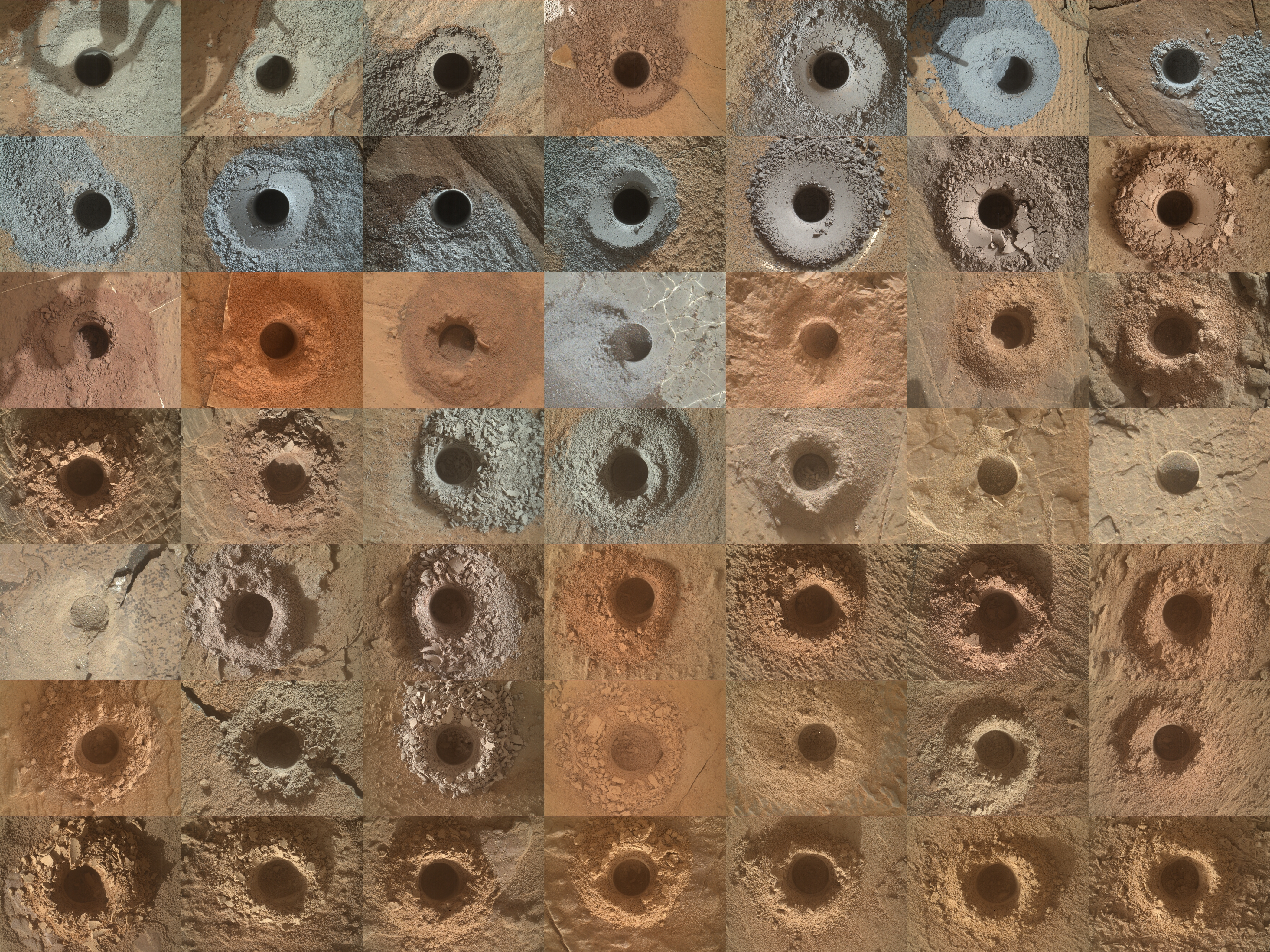
Image: NASA/JPL-Caltech/MSSS. Original page
This is a collage of sampling photographs collected through November 2026. Each panel records a separate sample site. The grid is not a single perforated slab, a natural honeycomb, or a panorama taken in one place on one day.
NASA's detailed image description gives the holes a scale you can draw: each is 16 millimeters across, or 1.6 centimeters. Measure out a circle that size on paper to see how small a window Curiosity opens in the rock.
Behind that window is a mobile laboratory. A drill at the end of the robotic arm grinds rock into powder. The rover delivers the samples to instruments inside its body to analyze their composition. A camera shows researchers what a surface looks like; a physical sample lets the instruments ask what it contains.
Curiosity landed in Gale Crater on August 6, 2012, and has been climbing Mount Sharp. Its work asks whether ancient Mars had environments capable of supporting microbial life. A photograph of a rock, by itself, does not establish that life existed there.
The close-ups were taken by the Mars Hand Lens Imager, or MAHLI, also mounted at the end of the robotic arm. Its name borrows from the magnifying lenses geologists use to examine rocks. On Mars, the arm does the holding.
Enlarge the collage and compare the powder, cracks, and textures around different holes. Lighting and imaging conditions can affect color, so a redder panel alone cannot tell you which minerals the laboratory found.
Open Curiosity's mission page and return to the collage. Pick three holes and describe their rims, powder, and nearby cracks. Start with what you can actually see, then separate those observations from what you think they might mean. It is a useful first step toward reading a picture from another planet.