
Phobos looks like a potato with a substantial piece scooped out. Stickney crater spans roughly nine kilometers, while the Martian moon's average diameter is only about 22 kilometers.
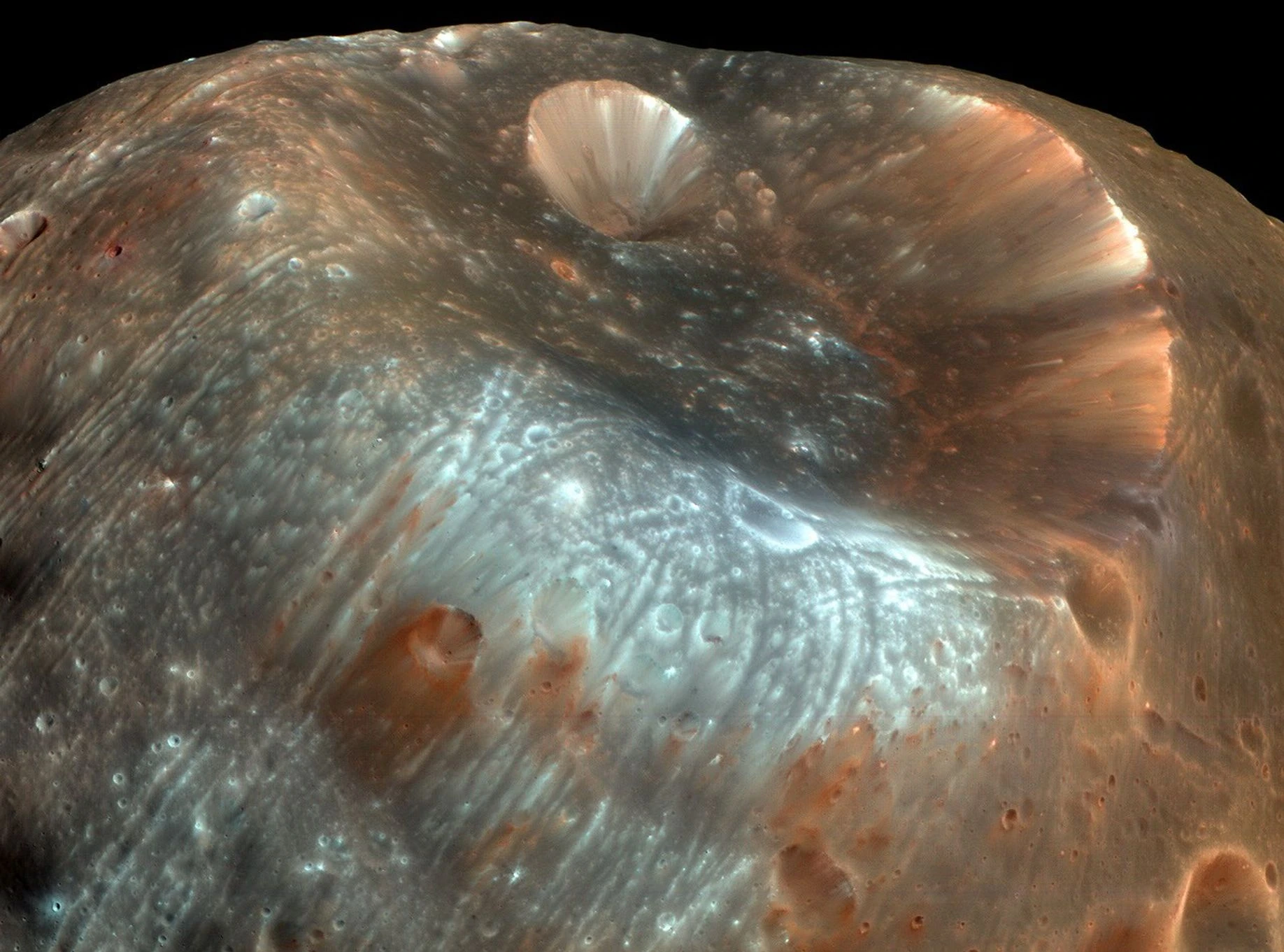
Image credit: HiRISE, MRO, LPL (U. Arizona), NASA | Original page. Enhanced colors differ from a natural view through human eyes.
The October 9 APOD revisits an image taken in March 2008 by HiRISE aboard the Mars Reconnaissance Orbiter. The crater is named for mathematician Chloe Angeline Stickney Hall. Her husband, Asaph Hall, discovered both Martian moons in 1877.
Weak Gravity Still Works
Fine lines on the crater walls suggest loose material sliding toward the interior. Slopes can fail on Phobos just as they do on Earth, even though surface gravity is less than one-thousandth of Earth's. Weak gravity can still move material downhill.
The original HiRISE account records two observations on March 23, 2008. The first was made from about 6,800 kilometers away, with a scale of 6.8 meters per pixel. Less than ten minutes later, a second observation from about 5,800 kilometers achieved 5.8 meters per pixel. Slightly different viewing angles allow the pictures to be combined into a stereo view.
APOD's close-up comes from this set of observations. The team also provides separate views of Stickney.
The moon is too small for its gravity to pull it into the nearly spherical shape of a large planet. A nine-kilometer crater on such a small body indicates an enormous impact. APOD suggests the collision likely came close to shattering Phobos; the picture preserves the aftermath.
Color Offers a Clue
HiRISE combines blue-green, red and near-infrared channels to emphasize differences that are less obvious in grayscale. Relatively blue material near Stickney's rim might be a fresher exposed surface. That interpretation draws on comparisons with lunar materials. Blue alone does not identify a mineral.
Long grooves cover other parts of Phobos. Their proposed origins include impacts, debris ejected by impacts on Mars, and tidal stresses. Calling them all cracks radiating from Stickney would overstate what is known. The original HiRISE caption notes that earlier studies placed their apparent center elsewhere.
The team also offers a brightened view of the dark side. Its faint illumination comes from sunlight reflected by Mars, or "Marsshine," analogous to Earthshine lighting the dark portion of our Moon.
A Moon That Rises in the West
NASA's CRISM resource gives Phobos an orbital period of about 7 hours and 39 minutes, compared with Mars's rotation period of about 24 hours and 37 minutes. Both move in the same direction, but the moon travels around faster. From the Martian surface, Phobos therefore rises in the west and sets in the east.
Mars also shapes its future. NASA's Phobos overview says the moon's orbit shrinks inward by about 1.8 meters per century. In roughly 50 million years, it may collide with Mars or break into a ring. That is a long-term evolutionary estimate.
Another Spacecraft Prepares to Leave
JAXA's Martian Moons eXploration mission, MMX, aims to return more than 10 grams of material from Phobos. Samples could help distinguish a captured asteroid from material assembled after a giant impact. A small amount of soil could address a large question about the moon's origin.
JAXA's formal launch announcement schedules H3 flight No. 10 from Tanegashima Space Center for October 20, 2026, at 04:41:03 JST. That is October 19 at 19:41:03 UTC or 15:41:03 EDT, and October 20 at 03:41:03 in Beijing. The reserved launch period runs from October 21 through November 7 in Japan. Timing may change, so check JAXA's notices near launch.
The mission plan calls for arrival in the Martian system in 2027. Observations and an IDEFIX rover survey precede spacecraft landing and sampling. Departure is planned for 2030, with sample-capsule recovery in Australia during fiscal year 2031. Launch, arrival and sampling occupy different parts of that journey.
Meanwhile, compare the ordinary image, enhanced dark-side view and red-blue stereo image on the HiRISE page. Red-blue glasses let you try the stereo version. Without them, you can still trace the rim, the landslide textures and distant grooves, then see which features remain recognizable from the second angle.