
Google has woven an orange-and-blue cloud into its logo, with white lettering still visible across the center. Two growing stars hide inside the bright central patch. The structures stretching away from them contain material thrown outward as the stars develop.
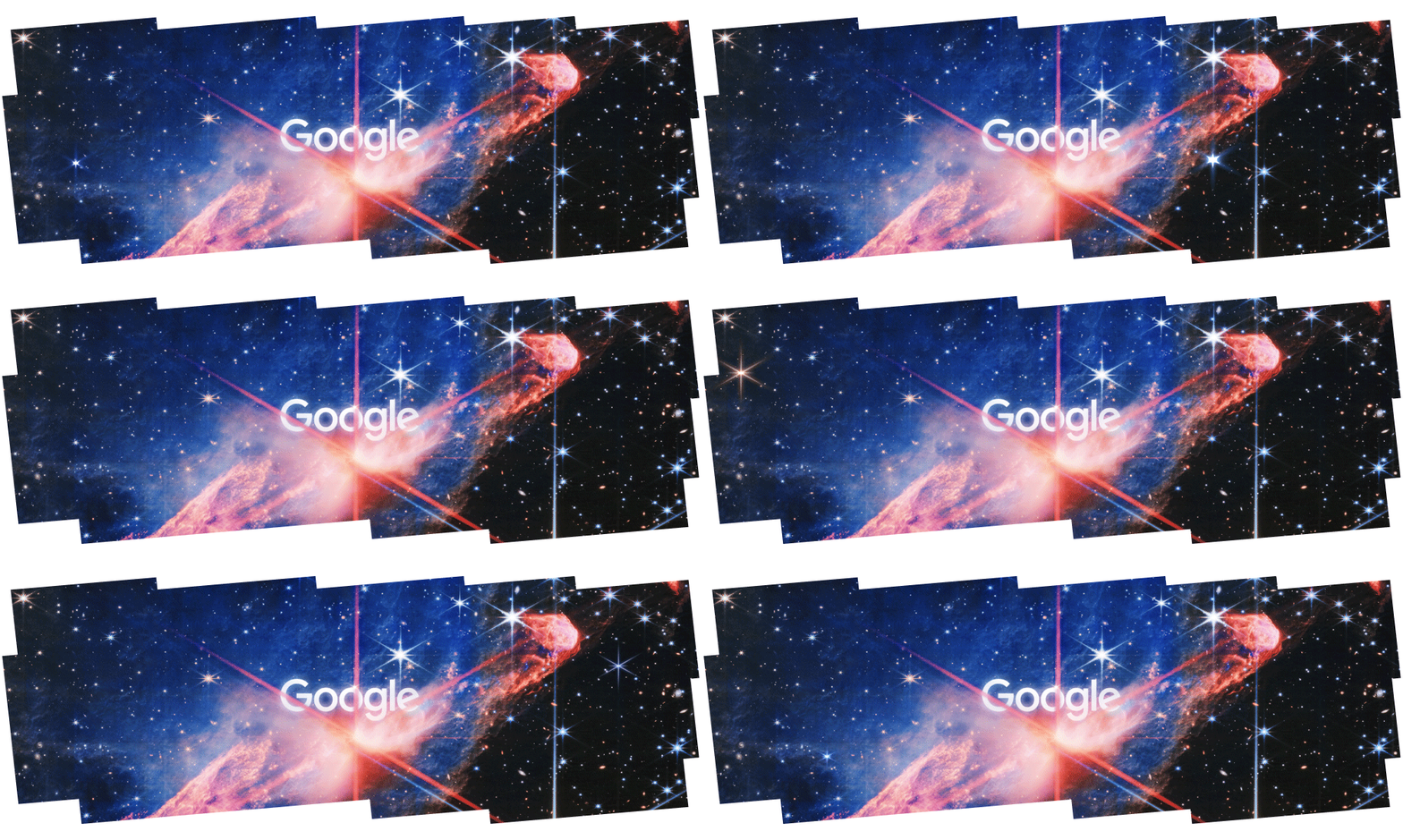
Image: Google Doodle | Google attributes the underlying image to NASA's James Webb Space Telescope | Original page.
The United Nations' World Space Week runs from October 4 through 10. Google's October 9 entry features Herbig-Haro 46/47, usually shortened to HH 46/47. It lies in Vela, about 1,470 light-years away. NASA's image record dates Webb's observations to May 24, 2023, and the image release to July 26 that year. Today's Doodle draws on that earlier view.
Find the Stars at the Center
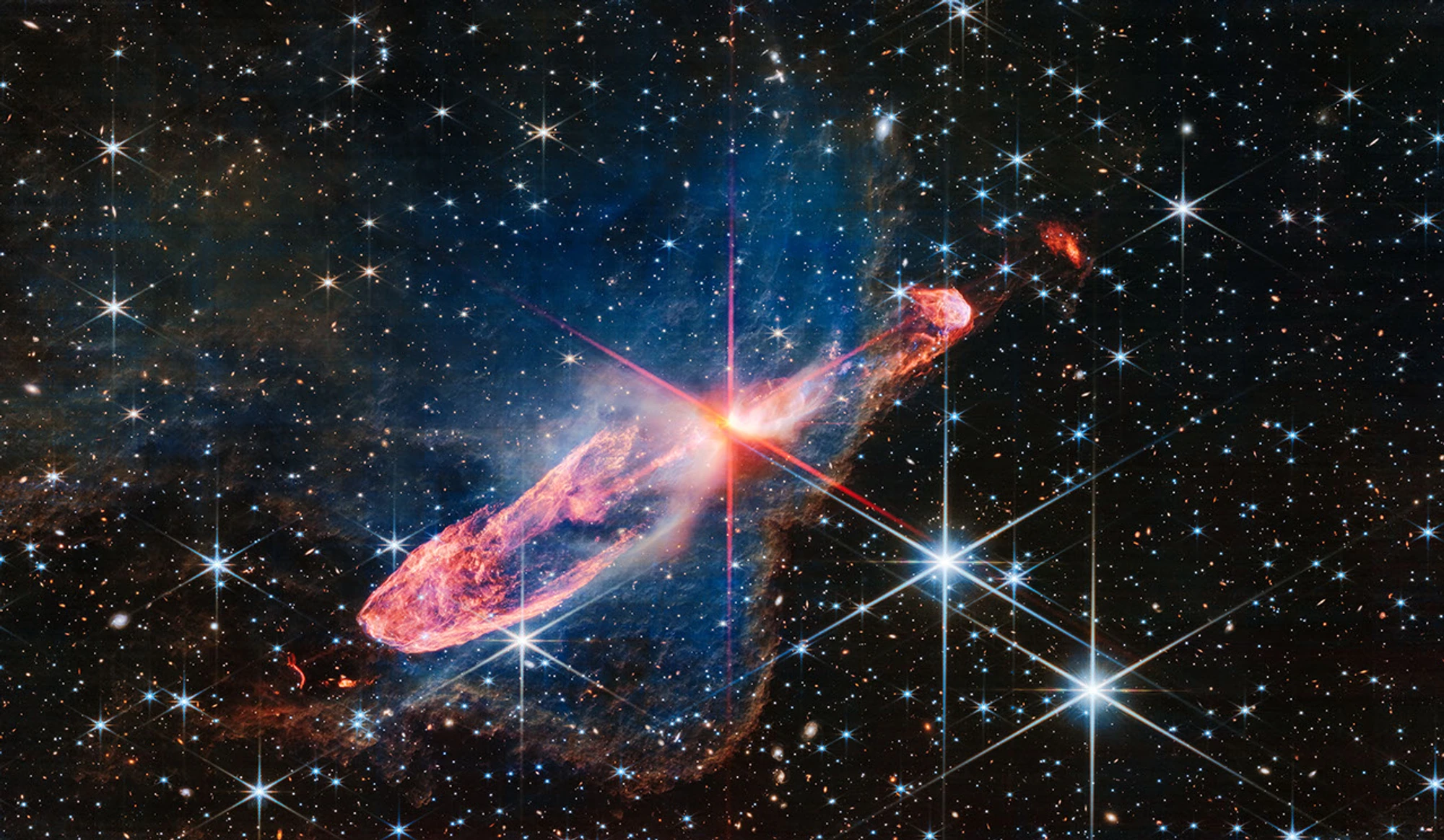
Image: NASA, ESA, CSA | Image processing: Joseph DePasquale (STScI), Anton Koekemoer (STScI) | Original page. Colors are assigned to infrared filters rather than showing the scene as human eyes would see it.
Follow the red diffraction spikes toward their intersection. The orange-white patch contains the two young stars. Those sharp spikes come from the telescope's optics; they are separate from the material the stars eject.
A surrounding disk of gas and dust feeds the pair. The disk itself is hidden, but NASA identifies its shadow in two dark cones near the central stars. An obstruction beside a lamp can also shape where light falls, though the structure here is far more complicated.
Inward and Outward at Once
Stars retain only part of the material that approaches them. Jets carry some gas away. When fast-moving material encounters surrounding gas, glowing structures form: Herbig-Haro objects are regions associated with these young stellar outflows.
NASA's explanation of the Webb image compares the repeated ejections to a fountain switching on and off. Each episode can release a different amount of material at a different speed. Newer ejecta catching older material reshape the lobes. The large orange lobes contain older ejections; thin blue threads trace newer ones. Outflows also help regulate how much mass the stars ultimately gather.
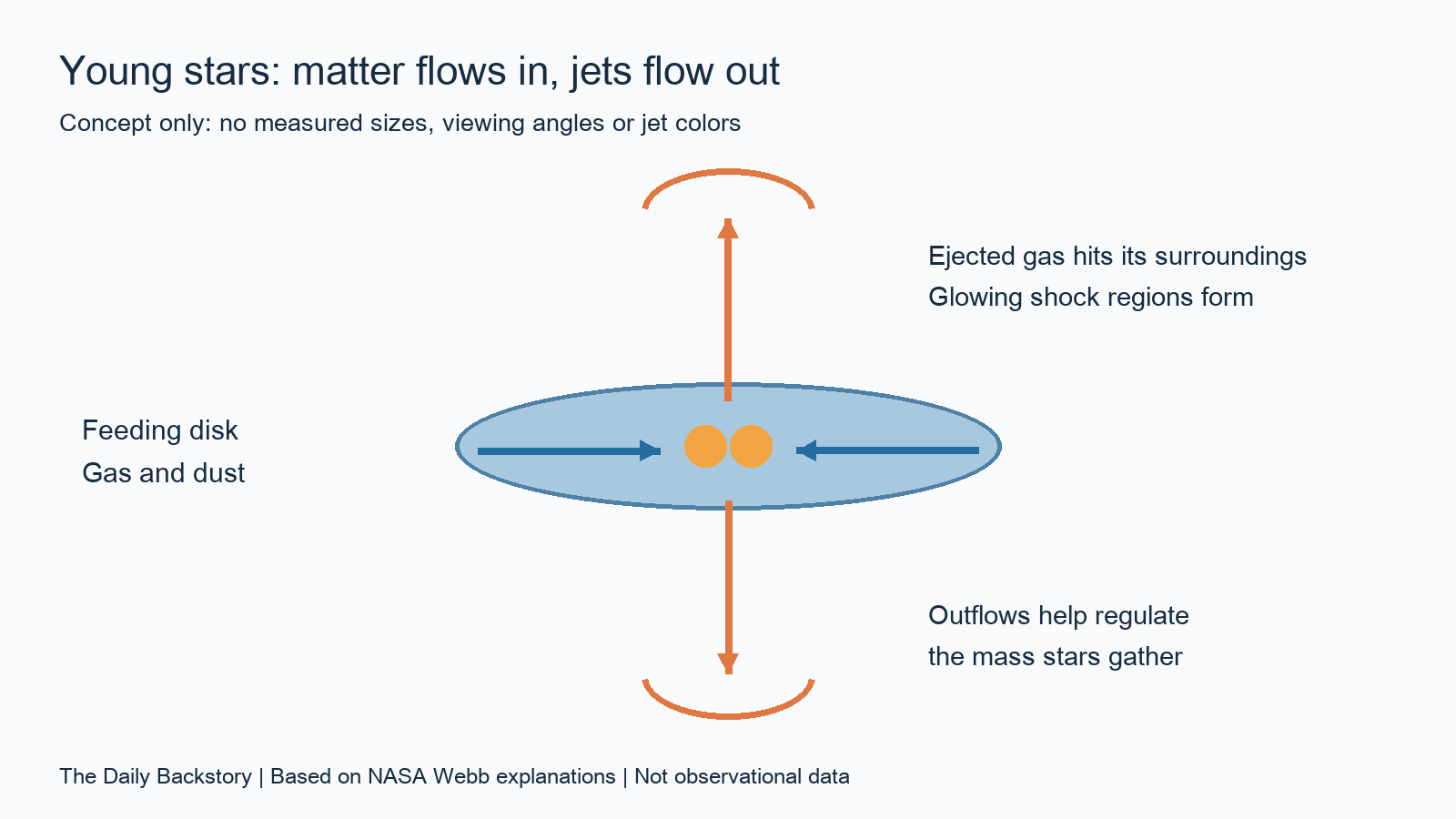
Explanation: The Daily Backstory, based on NASA Webb descriptions. Sizes, angles and colors are conceptual.
A NASA Hubble account of this system gives outflow speeds above 150 kilometers per second and explains the bright shock waves produced by collisions with surrounding gas. Different regions and measurements can yield different velocities. A colorful image supplies no single speed for all its material.
The surrounding blue cloud is a Bok globule: a dense concentration of gas and dust. It looks almost black in visible light. Webb's near-infrared observations reveal more of its interior and objects farther behind it. Infrared visibility still depends on the material and its thickness.
There is another easily mistaken detail. The larger, brighter lobe at lower left points away from Earth. The smaller lobe at upper right tilts slightly toward us. Apparent size is a poor distance ruler here.
Open NASA's full image, find the central patch, then follow the threads and the more distant arcs on either side. Separate the telescope's diffraction spikes from the stars' ejected material and the obscuring cloud. The colorful scene becomes a structure you can read.