
Most of New York's buildings kept their everyday lights, while the top of the Empire State Building turned gold. NASA photographer Bill Ingalls captured the skyline on November 17, 2026, as Voyager 1 approached a new milestone: one light-day from Earth.

Image: NASA/Bill Ingalls. Original page
The photograph became NASA's Image of the Day on November 18. The gold also points to a physical object aboard the Voyager spacecraft: a gold-plated copper record carrying sounds, images, and greetings from Earth.
A day for the question, another for the reply
The time published by NASA was November 18, 2026, at 5:16:07 a.m. EST, equivalent to 10:16:07 UTC and 6:16:07 p.m. in Beijing. That moment has now passed.
A light-day is the distance light travels in a day, about 25.9 billion kilometers. Radio signals are electromagnetic waves too, traveling at light speed in a vacuum. At that distance, a command from Earth takes about 24 hours to arrive. If the spacecraft could answer immediately, the reply would need another day: about 48 hours for the simplest exchange, before processing and scheduling delays. The distance also changes as the spacecraft travels.
Voyager left Earth in 1977. It needed almost half a century to travel as far as light can go in a single day. That comparison gives the enormous kilometer count a more tangible meaning.
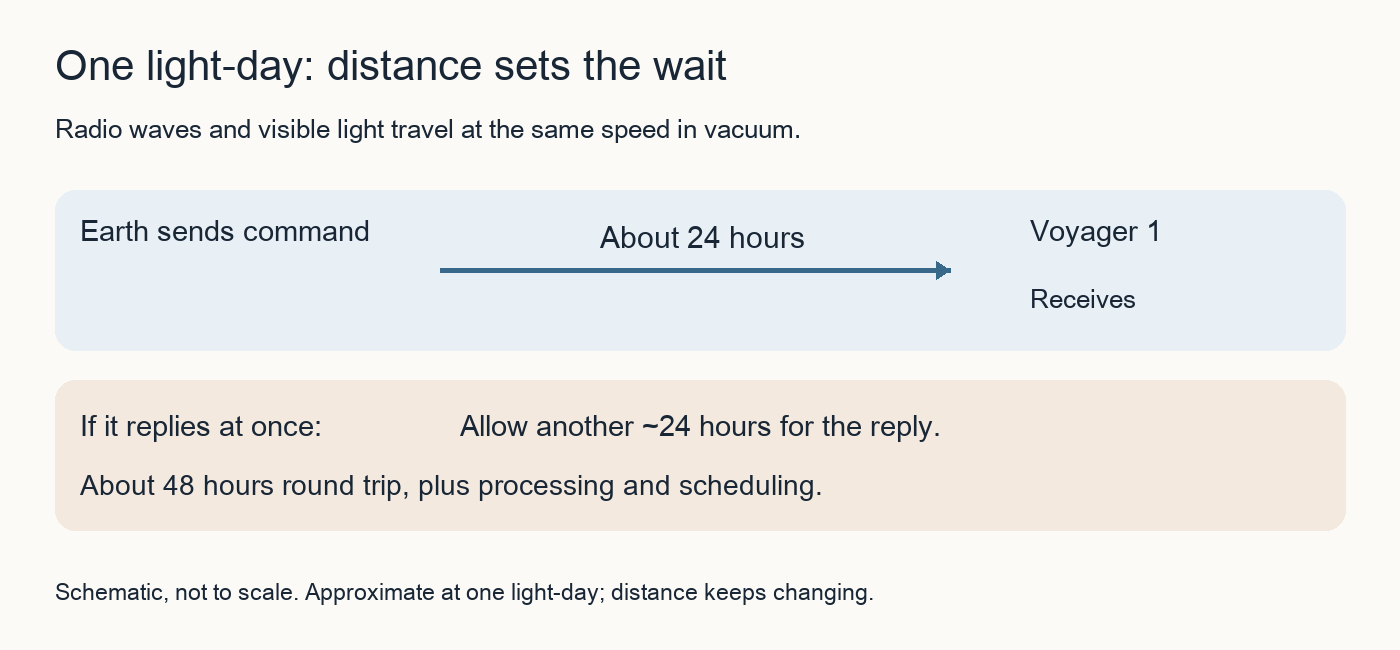
Diagram: Laili. Approximate light-travel times at one light-day, before processing and scheduling delays.
There is also a problem unfolding now. NASA/JPL's November 19 announcement says the team has received no science or engineering data from Voyager 1 since November 14, although its radio carrier signal continues to reach Earth. Engineers used that carrier and trajectory calculations to confirm the distance while investigating the data issue. Detecting a spacecraft's signal and reading its scientific measurements are different accomplishments. The day-long delay makes each troubleshooting step a patient undertaking.
A record someone would have to find
NASA describes the Golden Record as a 12-inch gold-plated copper disk. It is a physical message that would have to be found and played, rather than music continuously broadcast by the spacecraft. Its contents include music from different cultures and eras, surf, wind, thunder, animal sounds, and greetings in 55 languages.
One selection is the guqin piece Flowing Streams, performed by Guan Pinghu. NASA's official music list lists the performer as Kuan P'ing-hu and the duration as seven minutes and 37 seconds. The greeting catalogue includes Amoy, a Southern Min variety: the greeting asks how its distant friends are, whether they have eaten, and invites them to visit when they have time. The record will not automatically deliver those words to a listener. Sending such familiar sounds as a physical object is part of its appeal.
The November 17 lighting celebration was symbolic, too. A household flashlight cannot replace a deep-space communications antenna. The event has ended, but NASA's page preserves the Morse code for V-G-R: V is three short flashes and one long; G is two long and one short; R is short-long-short. Try it face to face with someone, then imagine each flash needing an entire day to reach its recipient. An ordinary light suddenly carries a sense of distance.