
A mottled river of stars rises above the Empire State Building. Below it, Manhattan is still blazing with lights. The buildings have kept their lights on; the photographer has changed which light the camera records.
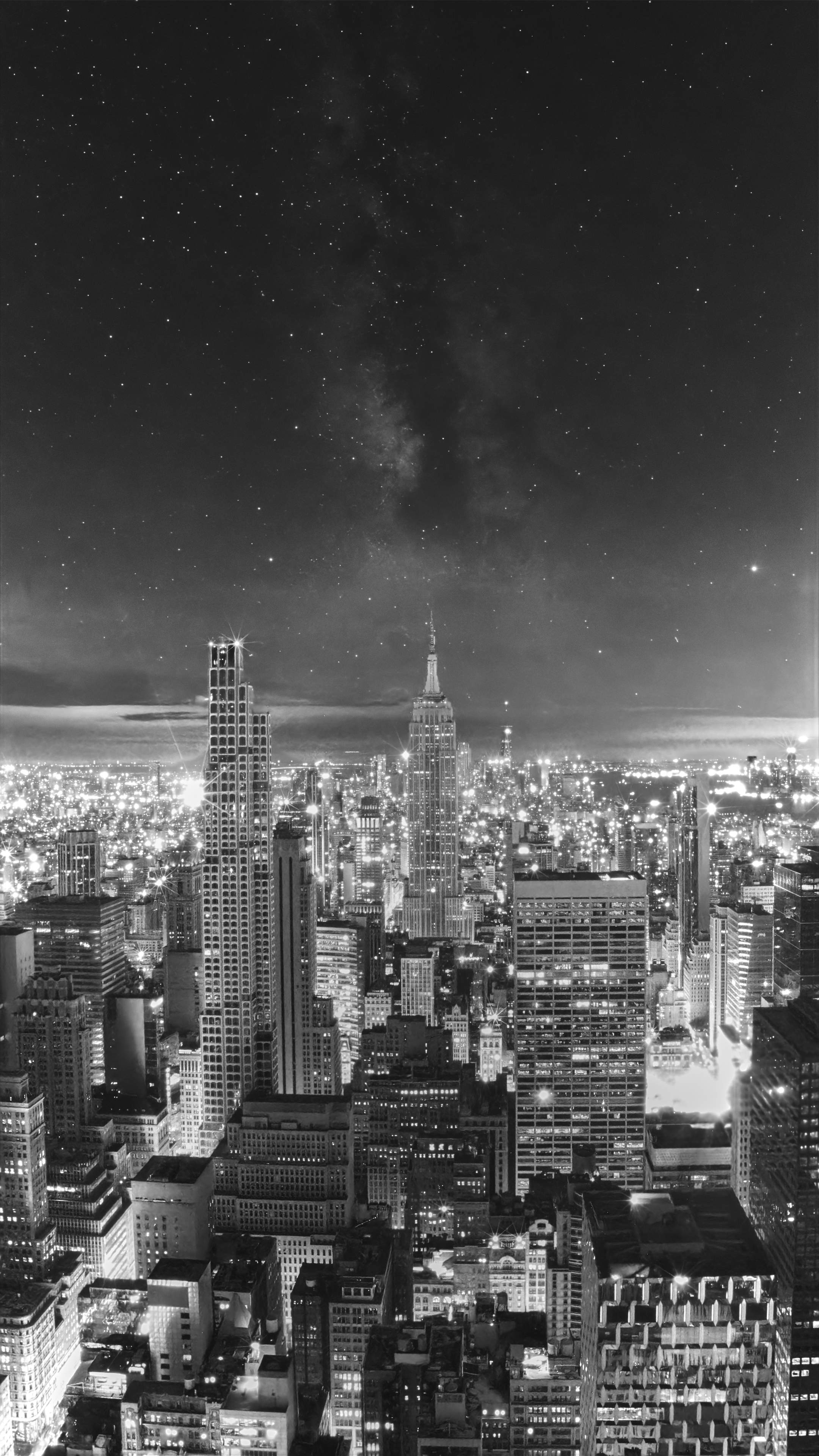
Image: NASA Astronomy Picture of the Day. Credit & Copyright: Jason Kurth, Ty Buckley. Original page.
Tuning past some of the noise
Our eyes detect a narrow part of the electromagnetic spectrum. Beyond red lies infrared light, with longer wavelengths. Imagine a distant song being overwhelmed by noise in one frequency range. Tune to another range, and the balance between the song and the background may change.
This photograph uses a difference of that kind. NASA's explanation says a filter blocks most visible light while the camera records near-infrared. Many LEDs and fluorescent lamps are much less prominent in this band, while stars continue to emit near-infrared light. The Milky Way becomes easier to distinguish from the background.
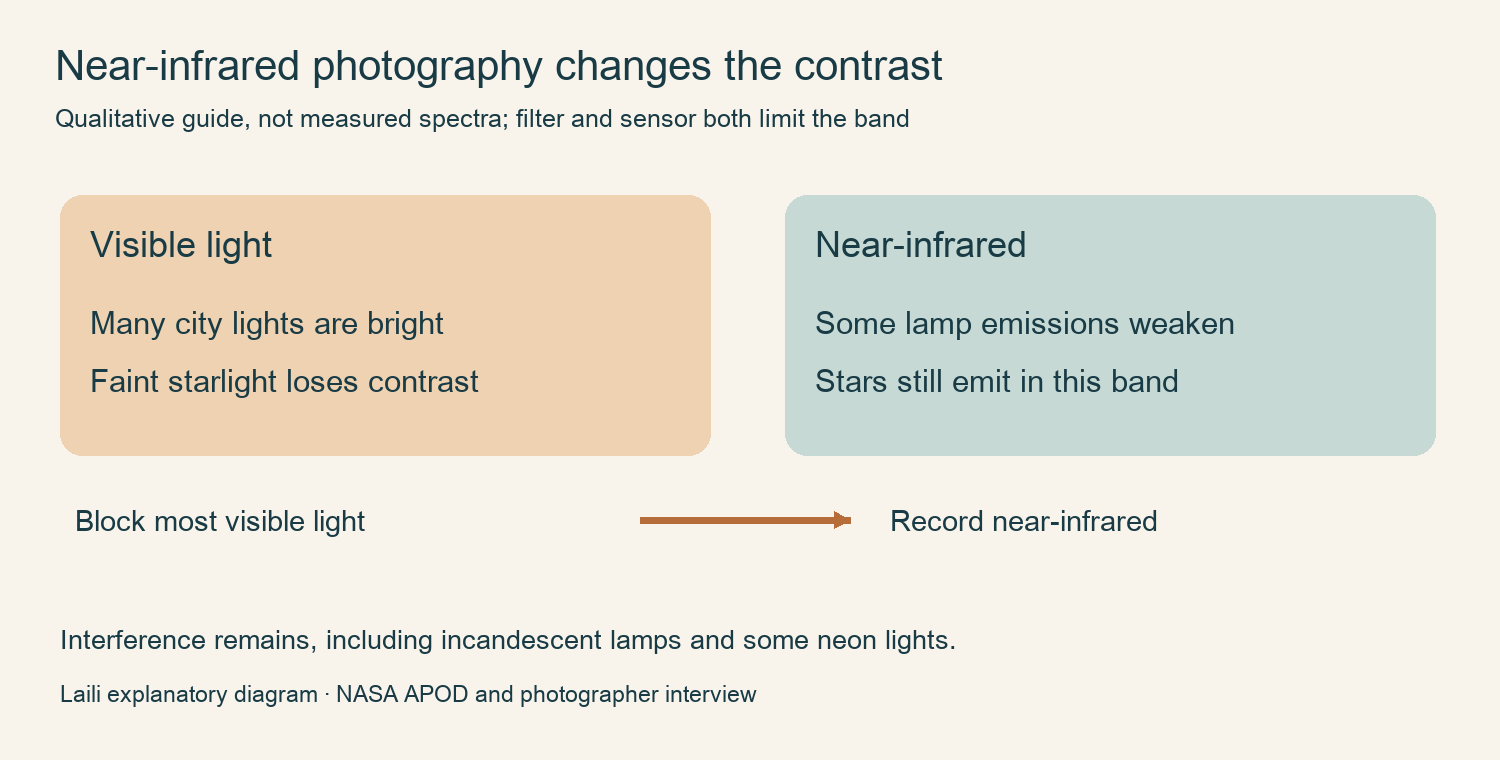
Diagram: The Daily Backstory. Choosing a band changes the contrast. This is a qualitative explanation, without measured spectra, based on NASA APOD and the photographer's interview.
Interference remains. Incandescent lamps and some neon lights still emit near-infrared, and a filter cannot clear the weather or eliminate every source of sky brightness. An observer at the same location would not see this view of the Milky Way with unaided eyes.
Making invisible light visible
In the photographer's interview linked by NASA, Jason Kurth describes a monochrome astronomy camera with high near-infrared sensitivity, an 850-nanometer filter fitted over its sensor, and an industrial lens designed for visible through shortwave-infrared wavelengths. He worked from Top of the Rock at Rockefeller Center and credited Ty Buckley with technical assistance.
The interview dates the timelapse shoot to October 4. NASA selected the picture on October 15. The date of a shoot and the date a daily-image column features it are different things.
The camera measures light our eyes cannot detect, then represents its intensity in shades a screen can display. The black-and-white result does not imply a colorless galaxy or a temperature map. As NASA's infrared astronomy guide explains, infrared observations cover several bands; an infrared camera need not work like a thermal imager used to measure body temperature.
Try pointing a remote control at a camera and pressing a button. Some cameras show a flash from its near-infrared emitter; others block it with an internal filter. This will not reproduce the Manhattan photograph, but it offers a small encounter with light that arrives without being visible to your eyes.
Turn the city sky into a record
To record how much of the sky remains visible where you live, try NOIRLab's Globe at Night. Its instructions call for observing during a campaign, more than an hour after sunset, with the Moon absent. Allow about ten minutes for your eyes to adjust. Compare the faintest stars you can see in the designated constellation with the site's charts, and record cloud cover. The next campaign currently listed is November 1-10, 2026. Choose a constellation appropriate to your hemisphere and location.
There is also a reason to seek darker skies this month. NASA's October 2026 skywatching guide highlights the Orionid meteor shower on the night of October 21 into the morning of October 22. These meteors come from debris left by Halley's Comet and can cross any part of the sky. A bright waxing gibbous Moon will hide some faint meteors. Check local moonset and dawn times for a dark interval; the useful window changes with location.