
First come the stars scattered across the frame. Then a much larger pattern emerges behind them: a galaxy opening its spiral arms almost face-on. IC 342, the subject of NASA's November 4 Astronomy Picture of the Day, is often called the Hidden Galaxy.
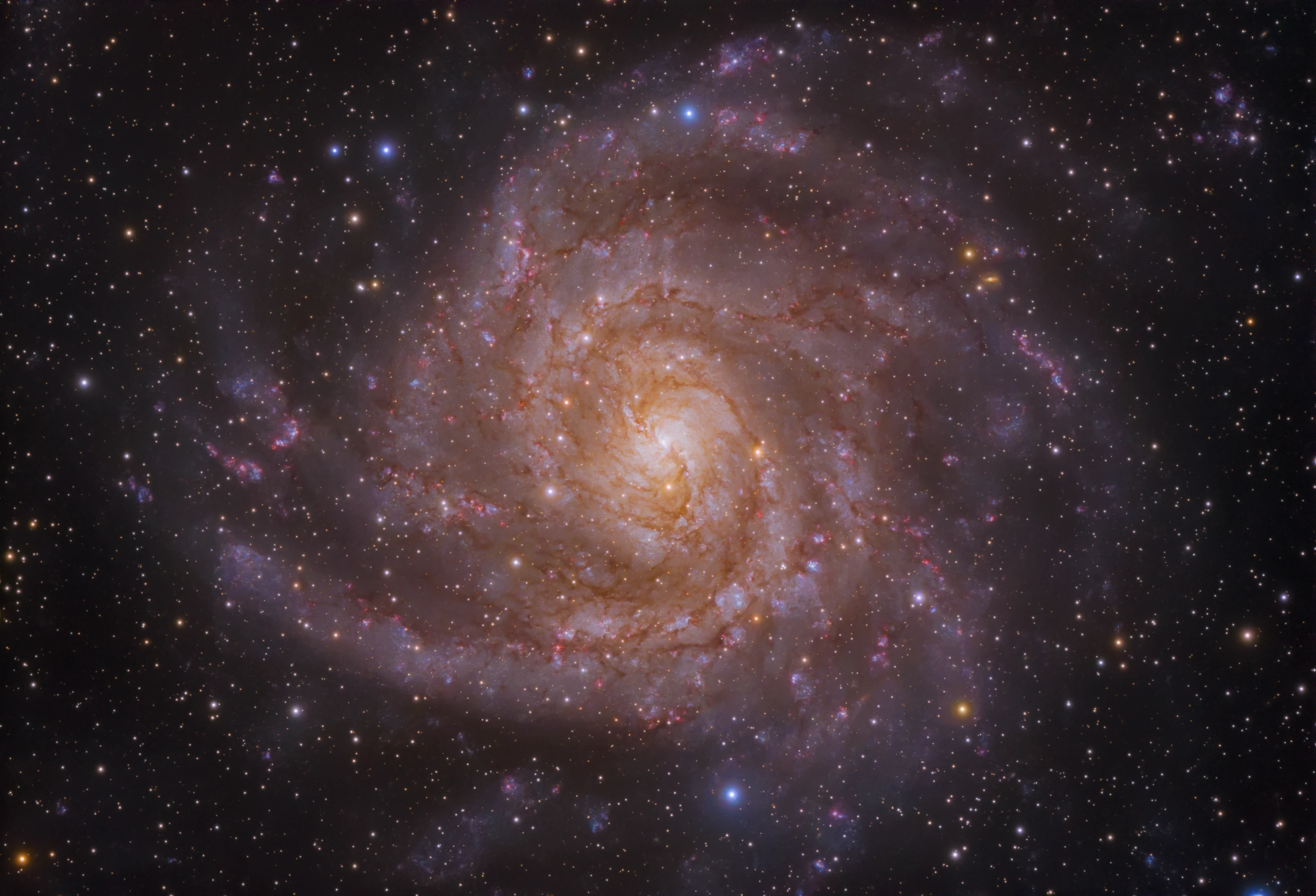
Image: NASA Astronomy Picture of the Day · Credit & copyright: Artem Mironov · Original page
The hiding place is along our line of sight. We look through stars, gas and dust near the plane of our own Milky Way to reach a galaxy roughly ten million light-years away. Many bright points belong to the foreground; the broad spiral behind them is another enormous stellar system. IC 342 has dust of its own, too, adding a second layer along the view.
Lines the photograph does not show
There is another structure in those arms that a visible-light picture cannot trace directly: a magnetic field. Researchers at the Max Planck Institute for Radio Astronomy combined observations from Germany's Effelsberg telescope and the Very Large Array in the United States, finding a helically twisted magnetic structure around one of IC 342's main spiral arms.
They inferred the field from the polarization of radio waves, the pattern in their vibration directions. They also had to correct for rotation of the polarization as the waves traveled through intervening magnetized material. The team's 2015 research account describes a field strong enough to affect gas flow and suggests a role in shaping spiral arms. It does not establish magnetism as their sole cause.
Artem Mironov's photograph shows the visible structure of starlight, gas and dust, rather than a map of that field. Compare it with the radio diagrams on the research page to see how astronomers investigate one object in different ways.
NASA's Caldwell 5 guide offers an introduction to finding IC 342. Faint galactic detail requires suitable equipment and dark skies; the colors and clarity of an astrophotograph are not a naked-eye view.