
Their light was not too faint. It was too "soft," slipping past telescopes that had been looking all along.
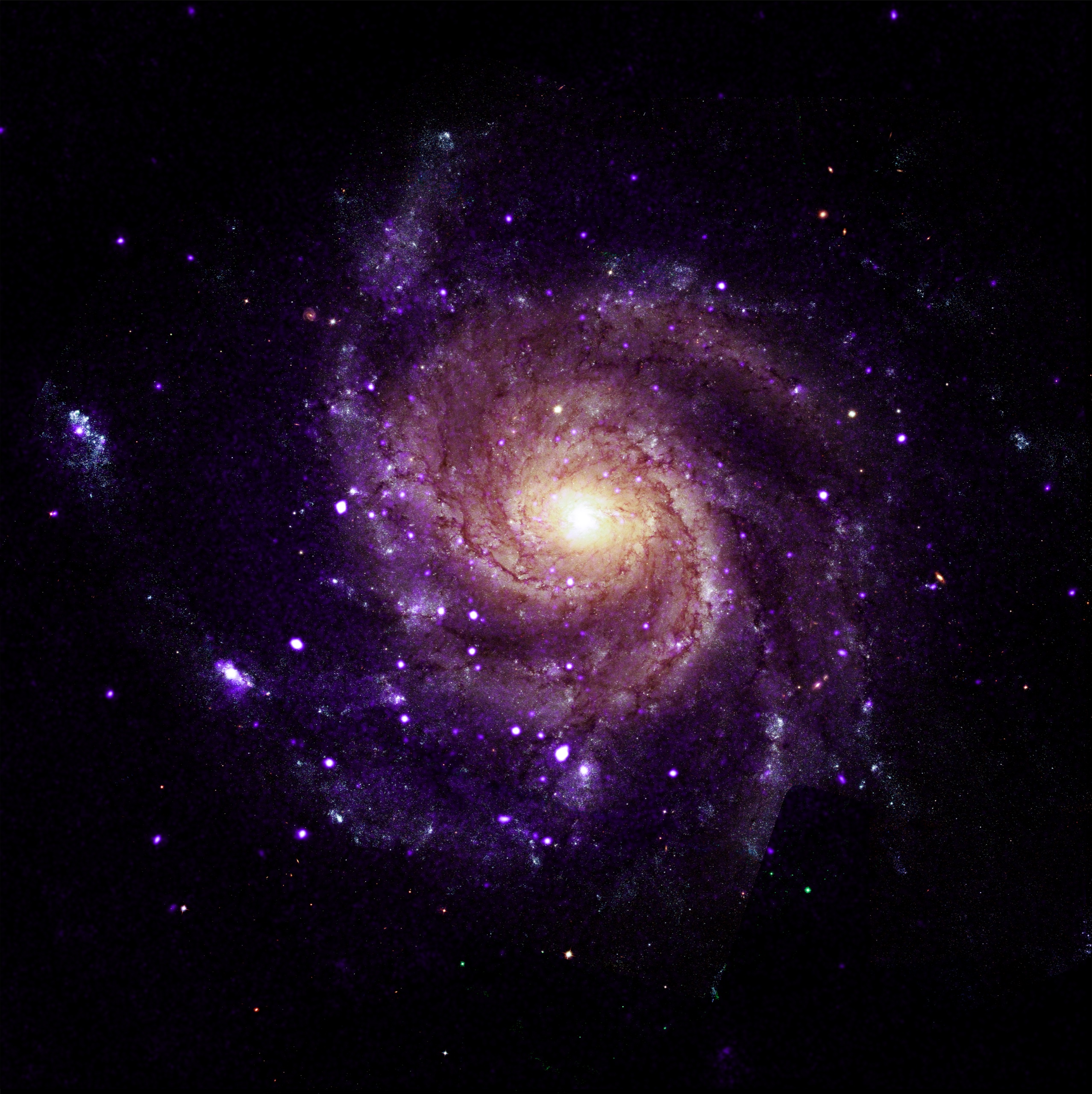
Image: NASA Image of the Day | Image credit: X-ray: NASA/CXC/Univ. of Alabama/M. Muhibullah et al.; Optical: NASA/ESA/STScI; Image Processing: NASA/CXC/SAO/N. Wolk | Original page
NASA's chosen image shows M101, better known as the Pinwheel Galaxy. Seen face-on, its four spiral arms spread like a firework paused in midair.
The underlying visible-light photograph comes from Hubble. The additional bright points come from the Chandra X-ray Observatory: sources revealed in X-rays, rather than ordinary stars in the optical image.
Before 2026, several of those points had gone unrecognized.
A blind spot
The discovery began in old files.
A team led by Mustafa Muhibullah at the University of Alabama reexamined more than twenty years of Chandra observations. The method was straightforward: compare images of the same patch of sky in the lowest-energy X-ray band with images at higher energies, and look for objects that shine clearly in the first but disappear in the second.
They found 84, spread across six galaxies: two spirals, Andromeda (M31) and the Pinwheel (M101), plus four elliptical galaxies.
The team called them hypersoft X-ray sources.
"We have never encountered a population of objects behaving like this," Muhibullah said.
The reason they escaped notice lies in the meaning of "soft."
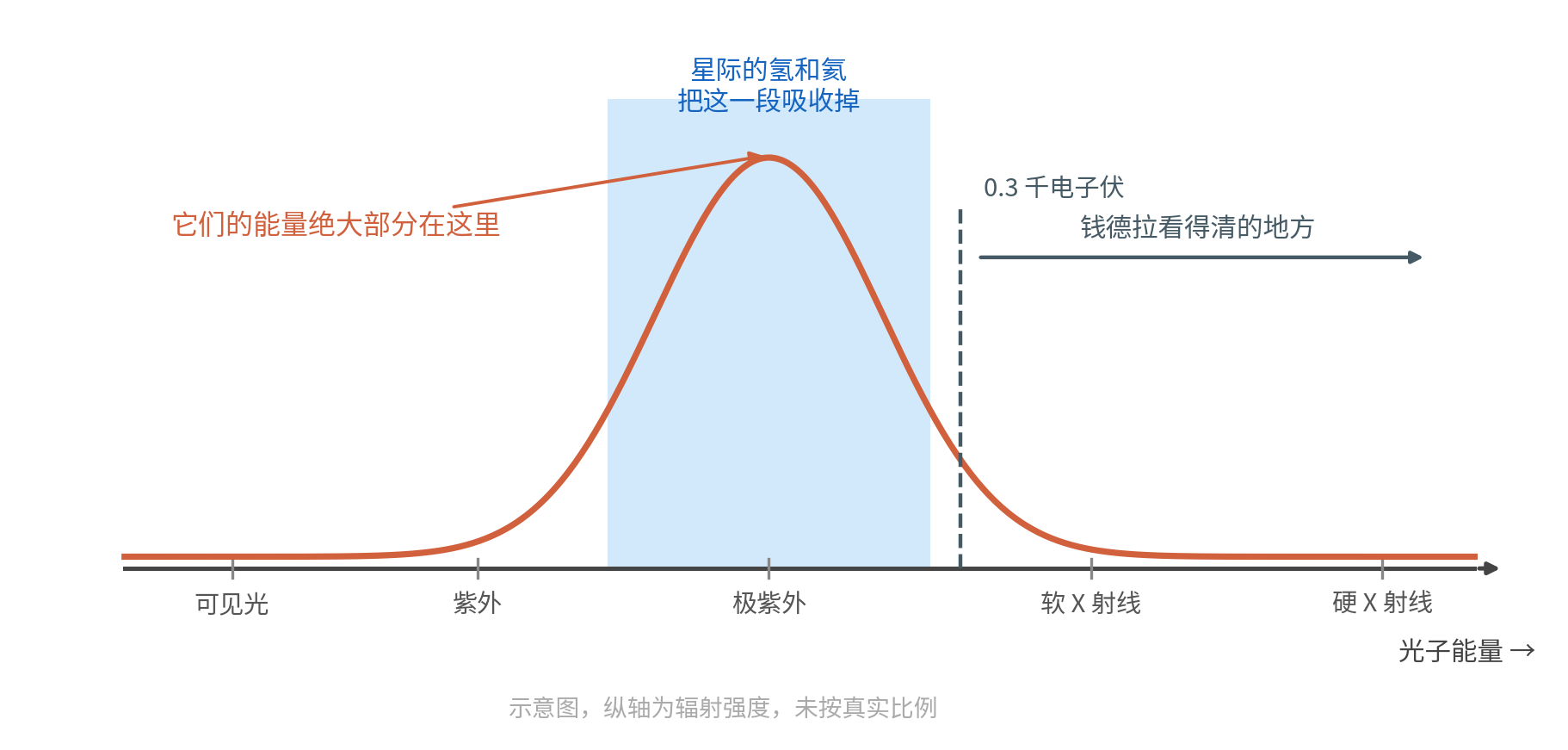
High-energy X-rays are called hard X-rays: they penetrate matter readily and are easier for telescopes to catch. Lower-energy X-rays are soft, and increasingly difficult to detect. Almost all the X-rays from these objects fall below 0.3 kiloelectronvolts, at the edge of Chandra's capabilities.
More troublesome still, most of their radiation is not in X-rays at all. It is in the extreme ultraviolet, which the hydrogen and helium found throughout space soak up like a sponge.
The result is counterintuitive. As Muhibullah explained, these elusive X-ray sources are among the most energetic objects in their galaxies. Yet most of that energy falls in a band telescopes can barely detect and intervening gas readily absorbs.
They are too soft, rather than too faint: like someone shouting at a frequency beyond human hearing. The loudest voice in the room can seem utterly silent.
Rosanne Di Stefano of the Center for Astrophysics | Harvard & Smithsonian described the achievement simply: "By combing through Chandra's archives, we have removed a blind spot the telescope previously had."
No new telescope was needed. The data had been sitting in a public archive, waiting for a different way of looking.
Two puzzles they might help solve
The Chandra team suspects that each source is a compact object, such as a black hole, neutron star, or white dwarf, drawing material from a companion star. The material heats up and radiates. That mechanism is familiar; the previously unseen combination of intense ultraviolet and extremely soft X-rays is not.
If these objects are white dwarfs accreting matter from companion stars, they could help resolve a longstanding astronomical puzzle.
A white dwarf that accumulates enough material can explode as a Type Ia supernova. These explosions have remarkably consistent luminosities, making them cosmic "standard candles." They were the tools that revealed the accelerating expansion of the universe.
Yet astronomers have never obtained a clear picture of a Type Ia system before it explodes.
"At present, we study them after they have exploded," said the University of Alabama's Jimmy Irwin. Identifying such systems beforehand, he explained, would be enormously valuable.
The second puzzle concerns gas inside galaxies. Much of the universe's interstellar gas is ionized, with electrons stripped from its atoms, but the energy budget has never quite added up. Hot, massive stars cannot account for all of it. The intense ultraviolet radiation from hypersoft sources could supply some of the missing energy.
Objects overlooked for twenty years might help close two gaps at once.
And it happened in this galaxy
M101 gives this image an extra resonance.
On August 24, 2011, the Pinwheel hosted a Type Ia supernova named SN 2011fe. Roughly 21 million light-years away, it was the nearest Type Ia since 1986. According to Lawrence Berkeley National Laboratory, researchers caught it just 11 hours after the explosion.
Those observations delivered the first direct evidence that a Type Ia supernova had originated from a carbon-oxygen white dwarf. The Berkeley team also used its early light curve to rule out several models, including a red giant companion. But the full picture of Type Ia progenitors remains unsettled, which is why the puzzle Irwin describes is still open.
Over fifteen years, the same galaxy has offered two perspectives: in 2011, the aftermath of an explosion; in 2026, perhaps a population of systems before they explode.
"Perhaps" matters. The nature of these 84 objects remains a hypothesis. Future observations must establish whether they are Type Ia progenitors or rule that possibility out.
Sources
- NASA Science: NASA's Chandra Unveils Mysterious X-Ray Objects.
- Chandra X-ray Observatory press release, September 9, 2026.
- NASA Image of the Day, "NASA's Chandra Finds Unusual Objects in Pinwheel Galaxy": Original page.
- Lawrence Berkeley National Laboratory: Closest Type Ia Supernova in Decades Solves a Cosmic Mystery.
- National Astronomical Data Center: Citizen Science in China and Ten Years of the PSP Project.
- Xingming Observatory: Introduction to the PSP Project.